

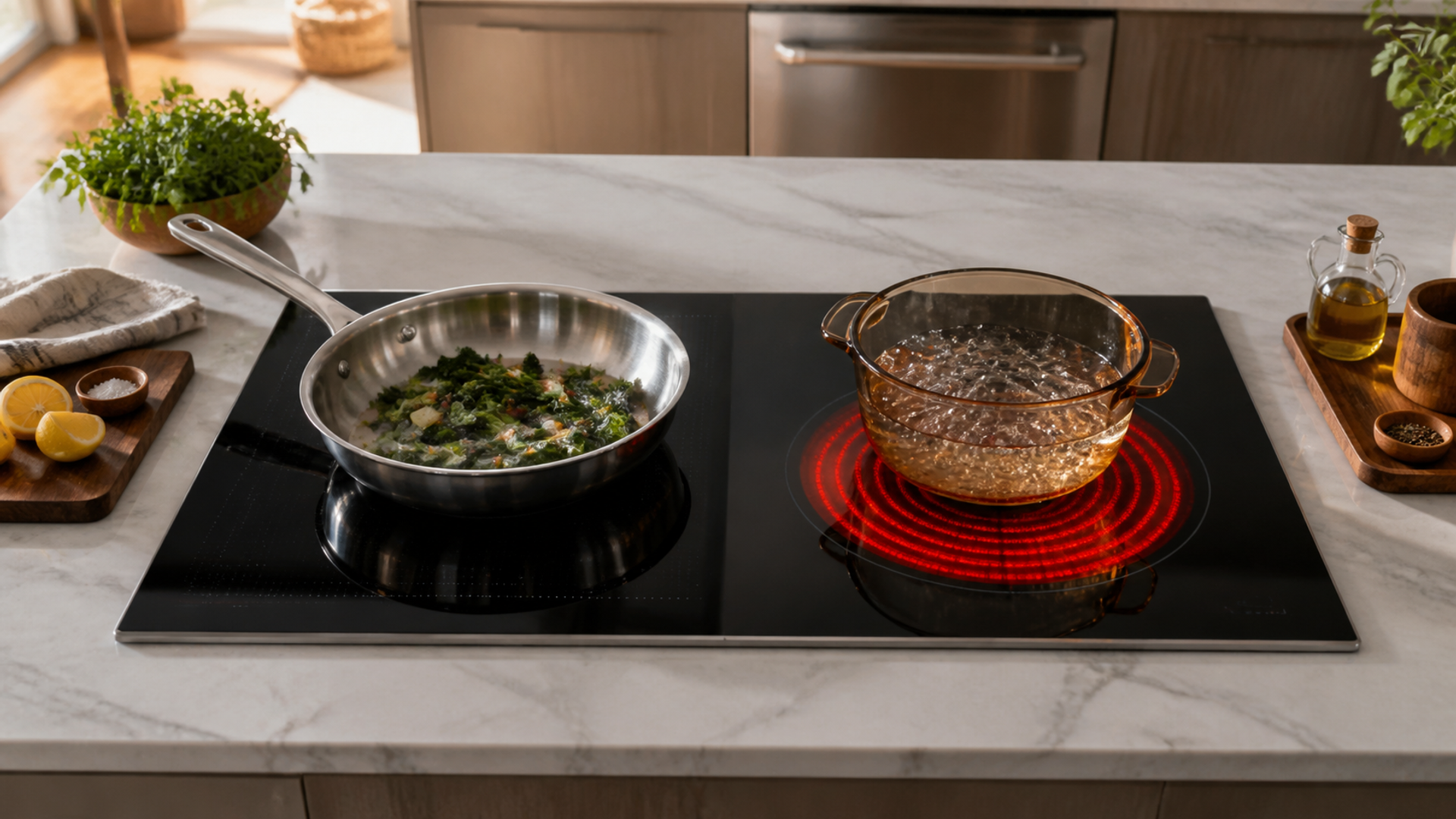
Induction versus electric cooktop usually compares electromagnetic induction with a radiant electric glass surface. Induction energises compatible magnetic cookware directly; radiant elements heat the glass and then the pan. Induction can be fast, responsive and efficient at the cooking surface, while radiant electric accepts a wider range of flat cookware and often costs less to buy. Electrical capacity, pan compatibility, controls, noise and repair access decide the result.
Start with pans and power
Choose induction when compatible cookware, suitable electrical service and responsive control justify the premium. Choose radiant electric when lower entry cost and broad flat-pan compatibility matter more than speed. Keep the current system when ventilation, cookware, technique or a failed element—not the heating principle—is the true bottleneck.
| Decision factor | Induction cooktop | Radiant electric cooktop | Keep the current system |
|---|---|---|---|
| Cookware | Most important pans pass the magnet and flatness test | Existing flat pans work on radiant heat | Replace only failed pieces |
| Control | Fast power changes improve cooking | Slower thermal response is acceptable | Practise burner matching |
| Power | Circuit and supply support the exact unit | Existing electrical service supports radiant | Upgrade only with a full load review |
| Surface heat | Lower residual surface heating is valuable | Hot-glass behaviour is familiar | Use residual indicators |
| Noise | Fan and coil sounds test acceptable | Silent radiant operation matters | Test the exact pan |
| Cost | Energy and control justify installation | Lower purchase price wins | Repair the current appliance |
This induction vs electric cooktop matrix is the article's working value object. Read the induction vs electric cooktop rows together: the decisive failure mode depends on this topic's evidence, operating context and reader objective.
How the heat reaches food
Evidence 1. ENERGY STAR describes induction as transferring energy directly to compatible cookware through an electromagnetic field.
Evidence 2. Whirlpool distinguishes induction from radiant electric by how heat is generated and by cookware requirements.
Evidence 3. Induction requires magnetic cookware with suitable contact, while pan geometry and material affect noise and performance.
Evidence 4. Electrical service, ventilation, controls and model-specific power sharing must be checked before purchase.
Reader-visible sources checked for this article:
energystar.gov — reader-visible current or official evidence
whirlpool.com — reader-visible current or official evidence
For induction vs electric cooktop, these sources establish only the claims inside their documented scope. Recheck every changeable specification, availability condition, price, policy or service term in the relevant market before acting.
Test control, installation and noise
The cookware row exposes a practical boundary. Route one assumes most important pans pass the magnet and flatness test, while route two is defensible only when existing flat pans work on radiant heat. Route three depends on replace only failed pieces. If that evidence is absent, keep the more reversible option.
Read control as a stop/go test: fast power changes improve cooking supports the first option; slower thermal response is acceptable supports the second; and practise burner matching supports the third. Record which source proves the condition and when it was checked.
A buyer can resolve power without starting from a brand preference. Ask whether circuit and supply support the exact unit; compare that with whether existing electrical service supports radiant; then use upgrade only with a full load review as the third route's safeguard. An unknown condition stays unknown.
On surface heat, popularity is not enough. The evidence for option one is that lower residual surface heating is valuable. Option two means hot-glass behaviour is familiar. Option three is rational where use residual indicators. Recheck any changeable term immediately before commitment.
The decision changes at noise. Choose the first path only if fan and coil sounds test acceptable; move to the second when silent radiant operation matters; use the third when test the exact pan. Save the downside that would make this row fail.
For cost, the first route works when energy and control justify installation; the second requires lower purchase price wins. The control for the third is repair the current appliance. Verify this row against the exact product, property, account or environment before it can reverse the decision.
Facts that would reverse the current choice
Reversal control 1 — Cookware. Before choosing Induction cooktop, write down how the decision changes if “Most important pans pass the magnet and flatness test” proves false. Do the same for Radiant electric cooktop and “Existing flat pans work on radiant heat”. Keep the Keep the current system route available until “Replace only failed pieces” is verified. This control belongs to induction vs electric cooktop; update it from the cited source or exact supplier rather than copying a generic checklist.
Reversal control 2 — Control. Before choosing Induction cooktop, write down how the decision changes if “Fast power changes improve cooking” proves false. Do the same for Radiant electric cooktop and “Slower thermal response is acceptable”. Keep the Keep the current system route available until “Practise burner matching” is verified. This control belongs to induction vs electric cooktop; update it from the cited source or exact supplier rather than copying a generic checklist.
Reversal control 3 — Power. Before choosing Induction cooktop, write down how the decision changes if “Circuit and supply support the exact unit” proves false. Do the same for Radiant electric cooktop and “Existing electrical service supports radiant”. Keep the Keep the current system route available until “Upgrade only with a full load review” is verified. This control belongs to induction vs electric cooktop; update it from the cited source or exact supplier rather than copying a generic checklist.
Reversal control 4 — Surface heat. Before choosing Induction cooktop, write down how the decision changes if “Lower residual surface heating is valuable” proves false. Do the same for Radiant electric cooktop and “Hot-glass behaviour is familiar”. Keep the Keep the current system route available until “Use residual indicators” is verified. This control belongs to induction vs electric cooktop; update it from the cited source or exact supplier rather than copying a generic checklist.
Reversal control 5 — Noise. Before choosing Induction cooktop, write down how the decision changes if “Fan and coil sounds test acceptable” proves false. Do the same for Radiant electric cooktop and “Silent radiant operation matters”. Keep the Keep the current system route available until “Test the exact pan” is verified. This control belongs to induction vs electric cooktop; update it from the cited source or exact supplier rather than copying a generic checklist.
Reversal control 6 — Cost. Before choosing Induction cooktop, write down how the decision changes if “Energy and control justify installation” proves false. Do the same for Radiant electric cooktop and “Lower purchase price wins”. Keep the Keep the current system route available until “Repair the current appliance” is verified. This control belongs to induction vs electric cooktop; update it from the cited source or exact supplier rather than copying a generic checklist.
Audit cookware
Test each important pan with a magnet and inspect its base for flat contact. Measure the diameters used and compare them with the cooktop's detection and element ranges. Record the exact model, recipe, room, climate, material or operating condition and the time of the check. Separate observed behaviour from a marketing label, and repeat the test in the intended setting rather than under ideal showroom conditions. If treasured cookware is incompatible, price replacement or retain a secondary method. Save the evidence that would reverse the choice, because a change in fit, specification, maintenance, service, price or environment must reopen the decision rather than inherit an old conclusion.
Cook three tasks
Boil a measured volume, hold a delicate simmer and sear the same food on candidate systems. Record time, control steps, cycling, fan noise and pan-handle temperature. Record the exact model, recipe, room, climate, material or operating condition and the time of the check. Separate observed behaviour from a marketing label, and repeat the test in the intended setting rather than under ideal showroom conditions. If touch controls frustrate wet or gloved use, that interaction can reverse the technology preference. Save the evidence that would reverse the choice, because a change in fit, specification, maintenance, service, price or environment must reopen the decision rather than inherit an old conclusion.
Verify installation
Have a qualified professional check circuit, breaker, cable, cut-out, ventilation and adjacent clearances. Confirm total connected load and whether zones share power at full demand. Record the exact model, recipe, room, climate, material or operating condition and the time of the check. Separate observed behaviour from a marketing label, and repeat the test in the intended setting rather than under ideal showroom conditions. If the installation requires major service work, include it before claiming payback. Save the evidence that would reverse the choice, because a change in fit, specification, maintenance, service, price or environment must reopen the decision rather than inherit an old conclusion.
Plan cleaning and repair
Read glass-cleaning rules, scratch risks, error diagnostics and service access. Check local parts and technician support for controls, fans, coils and power electronics. Record the exact model, recipe, room, climate, material or operating condition and the time of the check. Separate observed behaviour from a marketing label, and repeat the test in the intended setting rather than under ideal showroom conditions. If a failed board would make the kitchen unusable, preserve a backup cooking route. Save the evidence that would reverse the choice, because a change in fit, specification, maintenance, service, price or environment must reopen the decision rather than inherit an old conclusion.
Three homes, three answers
Frequent precise cooking
Induction can reward responsive control. Define the fact that would reverse this recommendation before committing.
Budget replacement with broad cookware
Radiant electric may minimise transition cost. Define the fact that would reverse this recommendation before committing.
Kitchen with inadequate circuit
Repairing the current system may be the responsible interim choice. Define the fact that would reverse this recommendation before committing.
Action checklist
Magnet-test pans.
Measure pan bases.
Check cut-out.
Verify circuit.
Test simmer.
Test boiling.
Listen for noise.
Use wet controls.
Price installation.
Confirm service.
Continue the decision
The linked VERTU articles expand adjacent parts of the induction vs electric cooktop decision. They do not substitute for the external evidence above.
The induction-versus-electric verdict
Choose induction when compatible cookware, suitable electrical service and responsive control justify the premium. Choose radiant electric when lower entry cost and broad flat-pan compatibility matter more than speed. Keep the current system when ventilation, cookware, technique or a failed element—not the heating principle—is the true bottleneck.
Keep the induction vs electric cooktop decision reversible until its material cost, safety, access, privacy and compatibility facts are verified. Unknown evidence stays unknown; it is never silently scored as favourable.
![How to Scan Receipts and Documents with Your Phone [Full Guide]](https://cdn.sanity.io/images/e0gp1l2g/production/0db13feec1d5e72b8a8a5f976d1f3e86619c9228-3840x1860.webp?w=180&h=180&q=78&auto=format&fit=crop)
![How to Scan Receipts and Documents with Your Phone [Full Guide]](https://cdn.sanity.io/images/e0gp1l2g/production/0db13feec1d5e72b8a8a5f976d1f3e86619c9228-3840x1860.webp?w=800&h=450&q=82&auto=format&fit=crop)
![Top 10 Two-Tone Carbon-Fibre Watches for Men [2026 List]](https://cdn.sanity.io/images/e0gp1l2g/production/18870799ba33fab0e038968359cd5772d7d7db30-1024x576.webp?w=800&h=450&q=82&auto=format&fit=crop)
![Top 10 Luxury Watches with Digital Complication Displays for Men [Latest]](https://cdn.sanity.io/images/e0gp1l2g/production/c4f6bf8c080f291c39f7cc85c7344ecff2fd3799-1024x553.webp?w=800&h=450&q=82&auto=format&fit=crop)