

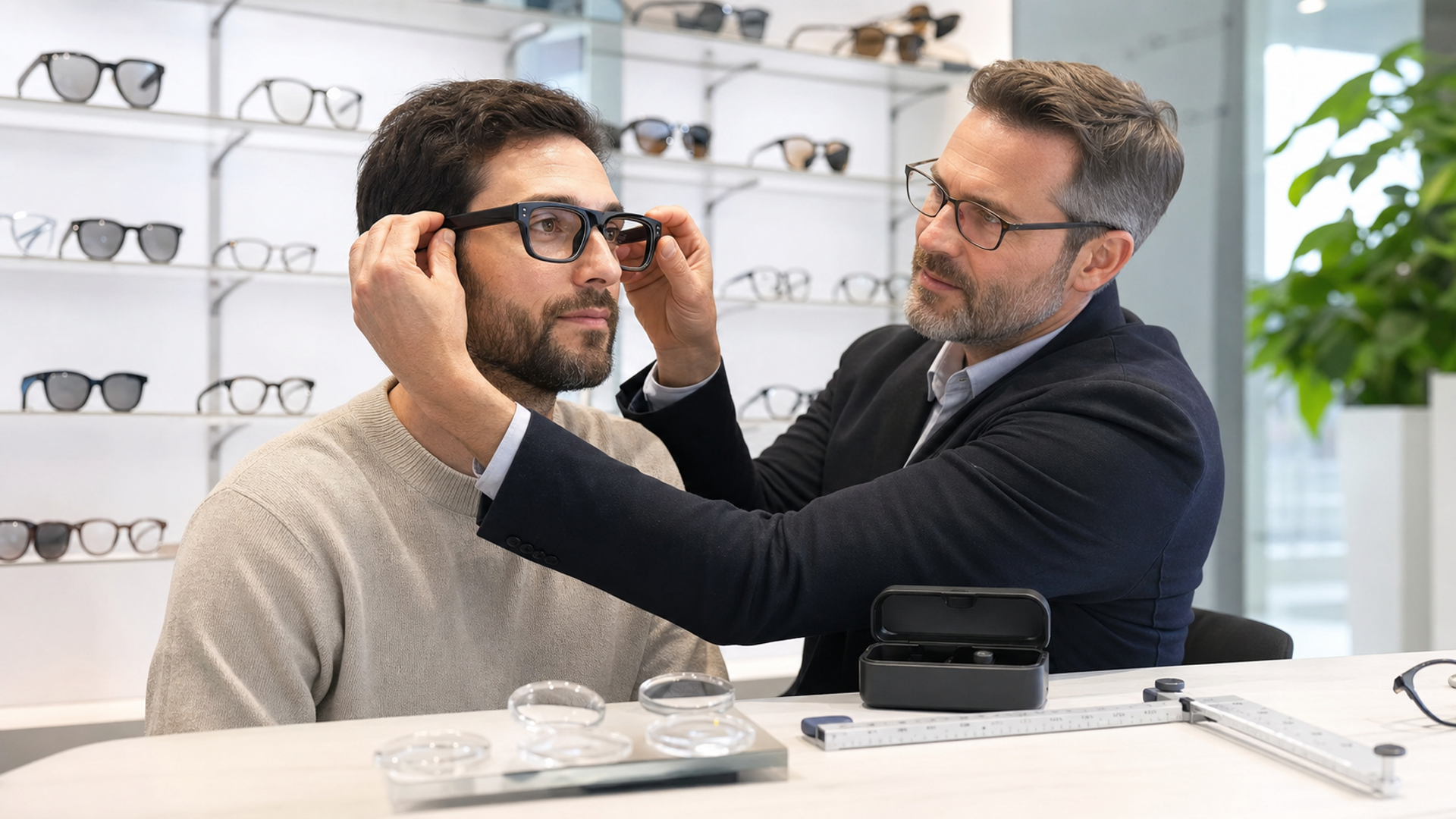
Meta’s new glasses launch with 26 styles, three frame families, a starting price of $299 and compatibility with prescription lenses. That makes the category look more like an ordinary eyewear purchase. It is not. A smart frame combines a medical-device-like optical fit, battery-powered electronics, cameras, microphones, a companion account and a product lifecycle that may be shorter than the lenses you normally wear.
Prescription compatibility is therefore the beginning of the buying process, not the conclusion. A frame can technically accept lenses while still being unsuitable for a strong prescription, progressive corridor, unusual pupillary distance, work posture or preferred lens material. It can look good in a product image but place weight poorly after three hours. The useful buyer question is whether the complete optical and electronic system can be fitted, supported, returned and eventually reglazed in your market.
> The short answer: Order only after an authorised optical provider confirms the exact prescription, measurements, lens options, warranty and return path for the specific frame—not merely that the range is ‘prescription compatible’.
What is confirmed, and what is not
Meta says the new line is compatible with prescription lenses and includes Adventurer in Standard and Large, Fury, and Meta Glasses by Kylie. It also describes three-way adjustable nose pads, eight-hour typical-use battery life and a charging case offering up to 40 hours. Those are manufacturer statements about the frame family, not an optician’s approval for every prescription.
The fit sheet below records the wearer, frame, lens and electronics as one order. Prices, supported prescriptions, insurance treatment, lens availability and returns vary by provider and region. Do not buy a non-prescription frame first and assume any local optician will later glaze it without affecting the electronics or warranty.
prescription and ownership fit sheet
| Check | Evidence or current signal | Decision use |
|---|---|---|
| Exact prescription range | Sphere, cylinder, axis, prism and add are accepted for this frame and lens | Optician hard gate |
| Monocular measurements | Right and left pupillary distance plus fitting height are measured on the chosen frame | Measure in person |
| Frame size and load | Bridge, temple, lens width and device weight remain comfortable for a full working session | Wear test |
| Lens material and treatment | Chosen material, tint, photochromic or coating is approved for the smart frame | Specify completely |
| Returns and adaptation | The policy distinguishes optical remake, frame return and electronic defect | Read before order |
| Battery and charging routine | Eight-hour claimed typical use fits the wearer’s real capture, audio and AI pattern | Model a day |
| Capture and bystander controls | The wearer understands the capture LED, camera disable behaviour and restricted spaces | Privacy gate |
| Account and phone compatibility | Companion app, account, language and phone requirements work in the buyer’s region | Verify live |
| Reglazing and end of life | An authorised route exists for new prescriptions, battery failure and responsible disposal | Ownership test |
A strong score in one row cannot cancel a hard failure in identity, safety, permission or recovery. Date every fact that can change and keep market, account, device or object configuration attached to the evidence.
Exact prescription range
Send a current prescription to the authorised provider and ask for written confirmation. ‘Prescription compatible’ may exclude high powers, certain prism, occupational lenses or some progressive designs. The frame’s lens shape and curvature affect thickness, weight and optical performance. If the prescription is near a limit, ask what happens if the finished lens fails tolerance or the wearer cannot adapt.
Decision use: Optician hard gate. Evidence to keep: Sphere, cylinder, axis, prism and add are accepted for this frame and lens.
Monocular measurements
A single total PD is often insufficient for precise progressive or asymmetric fitting. The optical centre must align with how the frame sits on the actual face, after nose-pad and temple adjustment. Request the recorded measurements and confirm whether remote ordering uses an approved measurement method. A fashionable frame that slides changes the optical relationship every time it moves.
Decision use: Measure in person. Evidence to keep: Right and left pupillary distance plus fitting height are measured on the chosen frame.
Frame size and load
Try the exact size rather than a visually similar conventional frame. Electronics distribute mass through temples and front. Check pressure behind ears, nose-pad marks, lash contact, headphone interference and stability when looking down. Wear it for at least 20 minutes in store if permitted, then simulate calls, walking and desk work. Fit should remain stable without overtightening.
Decision use: Wear test. Evidence to keep: Bridge, temple, lens width and device weight remain comfortable for a full working session.
Lens material and treatment
Ask which high-index materials, anti-reflective coatings, sun lenses or photochromic options are supported. Confirm whether the camera’s field, sensors or capture indicator can be obstructed by lens shape or treatment. Clarify replacement cost for scratched lenses separately from electronic failure. A premium coating can outlast the software platform, so future reglazing matters.
Decision use: Specify completely. Evidence to keep: Chosen material, tint, photochromic or coating is approved for the smart frame.
Returns and adaptation
Prescription products often have different return rules from stock eyewear. Ask how many remakes are allowed, who pays, the adaptation period for progressives, and whether opening or pairing the electronics changes eligibility. Record the process if the frame fits but vision is wrong—or vision is correct but the battery or audio is unsatisfactory.
Decision use: Read before order. Evidence to keep: The policy distinguishes optical remake, frame return and electronic defect.
Battery and charging routine
Manufacturer typical-use claims are not guarantees for continuous calls, frequent capture or cold-weather operation. List the hours when corrective vision is essential. If the frame battery expires, the lenses still work, but electronic functions stop; if the only pair is required for driving or work, battery inconvenience cannot force unsafe substitution. Check case size, replacement availability and travel charging.
Decision use: Model a day. Evidence to keep: Eight-hour claimed typical use fits the wearer’s real capture, audio and AI pattern.
Capture and bystander controls
Meta’s FAQ explains that the capture LED signals recording and that the camera is designed to disable if the LED is covered or tampered with. That signal does not create consent or override workplace, school, venue or local rules. Decide where the glasses will be removed, when spoken notice is appropriate and how captured media is reviewed before sharing.
Decision use: Privacy gate. Evidence to keep: The wearer understands the capture LED, camera disable behaviour and restricted spaces.
Account and phone compatibility
AI, translation and communication features can vary by language, country, network and software. Test the app-store availability and supported phone before ordering expensive lenses. Decide which cloud account will hold captures and how it will be recovered if the phone is lost. A prescription frame can remain useful as eyewear while its connected services change, but the purchase price may assume those services.
Decision use: Verify live. Evidence to keep: Companion app, account, language and phone requirements work in the buyer’s region.
Reglazing and end of life
Ask whether the frame can be reglazed when the prescription changes and whether third-party work affects warranty. Record the expected service route for broken temples, nose pads, charging case and battery. Electronics and prescription lenses have different lifecycles; a credible ownership plan accounts for both rather than treating the complete object as disposable eyewear.
Decision use: Ownership test. Evidence to keep: An authorised route exists for new prescriptions, battery failure and responsible disposal.
Put the framework into a real decision
Take a one-page fit sheet to the optician. The first section records prescription date, monocular PD, fitting height and lens type. The second records exact frame, size, bridge, colour and approved lens options. The third records battery expectation, phone compatibility, account, returns and service. The final section contains a 20-minute wear test with pressure, slippage, visual distortion and audio observations.
Do not let the 26-style launch range turn the appointment into a colour decision. Narrow by prescription first, then fit, then ownership terms, and only then style. If ordering remotely, preserve the prescription, measurements, provider confirmation and return policy as a dated evidence pack. The strongest reason to wait is not fear of new technology; it is an unresolved optical or service question that cannot be corrected cheaply after custom lenses are made.
A decision record another person can audit
Create a dated record containing the exact object, device, system or route; the source URL and access time; the person responsible for verification; and the condition that would change the recommendation. Preserve earlier observations instead of overwriting them when facts move. For product, policy and service claims, record the market and configuration. For private identifiers, store a redacted public copy and a controlled private copy.
End with one of four outcomes: proceed, wait, request evidence or decline. State the reason in one sentence, list the unresolved risk and name the next review date. This makes later performance review more honest: an editor can see what was knowable at publication rather than judging the decision with hindsight.
Action checklist
Use a current eye examination and exact prescription.
Confirm the specific frame accepts every prescription component.
Record monocular PD and fitting height.
Wear-test the exact size.
Specify lens material, coating and tint.
Separate optical-remake and electronics-return policies.
Model battery use across a real day.
Review capture rules and account recovery.
Confirm reglazing and service routes.
Related VERTU reading
These links cover adjacent decisions. They do not replace the current primary source or the exact configuration under review.
Sources and verification
Sources were accessed on 21 July 2026. Product availability, software features, laws, official alerts, policies, prices and service terms can change. Recheck the live source before acting. Legal, financial, insurance, health, travel-security and conservation references are general information rather than individual professional advice.
Final view
Smart glasses become a good prescription purchase only when optics, fit, electronics and service align. Verify the exact prescription and measurements, test the frame under real wear, read the custom-product rules and plan for reglazing. The right style is the last decision. The most expensive mistake is a beautiful connected frame that you cannot comfortably see through.
![How to Scan Receipts and Documents with Your Phone [Full Guide]](https://cdn.sanity.io/images/e0gp1l2g/production/0db13feec1d5e72b8a8a5f976d1f3e86619c9228-3840x1860.webp?w=180&h=180&q=78&auto=format&fit=crop)
![How to Scan Receipts and Documents with Your Phone [Full Guide]](https://cdn.sanity.io/images/e0gp1l2g/production/0db13feec1d5e72b8a8a5f976d1f3e86619c9228-3840x1860.webp?w=800&h=450&q=82&auto=format&fit=crop)
![Top 10 Two-Tone Carbon-Fibre Watches for Men [2026 List]](https://cdn.sanity.io/images/e0gp1l2g/production/18870799ba33fab0e038968359cd5772d7d7db30-1024x576.webp?w=800&h=450&q=82&auto=format&fit=crop)
![Top 10 Luxury Watches with Digital Complication Displays for Men [Latest]](https://cdn.sanity.io/images/e0gp1l2g/production/c4f6bf8c080f291c39f7cc85c7344ecff2fd3799-1024x553.webp?w=800&h=450&q=82&auto=format&fit=crop)