

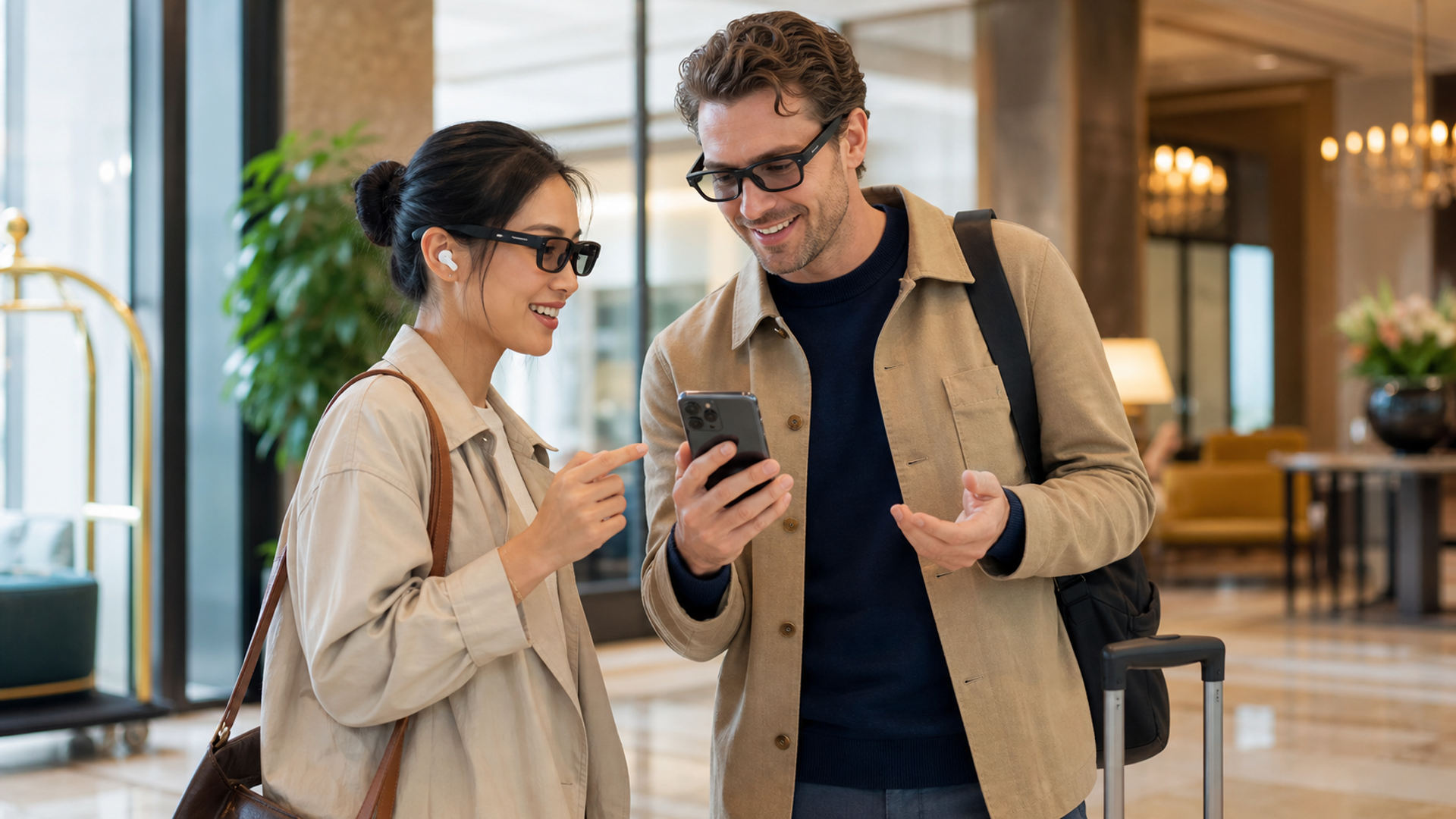
The best translation device depends less on the advertised language count than on who must hear, see and trust the result. A phone is easiest to share and correct. Earbuds can make a conversation feel more natural but create hygiene and turn-taking problems. Smart glasses keep the user’s hands free, yet cameras and invisible audio can make the other person uncomfortable.
For high-stakes travel, the phone remains the safest default because it can show the original phrase, the translation and a correction on one visible screen. Wearables are useful accelerators, not evidence that a medical instruction, contract term or border question has been understood correctly.
Five-scenario translation matrix
| Scenario | Phone | Earbuds | Smart glasses | Best default |
|---|---|---|---|---|
| Hotel check-in | Easy to show names and dates | Natural for conversation | Hands-free but visually ambiguous | Phone |
| Street directions | Good map and text context | Useful while walking | Strong hands-free context | Phone or glasses |
| Quiet business meeting | Visible notes and consent | Discreet audio but easy to mishear | Camera/privacy concern | Phone with agreed workflow |
| Noisy transport hub | Microphone may struggle | Ear sealing can help or isolate | Audio capture still challenged | Phone text plus confirmation |
| Medical, legal or financial discussion | Can preserve exact source text | Poor auditability | Poor auditability | Human interpreter |
Google explains the supported conversation and transcribe modes in its Translate help centre, while Apple documents Live Translation availability across supported devices, languages and regions. These pages are better buying evidence than a headline claiming “real-time translation”: they reveal which modes need connectivity, which languages are supported and where features vary.
The phone wins on shared context
A phone makes the translation inspectable. Both people can see names, numbers and dates, point to the word that looks wrong and switch from speech to typing when the environment is noisy. It also gives access to maps, booking confirmations and photographs that resolve ambiguity without more language.
Its weakness is social: holding a phone between two people can slow eye contact, and an active microphone may feel like recording. State what the app is doing before you start. If the conversation is sensitive, ask permission, avoid saving audio where possible and delete temporary text when it is no longer needed.
Earbuds reduce friction but increase asymmetry
Translation earbuds are attractive because the user can listen without staring at a screen. They work well for short, predictable exchanges when each speaker understands the turn-taking pattern. Problems begin when only one person hears the translated output, an earbud must be shared, or the system produces a confident but incorrect phrase that nobody can inspect.
Do not hand an in-ear device to a stranger. Choose a mode where the other person speaks toward the phone and hears a speaker response, or use two personally assigned earpieces designed for the workflow. Check battery life with the microphones active; translation endurance can be shorter than ordinary music playback.
Smart glasses are strongest when hands matter
Glasses can help while carrying luggage, following directions or working with equipment. Visual captions may be less isolating than audio in one ear. But the camera and microphone are physically close to the user and may not be obvious to the other person. In a hotel, meeting room or immigration queue, that ambiguity can outweigh the convenience.
Treat the recording indicator and local rules as minimums, not full consent. Explain that translation is active. If the environment prohibits photography or recording, switch to a phone text exchange or a human interpreter. A wearable should never be used to conceal capture.
Run a real test before buying
Use the same ten phrases on every candidate device: a name, room number, dietary restriction, time, currency amount, address, negation, emergency statement, unfamiliar proper noun and a question with two possible meanings. Test in a quiet room and then in street noise. Score four things:
Did it recognise the original words correctly?
Could both people inspect and correct the result?
How long did the exchange take?
What happened when the connection disappeared?
Language count does not answer these questions. A device may support a language for typed text but not live speech, or offer on-device processing for one pair and cloud processing for another. Download offline packs where supported, then place the phone in aeroplane mode and prove the workflow before departure.
Know when to hand off
Machine translation is a convenience layer. Use a qualified human interpreter when a misunderstanding could affect consent, legal rights, diagnosis, medication, immigration status or a material financial decision. In business meetings, send important numbers and decisions in writing afterwards and ask the other party to confirm them.
The same principle applies to AI concierge workflows: automation can prepare and coordinate, while a person owns consequential judgement. The GMT watch, world timer and smartwatch travel comparison uses a similar idea—choose the tool around the failure you cannot accept, not the novelty you most enjoy.
Build a phrase pack before departure
Prepare critical phrases with a native speaker or trusted professional where possible: allergies, accessibility needs, destination addresses, medication names and the difference between “can” and “cannot”. Save both source and target text offline. Proper nouns and addresses should remain visible rather than being trusted to speech recognition.
At the end of an important exchange, show the written decision, ask the other person to repeat the meaning in their own words and confirm dates and amounts separately. This is slower than a seamless demo and safer than discovering later that both sides accepted different meanings.
Score the system, not the demonstration
A polished demonstration usually uses a quiet room, familiar vocabulary and two speakers who wait for the device. Travel is less cooperative. Build a scorecard that separates recognition, translation, delivery and recovery. A system can translate a correctly captured sentence well yet fail because the microphone heard the wrong station, surname or negative word.
Use a five-point score for each stage:
| Stage | Question | Failure to watch |
|---|---|---|
| Capture | Did the device hear the source accurately? | Noise, accent or speaker overlap changes the words |
| Meaning | Did the translation preserve intent? | Negation, tense, amount or politeness shifts |
| Delivery | Could both people receive and inspect it? | Only one earpiece hears the result |
| Correction | Could either person amend the text quickly? | The interface hides the source sentence |
| Recovery | What happened offline or on low battery? | The conversation stops without an alternative |
Average language support is less important than the weakest stage in the scenario you actually face. A hotel conversation may tolerate a slow correction. A platform change announced over loudspeakers may not. Record the failure mode, not merely whether the translation eventually appeared.
Work through three realistic conversations
At hotel check-in, the phone is normally strongest because the traveller can show a reservation, name spelling and room dates alongside the translation. Use speech for the greeting, then switch to text for the surname, deposit amount and checkout time. The device helps coordinate; the booking record remains the source of truth.
During a supplier visit, smart glasses may keep hands available while the user examines an object, but consent and terminology need more preparation. Explain the translation mode, agree whether audio or captions will be used, and load a glossary of model numbers and technical terms. When a quantity or delivery date is agreed, move it into a shared written note and ask the other party to confirm it.
In a medical appointment, legal consultation or financial transaction, none of the three consumer devices should be treated as the final interpreter. Use them to request qualified assistance or communicate simple logistics. Preserve the exact source documents and let an authorised professional carry the consequential meaning. Convenience is valuable precisely because it helps the traveller reach the appropriate human process sooner.
Evaluate privacy as part of accuracy
Translation quality is not only linguistic. A result is operationally poor if it requires covert capture, exposes confidential conversation or stores sensitive text without a clear reason. Before buying, identify whether audio and transcripts are processed on the device, sent to a cloud service or retained in account history. Settings and supported modes can change, so verify them on the exact software version.
In a team setting, agree who may initiate translation and who can view the transcript. Avoid leaving meeting text in a personal account when it belongs in an approved corporate record. Delete disposable conversations under the relevant retention policy, but keep confirmed decisions in the system that actually governs them.
The more invisible the device becomes, the more explicit the human explanation should be. A visible phone held between two people may feel less elegant than captions inside glasses, yet it often gives the other person a clearer chance to consent, inspect and correct.
The choice
Buy a phone-led solution when clarity, correction and broad compatibility matter. Add earbuds when repeated conversational use justifies the learning curve and each user has a hygienic listening setup. Choose smart glasses when hands-free context is genuinely valuable and you can make capture obvious and consensual.
For a globally mobile executive, the most resilient kit is still layered: phone for visible truth, wearable for convenience and human interpretation for consequential moments.
![How to Scan Receipts and Documents with Your Phone [Full Guide]](https://cdn.sanity.io/images/e0gp1l2g/production/0db13feec1d5e72b8a8a5f976d1f3e86619c9228-3840x1860.webp?w=180&h=180&q=78&auto=format&fit=crop)
![How to Scan Receipts and Documents with Your Phone [Full Guide]](https://cdn.sanity.io/images/e0gp1l2g/production/0db13feec1d5e72b8a8a5f976d1f3e86619c9228-3840x1860.webp?w=800&h=450&q=82&auto=format&fit=crop)
![Top 10 Two-Tone Carbon-Fibre Watches for Men [2026 List]](https://cdn.sanity.io/images/e0gp1l2g/production/18870799ba33fab0e038968359cd5772d7d7db30-1024x576.webp?w=800&h=450&q=82&auto=format&fit=crop)
![Top 10 Luxury Watches with Digital Complication Displays for Men [Latest]](https://cdn.sanity.io/images/e0gp1l2g/production/c4f6bf8c080f291c39f7cc85c7344ecff2fd3799-1024x553.webp?w=800&h=450&q=82&auto=format&fit=crop)