

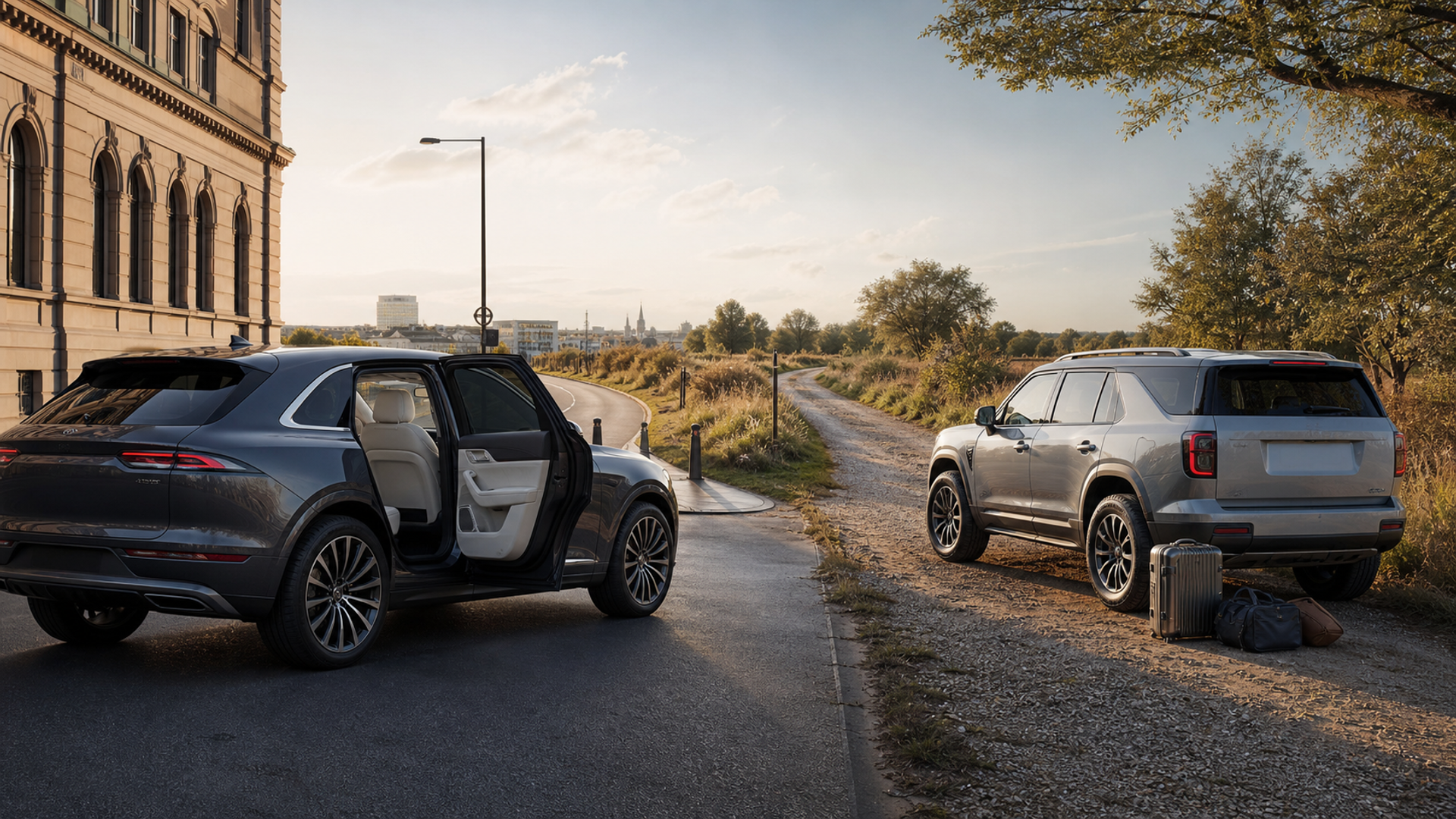
The Porsche Cayenne is usually the stronger choice for a driver who wants sports-car responses, a broad powertrain range and detailed chassis configuration in a practical SUV. The Range Rover Sport is usually better for a buyer who values ride isolation, elegant cabin atmosphere, commanding design and genuine all-terrain systems. Both can be fast and luxurious; the real choice is whether the driver or the whole journey should dominate.
This Porsche Cayenne vs Range Rover Sport comparison uses current official manufacturer information and a use-case matrix. Model years, prices and engines vary by country, so every figure must be confirmed in the local configurator before ordering.
Quick verdict
Choose Porsche Cayenne when steering, body control, braking feel and powertrain choice are central, and you are willing to specify options carefully. Choose Range Rover Sport when long-distance calm, rear-seat ambience, low-speed manoeuvrability and off-road breadth matter more than the sharpest road response.
The best answer can change by derivative. A base six-cylinder Cayenne should not be compared with a Range Rover Sport SV as though they are price equivalents. Fix a delivered budget first, then compare cars with similar performance, suspension and comfort equipment.
Cayenne vs Range Rover Sport decision matrix
| Factor | Porsche Cayenne | Range Rover Sport | Buyer who benefits most |
|---|---|---|---|
| Road character | Precise, driver-led and highly configurable | Composed, substantial and isolated | Enthusiast vs comfort-led owner |
| Powertrain range | Petrol, E-Hybrid and new electric choices in current range | Petrol, mild-hybrid and electric-hybrid choices by market | Buyer matching home charging and use |
| Ride | Excellent when wheel and suspension choices align | Air-suspension calm is a core attraction | Frequent long-distance passengers |
| Rear cabin | Practical, premium, more driver-centred overall | Strong sense of occasion and optional rear entertainment | Chauffeured or family use |
| Manoeuvrability | Rear-axle steering available on selected models/options | All-wheel steering can reduce turning circle below 36 ft | City, hotel and tight parking use |
| Off-road ability | Capable, with options and modes depending on model | Terrain capability is central to the brand proposition | Rural property, winter and rough access |
| Specification risk | Long options list can alter character and price | Trim, wheel and technology packs also change the car | Anyone ordering without a close test drive |
Compare equivalent builds, not badge entry points
Porsche’s official Cayenne range currently spans petrol, hybrid and electric models. The US range includes a 2026 Cayenne Electric family while petrol and E-Hybrid versions move into the 2027 model year on the live configurator. This transition is important: a “2026 comparison” may involve vehicles with different model-year labels depending on market and powertrain.
Range Rover Sport availability also differs by country. The local range may include six-cylinder petrol, mild hybrid, plug-in electric hybrid, V8 and high-performance derivatives. Do not assume an engine or feature described in one market is available in another.
Build both cars to the same delivered budget. Include suspension, rear-wheel steering, seats, audio, driver assistance, wheels, paint and warranty or service plans. A minimally equipped car and a demonstrator loaded with dynamic and luxury packages are not meaningful evidence.
Driving character: accuracy versus effortless authority
The Cayenne’s defining strength is the way it reduces the sensation of SUV mass. Steering response, body control and braking can feel coherent in a way that encourages the driver to use a winding road. Porsche offers a deep chassis menu, and selected models can add rear-axle steering, torque vectoring, active anti-roll systems or Porsche Active Ride.
The Range Rover Sport takes a different path. It aims to combine controlled on-road performance with the isolation and authority expected of a Range Rover. Land Rover’s official innovation overview describes all-wheel steering that can turn the rear wheels up to 7.3 degrees. At low speed they turn opposite the front wheels, giving a stated turning circle of less than 36 feet on the relevant configuration; at higher speed they turn in the same direction to support stability.
Neither approach is universally superior. The Cayenne can make an empty road feel engaging. The Range Rover Sport can make a long, poor-surface journey feel less demanding. Test both on the road you actually use, not only a smooth dealer loop.
Ride quality is created by the wheel-and-suspension combination
Large wheels photograph well and can sharpen response, but they reduce tyre sidewall and may increase impact harshness and road noise. The effect can be more important than the difference between badges. Drive the intended wheel size over broken surfaces, expansion joints and low-speed ramps.
Porsche’s suspension choices can transform the Cayenne. A well-configured air-suspension car can be both controlled and comfortable; a performance-focused build on very large wheels can feel busier. Range Rover Sport leans towards air-suspended calm, but wheel size, tyre and dynamic specification still matter.
Evaluate the second row as carefully as the driver’s seat. Rear passengers experience vertical movement differently because they sit closer to the rear axle. Bring the people who will use the car, and ask them to work, read and use a phone during the test.
Powertrain choice should follow the weekly journey
The Cayenne range now gives buyers three broad paths. Petrol models keep the traditional refuelling pattern; E-Hybrids add electric local travel and performance support; the new Cayenne Electric targets fully electric use. Porsche’s current US technical data for the 2026 E-Hybrid identifies 463 hp combined and a 25.9 kWh gross battery, while the current electric range introduces dramatically higher power and fast-charging capability. Those are different ownership briefs.
Range Rover Sport’s Electric Hybrid can combine quiet local driving with long-distance petrol flexibility, while mild-hybrid and V8 derivatives suit other priorities. Local electric range, charging connector and derivative availability must be confirmed because regional specifications differ.
A plug-in hybrid only makes sense when it is charged. Record a week of driving and identify the exact charging location. If most days fit within the electric range and home charging is simple, the PHEV can provide a calm routine. If charging is unreliable, the battery becomes weight and complexity rather than a benefit.
Cabin and interface: driver cockpit versus travelling lounge
The Cayenne cabin places the driver at the centre, with a low, deliberate relationship between seat, wheel and controls. Current versions add large digital displays and extensive customisation. The advantage is a focused driving environment; the risk is paying for technology or trim that adds little to your routine.
Range Rover Sport creates more visual calm. Its upright view, strong centre console and reductive surfaces produce a sense of enclosure. Land Rover’s official interior gallery lists a 13.1-inch curved-glass touchscreen and optional 11.4-inch rear entertainment screens on relevant configurations.
Test the interface while stationary and moving. Change climate settings, enter a destination, disable an unwanted assistance alert and switch drive modes. A beautiful screen that demands attention on every journey is not effortless luxury.
Rear-seat and luggage use
Both are two-row SUVs with useful luggage space, but body style and hybrid packaging change capacity. Cayenne Coupé models trade some rear volume and headroom for profile. E-Hybrid versions also package a high-voltage battery. The standard SUV is generally the practical Cayenne choice.
Range Rover Sport’s tailgate, ride height and broad rear cabin make it attractive for family and leisure use. Test whether older passengers can enter comfortably, whether child seats leave front-seat room and whether the boot floor works with your cases or sporting equipment.
Use physical luggage. Published litres or cubic feet do not reveal wheel-arch shape, floor height, parcel-shelf conflict or whether a dog crate fits. If the car regularly travels with four people and golf bags, demonstrate that exact load before signing.
Off-road capability: buy only what you will use
Range Rover Sport’s terrain capability is part of its identity. Air suspension, all-wheel drive, electronic controls and selectable modes can support snow, mud, steep access and water crossings within the vehicle’s rated limits. That breadth is valuable for rural property, winter routes or outdoor travel.
The Cayenne is more capable away from tarmac than its sporting reputation suggests, and Porsche offers off-road-related configurations on selected variants. Yet most buyers will use capability for poor tracks, snow or towing rather than serious terrain.
Do not pay for a dramatic maximum if the hardest task is a gravel hotel drive. Conversely, do not assume road tyres and large wheels can deliver the off-road performance shown in marketing imagery. Tyres, recovery equipment, driver training and local conditions matter.
Reliability, service and complexity
Both vehicles are complex premium SUVs. Air suspension, active chassis systems, high-voltage hybrids, large brakes and advanced infotainment improve the experience while increasing the number of systems that may require specialist workshop investigation. Reliability cannot be reduced to one anecdote or brand stereotype.
Compare local retailer access, warranty terms, roadside assistance, replacement-car policy and workshop lead time. If the vehicle travels across countries, map service points on common routes. Ask what happens when a fault occurs away from the selling dealer.
Options can also affect replacement cost. Very large tyres, carbon-ceramic brakes or unusual trim may be expensive or slow to source. The right specification protects both the experience and the maintenance plan.
Total-cost decision framework
Add these lines to the delivered price:
Finance or opportunity cost.
Insurance for the exact derivative and postcode.
Energy or fuel based on your real mileage.
Tyres, brakes and routine service.
Charging installation for a PHEV or EV.
Expected options needed to achieve the tested character.
Warranty-extension or service-plan cost.
Depreciation scenario, treated as uncertain rather than guaranteed.
Do not compare a discounted stock Cayenne with a custom Range Rover Sport and call the price gap a brand trait. Compare written quotes with equivalent tax, delivery and options.
Five buyer scenarios
The owner-driver
Choose Cayenne when you look for reasons to take the long route and care about steering and chassis response. Range Rover Sport remains fast, but its core appeal is broader than driver engagement.
The executive with frequent rear passengers
Range Rover Sport often has the stronger atmosphere and calmer visual language. Still test rear ride; the wrong wheels can undermine the promise.
The city resident
All-wheel steering can make either model easier to manoeuvre when fitted. Measure garage width, ramp angle and charging access. Size can matter more than acceleration.
The rural-property owner
Range Rover Sport’s terrain systems are compelling. The Cayenne can still fit if road behaviour dominates and rough access is moderate. Choose tyres for the real surface.
The plug-in hybrid commuter
Either can work if charged regularly. Compare exact electric range, boot packaging, charging time and engine transition. The better PHEV is the one that stays electric through your routine without creating inconvenience.
For a wider shortlist, see the best luxury hybrid SUVs in 2026 and the broader best luxury SUVs guide. Those pages answer category questions; this page owns the direct Cayenne-versus-Range-Rover-Sport decision.
Final verdict
Choose the Porsche Cayenne when driving precision, chassis choice and powertrain breadth are the centre of the brief. Choose the Range Rover Sport when long-distance calm, rear-cabin ambience, manoeuvrability and terrain capability create more value. Fix the delivered budget, test equivalent builds on imperfect roads, load the people and luggage you actually carry, and buy the configuration—not the badge.
Sources
Porsche, Cayenne model overview, accessed 2 August 2026.
Porsche Newsroom USA, 2026 Cayenne technical specifications, accessed 2 August 2026.
Land Rover, Range Rover Sport innovations, accessed 2 August 2026.
Land Rover, Range Rover Sport interior gallery, accessed 2 August 2026.
![How to Scan Receipts and Documents with Your Phone [Full Guide]](https://cdn.sanity.io/images/e0gp1l2g/production/0db13feec1d5e72b8a8a5f976d1f3e86619c9228-3840x1860.webp?w=180&h=180&q=78&auto=format&fit=crop)
![How to Scan Receipts and Documents with Your Phone [Full Guide]](https://cdn.sanity.io/images/e0gp1l2g/production/0db13feec1d5e72b8a8a5f976d1f3e86619c9228-3840x1860.webp?w=800&h=450&q=82&auto=format&fit=crop)
![Top 10 Two-Tone Carbon-Fibre Watches for Men [2026 List]](https://cdn.sanity.io/images/e0gp1l2g/production/18870799ba33fab0e038968359cd5772d7d7db30-1024x576.webp?w=800&h=450&q=82&auto=format&fit=crop)
![Top 10 Luxury Watches with Digital Complication Displays for Men [Latest]](https://cdn.sanity.io/images/e0gp1l2g/production/c4f6bf8c080f291c39f7cc85c7344ecff2fd3799-1024x553.webp?w=800&h=450&q=82&auto=format&fit=crop)