The power bank rules for flights became more specific in 2026. International Air Transport Association guidance now tells passengers to carry no more than two lithium-ion power banks of up to 100 watt-hours each, keep them in the cabin, avoid recharging them from aircraft power and not store them in an overhead locker. Airlines may impose stricter conditions, so the carrier operating each sector still has the final word.
That changes the sensible travel-charging decision. The largest battery you can buy is not automatically the best battery to fly with. A better kit balances three separate needs: reserve energy when no socket exists, a compact mains charger when one does, and cables that support the power your devices can actually accept.
The 2026 flight rules in one minute
The following is a practical reading of IATA's 2026 passenger guidance, not a substitute for an airline's own policy.
| Item | Cabin bag | Checked bag | Important 2026 point |
|---|---|---|---|
| Power bank up to 100 Wh | Usually permitted | No | Maximum two under IATA guidance; protect against short circuits |
| Power bank above 100 Wh | Airline approval may be required | No | Do not assume approval; ask before travel |
| Battery charging case | Prefer cabin | Avoid checking | Treat it as a battery-powered device and confirm carrier rules |
| Phone or laptop with installed battery | Cabin preferred | Conditional | If checked, fully power off and protect from damage |
| Wall charger with no battery | Yes | Yes | Not a lithium battery; usefulness depends on socket availability |
| Loose cables and adapters | Yes | Yes | Label or organise them so security checks remain simple |
IATA's current guidance says power banks should remain accessible rather than disappearing into an overhead locker. It also says they should not power another device during taxi, take-off or landing. Those details matter because a battery that becomes hot, swells, smokes or is damaged can be noticed and dealt with more quickly in the cabin.
The FAA's battery guidance follows the same core logic: spare batteries and portable rechargers belong with the passenger, not in checked baggage. If your cabin bag is taken at the gate, remove the power bank before the bag enters the hold.
Calculate watt-hours before you pack
Airline rules are written in watt-hours, while many power banks are marketed in milliamp-hours. The conversion is straightforward when the nominal battery voltage is shown:
> Watt-hours = volts × amp-hours. For a label in milliamp-hours, divide by 1,000 first.
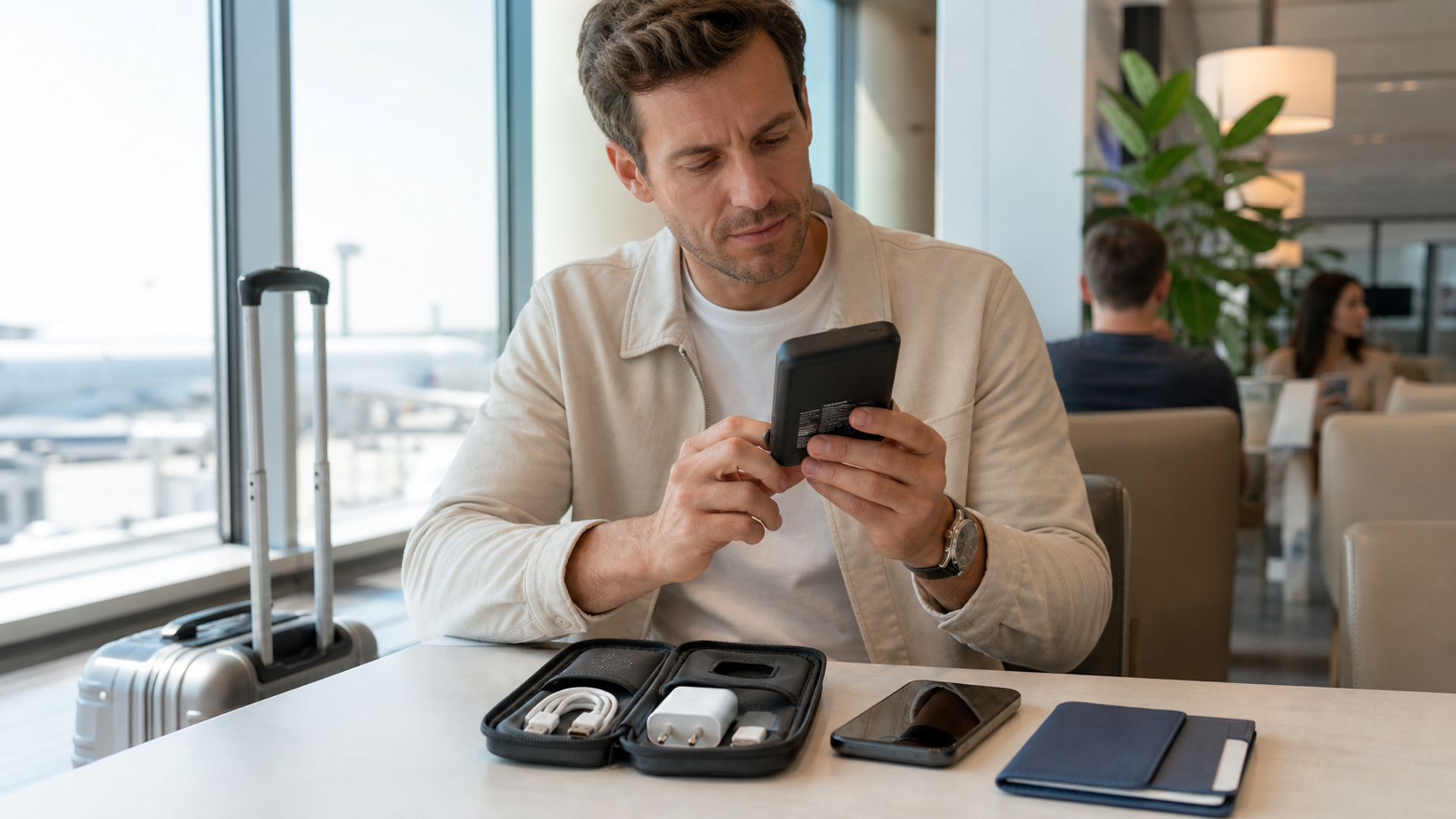
A power bank labelled 20,000 mAh at 3.7 V is approximately 74 Wh: 3.7 × 20 = 74. A 27,000 mAh pack at the same nominal voltage is approximately 99.9 Wh. Do not estimate at the airport if the label is missing or illegible. Choose a pack whose watt-hour rating is printed clearly on the casing.
Capacity on the box is not identical to energy delivered into the phone. Conversion losses, cable resistance, heat and the device's charging curve all reduce usable output. That is why a modest, efficient pack with a readable label can be more useful than a very large no-name battery whose specifications cannot be verified.
Power bank, battery case or compact charger?
Choose a power bank when sockets are genuinely uncertain
A power bank is the right reserve for long transfers, outdoor days, older aircraft or disruption that keeps you away from a room. It can serve several devices and remains useful when local plug types change. Its disadvantages are weight, heat and flight restrictions.
For most phone-led trips, a clearly labelled unit below 100 Wh is the sensible ceiling, not a target. Two smaller packs may offer redundancy, but IATA's two-power-bank limit means they also consume the entire allowance. Confirm the operating airline's policy for every leg, including a codeshare.
Choose a battery case when one phone is the only priority
A battery case removes cable clutter and keeps reserve power attached to the device. It is convenient for a day of maps, boarding passes and calls. The trade-offs are extra heat, bulk and limited usefulness once you change phone.
Heat is the overlooked issue. Charging while using navigation, video or a weak cellular connection can raise device temperature. If the phone limits charging or feels unusually hot, stop adding power, move it out of direct sun and let it cool naturally. Do not place it against ice or an air-conditioning vent; sudden condensation is not a repair strategy.
Choose a compact wall charger when the itinerary is predictable
A multi-port USB-C charger contains no reserve battery, so it avoids the power-bank allowance. It is usually the lightest way to support a phone, tablet and laptop in a hotel or lounge. Its weakness is obvious: a charger is useless without a working socket.
Check the total shared output, not only the largest number printed on the front. A charger advertised at 100 W may divide that power across ports when several devices are connected. Match the cable as well; a capable charger paired with a low-power cable will not deliver the expected result.
A decision matrix for four travel patterns
| Travel pattern | Primary choice | Useful backup | Why |
|---|---|---|---|
| Overnight city trip | Compact wall charger | Small power bank | Low weight, enough reserve for disruption |
| Long-haul with connections | Sub-100 Wh power bank | Multi-port charger | Covers airport gaps and destination charging |
| Outdoor or event day | Power bank carried accessibly | Short robust cable | Sockets cannot be assumed |
| Executive trip with phone and laptop | Multi-port USB-C charger | Labelled power bank for phone | Mains power handles the laptop; reserve stays focused |
The kit should reflect the most expensive failure, not the largest number of gadgets. If a flat phone would remove access to a boarding pass, authentication app and driver contact, phone reserve comes first. If a laptop can remain closed until the hotel, carrying a second high-capacity battery may solve no real problem.
Build the kit before travel day
Read the watt-hour label on every power bank.
Check the policy of the operating airline, not only the booking brand.
Put each power bank in a protective pouch or isolate exposed terminals.
Keep batteries in the cabin and easy to reach.
Pack one known-good cable per essential connector, plus one spare for the phone.
Test the charger with all intended devices connected at once.
Save boarding passes, hotel details and essential contact numbers for offline access.
If a cabin bag is gate-checked, remove power banks and spare batteries.
This also changes how you should plan connectivity. A power bank cannot fix a poor roaming setup, so decide between an eSIM, physical SIM and pocket hotspot before departure. If you will work from accommodation, use a deliberate hotel Wi-Fi, hotspot or travel-router threat model rather than treating charging and security as separate packing lists.
Travellers who keep large offline maps, video and work files should also choose phone storage capacity before relying on cloud access. Reserve power is most valuable when the device still has the information needed to continue the journey.
Check the whole itinerary, not only the first flight
A connection can change the answer. IATA publishes an industry framework, but the operating airline may apply a stricter limit on number, placement or use. A codeshare ticket can involve two operating carriers, and the return journey may depart under a different authority.
Open each operating airline's dangerous-goods page rather than relying on the brand shown most prominently on the booking. Record the strictest rule that applies. If one carrier permits a 100 Wh unit but another limits passengers to smaller units or prohibits use in flight, build the kit around the stricter leg.
Do the same check after a schedule change. A new flight number can mean a new operating airline. Capacity also needs an honest calculation: labelled watt-hours are not the energy that reaches a phone after voltage conversion and heat loss. Plan with a margin rather than promising a fixed number of charges. A smaller, clearly labelled unit that covers the real journey is often more useful than carrying the largest capacity allowed.
Photograph each battery label before leaving home and keep the purchase or product record available offline. Replace any unit with swelling, impact damage, unusual heat or an unreadable rating. During the flight, keep it where you can notice a problem quickly; do not wedge it into a seat mechanism or cover it with bedding. If a device becomes hot, smells unusual, smokes or expands, disconnect it when safe and alert cabin crew immediately rather than placing it in water or a rubbish bin.
Assign every cable a purpose before packing. A high-wattage laptop charger may require an e-marked USB-C cable, while a small phone cable can limit charging speed even when the power bank is capable of more. Test the exact bank, cable and device combination under load. Remove decorative metal accessories that could bridge exposed terminals, and do not carry loose cells in a pocket with keys or coins. The safest kit is one whose components have already worked together without abnormal heat.
The practical verdict
The flight-safe answer is usually a combination, not a winner. Carry one clearly labelled power bank below 100 Wh for uncertain moments and one compact mains charger for routine charging. Add a battery case only when uninterrupted use of one phone matters more than heat, weight and flexibility.
Most importantly, treat airline rules as live operational information. IATA sets a common safety direction, but carriers may be stricter. Check again before each itinerary, keep the batteries accessible and never put a power bank in checked baggage.