

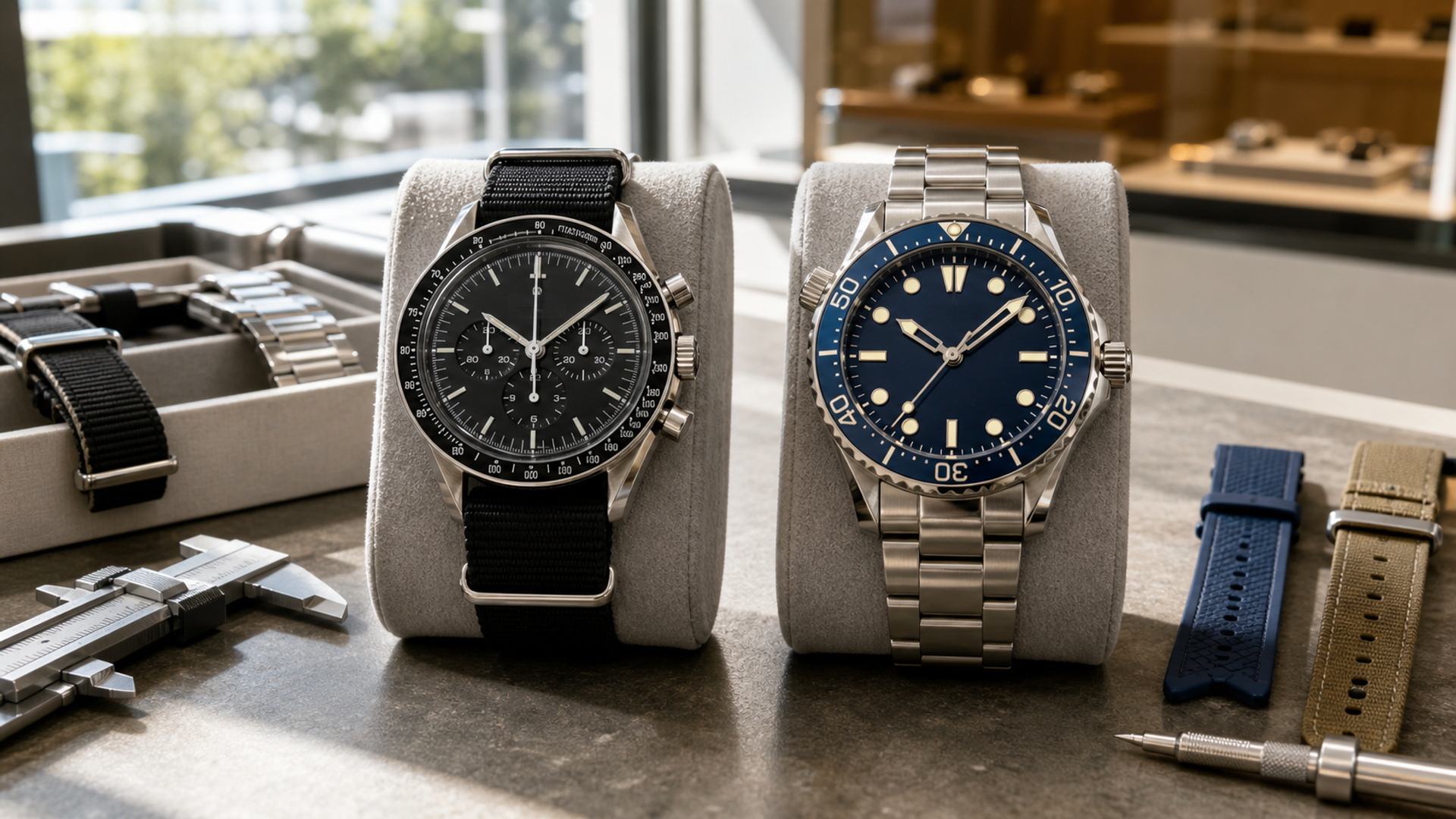
Choose an Omega Speedmaster if the watch's primary role is a historically rooted chronograph for daily wear, timing and collector continuity. Choose an Omega Seamaster if water use, swimming, a rotating dive bezel or a more overtly robust sports-watch identity matters. For a one-watch collection, the Seamaster is usually the practical all-environment choice; the Speedmaster is the emotionally coherent choice for someone drawn to chronographs and the Moonwatch story.
“Speedmaster” and “Seamaster” are families, not single specifications. This comparison uses the Speedmaster Moonwatch Professional and Seamaster Diver 300M as reference points. Verify the exact reference, movement, dimensions, bracelet and water-resistance rating on Omega's current page before buying.
The decision in one table
| Criterion | Speedmaster Moonwatch Professional | Seamaster Diver 300M | One-watch implication |
|---|---|---|---|
| Core identity | Manual-wind space chronograph | Automatic modern dive watch | Choose the story you want daily |
| Timing | Chronograph | Rotating dive bezel | Different interaction styles |
| Water use | Check exact reference; not a dive watch | Designed for substantial water use | Seamaster for swimming/diving |
| Winding | Regular manual ritual | Automatic winding | Preference, not quality hierarchy |
| Dial | Dense chronograph display | High-contrast dive display | Try both in low light |
| Thickness/shape | Broad case with chronograph profile | Robust case and bezel | Wrist fit differs by reference |
| Formal flexibility | Strong on strap, restrained variants | Sportier, though versatile | Wardrobe matters |
| Collector narrative | Moonwatch continuity | Maritime and Bond-era associations | Emotion drives long ownership |
The table does not declare a better watch. It identifies which compromises are likely to remain acceptable.
Speedmaster: the chronograph proposition
The Moonwatch Professional is defined by a manually wound mechanical chronograph, tachymeter bezel and a design connected to space exploration. The act of winding becomes part of ownership. The chronograph offers a tactile way to time short events, though a phone is more precise.
Its appeal is consistency: the watch feels connected to earlier Speedmasters without being a costume. The dial is information-rich, yet the white hands and markers create strong legibility. Buyers should test the pushers, winding crown and sub-dial readability rather than buying solely for history.
Omega's official account of the Speedmaster Moonwatch with lacquered white dial confirms the contemporary 42 mm case, Calibre 3861 and bracelet-or-strap choices. Exact references still need an authorised retailer check before purchase.
Seamaster: the dive-watch proposition
The Seamaster Diver 300M is built around water resistance, a unidirectional timing bezel, luminous display and an automatic movement. Its wave-pattern dial, skeletonised hands and helium-escape valve create a recognisable modern identity. Some buyers love those signatures; others find them visually busy.
The bezel is useful for parking, cooking and meetings as well as diving. Automatic winding reduces routine interaction, though the watch still needs setting after sufficient time off the wrist. Bracelet and rubber-strap options change weight and character considerably.
Omega's official introduction to the new Seamaster Diver 300M range confirms the 42 mm format and current material direction; exact references and dimensions still vary.
Water resistance and real use
A Seamaster is the clear choice if the watch will be used for regular swimming or diving within its rated conditions. Water resistance is not permanent. Gaskets age, crowns can be left unsecured and impacts can affect seals. Follow Omega's service and testing guidance.
The Moonwatch has a water-resistance specification for each reference, but it is not designed as a dive watch. An owner wanting one watch for pool, beach and boat use should not rationalise around the minimum possible exposure.
If water never enters the owner's life, the Seamaster's capability may be reassuring but unnecessary. Buy for the actual environment.
Manual winding versus automatic convenience
Winding a Speedmaster each morning creates a moment of attention and keeps the watch ready. Some collectors find it intimate; others find it an obligation. The process also encourages awareness of the crown and power reserve.
The Seamaster's automatic movement winds through wrist motion and is easier for continuous wear. It can still stop after being left unused. Neither architecture is inherently more prestigious. Both require service, and both should be protected from careless setting or impact.
Before buying, wind the Speedmaster and set both watches. Ownership is made of these small interactions.
Wrist-fit matrix
| Wrist/fit preference | Speedmaster tendency | Seamaster tendency | What to test |
|---|---|---|---|
| Flatter case feel | Curved lugs can distribute width | Bezel and valve add visual height | Lug overhang |
| Lightweight preference | Strap can reduce weight | Rubber often lighter than bracelet | Complete configured weight |
| Small wrist | Broad dial may still wear balanced | Dive bezel concentrates diameter | Top-down and mirror views |
| Cuff compatibility | Strap and case profile matter | Bezel/bracelet can catch tighter cuffs | Wear with actual shirt/jacket |
| Strong wrist presence | Historic instrument character | More overt sports-watch character | Side profile |
Published diameter alone does not predict fit. Lug-to-lug, thickness, case-back shape and bracelet articulation matter.
Dial legibility and timing
The Speedmaster's central chronograph seconds and sub-dials reward close engagement. It is suited to someone who enjoys reading a mechanical instrument. The Seamaster's large luminous markers and bezel create a quicker elapsed-time reference, especially in water or low light.
Test at arm's length and in a dim area. Check whether polished hands disappear against reflections. If reading glasses are needed for the sub-dials, decide whether the chronograph will still be used. A complication that cannot be read comfortably may become decoration.
For timing a presentation, both can work; the preferred interaction is personal.
Bracelet, strap and wardrobe
The Moonwatch moves easily between bracelet, leather and textile straps. On leather it can sit comfortably with tailoring, though its instrument dial remains informal. The Seamaster on steel or rubber is sportier; restrained dial and strap combinations can still work with business clothing.
The sports-watch versus dress-watch guide provides a useful wardrobe test if formal versatility is the deciding factor rather than water use or chronograph identity.
Changing straps can make a one-watch collection more versatile, but confirm lug width, clasp quality and water suitability. Leather is not the default for swimming. A travel strap change should use proper tools or a qualified watchmaker.
Choose the configuration that will be worn most often, not the one that photographs best in a launch image.
Service, magnetism and ownership
Modern Omega movements in these families use Co-Axial architecture and current anti-magnetic engineering, but exact calibre and certification depend on the reference. Read the product specification and warranty terms. Do not assume that resistance to magnetism removes all need for sensible care.
Service cost and access matter in a one-watch collection because the watch may be unavailable during maintenance. Ask an authorised service centre about expected intervals, water-resistance tests, refinishing policy and whether replaced parts are returned.
Keep purchase documents and service records. They support provenance but do not guarantee future resale value.
New, pre-owned and reference selection
Buying new offers current warranty, known condition and a straightforward configuration. Pre-owned opens discontinued dials, bracelets and prices, but adds authentication and service uncertainty. Compare reference numbers, not just family names.
Inspect polishing, bracelet stretch, bezel action, chronograph reset, crown feel and timekeeping. Confirm serial and movement through a qualified professional. A full set is attractive, but papers do not authenticate a watch on their own.
VERTU's three-watch collection guide can help if the one-watch constraint later expands.
Who should choose the Speedmaster
Choose the Speedmaster if you value the Moonwatch narrative, enjoy manual winding, prefer a chronograph to a dive bezel and do not need one watch for regular water activity. It suits a collector who wants a design with historical continuity and accepts that the daily ritual is part of the product.
It is also the more compelling choice when the emotional answer was clear before the comparison began. A one-watch collection must be worn with pleasure, not merely optimised.
Who should choose the Seamaster
Choose the Seamaster if swimming, water resistance, luminous readability and automatic convenience outweigh the appeal of a manual chronograph. It is the rational travel companion for mixed environments and the stronger default for someone who wants one mechanical watch without planning around water.
Make sure the wave dial, hands and helium valve remain satisfying after the first impression. Practical capability does not compensate for a design the owner finds busy.
Final one-watch verdict
For capability breadth, the Seamaster Diver 300M wins: water, automatic winding and robust legibility cover more environments. For narrative coherence and collector attachment, the Speedmaster Moonwatch Professional wins. The correct one-watch collection is the one whose losing column contains compromises you can live with.
Try both on the same day, in the intended configurations, with the clothing you normally wear. Photograph from a distance, operate every control and leave without buying. The watch you continue to think about after the specifications fade is usually the better long-term choice.
Insurance and travel
A one-watch collection concentrates emotional and financial value in one object. Confirm whether household or specialist insurance covers loss, accidental damage and travel outside the home country, and read valuation and security conditions. Keep the policy evidence separate from the watch.
When travelling, avoid posting a real-time location with a recognisable serial or itinerary. Use a discreet watch roll only when the watch is off wrist and keep it in carry-on control, not checked baggage. A hotel safe may reduce casual access but its terms and security vary. The simplest risk control is often to wear a less identifiable watch when the destination or activity makes the primary piece a distraction.
![Top 10 Luxury Smartwatches for Business Travel [2026]](https://cdn.sanity.io/images/e0gp1l2g/production/8b5e5b21db42a1c5f040e828bd041857353a8eb2-2560x1382.webp?w=800&h=450&q=82&auto=format&fit=crop)