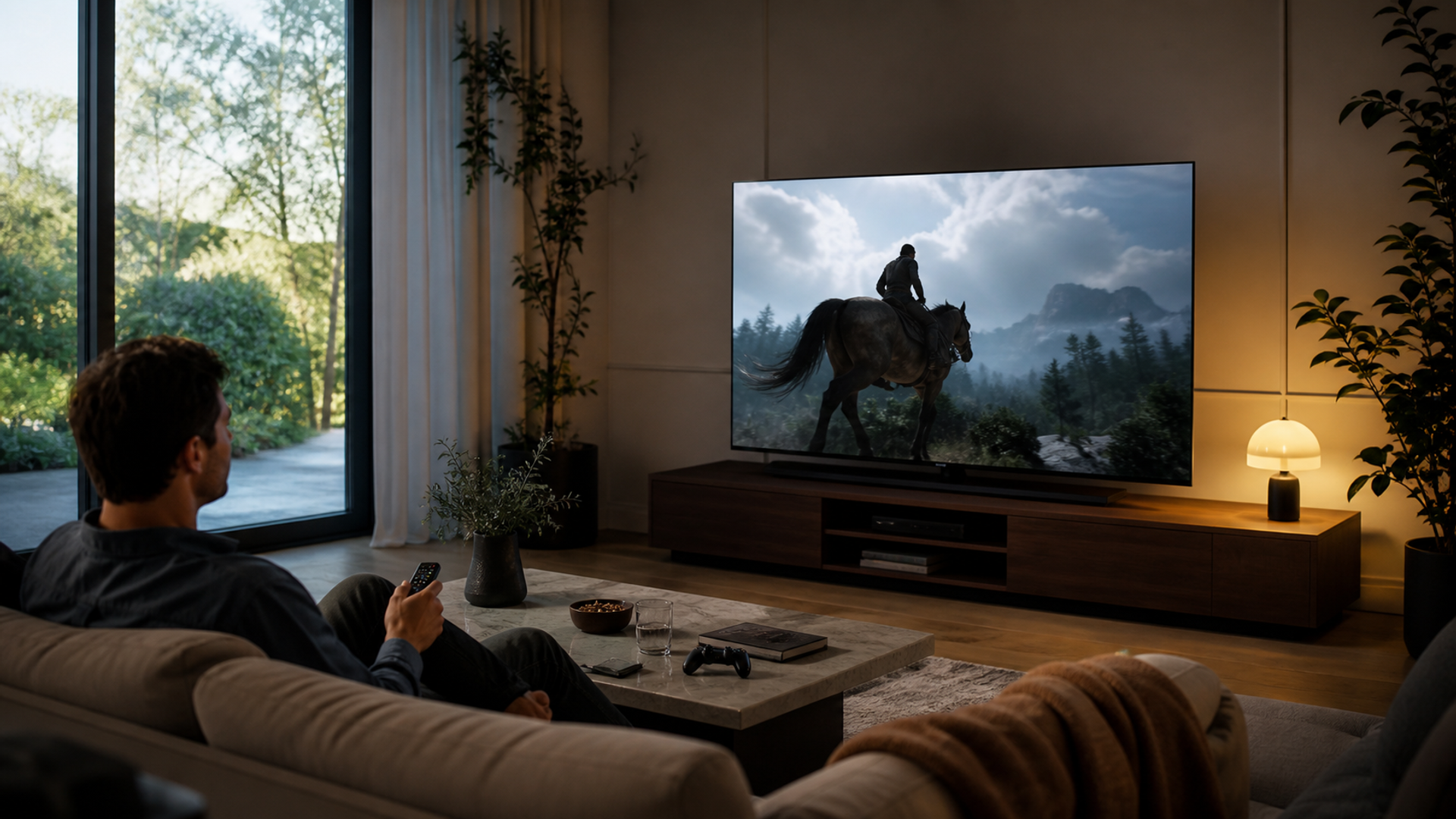
OLED remains attractive because each pixel can control its own light, but the best OLED TV is determined by the room and content. A bright open-plan space, a dark cinema room, a gaming setup and a screen used all day for static news or desktop work impose different demands.
Start with the room
Choose a current OLED by measured room light, screen reflections, seating distance, gaming inputs, motion needs and static-content exposure. Compare the exact size and regional model, because panel type, brightness features, stand design and warranty terms can differ within a series.
| Decision factor | Cinema-first OLED | Bright-room OLED | Gaming-first OLED |
|---|---|---|---|
| Ambient light | Best when direct light can be controlled | Needs stronger brightness and reflection handling | Needs enough brightness without sacrificing response |
| Film viewing | Prioritises shadow detail and accurate modes | Balances impact with daytime visibility | Requires low-latency modes that preserve picture quality |
| Gaming | Two HDMI 2.1 inputs may be sufficient | Mixed household sources need flexible connectivity | Multiple high-bandwidth inputs and VRR matter |
| Sports | Motion processing should remain natural | Glare control matters across wide seating | Fast response is useful but broadcast quality still limits detail |
| Static content | Occasional menus present limited exposure | News tickers and dashboards need active risk management | PC interfaces require screen savers and varied use |
| Installation | Wall mounting can optimise a dark room | Swivel or placement flexibility may reduce reflections | Console, receiver and cable routing need planning |
This best OLED TV 2026 matrix is the article's working value object. Read the rows together: the decisive failure mode depends on this topic's evidence, operating context and reader objective.
What the specifications do and do not prove
Evidence 1. LG's current OLED range separates models by brightness, processing, design and size, so the OLED label alone does not identify the right television.
Evidence 2. LG's support guidance recognises image retention and burn-in controls, reinforcing that static-content patterns remain part of responsible OLED ownership.
Evidence 3. Samsung's OLED range provides a separate implementation and feature mix, which makes exact model and regional specification checks more useful than panel-label arguments.
Reader-visible sources checked for this article:
lg.com — reader-visible current or official evidence
lg.com — reader-visible current or official evidence
samsung.com — reader-visible current or official evidence
For best OLED TV 2026, these sources establish only the claims inside their documented scope. Recheck every changeable specification, availability condition, price, policy or service term in the relevant market before acting.
Control static-content risk
The decision changes at ambient light. Choose the first path only if best when direct light can be controlled; move to the second when needs stronger brightness and reflection handling; use the third when needs enough brightness without sacrificing response. Save the downside that would make this row fail.
For film viewing, the first route works when prioritises shadow detail and accurate modes; the second requires balances impact with daytime visibility. The control for the third is requires low-latency modes that preserve picture quality. Verify this row against the exact product, property, account or environment before it can reverse the decision.
The gaming row exposes a practical boundary. Route one assumes two HDMI 2.1 inputs may be sufficient, while route two is defensible only when mixed household sources need flexible connectivity. Route three depends on multiple high-bandwidth inputs and VRR matter. If that evidence is absent, keep the more reversible option.
Read sports as a stop/go test: motion processing should remain natural supports the first option; glare control matters across wide seating supports the second; and fast response is useful but broadcast quality still limits detail supports the third. Record which source proves the condition and when it was checked.
A buyer can resolve static content without starting from a brand preference. Ask whether occasional menus present limited exposure; compare that with whether news tickers and dashboards need active risk management; then use pC interfaces require screen savers and varied use as the third route's safeguard. An unknown condition stays unknown.
On installation, popularity is not enough. The evidence for option one is that wall mounting can optimise a dark room. Option two means swivel or placement flexibility may reduce reflections. Option three is rational where console, receiver and cable routing need planning. Recheck any changeable term immediately before commitment.
Facts that would reverse the current choice
Reversal control 1 — Ambient light. Before choosing Cinema-first OLED, write down how the decision changes if “Best when direct light can be controlled” proves false. Do the same for Bright-room OLED and “Needs stronger brightness and reflection handling”. Keep the Gaming-first OLED route available until “Needs enough brightness without sacrificing response” is verified. This control belongs to best OLED TV 2026; update it from the cited source or exact supplier rather than copying a generic checklist.
Reversal control 2 — Film viewing. Before choosing Cinema-first OLED, write down how the decision changes if “Prioritises shadow detail and accurate modes” proves false. Do the same for Bright-room OLED and “Balances impact with daytime visibility”. Keep the Gaming-first OLED route available until “Requires low-latency modes that preserve picture quality” is verified. This control belongs to best OLED TV 2026; update it from the cited source or exact supplier rather than copying a generic checklist.
Reversal control 3 — Gaming. Before choosing Cinema-first OLED, write down how the decision changes if “Two HDMI 2.1 inputs may be sufficient” proves false. Do the same for Bright-room OLED and “Mixed household sources need flexible connectivity”. Keep the Gaming-first OLED route available until “Multiple high-bandwidth inputs and VRR matter” is verified. This control belongs to best OLED TV 2026; update it from the cited source or exact supplier rather than copying a generic checklist.
Reversal control 4 — Sports. Before choosing Cinema-first OLED, write down how the decision changes if “Motion processing should remain natural” proves false. Do the same for Bright-room OLED and “Glare control matters across wide seating”. Keep the Gaming-first OLED route available until “Fast response is useful but broadcast quality still limits detail” is verified. This control belongs to best OLED TV 2026; update it from the cited source or exact supplier rather than copying a generic checklist.
Reversal control 5 — Static content. Before choosing Cinema-first OLED, write down how the decision changes if “Occasional menus present limited exposure” proves false. Do the same for Bright-room OLED and “News tickers and dashboards need active risk management”. Keep the Gaming-first OLED route available until “PC interfaces require screen savers and varied use” is verified. This control belongs to best OLED TV 2026; update it from the cited source or exact supplier rather than copying a generic checklist.
Reversal control 6 — Installation. Before choosing Cinema-first OLED, write down how the decision changes if “Wall mounting can optimise a dark room” proves false. Do the same for Bright-room OLED and “Swivel or placement flexibility may reduce reflections”. Keep the Gaming-first OLED route available until “Console, receiver and cable routing need planning” is verified. This control belongs to best OLED TV 2026; update it from the cited source or exact supplier rather than copying a generic checklist.
Measure light at the screen
Observe the room at the times the television will be used. Direct windows opposite the screen, bright lamps and pale walls can reduce perceived contrast even when a specification advertises high peak brightness. A curtain or altered mounting angle may improve the experience more than paying for a different panel. Photograph reflection paths before installation.
Compare the exact size
A television family can use different panel generations, stands or audio systems at different sizes. Open the regional product sheet for the exact diagonal and model suffix. Confirm HDMI bandwidth, refresh rates, tuner, stand width, wall-mount pattern and included accessories. Retailer titles frequently compress those differences into one series name.
Treat burn-in as a usage variable
OLED wear is cumulative and uneven static elements can create risk. Enable built-in logo dimming, pixel shifting and scheduled maintenance features. Avoid leaving paused games, news tickers or desktop interfaces at high brightness for long periods. A household with varied films and series has a different exposure pattern from a trading desk showing fixed panels every day.
Test motion and low-light detail
Use familiar content rather than showroom loops. Check a dark film scene, a live sports broadcast, subtitles, a game in low-latency mode and a compressed streaming programme. Look for crushed shadows, distracting processing, judder and reflection. The correct setting may vary by input, so save and label profiles after calibration.
Four viewing profiles
A dedicated cinema room
Prioritise black-level control, shadow detail, accurate picture modes and the screen size that fits viewing distance. Extreme daytime brightness is less important. Define the fact that would reverse this recommendation before committing.
A bright family room
Prioritise reflection handling, usable full-screen brightness, wide seating and simple input switching. Consider whether a premium mini-LED remains a better fit. Define the fact that would reverse this recommendation before committing.
A console and PC setup
Confirm high-refresh support, VRR ranges, input count, chroma handling and static desktop habits. Plan screen savers and varied content from the first day. Define the fact that would reverse this recommendation before committing.
Action checklist
Observe the room in daylight and at night.
Measure seating distance.
Check reflections from the viewing position.
Verify the exact regional model.
Count HDMI 2.1 sources.
Test game mode picture quality.
Review static-content exposure.
Enable panel-protection features.
Confirm mounting and cable access.
Check local warranty terms.
Continue the decision
The linked VERTU articles expand adjacent parts of the best OLED TV 2026 decision. They do not substitute for the external evidence above.
The OLED buying verdict
Choose a current OLED by measured room light, screen reflections, seating distance, gaming inputs, motion needs and static-content exposure. Compare the exact size and regional model, because panel type, brightness features, stand design and warranty terms can differ within a series.
Keep the best OLED TV 2026 decision reversible until its material cost, safety, access, privacy and compatibility facts are verified. Unknown evidence stays unknown; it is never silently scored as favourable.