QD-OLED and other OLED televisions share self-emissive pixels, but they create colour differently. QD-OLED uses blue OLED light and quantum-dot conversion, while common white-OLED architectures use additional layers and colour filtering. The category difference can affect colour volume and brightness, yet room reflections, screen coating, processing and exact model tuning often matter more than the badge.
Room-first display selector
Choose the exact television, not the acronym. QD-OLED is attractive for vivid HDR colour and wide viewing, especially when the model controls reflections well. Other OLED designs offer broad size, price and brightness options. Test black appearance in the real room, verify ports and gaming features, and compare measured model performance at the size you will actually buy.
| Decision factor | QD-OLED shortlist | Other OLED shortlist | Room-first mixed shortlist |
|---|---|---|---|
| Colour approach | Quantum-dot conversion from blue OLED | White-OLED architecture with colour filtering or enhancement | Compare measured colour volume by model |
| Black level | Pixel-level control, room reflections still matter | Pixel-level control, coating and ambient light matter | Test with lights on and off |
| Bright colour | Often a key strength | Varies strongly by generation and model | Use measured HDR scenes |
| Screen sizes | Model range can be narrower | Often broader across brands and sizes | Let viewing distance set the size |
| Gaming | Verify ports, refresh, latency and dimming | Verify the same model-level features | Connect the actual console or PC |
| Main risk | Paying for colour advantages hidden by the room | Choosing category familiarity over measured performance | Store demo conditions misrepresenting both |
This QD-OLED vs OLED matrix is the article's working value object. Read the rows together: the decisive failure mode depends on this topic's evidence, operating context and reader objective.
What the panel makers establish
Evidence 1. Samsung Display describes QD-OLED as combining self-emissive blue OLED with quantum-dot colour conversion.
Evidence 2. LG Display describes OLED as self-emissive technology with pixel-level light control.
Evidence 3. Neither panel label alone establishes a television's processing, reflection handling, ports, warranty or calibrated accuracy.
Reader-visible sources checked for this article:
global.samsungdisplay.com — current reader-visible source
lgdisplay.com — current reader-visible source
For QD-OLED vs OLED, these sources establish only the claims inside their documented scope. Recheck every changeable specification, schedule, price, access condition or policy in the relevant market before acting.
Compare the exact television
On colour approach, popularity is irrelevant. The evidence for option one is that quantum-dot conversion from blue OLED. Option two means white-OLED architecture with colour filtering or enhancement. Option three is rational where compare measured colour volume by model. Recheck any changeable term immediately before commitment.
The decision changes at black level. Choose the first path only if pixel-level control, room reflections still matter; move to the second when pixel-level control, coating and ambient light matter; use the third when test with lights on and off. Save the downside that would make this row fail.
For bright colour, the first route works when often a key strength; the second requires varies strongly by generation and model. The control for the third is use measured HDR scenes. Verify this row against the exact market, model, venue or itinerary before it can reverse the decision.
The screen sizes row exposes a practical boundary. Route one assumes model range can be narrower, while route two is defensible only when often broader across brands and sizes. Route three depends on let viewing distance set the size. If that evidence is absent, keep the more reversible option.
Read gaming as a stop/go test: verify ports, refresh, latency and dimming supports the first option; verify the same model-level features supports the second; and connect the actual console or PC supports the third. Record which source proves the condition and when it was checked.
A buyer can resolve main risk without a brand preference. Ask whether paying for colour advantages hidden by the room; compare that with whether choosing category familiarity over measured performance; then use store demo conditions misrepresenting both as the third route's safeguard. An unknown condition stays unknown.
Facts that would reverse the current choice
Reversal control 1 — Colour approach. Before choosing QD-OLED shortlist, write down how the decision changes if 'Quantum-dot conversion from blue OLED' proves false. Do the same for Other OLED shortlist and 'White-OLED architecture with colour filtering or enhancement'. The Room-first mixed shortlist path should remain available until 'Compare measured colour volume by model' is verified. This control belongs to QD-OLED vs OLED; it should be updated from the cited source or the exact supplier, device, venue or operator rather than copied from a generic checklist.
Reversal control 2 — Black level. Before choosing QD-OLED shortlist, write down how the decision changes if 'Pixel-level control, room reflections still matter' proves false. Do the same for Other OLED shortlist and 'Pixel-level control, coating and ambient light matter'. The Room-first mixed shortlist path should remain available until 'Test with lights on and off' is verified. This control belongs to QD-OLED vs OLED; it should be updated from the cited source or the exact supplier, device, venue or operator rather than copied from a generic checklist.
Reversal control 3 — Bright colour. Before choosing QD-OLED shortlist, write down how the decision changes if 'Often a key strength' proves false. Do the same for Other OLED shortlist and 'Varies strongly by generation and model'. The Room-first mixed shortlist path should remain available until 'Use measured HDR scenes' is verified. This control belongs to QD-OLED vs OLED; it should be updated from the cited source or the exact supplier, device, venue or operator rather than copied from a generic checklist.
Reversal control 4 — Screen sizes. Before choosing QD-OLED shortlist, write down how the decision changes if 'Model range can be narrower' proves false. Do the same for Other OLED shortlist and 'Often broader across brands and sizes'. The Room-first mixed shortlist path should remain available until 'Let viewing distance set the size' is verified. This control belongs to QD-OLED vs OLED; it should be updated from the cited source or the exact supplier, device, venue or operator rather than copied from a generic checklist.
Reversal control 5 — Gaming. Before choosing QD-OLED shortlist, write down how the decision changes if 'Verify ports, refresh, latency and dimming' proves false. Do the same for Other OLED shortlist and 'Verify the same model-level features'. The Room-first mixed shortlist path should remain available until 'Connect the actual console or PC' is verified. This control belongs to QD-OLED vs OLED; it should be updated from the cited source or the exact supplier, device, venue or operator rather than copied from a generic checklist.
Reversal control 6 — Main risk. Before choosing QD-OLED shortlist, write down how the decision changes if 'Paying for colour advantages hidden by the room' proves false. Do the same for Other OLED shortlist and 'Choosing category familiarity over measured performance'. The Room-first mixed shortlist path should remain available until 'Store demo conditions misrepresenting both' is verified. This control belongs to QD-OLED vs OLED; it should be updated from the cited source or the exact supplier, device, venue or operator rather than copied from a generic checklist.
Test black in the room, not in theory
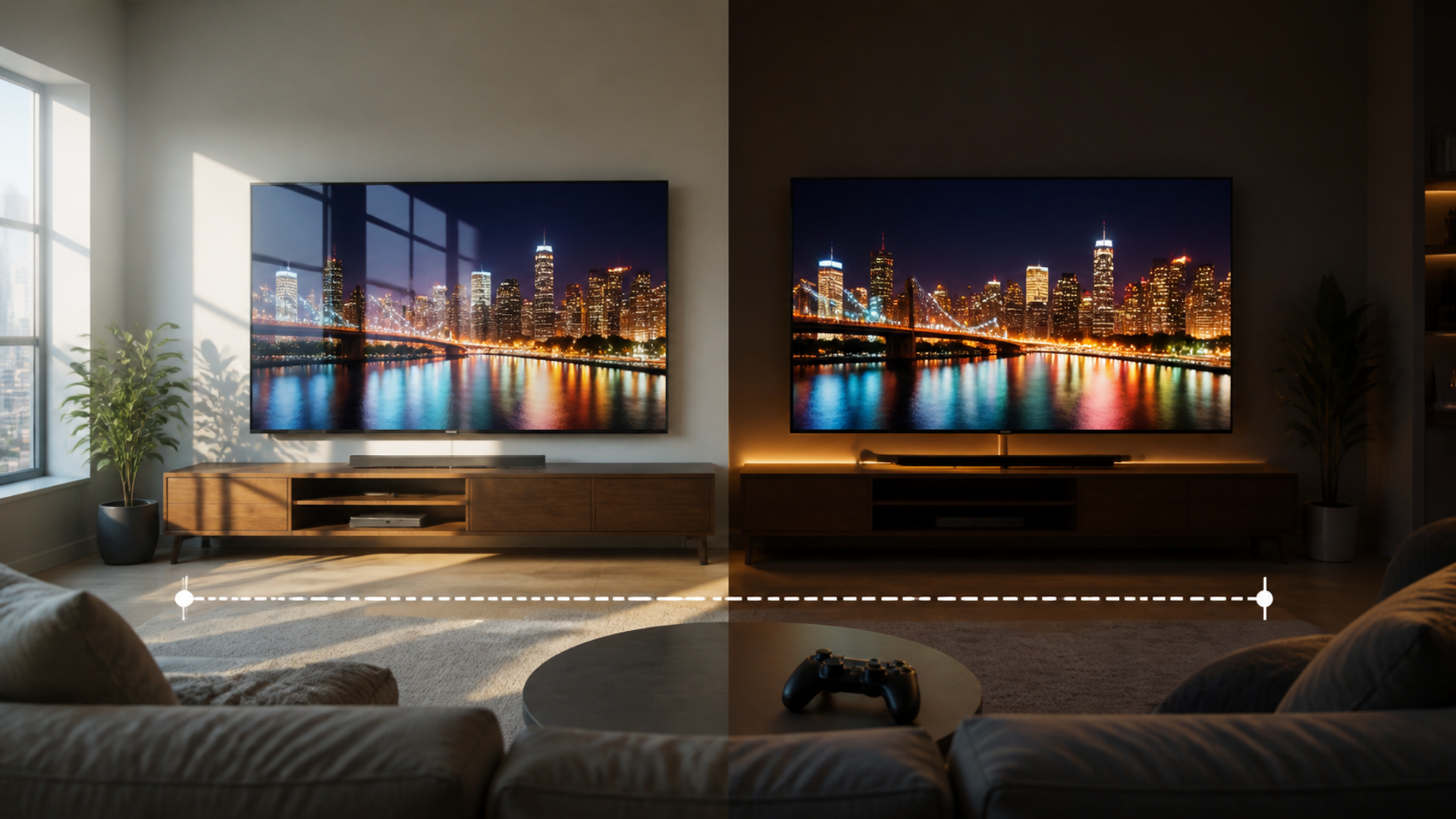
Both technologies can switch pixels off, but ambient light interacts with the screen surface and panel structure. A black test image under showroom darkness says little about a bright living room. Photograph windows from the seating position, test daytime reflections and compare how black and shadow detail hold up with the lights used at home.
Colour volume needs real content
Highly saturated highlights can reveal a QD-OLED advantage, but many films and broadcasts do not live at the edge of the colour gamut. Compare familiar HDR material, skin tones and near-black scenes after using accurate picture modes. Avoid vivid showroom presets that exaggerate saturation and edge enhancement.
Size can outweigh panel architecture
A correctly sized 77-inch display may deliver more immersion than a technically stronger but undersized screen. Use viewing distance and room layout to set a size range, then compare models available inside it. Confirm delivery route, stand width, wall structure, cable access and heat clearance before treating the purchase as a panel-only decision.
Ownership is model-specific
Check static-content protection, warranty wording, firmware history, input behaviour and service network. Gamers should verify full-bandwidth ports, variable refresh rate, frame-rate combinations and input switching. A panel advantage does not compensate for missing connectivity or unstable software in the buyer's actual system.
Three viewing-room profiles
Dark-room film viewer
Start with accurate-mode black detail, tone mapping and screen size; compare QD-OLED colour benefits using real HDR films. Define the fact that would reverse the choice before committing.
Bright multipurpose room
Prioritise reflections and daytime black appearance before peak-colour claims. Define the fact that would reverse the choice before committing.
Gaming household
Test console and PC sources, static-interface use, ports, latency and automatic brightness behaviour on the exact model. Define the fact that would reverse the choice before committing.
Action checklist
Measure viewing distance.
Photograph room reflections.
Choose the screen-size range.
Use accurate picture modes.
Compare measured HDR colour.
Verify every required port.
Read warranty and service terms.
Test the exact model when possible.
Related VERTU reading
The linked VERTU reading expands adjacent parts of the QD-OLED vs OLED decision. It does not substitute for the external evidence above, and brand relevance is kept out when it adds no reader value.
The QD-OLED decision
Choose the exact television, not the acronym. QD-OLED is attractive for vivid HDR colour and wide viewing, especially when the model controls reflections well. Other OLED designs offer broad size, price and brightness options. Test black appearance in the real room, verify ports and gaming features, and compare measured model performance at the size you will actually buy.
Keep the QD-OLED vs OLED decision reversible until its material cost, safety, access and compatibility facts are verified. Unknown evidence stays unknown; it is never silently scored as favourable.