

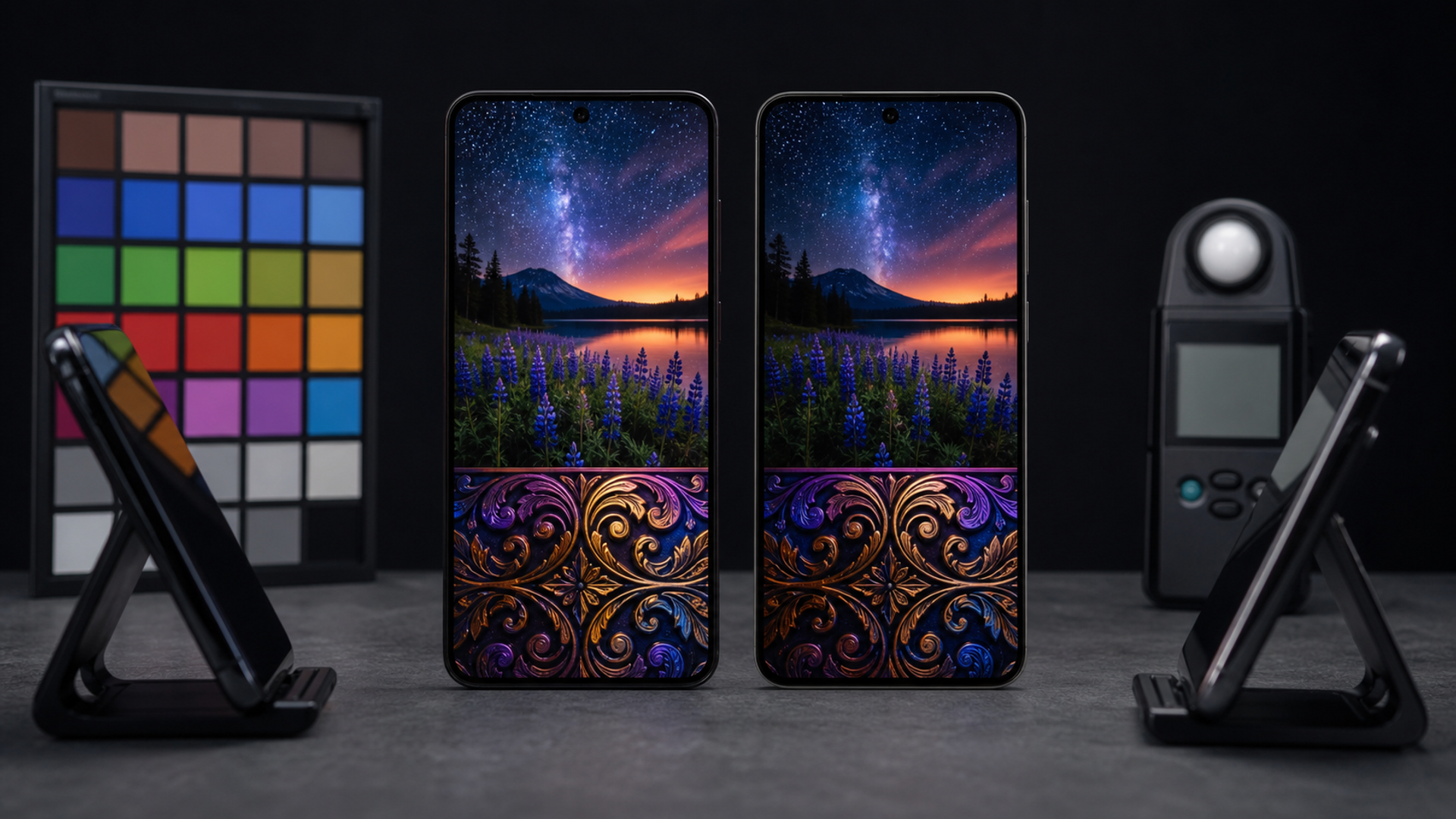
AMOLED is a type of OLED, not a rival display chemistry. OLED describes pixels made from organic light-emitting materials; AMOLED adds an active-matrix backplane that controls those pixels individually. Almost every modern premium smartphone marketed as OLED uses an active-matrix implementation, even when the manufacturer writes only “OLED”. That makes OLED vs AMOLED a poor shortcut for display quality.
The better phone display is the panel that combines usable outdoor brightness, stable colour, appropriate refresh behaviour, acceptable power consumption, comfortable dimming, controlled reflections and durable integration. A mediocre panel does not become excellent because “AMOLED” appears in the name, and an “OLED” label does not prove that active-matrix control is absent.
Use the label to identify the display family, then evaluate the implementation.
OLED vs AMOLED in one table
| Term or feature | What it means | What it does not prove |
|---|---|---|
| OLED | Organic light-emitting diode; pixels produce their own light rather than relying on a common backlight | Brightness, colour accuracy, refresh rate, PWM behaviour or panel life |
| AMOLED | Active-matrix OLED, with a transistor network addressing individual pixels | That one AMOLED phone is better than another OLED phone |
| Super AMOLED and similar brands | Manufacturer-specific integration or marketing for an OLED implementation | A cross-brand quality ranking unless measured under the same conditions |
| LTPO | A backplane approach that can vary refresh rate over a wider range | That the phone always reaches the advertised minimum or saves power in every app |
| 120Hz | The display can refresh up to 120 times per second in supported modes | Constant 120Hz operation, low latency in every app or low battery use |
| Peak brightness | Maximum brightness under a specified window, duration and condition | Full-screen sustained brightness outdoors or when the device is hot |
| HDR | Ability to accept and render high-dynamic-range content under a defined standard | Accurate tone mapping, wide full-screen brightness or identical results across services |
Samsung Display’s technical explanation of AMOLED describes an organic electroluminescent structure controlled by an active matrix and highlights the absence of a backlight. That architecture enables thin panels, per-pixel blacks and fast response. It does not remove differences in materials, backplane, calibration, cover glass, touch layer and phone software.
Why OLED black looks different
An LCD normally modulates light from a backlight. Even with local dimming, some light can leak through a nominally black area. An OLED pixel can switch off, producing very low black levels beside illuminated pixels. That creates strong contrast in dark scenes and lets an always-on display illuminate only the required pixels.
Per-pixel light also changes power behaviour. A mostly black interface can use less panel power than a bright white page at the same perceived brightness. The relationship is not absolute because the display driver, refresh rate, radio, processor and thermal state also consume energy. Dark mode can help on OLED, but it cannot compensate for maximum brightness, constant navigation or an inefficient app.
The benefit is most visible in controlled light. Outdoors, reflections can lift the apparent black level even when the pixel is off. Anti-reflective treatment and cover-glass design may improve real contrast more than a laboratory black measurement.
Brightness numbers need three qualifiers
Phone launches often quote a peak nit value. Ask: over how much of the screen, for how long, and in which mode? A tiny HDR highlight can reach a figure the full display cannot sustain. High-brightness mode under sunlight can behave differently from manual brightness. Heat can force dimming after navigation, video recording or gaming.
Test a phone outside with a white webpage, a map and the camera viewfinder. Wait several minutes, because initial brightness may fall. Wear polarised sunglasses if you use them and rotate the phone to check viewing interaction. Compare reflections, not just emitted light.
A premium display should preserve text readability and colour relationships rather than merely produce a dazzling demo. Extremely saturated shop mode can look impressive while hiding inaccurate skin tones or crushed shadow detail. Look for a natural or reference colour mode and independent measurements covering white point and greyscale.
Refresh rate: adaptive is more important than maximum
Answer 120Hz display can make scrolling and animation appear smoother than 60Hz. The battery cost depends on how intelligently the system changes refresh rate. LTPO panels can support a broad variable range, allowing low rates for static content and high rates for interaction. But the operating system, app and display mode decide what happens in practice.
Open the browser, reading app, video player and game you actually use. Some apps cap frame rate; some phones stay at a higher rate when brightness or input changes; some reduce rate aggressively during heat. An advertised 1Hz minimum may apply only to an always-on screen or specific static content.
Touch sampling and animation latency are separate from refresh rate. A 120Hz panel with delayed software can feel worse than a well-tuned lower-rate phone. Judge the complete interaction.
PWM and low-brightness comfort
Many OLED phones control low brightness by rapidly switching pixels or varying pulses. This pulse-width modulation, or PWM, is invisible to many people but can cause discomfort, fatigue or headaches for sensitive users. Frequency alone does not describe the experience; modulation depth, waveform, brightness and individual sensitivity matter.
Do not diagnose sensitivity from a specification table. Use the phone at your normal night brightness for at least ten minutes, reading small text and scrolling. Check whether a high-frequency or anti-flicker mode changes colour or maximum brightness. If you have persistent symptoms, seek appropriate medical advice rather than forcing adaptation to an expensive device.
An LCD is not automatically flicker-free, and an AMOLED brand does not predict PWM behaviour. Independent measurements at multiple brightness levels are more useful than a single manufacturer frequency.
Burn-in, image retention and ageing
OLED materials age as they emit light. Uneven use can produce persistent differences called burn-in; temporary image retention can look similar but fade. Modern phones use pixel shifting, interface changes and compensation algorithms to reduce risk. The risk rises with high brightness, heat and static content over long periods.
For ordinary mixed use, burn-in is less dramatic than early OLED history suggests, but specialist routines matter. A phone used daily for navigation, a point-of-sale screen or a permanently visible trading interface experiences more static elements than a typical handset. Ask about display warranty language and replacement cost if your use is unusual.
Avoid static maximum-brightness screens, use auto brightness where sensible and keep software updated. Do not run “burn-in repair” videos that age the rest of the panel in an attempt to equalise wear.
Foldable OLED adds mechanical variables
Foldable phones use flexible OLED because the emissive stack can be made thin and bendable. The panel label says nothing about hinge radius, protective layers, crease, impact sensitivity or replacement process. Samsung Display’s overview of flexible AMOLED explains why the technology enables curved and folding form factors, but the finished phone’s durability depends on the entire module.
Inspect a foldable under white and dark content, straight on and at an angle. Run a finger lightly across the crease without pressing. Check the warranty for the inner protector, accidental damage and foreign-object intrusion. Our three-year foldable ownership test covers the costs the panel name omits.
The display buyer scorecard
Evaluate the exact phone from zero to five in eight categories:
sustained outdoor readability;
reflections under office lights and daylight;
colour accuracy in the mode you will use;
dark-scene shadow detail;
adaptive refresh in your apps;
low-brightness comfort;
battery during your dominant screen content;
warranty and replacement cost.
Double the scores for outdoor readability and low-brightness comfort if you navigate frequently or read at night. For a creator, double colour and shadow detail. For a gamer, add response, thermal dimming and app frame-rate support. This turns a vague AMOLED preference into a use-case decision.
What to ignore in a shop
Ignore side-by-side demo videos unless both phones use the same file, brightness, colour mode and ambient light. Ignore wallpaper designed to exploit saturated OLED colours. Ignore peak brightness without test conditions. Ignore “billion colours” unless the content pipeline and calibration support a visible benefit. Ignore the assumption that a higher resolution is always sharper; screen size, sub-pixel layout, scaling and viewing distance matter.
Also ignore false hierarchy among marketing labels. “Dynamic”, “Super”, “Retina” and other names can package real engineering, but they are not universal standards that rank unrelated products. Read the underlying specification and independent measurements.
OLED vs AMOLED verdict
For a modern phone, AMOLED normally means active-matrix OLED, while “OLED” often describes the same broad architecture without the extra letter. The label does not choose the better display. Brightness behaviour, reflections, calibration, adaptive refresh, PWM, thermal control and device integration do.
When buying, compare the exact phones under the conditions that challenge your eyes: direct sun, a dark room, scrolling text, HDR video and several minutes of heat. A display is the part of a phone you experience every second. It deserves a test more precise than counting letters in its name.
![How to Scan Receipts and Documents with Your Phone [Full Guide]](https://cdn.sanity.io/images/e0gp1l2g/production/0db13feec1d5e72b8a8a5f976d1f3e86619c9228-3840x1860.webp?w=180&h=180&q=78&auto=format&fit=crop)
![How to Scan Receipts and Documents with Your Phone [Full Guide]](https://cdn.sanity.io/images/e0gp1l2g/production/0db13feec1d5e72b8a8a5f976d1f3e86619c9228-3840x1860.webp?w=800&h=450&q=82&auto=format&fit=crop)
![Top 10 Two-Tone Carbon-Fibre Watches for Men [2026 List]](https://cdn.sanity.io/images/e0gp1l2g/production/18870799ba33fab0e038968359cd5772d7d7db30-1024x576.webp?w=800&h=450&q=82&auto=format&fit=crop)
![Top 10 Luxury Watches with Digital Complication Displays for Men [Latest]](https://cdn.sanity.io/images/e0gp1l2g/production/c4f6bf8c080f291c39f7cc85c7344ecff2fd3799-1024x553.webp?w=800&h=450&q=82&auto=format&fit=crop)