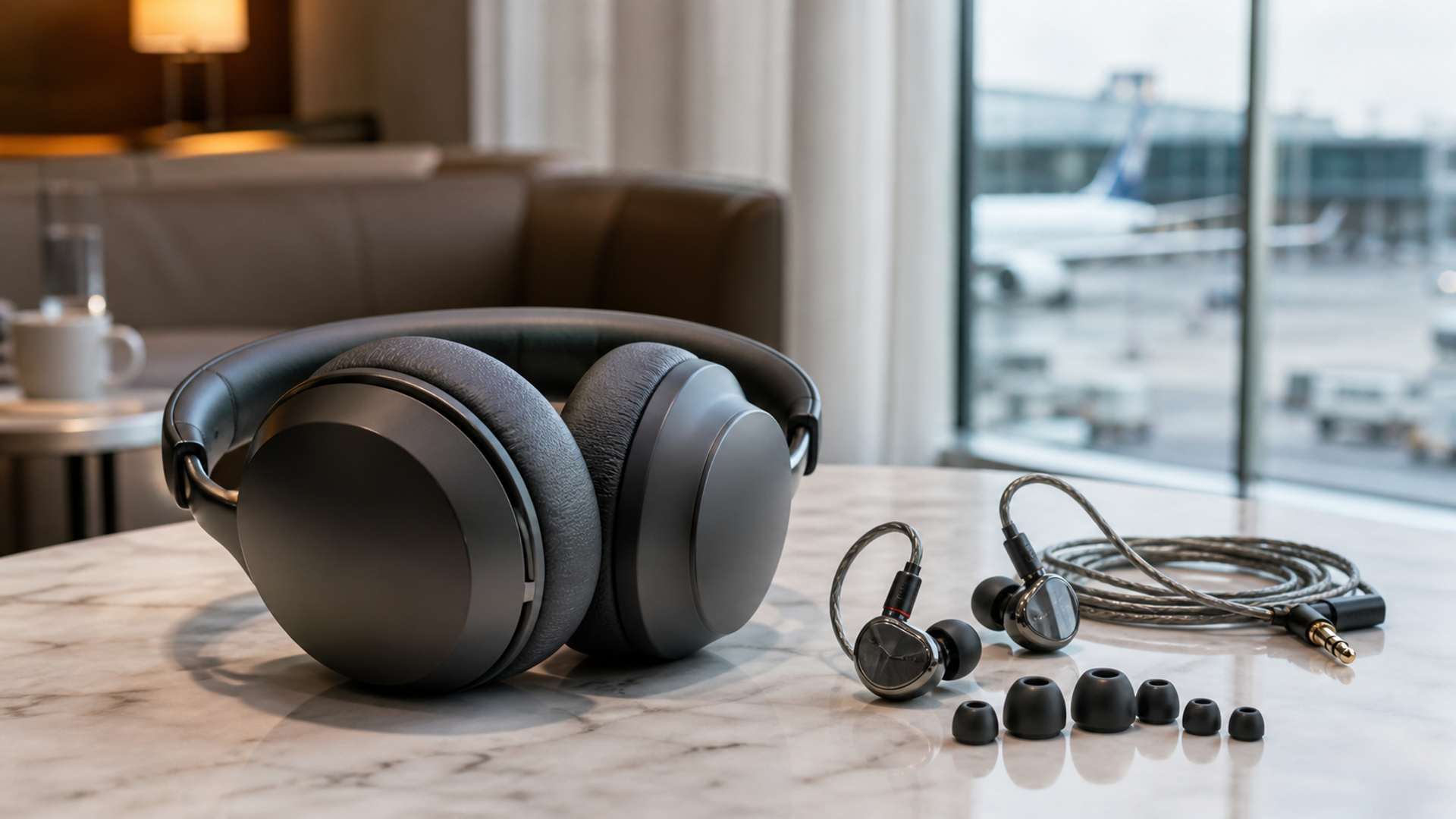
Noise cancelling versus noise isolating compares electronic processing with physical sealing. Active noise cancellation uses microphones and an opposing signal, working especially well against steady low-frequency sound. Passive isolation relies on ear-cup, pad or tip fit and material, often helping higher-frequency intrusion. Many products combine both, while safety awareness can make maximum isolation the wrong goal.
Start with the noise and environment
Choose ANC for aircraft, trains and steady low-frequency environments when battery and electronics fit. Choose passive isolation when fit, simplicity and physical attenuation suit the task. Combine both for demanding travel, or preserve awareness around traffic, machinery and announcements.
| Decision factor | Active noise cancelling | Passive noise isolating | Combine both or preserve awareness |
|---|---|---|---|
| Noise type | Steady engine or HVAC dominates | Speech and high-frequency leakage need seal | Combine technologies |
| Fit | Processing works with a comfortable seal | Tips or pads stay stable | Change size or form |
| Battery | Powered operation fits the trip | Passive use must continue | Carry cable or backup |
| Awareness | Transparency controls are adequate | Partial isolation preserves cues | Use open equipment |
| Comfort | Pressure sensation is tolerated | Clamp or in-ear seal is comfortable | Reduce isolation |
| Hearing behaviour | Lower volume follows reduced noise | Good seal avoids escalation | Use limits and breaks |
This noise cancelling vs noise isolating matrix is the article's working value object. Read the noise cancelling vs noise isolating rows together: the decisive failure mode depends on this topic's evidence, operating context and reader objective.
How cancellation and isolation differ
Evidence 1. Bose explains ANC as microphones and processing producing an opposing signal.
Evidence 2. ANC is generally strongest against steady low-frequency noise.
Evidence 3. Passive isolation comes from ear cups, padding and a secure seal.
Evidence 4. Active and passive methods often work together and should not hide safety-critical cues.
Reader-visible sources checked for this article:
bose.com — reader-visible current or official evidence
bose.com — reader-visible current or official evidence
For noise cancelling vs noise isolating, these sources establish only the claims inside their documented scope. Recheck every changeable specification, availability condition, price, policy or service term in the relevant market before acting.
Test fit, battery and awareness
On noise type, popularity is not enough. The evidence for option one is that steady engine or HVAC dominates. Option two means speech and high-frequency leakage need seal. Option three is rational where combine technologies. Recheck any changeable term immediately before commitment.
The decision changes at fit. Choose the first path only if processing works with a comfortable seal; move to the second when tips or pads stay stable; use the third when change size or form. Save the downside that would make this row fail.
For battery, the first route works when powered operation fits the trip; the second requires passive use must continue. The control for the third is carry cable or backup. Verify this row against the exact product, property, account or environment before it can reverse the decision.
The awareness row exposes a practical boundary. Route one assumes transparency controls are adequate, while route two is defensible only when partial isolation preserves cues. Route three depends on use open equipment. If that evidence is absent, keep the more reversible option.
Read comfort as a stop/go test: pressure sensation is tolerated supports the first option; clamp or in-ear seal is comfortable supports the second; and reduce isolation supports the third. Record which source proves the condition and when it was checked.
A buyer can resolve hearing behaviour without starting from a brand preference. Ask whether lower volume follows reduced noise; compare that with whether good seal avoids escalation; then use use limits and breaks as the third route's safeguard. An unknown condition stays unknown.
Facts that would reverse the current choice
Reversal control 1 — Noise type. Before choosing Active noise cancelling, write down how the decision changes if “Steady engine or HVAC dominates” proves false. Do the same for Passive noise isolating and “Speech and high-frequency leakage need seal”. Keep the Combine both or preserve awareness route available until “Combine technologies” is verified. This control belongs to noise cancelling vs noise isolating; update it from the cited source or exact supplier rather than copying a generic checklist.
Reversal control 2 — Fit. Before choosing Active noise cancelling, write down how the decision changes if “Processing works with a comfortable seal” proves false. Do the same for Passive noise isolating and “Tips or pads stay stable”. Keep the Combine both or preserve awareness route available until “Change size or form” is verified. This control belongs to noise cancelling vs noise isolating; update it from the cited source or exact supplier rather than copying a generic checklist.
Reversal control 3 — Battery. Before choosing Active noise cancelling, write down how the decision changes if “Powered operation fits the trip” proves false. Do the same for Passive noise isolating and “Passive use must continue”. Keep the Combine both or preserve awareness route available until “Carry cable or backup” is verified. This control belongs to noise cancelling vs noise isolating; update it from the cited source or exact supplier rather than copying a generic checklist.
Reversal control 4 — Awareness. Before choosing Active noise cancelling, write down how the decision changes if “Transparency controls are adequate” proves false. Do the same for Passive noise isolating and “Partial isolation preserves cues”. Keep the Combine both or preserve awareness route available until “Use open equipment” is verified. This control belongs to noise cancelling vs noise isolating; update it from the cited source or exact supplier rather than copying a generic checklist.
Reversal control 5 — Comfort. Before choosing Active noise cancelling, write down how the decision changes if “Pressure sensation is tolerated” proves false. Do the same for Passive noise isolating and “Clamp or in-ear seal is comfortable”. Keep the Combine both or preserve awareness route available until “Reduce isolation” is verified. This control belongs to noise cancelling vs noise isolating; update it from the cited source or exact supplier rather than copying a generic checklist.
Reversal control 6 — Hearing behaviour. Before choosing Active noise cancelling, write down how the decision changes if “Lower volume follows reduced noise” proves false. Do the same for Passive noise isolating and “Good seal avoids escalation”. Keep the Combine both or preserve awareness route available until “Use limits and breaks” is verified. This control belongs to noise cancelling vs noise isolating; update it from the cited source or exact supplier rather than copying a generic checklist.
Classify the environment
Record aircraft, train, office speech, HVAC, workshop or street use. Separate steady low-frequency rumble from voices and sharp events, and write awareness requirements before testing. Record the exact model, material, room, recipe or operating condition and the time of the check. Keep the observation separate from a marketing promise, and repeat the test under the intended use rather than an ideal showroom condition. If alarms or traffic must remain audible, maximum isolation cannot win. Save the result and the evidence that would reverse it, because a change in fit, specification, service, price or environment must reopen this decision rather than inherit an old conclusion.
Run a fit test
Try every tip or adjustment with glasses, earrings and travel hairstyle. Wear for at least thirty minutes and compare seal, heat, clamp and jaw movement without forcing an oversized tip. Record the exact model, material, room, recipe or operating condition and the time of the check. Keep the observation separate from a marketing promise, and repeat the test under the intended use rather than an ideal showroom condition. If the owner will not tolerate fit, electronics cannot rescue it. Save the result and the evidence that would reverse it, because a change in fit, specification, service, price or environment must reopen this decision rather than inherit an old conclusion.
Test power states
Compare ANC levels, transparency, wind, calls, latency, cable mode and battery-empty behaviour. Verify which features disappear and carry the correct cable and charging plan. Record the exact model, material, room, recipe or operating condition and the time of the check. Keep the observation separate from a marketing promise, and repeat the test under the intended use rather than an ideal showroom condition. If unpowered use fails the journey brief, add a fallback. Save the result and the evidence that would reverse it, because a change in fit, specification, service, price or environment must reopen this decision rather than inherit an old conclusion.
Protect hearing
Use level limits, breaks and appropriate guidance rather than assuming reduced background noise makes any volume safe. Remove isolation around vehicles, machinery or critical announcements because transparency is not a guarantee. Record the exact model, material, room, recipe or operating condition and the time of the check. Keep the observation separate from a marketing promise, and repeat the test under the intended use rather than an ideal showroom condition. If awareness risk rises, switch mode or remove the device. Save the result and the evidence that would reverse it, because a change in fit, specification, service, price or environment must reopen this decision rather than inherit an old conclusion.
Three journeys, three answers
Long-haul flight
Combined seal and ANC can reduce cabin rumble with a power fallback. Define the fact that would reverse this recommendation before committing.
Office conversation
Strong fit may matter as much as ANC for irregular speech. Define the fact that would reverse this recommendation before committing.
Busy city walk
Awareness outranks maximum attenuation. Define the fact that would reverse this recommendation before committing.
Action checklist
Name noise.
Test tips.
Wear thirty minutes.
Compare ANC.
Check transparency.
Test calls.
Verify fallback.
Set volume limit.
Preserve awareness.
Retest in place.
Continue the decision
The linked VERTU articles expand adjacent parts of the noise cancelling vs noise isolating decision. They do not substitute for the external evidence above.
The noise-control verdict
Choose ANC for aircraft, trains and steady low-frequency environments when battery and electronics fit. Choose passive isolation when fit, simplicity and physical attenuation suit the task. Combine both for demanding travel, or preserve awareness around traffic, machinery and announcements.
Keep the noise cancelling vs noise isolating decision reversible until its material cost, safety, access, privacy and compatibility facts are verified. Unknown evidence stays unknown; it is never silently scored as favourable.