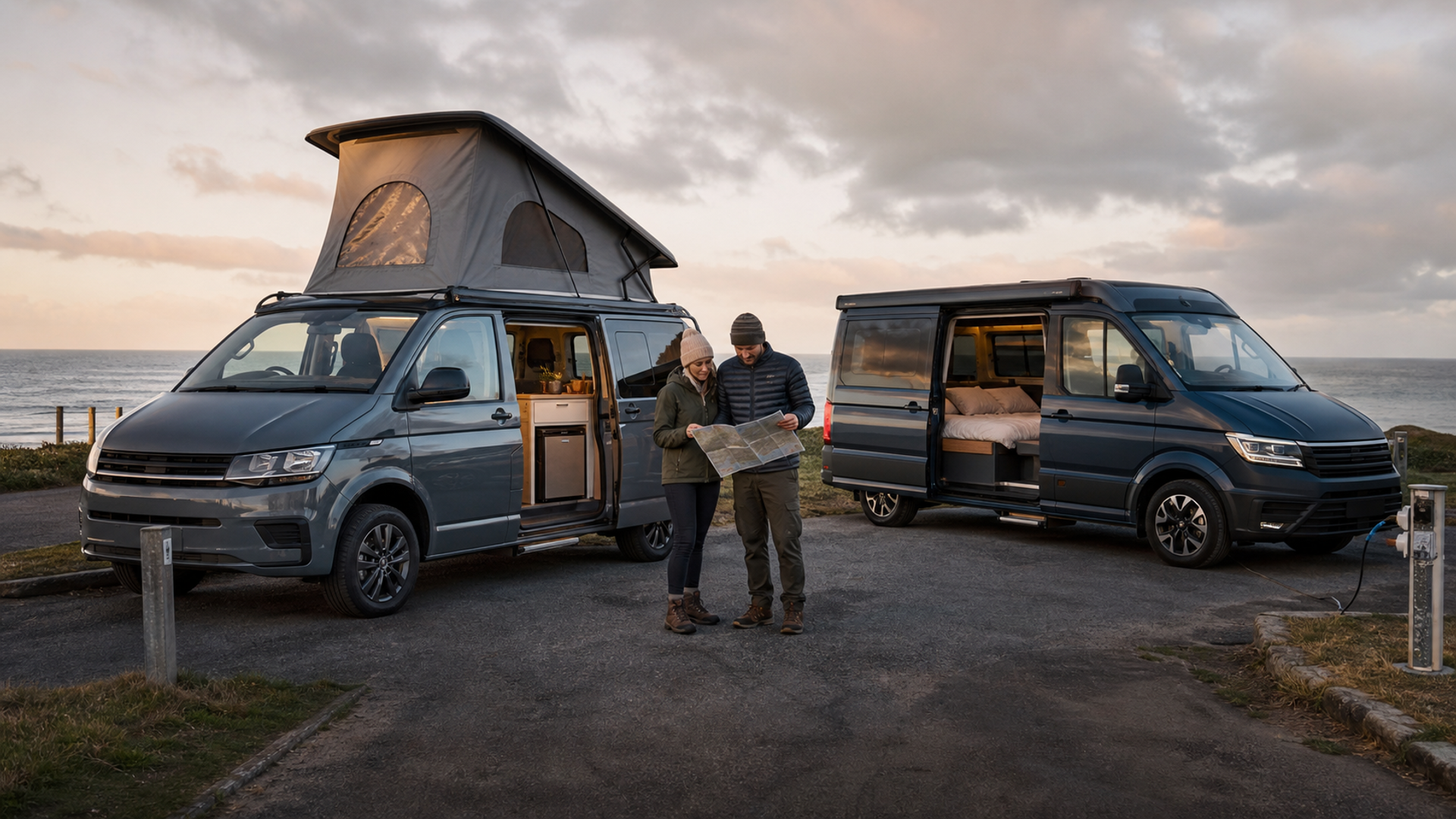
The new Mercedes-Benz Marco Polo and the current Volkswagen California solve the same broad problem in different ways: each tries to be a usable road car and a credible four-berth camper. The evidence available on 6 August 2026, however, is not perfectly symmetrical. Mercedes has published European launch information for the revised Marco Polo and a current UK specification page for the V 300 d; Volkswagen publishes a detailed UK brochure covering the Beach Camper, Coast and Ocean. A responsible comparison therefore needs to separate confirmed design changes from market-specific dimensions, weights and prices.
The short answer is this: the Marco Polo makes the stronger case for buyers who want a V-Class-based cabin, a conventional side-kitchen layout and Mercedes' newly revised roof and living details. The California makes the stronger case for buyers who value two sliding doors, modular rear seats, three clearly differentiated camping trims and published UK payload data. Neither is automatically the better family camper. The decision turns on bed use, legal payload, parking, cooking flow and whether the exact derivative is actually available in the buyer's market.
Evidence scope before the comparison
Mercedes announced on 27 July 2026 that the revised Marco Polo would become orderable in Germany and other European markets from 6 August. The release confirms a double-skinned aluminium pop-up roof, 10 cm more headroom at the rear when fully raised, new roof lighting, revised blackout arrangements, an updated awning and further development of Mercedes-Benz Advanced Control. It also says the sliding roof and a panoramic opening in the roof canvas are scheduled for the end of 2026, so those later features should not be assumed on an early vehicle. See the Mercedes-Benz launch release.
For current UK dimensions and weight, the Mercedes-Benz UK Marco Polo page lists the V 300 d at 5,140 mm long, 1,990 mm high and 2,249 mm wide with mirrors. It gives an EU payload figure of 504 kg for that displayed specification. Those numbers are useful, but they are not permission to assume that every 2026 European configuration has the same engine, options or payload.
Volkswagen's current UK California brochure is more granular. It covers Beach Camper, Coast and Ocean, and states that all have two sliding doors and a pop-up roof. It lists a length of 5,173 mm, a width of 2,252 mm with mirrors and a height below 2.0 metres. Crucially, its published payload figures range from 287 kg for the Ocean eHybrid to 467 kg for the Beach Camper diesel before options or dealer accessories alter the result.
That evidence difference matters. The figures below compare one current UK Mercedes specification with several current UK Volkswagen derivatives; they are not a universal Europe-wide price or availability comparison.
Verified dimensions and camping hardware
| Decision data, observed 6 August 2026 | Mercedes-Benz Marco Polo V 300 d, current UK page | Volkswagen California, current UK brochure | Why it matters |
|---|---|---|---|
| Length | 5,140 mm | 5,173 mm | Both require roughly the same kerb space; the California is 33 mm longer on these sources |
| Width including mirrors | 2,249 mm | 2,252 mm | Practically identical for narrow streets and gates |
| Published height | 1,990 mm | Under 2.0 m | A nominal sub-two-metre figure still needs checking against the actual car and car-park margin |
| Published payload | 504 kg for displayed V 300 d specification | 287-467 kg, depending on trim and powertrain | Four adults, water, luggage, bikes and options can consume the allowance quickly |
| Side-door layout | Current UK page lists three doors; verify exact access arrangement | Sliding doors on both sides | Two-sided access changes how a campsite pitch and kitchen can be used |
| Upper bed | Revised aluminium roof confirmed; exact bed dimensions were not stated in the launch release | 2,054 x 1,137 mm, 200 kg maximum | Bed dimensions should be tested against the actual occupants |
| Lower bed | Verify on exact vehicle | 1,980 x 1,330 mm on Beach Camper; 1,980 x 1,080 mm on Coast/Ocean | The wider Beach lower bed comes with a different kitchen concept |
| Water system | Verify current market specification | Coast/Ocean: 29-litre fresh and 23-litre grey tanks | Water capacity affects independence and payload at the same time |
This table is the article's decision object, not a ranking. It shows why choosing “the California” without naming Beach, Coast or Ocean is too vague, and why using a single Marco Polo payload number without confirming the ordered vehicle is unsafe.
The first choice is layout, not badge
The Marco Polo follows the familiar premium camper pattern: a side kitchen, a rear bench that converts into the lower bed and a pop-up roof above. Mercedes' 2026 work concentrates on the roof, lighting, blackout system, awning and small living-area details. That is meaningful for an owner who wants the living space to feel integrated rather than modular, but the launch release does not replace a physical bed and storage test.
Volkswagen splits the decision three ways. The Beach Camper uses three individual rear seats and a fold-out one-burner kitchen at the rear. Its lower bed is wider than those listed for Coast and Ocean. Coast and Ocean use two individual rear seats and a side kitchenette, with an electrohydraulic pop-up roof, fresh- and grey-water tanks and additional leisure batteries. Buyers who simply compare the most luxurious California with the Marco Polo may miss that the Beach Camper can be the more practical answer for passenger flexibility and bed width.
Open every door, deploy every bed and then ask where the luggage goes. A four-berth label does not show whether bedding blocks the kitchen, whether a child can reach the upper bed safely, or whether bags must move outside each night. The useful showroom test lasts at least an hour and uses the luggage, child seats or sports equipment the household actually carries.
Payload can reverse the result
Payload is where premium options become a constraint. Volkswagen defines payload in its brochure as gross vehicle weight minus unladen weight and warns that trim, factory options and dealer-fitted accessories can change it. Its range demonstrates the point: the diesel Beach Camper is listed at 467 kg, while the eHybrid Ocean is listed at 287 kg. Four 75 kg occupants would total 300 kg before water, food, bedding or bicycles.
The current Mercedes UK page's 504 kg figure offers more theoretical margin than any California figure in the cited brochure, but it belongs to the displayed V 300 d specification. An awning, towbar, upgraded seating, roof equipment or other options may change the plated result. Ask the retailer for the exact vehicle's mass and permissible gross weight, then build a written load budget. Do not use catalogue storage volume as a substitute for legal carrying capacity.
A practical calculation should include every traveller at realistic weight, full or planned fuel, fresh water, food, clothing, outdoor furniture, bikes and their rack, plus any removable leisure battery or accessories. Leave a margin rather than targeting the legal maximum. If the chosen specification cannot carry the intended trip, the correct answer is a different derivative, fewer options or a hotel-and-car journey—not optimistic arithmetic.
Daily use is a near draw on size, but not on access
On the published UK figures, the vans are separated by only 33 mm in length, 3 mm in mirror width and about 10 mm in nominal height. Neither has a decisive geometric advantage. Home-garage shape, ramp angle, roof accessories and the clearance policy of a regular car park matter more than the small catalogue differences.
The California's two sliding doors are the more substantial everyday distinction. They allow kerb-side access from either side and can improve movement around a campsite, although the side kitchen on Coast and Ocean still dictates how the living area works. The Marco Polo buyer should confirm the door arrangement and test whether the kitchen, bench and luggage route remain usable when parked tightly beside another vehicle.
Both vehicles concentrate camping controls in digital systems. Mercedes says MBAC can control the new roof lighting and sound system through the head unit or smartphone app. Volkswagen provides a camper control unit, infotainment interface and California app for functions including water levels, lighting, power, cooling and auxiliary heating, with some functions varying by trim. During a test, operate essential camping systems without relying on a mobile signal and ask what remains available if the phone or infotainment screen fails.
A trip-pattern scorecard
Score each row from 0 (unacceptable) to 3 (strong), using the exact vehicle rather than the model name.
| Real use case | Weight | Marco Polo question | California question |
|---|---|---|---|
| Four-person sleeping, 10-20 nights a year | 3 | Do both beds work with luggage still inside? | Is Beach bed width or Coast/Ocean kitchen equipment more important? |
| Everyday school or office use | 3 | Can passengers reach seats without moving camping kit? | Do twin doors and modular seats improve the weekly routine? |
| Bikes, water and long-distance luggage | 3 | Does the plated payload preserve a useful margin? | Which derivative avoids the low-payload trap? |
| Cooking in poor weather | 2 | Can two people move past the side kitchen? | Is a rear Beach kitchen acceptable, or is Coast/Ocean required? |
| City parking and home storage | 2 | Does the exact roof and awning clear regular barriers? | Does the actual vehicle remain below the relevant clearance? |
| Remote touring and maintenance | 2 | Who services roof, water, cooling and base vehicle? | Can the chosen Van Centre support the camping conversion? |
The weighting makes the recommendation personal without pretending that subjective comfort is a universal score. Any zero in a safety, payload or sleeping row should veto the purchase until resolved.
Which buyer fits each camper?
The Marco Polo is the more coherent shortlist for a couple or small family who values the V-Class cabin, uses the camper frequently enough to appreciate an integrated side kitchen and wants the revised Mercedes living environment. It is also the stronger paper choice when the exact UK V 300 d payload remains close to the published figure after options. The buyer must still confirm local order timing and the installed roof specification, especially because Mercedes says the sliding roof and panoramic canvas opening follow later in the year.
The California Beach Camper suits a household that needs more flexible rear seating, values the wider listed lower bed and can accept a simpler rear kitchen. Coast and Ocean suit buyers who want the side kitchenette, water system and more complete camping equipment, but their payload needs especially careful scrutiny. The Ocean eHybrid's cited 287 kg figure is a clear reminder that the most comprehensively equipped model is not automatically the best tourer for four people.
For travellers who camp only two or three times a year, renting a camper or combining a conventional vehicle with hotels remains a serious control. Storage, depreciation, annual servicing and specialist conversion maintenance continue even when the kitchen is unused. Ownership is justified by repeated use and a layout that improves the journey, not by the idea of spontaneity alone.
Before signing an order
Obtain the exact build sheet, plated mass, gross vehicle weight and payload.
Confirm market availability and which 2026 roof features are installed at delivery.
Deploy both beds with the intended occupants and all normal luggage inside.
Measure the home garage and three regularly used car parks rather than relying on “under two metres”.
Prepare and clear a simple meal while another person remains seated.
Test heating, lighting, water and roof controls without a mobile connection.
Identify who services the base vehicle and each camping component.
Compare the five-year ownership cost with rental and hotel alternatives.
For adjacent ownership decisions, see VERTU's guides to luxury family SUVs and an EV road-trip charging checklist. They are contextual reading, not evidence for either camper's specification.
Verdict
The 2026 Marco Polo is the more persuasive choice when an integrated Mercedes living space, its revised roof and a useful confirmed payload align with the buyer's routine. The California wins when twin-door access, modular seating and a clearly chosen Beach, Coast or Ocean layout solve the trip more precisely. On current official evidence, the comparison should remain derivative-specific and market-specific. The decisive test is not which van looks more luxurious; it is which exact vehicle can carry the people and equipment legally, fit the places they use and convert from road mode to sleep mode without nightly friction.