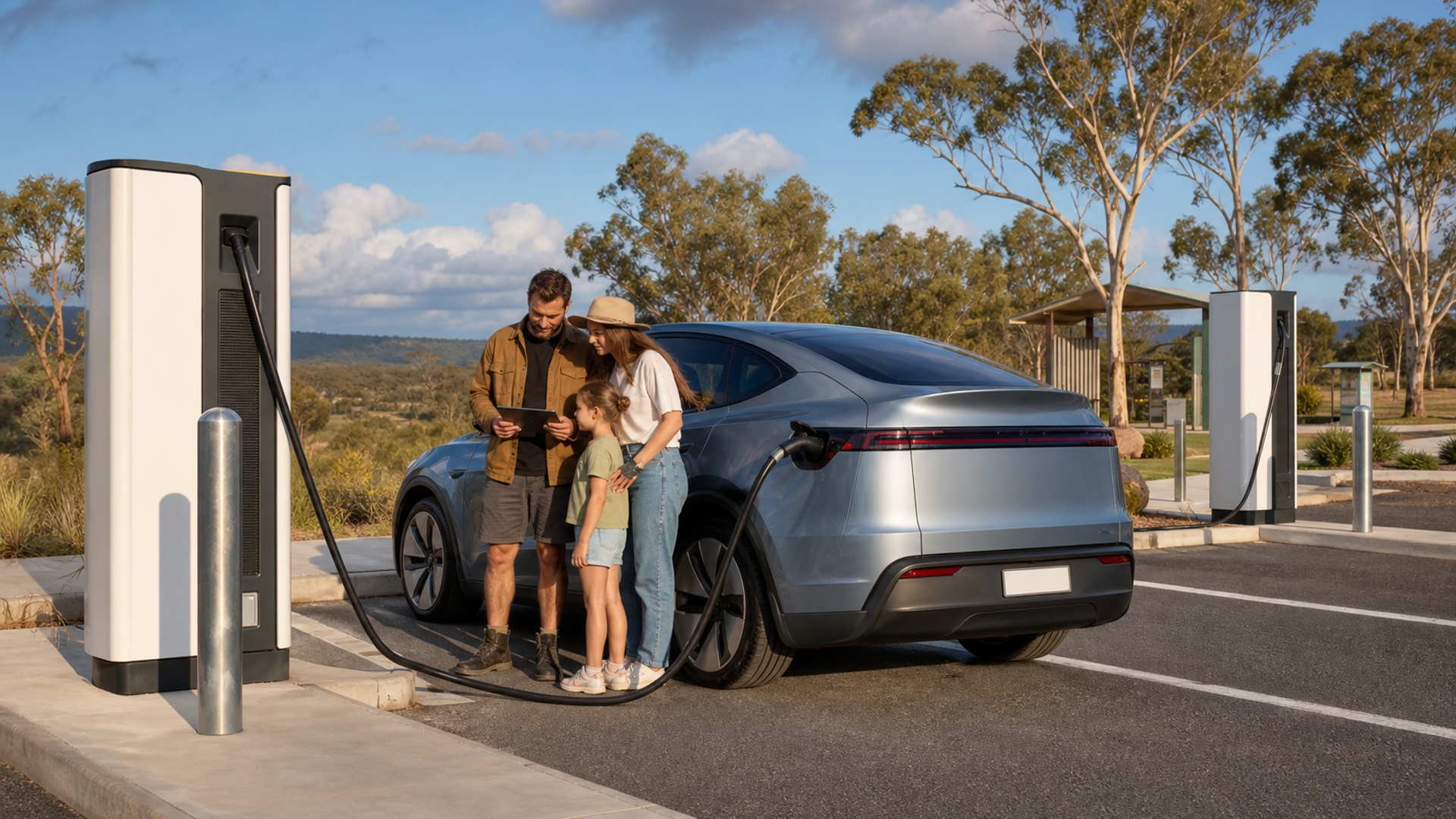
An electric-vehicle road trip does not fail because the national map has no chargers. It fails when a plan treats every charger symbol as available, compatible and fast at the exact moment a family arrives.
Australia’s distances magnify small assumptions. A closed site, a strong headwind, a cold battery or a queue can turn a comfortable-looking leg into an anxious one. The solution is not to drive slowly and hope. It is to build a route with an energy margin, a second payment method and a fallback that still works when mobile coverage does not.
The Australian Government’s EV road-trip guidance recommends planning around charging needs, carrying provider apps and compatible RFID cards, understanding the car’s range, leaving home fully charged and using two-hour rest breaks productively. This guide turns those principles into a repeatable pre-departure check.
The route-risk checklist
| Check | Green | Amber | Red |
|---|---|---|---|
| Arrival state of charge | Forecast arrival above 20%, with conservative weather and speed assumptions | 12–20% with a verified nearby alternative | Below 12% or dependent on one optimistic range estimate |
| Charger redundancy | A compatible backup is reachable before reserve is exhausted | Backup requires a detour or slower charger | Only one usable charger on the leg |
| Live status | Recent successful check-ins or operator status show available units | Status is old or one unit is reported faulty | Site is offline, access-restricted or repeatedly unreliable |
| Payment | App is logged in, card works and RFID or contactless fallback is carried | Only one digital method is ready | Registration will be attempted at the site with weak coverage |
| Queue exposure | Multiple units and nearby facilities allow a practical wait | One or two units on a busy holiday corridor | Single unit, peak arrival time and no onward buffer |
| Weather and load | Forecast, elevation, towing and cabin use are included | One factor may reduce range materially | Route depends on rated range despite several penalties |
| Destination charging | Accommodation has confirmed compatible access | Public charging is nearby but not reserved | Arrival depends on an unverified private socket |
| Recovery route | Driver knows the last safe turn-back or slower-charge option | Recovery exists but adds hours | No known recovery before the battery reserve is consumed |
If any leg is red, change the route before departure. A faster charger does not compensate for a plan with no redundancy.
Start with usable range, not the brochure number
The vehicle’s rated range is a standardised comparison figure. It is not a prediction for a loaded car at motorway speed in rain, heat, cold or wind. Use recent consumption from similar driving as the starting point.
A simple planning estimate is:
usable distance = usable battery energy ÷ conservative consumption
If a car has 70 kWh available and the trip computer shows 20 kWh per 100 kilometres under similar conditions, the mathematical range is 350 kilometres. A sensible route should not plan to consume all of it. Retaining a 15–20% arrival margin turns that number into roughly 280–300 kilometres, before allowing for a severe weather or elevation penalty.
Consumption can rise with:
motorway speed;
headwinds and heavy rain;
low temperature or strong air-conditioning demand;
roof boxes, bicycles and trailers;
steep climbs;
a full passenger and luggage load;
underinflated tyres.
The car’s navigation system may adjust for some of these factors, but the driver remains responsible for noticing when actual consumption is diverging from the forecast. Review the projected arrival charge after the first 30 minutes and again before passing a viable backup.
Build each leg around a primary and a fallback
Choose the primary charger for speed, location and facilities. Then select a fallback that can be reached before the car enters its protected reserve. A charger 60 kilometres beyond the primary is not a fallback if the car is expected to arrive at the primary with 8%.
The best backup may be earlier on the route. If the primary site reports a queue or fault, taking a shorter charge at the previous town can preserve options. This feels slower at the moment and is often faster than arriving at a dead unit.
For remote or regional travel, record:
site name and physical address;
operator and plug type;
number of units;
maximum power relevant to your car;
opening hours or car-park restrictions;
payment methods;
nearby slower chargers;
operator support number;
the last safe alternative before the site.
Save the information offline. A screenshot of the map and charger ID is more useful than an app that cannot load.
Charger power is not the same as charging speed
A site labelled 350 kW does not guarantee the car will receive 350 kW. The vehicle has its own peak, the battery must be at a suitable temperature and the charging curve usually tapers as state of charge rises. Some sites share power between units.
This is why the Australian guidance uses 80% as a practical rule of thumb away from home. Charging often slows materially above that point. On a route with frequent reliable chargers, two shorter stops can be faster than waiting for a full battery. On a sparse route, the extra time to charge higher may buy necessary resilience.
Plan the stop around the next leg, not a ritual percentage. Ask:
What arrival margin is needed at the next charger?
Is the next site reliable and accessible?
Will the weather worsen?
Is this the last fast charger before a remote section?
Does the driver need a longer rest regardless of charging time?
The fastest possible session is not always the safest journey.
Prepare payment before mobile coverage disappears
Charging networks use different combinations of apps, accounts, bank cards, QR codes and RFID cards. Register at home, add the vehicle and test the payment card. If the operator offers an RFID card, carry it where it can be reached without unloading the boot.
Keep more than one payment option. A bank may block an unfamiliar pre-authorisation, a phone may have no signal or an app session may expire. Contactless payment at the charger is useful when available, but it should not be the only assumption.
Record operator support numbers. If a session will not start, the operator may be able to reset the unit. Note the charger number displayed on the cabinet before calling.
Never scan a suspicious replacement sticker placed over the official QR code. Charging sites can be targets for payment phishing. Open the known operator app directly or type the official domain rather than trusting a pasted label.
Time holiday-corridor stops, not only distances
One working charger can be operationally unavailable when three vehicles are waiting. Holiday traffic concentrates demand around meal times and popular departure days. A route planner that ignores queues can produce a mathematically valid but practically poor itinerary.
Prefer sites with several units. Arrive outside predictable peaks when possible and keep enough charge to move to an alternative. Use current operator status and recent user check-ins as signals, not guarantees.
Charging etiquette helps the whole corridor. Move the vehicle when the required charge is reached. Do not occupy a bay after the session ends, and avoid charging to 100% on a busy fast charger unless the next leg requires it. The government’s DRIVE reminder explicitly includes vacating the bay when finished.
A two-hour driving break can align naturally with food, toilets and movement, but do not make the children’s meal or a fixed reservation depend on one charger working. Separate essential rest from optional charging where possible.
Confirm accommodation charging in writing
“EV charging available” can mean a dedicated wallbox, one shared socket, a public charger next door or permission to use an outlet at the owner’s discretion. Ask the accommodation:
connector type and power;
number of bays;
whether booking is required;
hours of access;
fee and payment method;
whether non-EVs can occupy the bay;
what happens if the unit is unavailable.
Do not assume an ordinary extension lead is safe or permitted. Use only equipment approved for the vehicle and location, follow the property’s instructions and avoid improvised adapters.
Destination charging is valuable because it converts parked time into range. It should be treated as confirmed only when the host has answered the specific questions and the car is compatible.
Weather, bushfire, flood and remote-route decisions
Australian road conditions can change quickly. Before departure and again on the day, check official road closures and weather warnings for every region crossed. A charging plan is irrelevant if the road to the site is closed.
Heat can increase cabin energy use and make waiting uncomfortable; cold can reduce efficiency and charging performance. Bushfire or flood conditions can remove both roads and electricity supply. Do not route towards a hazard simply because a charger map still shows a green icon.
Carry water, appropriate clothing, medication and the equipment expected for the route. Tell someone the planned path when travelling remotely. An EV does not remove ordinary outback or regional-road precautions.
If the projected arrival charge falls faster than expected:
reduce speed safely and smoothly;
limit unnecessary climate or accessory loads without compromising safety;
select an earlier compatible charger;
avoid passing the last safe alternative;
contact roadside assistance before the battery reaches zero.
The purpose of reserve is to create time for a decision, not permission to continue blindly.
A family departure routine
The evening before travel, charge at home, check tyre pressures and confirm that the cable, adapters and RFID cards are present. Download the relevant apps and offline maps. Review live charger status and official road alerts.
On departure morning, check the weather and load the car without blocking access to the charging kit. Set the primary and fallback sites in navigation. Confirm the first stop’s opening hours and expected arrival charge.
During the journey, compare predicted and actual consumption. If the margin is shrinking, act early. At each charge, verify that energy is flowing before walking away and set a notification for the target state of charge.
At the destination, plug in only after confirming the equipment and property instructions. Before the return, repeat the route check rather than assuming the outward plan still applies.
Our universal travel-adapter buying guide is useful for ordinary electronics, but an EV charging cable is high-power equipment with vehicle, supply and regulatory requirements. Never treat a consumer travel adapter as an EV charging solution. For luggage and journey resilience, the current AirTag checked-luggage guide illustrates the same principle: verify the transport provider’s actual rules before relying on a connected accessory.
What a resilient plan looks like
A good EV road trip is not one that reaches every charger with the smallest possible battery percentage. It is one in which the driver can absorb a fault, queue, detour or weather change without turning the journey into an emergency.
Use conservative real-world consumption. Keep a meaningful arrival reserve. Prepare payment and support details before leaving coverage. Confirm destination charging. Choose multi-unit sites and know the last safe fallback.
Australia’s charging network can support increasingly ambitious journeys, and government programmes continue to expand highway infrastructure. The network’s existence does not remove the need for route judgement. The most valuable feature in the car remains the ability to change the plan while several safe options are still available.


![Top 10 Tourbillon Watches for Men [2026 Latest]](https://cdn.sanity.io/images/e0gp1l2g/production/8cb6bc45133cf9453382fc7d074465af588bb610-1800x1080.webp?w=800&h=450&q=82&auto=format&fit=crop)