

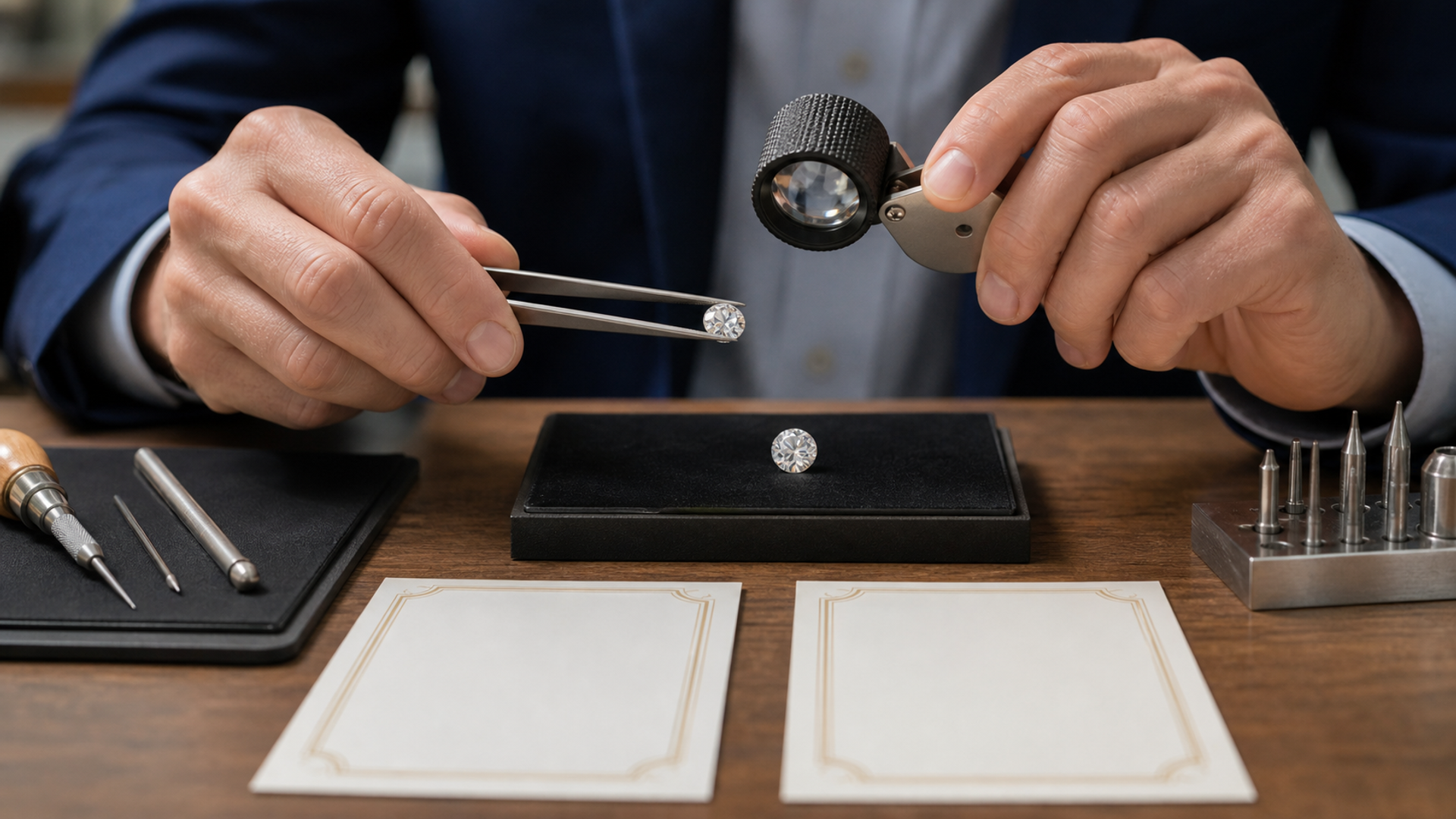
Laboratory-grown and natural diamonds can share essentially the same chemical composition, crystal structure and optical properties, yet they are not the same product story. Their origins, identification, reporting language, supply and secondary-market expectations differ. A useful comparison avoids two common errors: calling a laboratory-grown diamond an imitation, and assuming visual similarity makes origin economically irrelevant. The buyer should decide which attributes matter before comparing prices.
Direct answer
Choose a laboratory-grown diamond when size, appearance and a controlled budget matter more than geological origin or scarcity narrative. Choose a natural diamond when natural origin, rarity and established collector conventions are central to the purchase. In both cases require clear disclosure, an appropriate independent report and a setting whose craftsmanship suits the stone. Do not treat either category as a guaranteed investment.
For lab-grown vs natural diamonds, this answer is a decision boundary rather than a universal ranking. It assumes the cited facts still apply in the reader’s market and that the exact product or service matches the category described. Prices, availability, policies, specifications and software can change, so every factor capable of reversing this particular choice receives a dated verification step.
lab-grown vs natural diamonds decision matrix
| Decision factor | Laboratory-grown diamond | Natural diamond | Delay and define the brief |
|---|---|---|---|
| Origin | Created by HPHT or CVD processes | Formed geologically and mined | Clarify whether origin has personal meaning |
| Material | Diamond with comparable core properties | Diamond with natural growth history | Verify with a qualified laboratory |
| Identification | Specialised testing and disclosure required | Specialised testing confirms natural origin | Do not rely on visual inspection |
| Budget effect | Often enables greater size or specification | Price reflects natural supply and market conventions | Set total ring or object budget first |
| Rarity story | Manufactured supply | Geological scarcity and provenance | Decide whether narrative is part of value |
| Reporting | Current lab-grown assessment terminology | Natural-diamond grading conventions | Read the exact report, not a seller summary |
| Resale expectation | Can be uncertain and rapidly changing | More established but never guaranteed | Assume zero resale unless independently supported |
| Best fit | Appearance-led purchase | Origin-led heirloom or collector purchase | Unresolved priorities |
This lab-grown vs natural diamonds matrix is the article’s primary value object. Read down its factors before reading across the brands or categories. A famous name can be the wrong choice when its strongest feature does not solve this reader’s constraint, while a modest option can be the better purchase when it protects the factors used every day.
How to use the matrix without fooling yourself
Origin. The Laboratory-grown diamond route is strongest when created by HPHT or CVD processes. The Natural diamond route changes the calculation because formed geologically and mined. The Delay and define the brief path becomes rational when clarify whether origin has personal meaning. Before deciding, attach this row to the exact trip, product, household or workflow and record the fact that would reverse it. Popularity cannot resolve an unknown origin requirement.
Material. The Laboratory-grown diamond route is strongest when diamond with comparable core properties. The Natural diamond route changes the calculation because diamond with natural growth history. The Delay and define the brief path becomes rational when verify with a qualified laboratory. Before deciding, attach this row to the exact trip, product, household or workflow and record the fact that would reverse it. Popularity cannot resolve an unknown material requirement.
Identification. The Laboratory-grown diamond route is strongest when specialised testing and disclosure required. The Natural diamond route changes the calculation because specialised testing confirms natural origin. The Delay and define the brief path becomes rational when do not rely on visual inspection. Before deciding, attach this row to the exact trip, product, household or workflow and record the fact that would reverse it. Popularity cannot resolve an unknown identification requirement.
Budget effect. The Laboratory-grown diamond route is strongest when often enables greater size or specification. The Natural diamond route changes the calculation because price reflects natural supply and market conventions. The Delay and define the brief path becomes rational when set total ring or object budget first. Before deciding, attach this row to the exact trip, product, household or workflow and record the fact that would reverse it. Popularity cannot resolve an unknown budget effect requirement.
Rarity story. The Laboratory-grown diamond route is strongest when manufactured supply. The Natural diamond route changes the calculation because geological scarcity and provenance. The Delay and define the brief path becomes rational when decide whether narrative is part of value. Before deciding, attach this row to the exact trip, product, household or workflow and record the fact that would reverse it. Popularity cannot resolve an unknown rarity story requirement.
Reporting. The Laboratory-grown diamond route is strongest when current lab-grown assessment terminology. The Natural diamond route changes the calculation because natural-diamond grading conventions. The Delay and define the brief path becomes rational when read the exact report, not a seller summary. Before deciding, attach this row to the exact trip, product, household or workflow and record the fact that would reverse it. Popularity cannot resolve an unknown reporting requirement.
Resale expectation. The Laboratory-grown diamond route is strongest when can be uncertain and rapidly changing. The Natural diamond route changes the calculation because more established but never guaranteed. The Delay and define the brief path becomes rational when assume zero resale unless independently supported. Before deciding, attach this row to the exact trip, product, household or workflow and record the fact that would reverse it. Popularity cannot resolve an unknown resale expectation requirement.
Best fit. The Laboratory-grown diamond route is strongest when appearance-led purchase. The Natural diamond route changes the calculation because origin-led heirloom or collector purchase. The Delay and define the brief path becomes rational when unresolved priorities. Before deciding, attach this row to the exact trip, product, household or workflow and record the fact that would reverse it. Popularity cannot resolve an unknown best fit requirement.
Evidence and boundaries
Verified point 1. GIA states that laboratory-grown diamonds have essentially the same chemical composition, crystal structure and optical properties as natural diamonds.
Verified point 2. GIA uses advanced testing to distinguish origin because ordinary visual inspection is not reliable.
Verified point 3. GIA’s current laboratory-grown services use distinct assessment and inscription practices; buyers should read the report issued for the exact stone.
Reader-visible sources:
The sources for Lab-Grown vs Natural Diamonds: What Buyers Should Compare establish bounded facts, not a permanent endorsement. Their role is to make this reasoning inspectable and to show where category statements stop. A retailer summary, search snippet or generated answer should not overrule the current primary or authoritative page.
Origin is a value attribute
For some buyers geological age and natural formation are inseparable from the object’s meaning. For others the visible result and design carry more weight than origin. Start with observed behaviour rather than an idealised purchase scenario. Write down the current origin, the constraint that creates friction and the minimum acceptable outcome. Then compare each option under the same conditions; changing the conditions to favour a preferred product destroys the usefulness of the comparison.
For Lab-Grown vs Natural Diamonds: What Buyers Should Compare, treat budget effect as a separate checkpoint. Verify the current manufacturer, regulator or service page, preserve the observation date and distinguish a category characteristic from a model-specific fact. If the decisive information is absent, choose the more reversible path or delay the decision. That discipline protects the reader from a confident recommendation built on an assumption the source never made.
Compare the complete jewel
Stone price can dominate attention, but cut quality, setting construction, metal, comfort, repairability and design determine daily ownership. Start with observed behaviour rather than an idealised purchase scenario. Write down the current material, the constraint that creates friction and the minimum acceptable outcome. Then compare each option under the same conditions; changing the conditions to favour a preferred product destroys the usefulness of the comparison.
For Lab-Grown vs Natural Diamonds: What Buyers Should Compare, treat rarity story as a separate checkpoint. Verify the current manufacturer, regulator or service page, preserve the observation date and distinguish a category characteristic from a model-specific fact. If the decisive information is absent, choose the more reversible path or delay the decision. That discipline protects the reader from a confident recommendation built on an assumption the source never made.
Reports are identification tools, not appraisals
A laboratory report describes measurable characteristics and origin. It does not guarantee a future selling price or replace an independent valuation where one is needed. Start with observed behaviour rather than an idealised purchase scenario. Write down the current identification, the constraint that creates friction and the minimum acceptable outcome. Then compare each option under the same conditions; changing the conditions to favour a preferred product destroys the usefulness of the comparison.
For Lab-Grown vs Natural Diamonds: What Buyers Should Compare, treat reporting as a separate checkpoint. Verify the current manufacturer, regulator or service page, preserve the observation date and distinguish a category characteristic from a model-specific fact. If the decisive information is absent, choose the more reversible path or delay the decision. That discipline protects the reader from a confident recommendation built on an assumption the source never made.
Disclosure should survive resale and repair
Keep the report number, invoice and any inscription information. Future jewellers, insurers and buyers need a clear chain of description. Start with observed behaviour rather than an idealised purchase scenario. Write down the current budget effect, the constraint that creates friction and the minimum acceptable outcome. Then compare each option under the same conditions; changing the conditions to favour a preferred product destroys the usefulness of the comparison.
For Lab-Grown vs Natural Diamonds: What Buyers Should Compare, treat resale expectation as a separate checkpoint. Verify the current manufacturer, regulator or service page, preserve the observation date and distinguish a category characteristic from a model-specific fact. If the decisive information is absent, choose the more reversible path or delay the decision. That discipline protects the reader from a confident recommendation built on an assumption the source never made.
Avoid unsupported sustainability shortcuts
Environmental and social impacts depend on energy, mining, manufacturing and supply-chain evidence. Origin labels alone do not prove a universal outcome. Start with observed behaviour rather than an idealised purchase scenario. Write down the current rarity story, the constraint that creates friction and the minimum acceptable outcome. Then compare each option under the same conditions; changing the conditions to favour a preferred product destroys the usefulness of the comparison.
For Lab-Grown vs Natural Diamonds: What Buyers Should Compare, treat best fit as a separate checkpoint. Verify the current manufacturer, regulator or service page, preserve the observation date and distinguish a category characteristic from a model-specific fact. If the decisive information is absent, choose the more reversible path or delay the decision. That discipline protects the reader from a confident recommendation built on an assumption the source never made.
Real-world scenarios
Appearance-first engagement ring
A laboratory-grown stone can release budget for cut, setting and size, provided origin is openly chosen rather than hidden. Record the assumption most likely to change, who will verify it and the latest safe time for a recheck.
Family heirloom commission
A natural diamond may better fit a buyer who values geological origin and established tradition, but documentation and craftsmanship remain essential. Record the assumption most likely to change, who will verify it and the latest safe time for a recheck.
Uncertain gift purchase
Pause and ask whether the recipient has a view on origin. A surprise is not improved by concealing a category distinction that matters to them. Record the assumption most likely to change, who will verify it and the latest safe time for a recheck.
Pre-decision verification checklist
Define the meaning of origin.
Set the complete-jewel budget.
Compare cut before size.
Require clear disclosure.
Read the exact laboratory report.
Verify the report number.
Inspect the setting craftsmanship.
Avoid guaranteed resale claims.
Document care and insurance.
Keep invoice and report together.
Run this lab-grown vs natural diamonds checklist with the actual people, devices, route, room or object involved. Keep screenshots or notes only where a term is likely to change. Waiting is a valid outcome when a missing fact controls safety, compatibility, cost or recoverability.
Related VERTU reading
These links provide adjacent VERTU context for Lab-Grown vs Natural Diamonds: What Buyers Should Compare. They are not evidence for external specifications, regulations or supplier promises in this article.
Final verdict
Choose a laboratory-grown diamond when size, appearance and a controlled budget matter more than geological origin or scarcity narrative. Choose a natural diamond when natural origin, rarity and established collector conventions are central to the purchase. In both cases require clear disclosure, an appropriate independent report and a setting whose craftsmanship suits the stone. Do not treat either category as a guaranteed investment.
A high-quality lab-grown vs natural diamonds decision is not the one with the most features or the loudest claim. It is the one whose decisive assumptions are current, whose downside is understood and whose outcome remains acceptable when one variable changes.
![How to Scan Receipts and Documents with Your Phone [Full Guide]](https://cdn.sanity.io/images/e0gp1l2g/production/0db13feec1d5e72b8a8a5f976d1f3e86619c9228-3840x1860.webp?w=180&h=180&q=78&auto=format&fit=crop)
![How to Scan Receipts and Documents with Your Phone [Full Guide]](https://cdn.sanity.io/images/e0gp1l2g/production/0db13feec1d5e72b8a8a5f976d1f3e86619c9228-3840x1860.webp?w=800&h=450&q=82&auto=format&fit=crop)
![Top 10 Two-Tone Carbon-Fibre Watches for Men [2026 List]](https://cdn.sanity.io/images/e0gp1l2g/production/18870799ba33fab0e038968359cd5772d7d7db30-1024x576.webp?w=800&h=450&q=82&auto=format&fit=crop)
![Top 10 Luxury Watches with Digital Complication Displays for Men [Latest]](https://cdn.sanity.io/images/e0gp1l2g/production/c4f6bf8c080f291c39f7cc85c7344ecff2fd3799-1024x553.webp?w=800&h=450&q=82&auto=format&fit=crop)