

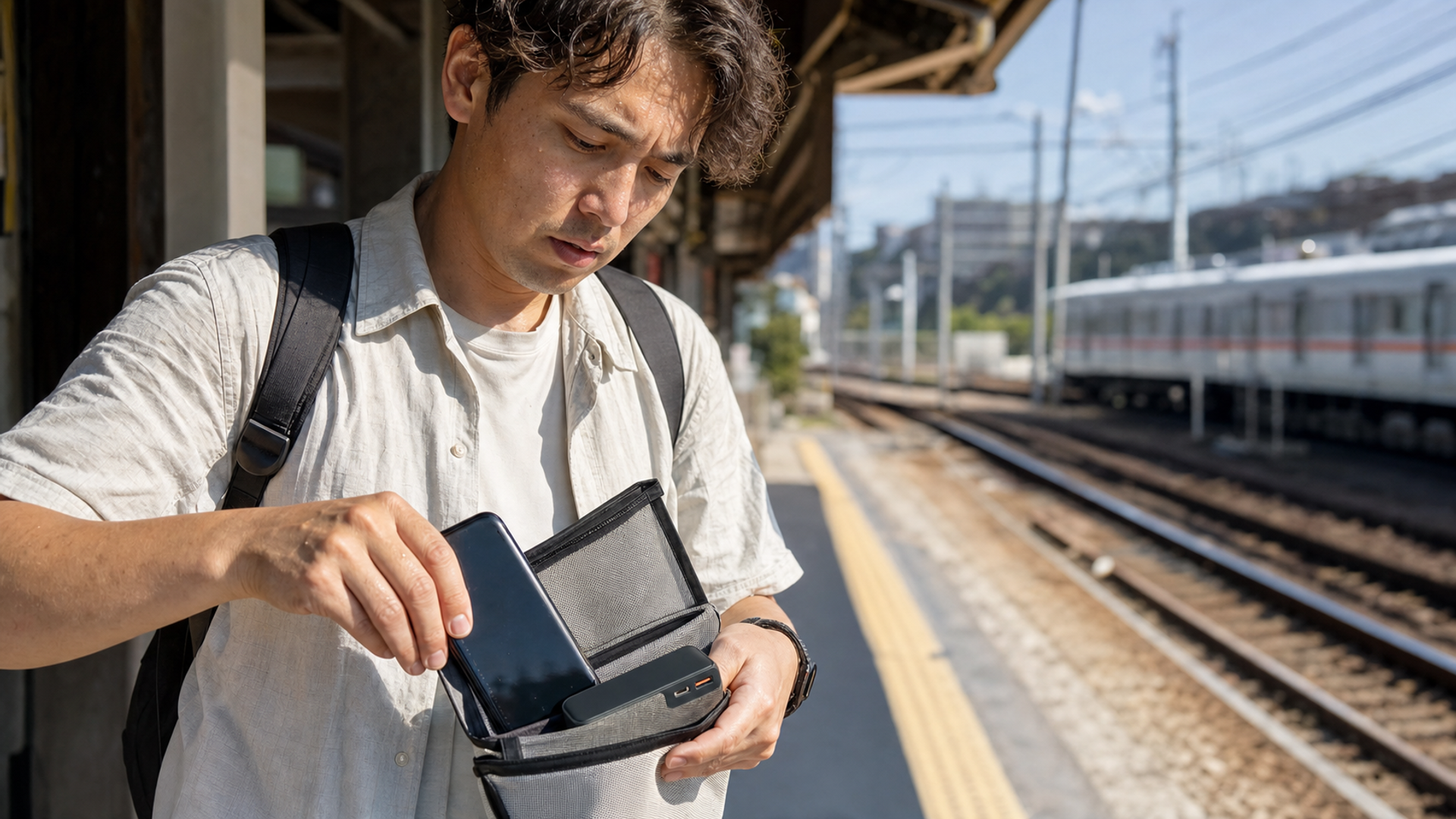
Japan entered late July 2026 with widespread extreme heat. The Japan Meteorological Agency’s seasonal observation table recorded hundreds of locations above 30°C on many days and 252 locations at or above 35°C on 20 July. Japan now uses an official term for days reaching 40°C or more, reflecting the need to communicate a level of heat that can affect people, transport and devices.
For travellers, the human risk comes first: follow heat-health alerts, hydrate, seek cooling and adjust plans. Phones, power banks, cameras and wearable batteries also need attention. High temperature accelerates battery ageing, can trigger protective shutdowns and increases danger when a lithium-ion product is damaged, poorly made or left in a parked vehicle.
Japan’s National Institute of Technology and Evaluation, NITE, reviewed 2,140 lithium-ion product incidents from 2021 to 2025 and says incidents tend to rise into summer and peak in August. Its 2026 warning uses three “Cs”: Check, Choose and Cool.
Temperature-and-action matrix
| Situation | Device risk | Immediate action | Do not do |
|---|---|---|---|
| Phone warm during navigation | Reduced performance and charging speed | Move to shade, stop heavy apps, remove insulating case if safe | Put it in a freezer or on ice |
| Device shows temperature warning | Protective shutdown | Stop use and charging; let it cool gradually | Force restart repeatedly |
| Power bank left in a parked car | Rapid internal heating | Do not use until cool and inspected | Charge it immediately |
| Battery swollen, leaking or smelling unusual | Possible internal damage | Isolate from people and combustibles; contact local professionals | Puncture, press or carry on a flight |
| Charger or cable unusually hot | Resistance, damage or incompatibility | Unplug safely and replace verified components | Cover it or keep charging unattended |
| Phone wet from condensation or rain | Short-circuit and corrosion risk | Power down if necessary and dry according to maker guidance | Charge while wet |
| Emergency smoke or hissing | Thermal runaway may be developing | Move away, alert staff and call emergency services | Hold or transport the device |
Current temperature counts are available from the Japan Meteorological Agency. Product-safety recommendations come from NITE’s July 2026 lithium-ion warning.
People before devices
A phone can be replaced; heat illness can become life-threatening. Japan’s Ministry of the Environment and JMA advise using heat-stress information and alerts, avoiding unnecessary exposure and acting early.
Plan outdoor sightseeing in cooler hours. Use air-conditioned stations, shops and public facilities for breaks. Carry water and know the signs of heat exhaustion and heatstroke. If a person is confused, collapses or cannot cool down, seek emergency help.
Do not remain in direct sun to keep a phone working. If navigation fails, move to a cool safe place first, then restore the device or ask staff for directions.
Why a parked car is especially dangerous
Interior car temperature can rise far above outdoor air temperature. A phone or power bank left on a dashboard receives both trapped heat and direct solar radiation. Even if the product does not ignite, high temperature can permanently degrade the battery and adhesives.
Take lithium-ion devices with you when leaving a car. If one has been forgotten, move the vehicle to shade or ventilate it before handling when practical. Let the device return gradually towards room temperature. Inspect for swelling, deformation, leakage, odour or unusual heat.
Do not connect it to a high-power charger as soon as it is retrieved. Charging generates additional heat and can stress a damaged cell.
NITE’s three Cs
Check
Inspect batteries, cables and products for damage, swelling, abnormal heat, odour or recall notices. Stop using a product that has been dropped hard or crushed if its condition is uncertain.
Check the manufacturer’s temperature limits. A phone may operate within one range and permit charging within a narrower range. Protective software can slow or stop charging for good reason.
Choose
Buy products from a responsible supplier with clear manufacturer, model and safety information. In Japan, look for applicable safety markings and verify that a replacement battery or charger is intended for the device.
A very cheap high-capacity power bank with vague labelling creates more risk than value. Capacity claims, cell quality and protection circuits cannot be judged from appearance.
Cool
Keep devices out of direct sun and away from hot enclosed spaces. Allow airflow around chargers. Stop intensive tasks when the device is already hot.
“Cool” means a moderate, dry environment—not rapid chilling. Moving a hot phone into a refrigerator or placing it against ice can create condensation and thermal stress.
Charging safely in a hotel
Charge on a hard, visible surface away from bedding, paper and curtains. Use a compatible charger and intact cable. Do not cover the device. Avoid leaving a questionable power bank charging while everyone is asleep or outside the room.
If the room is hot, use air conditioning before charging. A device under a pillow cannot release heat. Wireless charging can generate more heat than a cable in some conditions; switch to a suitable wired charger if the phone becomes unusually warm.
Hotel outlets in Japan supply different voltage from some countries. A simple plug adapter does not convert voltage. Most modern phone and laptop chargers accept a broad input range printed on the label, but verify it. Never use a damaged travel adapter.
Navigation without overheating
Navigation combines bright display, GPS, mobile data and processor activity. A phone mounted behind a windscreen can receive direct sun while charging, creating a worst-case thermal load.
Download maps and essential tickets in advance. Reduce display brightness when safe, close unnecessary apps and use audio directions. Position the phone away from direct sun and hot air. If driving, never handle a device to cool it while the vehicle is moving.
For a walking day, carry a paper hotel card or screenshot with the Japanese address. A backup reduces pressure to keep a hot phone running.
Power-bank rules for travel
Airlines generally require spare lithium batteries and power banks in carry-on baggage rather than checked luggage, with capacity and airline rules applying. Check the airline’s current policy before departure.
During heat:
keep the power bank inside the cabin bag, not on a sun-heated window ledge;
protect terminals from short circuit;
do not use a swollen or damaged unit;
avoid charging a phone and the power bank simultaneously in a closed bag;
label capacity clearly;
carry only what is needed.
Our flight-safe power-bank guide covers airline preparation. Heat safety does not replace aviation rules.
Cameras, watches and earbuds
Small devices are not exempt. Earbud cases and watch batteries can heat in direct sun. A camera left in a closed bag can become very warm, while moving between humid heat and strong air conditioning can create condensation.
Let camera equipment acclimatise inside a bag when moving between temperature extremes. Keep batteries in protective cases. Do not leave a wearable charging on a soft surface. If any device becomes swollen or distorted, stop using it.
Water resistance is not heat resistance. Seals can degrade, and a hot device exposed to cold water may experience stress or condensation.
What to do when a phone overheats
Move to shade or an air-conditioned area.
Disconnect charging and accessories.
Stop gaming, video recording, hotspot use and navigation where safe.
Remove a thick case if the device can be handled comfortably.
Place it on a dry, hard surface with airflow.
Wait for the warning to clear naturally.
Back up important data after the device returns to normal.
Seek authorised service if overheating repeats during light use.
Do not pour water over the phone, place it on ice or use compressed cooling sprays. Rapid cooling can cause moisture and damage.
Signs that require retirement, not cooling
Heat alone can trigger a temporary warning. Physical battery changes are different. Stop using the device if:
the case separates or screen lifts;
the battery or power bank swells;
liquid leaks;
a sweet, solvent-like or unusual odour appears;
hissing, popping or smoke occurs;
the device remains hot while switched off;
charging behaviour changes sharply after impact.
Do not squeeze a swollen battery back into shape. Do not put it in ordinary rubbish. Ask the manufacturer, retailer, hotel or local authority for safe handling and recycling guidance. Transport rules may prohibit carrying a damaged lithium battery.
Emergency response
If a device emits smoke, hisses or ignites, move people away and alert venue or transport staff. Call Japan’s emergency services when needed. Do not risk burns by carrying an actively failing product through a hotel or train.
Follow the instructions of trained staff. Battery fires can re-ignite. After an event, treat nearby devices and materials as potentially damaged.
For a warm but stable device, emergency action is not required. The challenge is distinguishing ordinary thermal protection from signs of physical failure, which is why inspection matters.
A heat-ready travel kit
Pack:
one reliable, clearly labelled power bank;
intact cables and compatible charger;
a small dry pouch for rain and condensation;
offline maps and ticket screenshots;
hotel address on paper;
airline and insurer contact details;
a second payment method;
a backup authentication method that does not depend on one phone.
The kit is intentionally modest. Carrying several unknown batteries increases heat and aviation complexity.
Why incident data should change behaviour
NITE’s 2,140 incidents cover multiple lithium-ion products and five years. The data does not mean every summer traveller is likely to experience a fire. It shows a recurring product-safety problem with a seasonal pattern and enough severity to justify basic controls.
Mobile batteries were the largest category in NITE’s warning. Many incidents involve product quality, damage, incorrect use or heat together rather than temperature alone. Good equipment and correct handling are therefore complementary.
This article is narrower than our recent Tour de France phone and wearable heat guide: it uses Japan’s current conditions and NITE’s local product-safety framework for travellers.
The verdict
Japan’s extreme heat can push phones and batteries beyond comfortable operating conditions, especially in parked cars, direct sun and enclosed bags. Most devices protect themselves by slowing, stopping charge or shutting down. Respect those warnings.
Apply NITE’s three Cs: check products for damage, choose responsible equipment and keep devices cool. Charge on a hard visible surface, carry power banks according to airline rules and retire any swollen or abnormal battery.
Above all, protect the traveller first. Move to a cool safe place, follow official heat alerts and use offline backups so a hot phone never becomes a reason to remain in dangerous conditions.
![How to Scan Receipts and Documents with Your Phone [Full Guide]](https://cdn.sanity.io/images/e0gp1l2g/production/0db13feec1d5e72b8a8a5f976d1f3e86619c9228-3840x1860.webp?w=180&h=180&q=78&auto=format&fit=crop)
![How to Scan Receipts and Documents with Your Phone [Full Guide]](https://cdn.sanity.io/images/e0gp1l2g/production/0db13feec1d5e72b8a8a5f976d1f3e86619c9228-3840x1860.webp?w=800&h=450&q=82&auto=format&fit=crop)
![Top 10 Two-Tone Carbon-Fibre Watches for Men [2026 List]](https://cdn.sanity.io/images/e0gp1l2g/production/18870799ba33fab0e038968359cd5772d7d7db30-1024x576.webp?w=800&h=450&q=82&auto=format&fit=crop)
![Top 10 Luxury Watches with Digital Complication Displays for Men [Latest]](https://cdn.sanity.io/images/e0gp1l2g/production/c4f6bf8c080f291c39f7cc85c7344ecff2fd3799-1024x553.webp?w=800&h=450&q=82&auto=format&fit=crop)