

-x8eu0gxj.webp)
Introduction
High-end smart jewelry is no longer a novelty you wear for a week and forget in a drawer. In 2026, the category is being reshaped by a simple expectation: it must read as jewelry first—and still deliver wellness insights you can trust.
This guide is designed to help you buy with confidence. You’ll learn what’s actually changing in 2026, how rings/bracelets/pendants differ, what the sensor stack can (and cannot) measure, and how to evaluate privacy, fit, and long-term ownership costs before you invest.
It’s written for US luxury buyers who care about aesthetics—and also want credible wellness data, not just pretty dashboards. In other words: luxury smart jewelry 2026, without the guesswork.
In a category where marketing is loud, treat this as your quiet decision framework.
Key TakeawayIn high-end smart jewelry, the real differentiators are fit, algorithms, and data policy—not surface-level feature lists.
2026 Luxury Trends
Discreet, jewelry-first aesthetics
The most important shift in luxury wearables is visual, not technical. The winning pieces no longer look like miniature gadgets. They look like heirloom-adjacent objects: clean profiles, controlled shine, real materials, and closures that don’t scream “charger port.”
For you as a buyer, this trend matters because it changes what “good design” means:
No exposed “tech texture” unless it’s intentional.
Finishes that hold up under everyday contact (desks, luggage handles, glassware).
Comfort that feels like jewelry comfort—light, balanced, and forgettable.
A useful test: if you can wear it into an intimate dinner or a boardroom without it becoming a conversation about your device, it’s in the right category.
Wellness analytics drive adoption
Luxury buyers are increasingly treating smart jewelry as a private instrument—more like a well-made mechanical watch than a fitness tracker. The goal is rarely “perfect numbers.” It’s repeatable trends: sleep consistency, recovery patterns, and stress signals that correlate with travel, alcohol, workload, and time zone shifts.
This is where many products diverge. Sensors collect data; software interprets it. And the interpretation is where credible value lives.
If you want a brand-safe, jewelry-oriented view of what’s inside these devices, VERTU’s own overview of sensors, power management, and companion software in its smart jewelry technology comparison guide (2026) is a solid starting point.
Limited editions and collaborations
Limited editions are also maturing. The best collaborations aren’t just colorways. They’re design decisions that respect jewelry logic: gemstone setting that doesn’t interfere with comfort, clasp design that keeps sensors stable, or materials that hide inevitable wear.
Collector’s note: In smart jewelry, “limited” should mean craft and finishing quality—not a shortage designed to force rushed purchases.
Forms & Exemplars
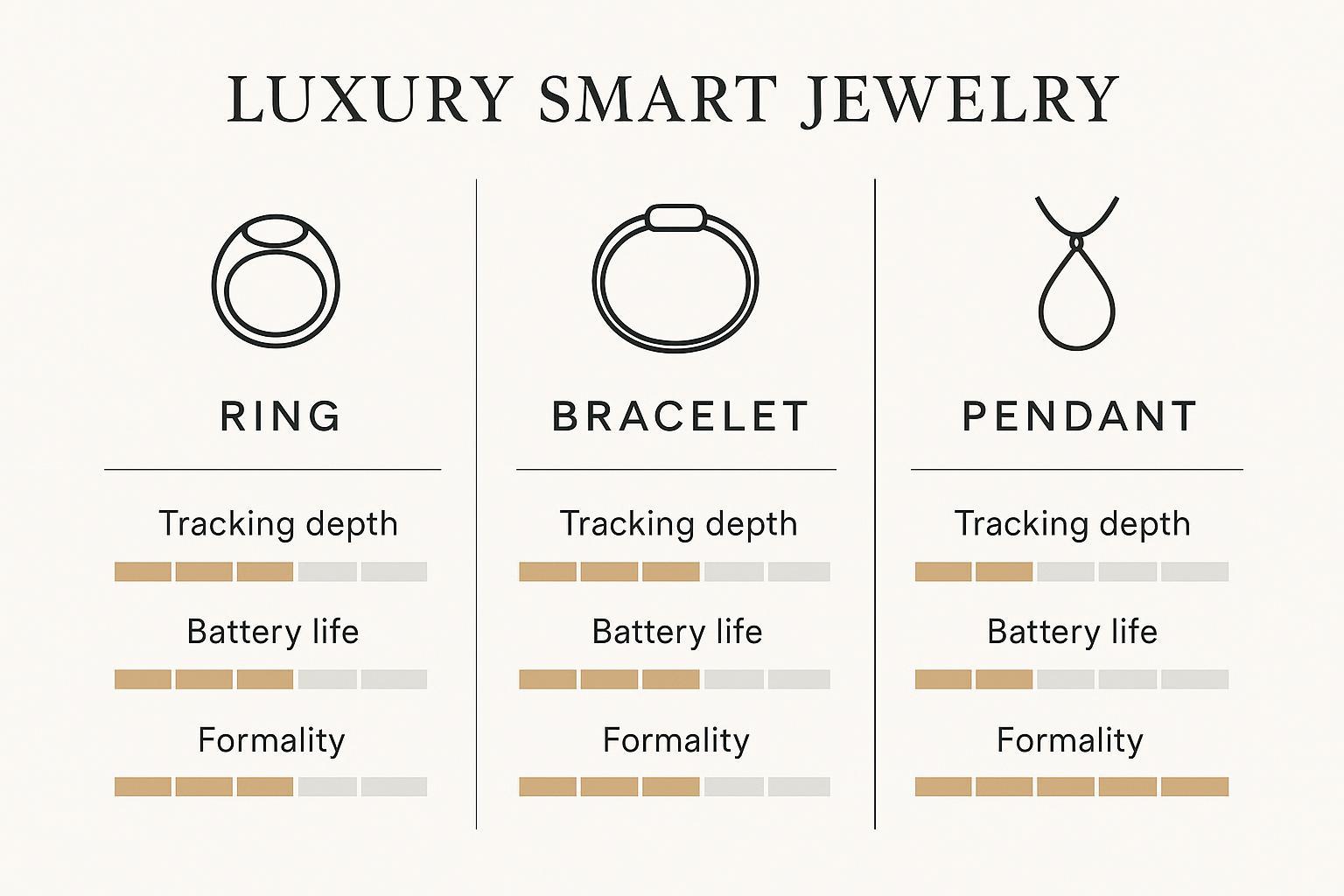
Smart rings lead the category
Smart rings lead for one practical reason: wear compliance. A well-sized ring can stay on through sleep, travel, and daily life without requiring you to “remember” to wear it.
There’s also an anatomical advantage. Finger-based sensing can support strong optical signals for photoplethysmography (PPG) under the right conditions, which is why smart rings are widely positioned as sleep and recovery devices. A 2025 PubMed Central review, Smart Ring in Clinical Medicine: A Systematic Review (2025), notes that engineering constraints and contact conditions meaningfully affect performance—reinforcing a buyer truth: fit is not a detail; it’s the product.
Choose a ring when:
Sleep and recovery trends are your priority.
You want maximum discretion.
You’re willing to do the sizing work (and accept that finger size changes with temperature and travel).
Bracelets: style-forward, lighter tracking
Bracelets tend to win when your priority is styling flexibility and easier “ownership.” They’re usually more forgiving on sizing, and many people simply prefer the feel of a bracelet to a ring.
The trade-off is subtle: bracelets can be more visibly “wearable tech,” and depending on design, they may move more during the day, which can degrade signal consistency. The upside is space: bracelets can sometimes accommodate larger batteries or different layouts.
Choose a bracelet when:
You want jewelry-forward styling and easier fit.
You prefer a wearable that feels more intentional on the wrist.
You’re optimizing for daily wellness cues rather than deep sleep metrics.
Pendants: elegant, rising interest
Pendants are gaining interest because they solve a social problem: they can look entirely like jewelry.
In practice, pendants tend to make the most sense when the value proposition is broader than “continuous biometrics.” Think posture cues, safety features, or lightweight wellness signals. They can also be a strong fit for evening wear, where a wrist device or ring may feel visually out of place.
If you’re weighing smart ring vs bracelet vs pendant, this is the simplest lens: rings optimize continuous contact, bracelets optimize styling flexibility, pendants optimize formality.
Choose a pendant when:
Formality and elegance are non-negotiable.
You want a piece that reads like jewelry in every context.
You’re comfortable with the idea that some health metrics may be less consistent than with a ring.
Technology, Simply Explained
Sensor stack and what it measures
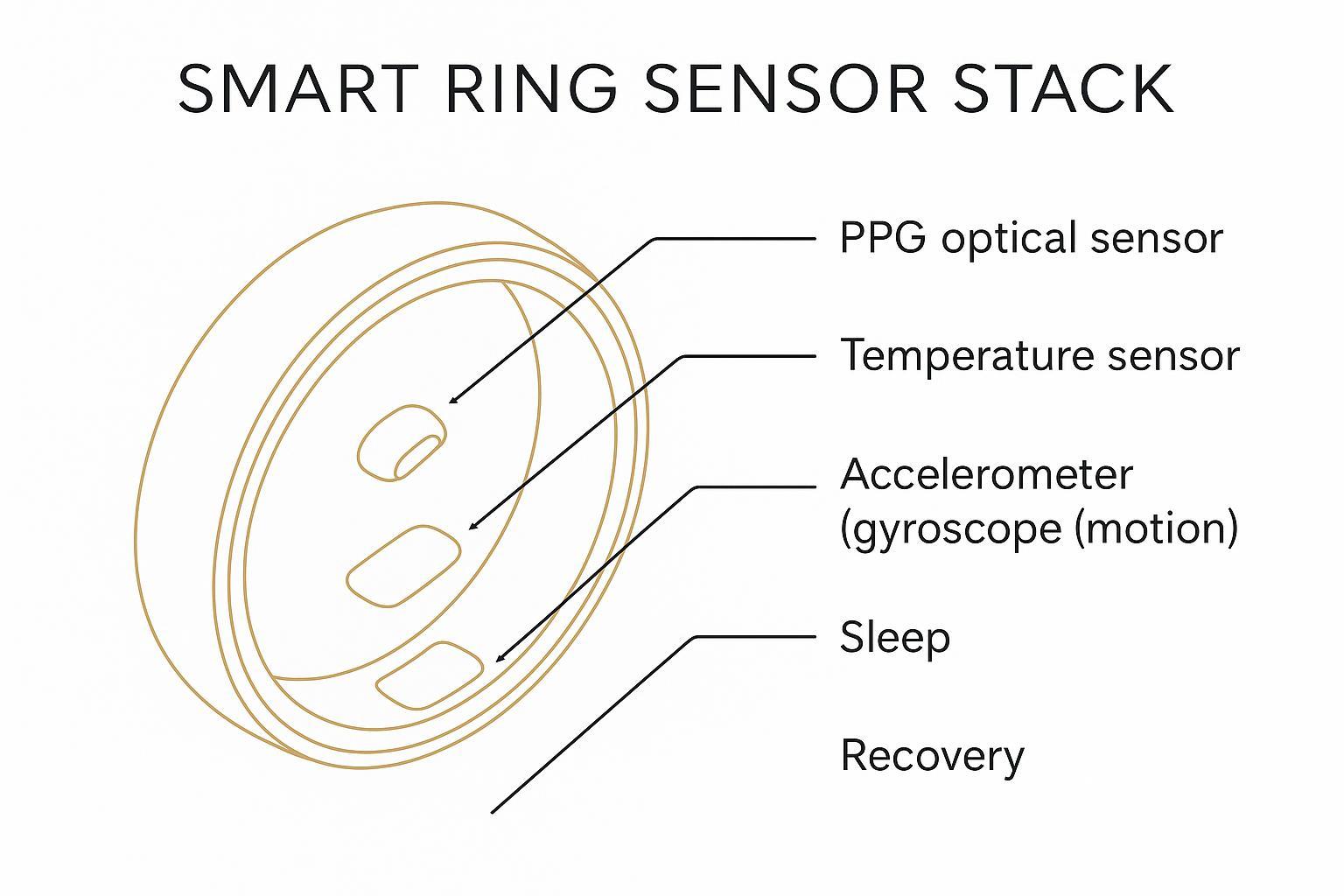
Most high-end smart jewelry is built around a small set of sensors. The names can feel technical, but the idea is simple: measure signals your body produces naturally, then translate them into trends.
PPG (optical sensor): shines light into the skin and measures reflected changes to estimate heart rate and related metrics.
Temperature sensor: tracks skin temperature trends.
Motion sensors (accelerometer/gyroscope): detect movement patterns for activity and sleep behavior.
The best buyer mindset is conservative: these tools are most useful for trend monitoring (especially during rest), not for diagnosing medical conditions.
Accuracy drivers: fit, contact, algorithms
If you want credible wellness data, you’re really buying three things:
Stable contact (fit + placement)
Signal conditions (motion, temperature, perfusion)
Algorithms (how the app cleans and interprets noise)
This is where smart ring accuracy is won or lost: not in a marketing promise, but in repeatable signal quality across your real days.
Peer-reviewed PPG literature is clear on the fundamentals: attachment and contact pressure meaningfully influence signal quality, and motion adds noise. A useful reference is the PubMed Central review Wearable Photoplethysmography for Cardiovascular Monitoring (2022), alongside the PubMed Central paper The 2023 wearable photoplethysmography roadmap (2023).
A practical buyer framework:
Trust sleep and rest trends first. Signal quality is usually better when you’re not moving.
Treat workout heart rate as a separate test. If exercise accuracy matters, validate it against a reference device you trust.
Assume cold hands change outcomes. Low perfusion can degrade optical signals; your ring may be “accurate” and still look inconsistent on a cold flight.
How to verify: Use the sizing kit for a full day and a full sleep. If the ring spins freely or leaves painful pressure marks, you’re not testing the device—you’re testing a bad fit.
Because you approved a public YouTube search, here’s one explainer that helps calibrate expectations around PPG limits (helpful before you buy):
Battery, charging, and ecosystem fit
Battery life isn’t just a convenience metric. It affects data quality. If you charge too often—or forget to charge—you create gaps in the very trends you’re trying to understand.
When you evaluate battery and charging, look past marketing language and ask:
How often will you realistically charge it? (Daily charging is a deal-breaker for many people who buy rings for sleep.)
Is the charger travel-friendly? Small, proprietary chargers get lost.
Does the ecosystem feel stable? The device is only as good as its app and update cadence.
VERTU’s smart jewelry technology comparison guide (2026) puts the emphasis in the right place: power management and companion software maturity are core decision criteria, not afterthoughts.
Buyer’s Guide for 2026
Lifestyle fits: travel, daily wellness, evening wear
The cleanest way to buy is to choose the scenario you care about most—then accept trade-offs elsewhere.
For travel (time zones, flights, hotels)
Rings tend to excel because they’re unobtrusive and stable for sleep tracking. Your priority should be comfort, battery that survives long travel days, and an app that helps you interpret trend changes without panic.
For daily wellness (low-friction habits)
Bracelets can be easier if you already wear wrist jewelry. You’re usually optimizing for gentle cues: daily activity, rest patterns, and stress indicators that align with your routines.
For evening wear (formal contexts)
Pendants can be the quiet luxury choice. If you’re dressing for aesthetics first, a pendant can preserve the line of an outfit in a way a wrist device can’t.
Budget tiers and value trade-offs
In high-end smart jewelry, “value” is rarely about the cheapest device with the longest feature list. It’s about the least regret.
Typically, you are paying for some combination of:
Materials and finishing quality
Comfort engineering (weight, edges, skin contact)
Battery and charging convenience
App quality and algorithm maturity
Support, warranty, and long-term service
One under-discussed trade-off: subscription dependence. Some devices gate important insights behind ongoing fees. That can be acceptable in luxury—if it’s explicit, stable, and paired with real support. It’s risky when the subscription feels like a moving target.
Craftsmanship, materials, and provenance checks
Luxury jewelry has a language: finishing, edges, setting work, clasp integrity, and how a piece feels after eight hours.
For smart jewelry, add a few modern checks:
Skin contact surfaces: They should feel smooth and stable, not sharp or bulky.
Water and durability standards: Don’t assume “jewelry” means delicate; don’t assume “wearable” means robust.
Provenance and purchase channel: Buy from official or clearly authorized channels, especially for limited editions.
If you want a definition-led view of why the smart ring format is treated differently (passive, discreet monitoring; fit as the performance driver), VERTU’s guide on what sets a wearable technology smart ring apart (2026) captures the buying logic clearly.
Privacy, Service, and Fit
Data control, app quality, and subscriptions
If you buy high-end smart jewelry for wellness, you’re also buying a data relationship.
If you’ve ever searched “privacy for wearable health data,” this is the section that decides whether you’ll enjoy ownership—or regret it.
Start with a blunt truth for US buyers: many consumer wearables are not automatically protected under HIPAA, because HIPAA applies primarily to covered healthcare entities—not every consumer device company. That’s why your real safeguards are the vendor’s policy, controls, and your own settings.
Evaluate:
What data is collected (raw signals vs derived insights)
Where it’s processed (on-device vs cloud)
Who it’s shared with (advertising, partners, “research,” affiliates)
Retention and deletion (can you truly delete your history?)
Account security (MFA, device access controls)
Subscription terms (which insights are paywalled?)
For a buyer-level overview of why conditions and handling affect PPG reliability—and why “more data” can still mean “more risk”—the 2026 PubMed Central article on determinants of PPG signal quality (2026) is a useful, technical reference.
For a brand view of how AI can translate signals into coaching-style insights (and why the app layer matters), see VERTU’s ultimate guide to AI-integrated jewelry (2026).
Here’s the single perspective insert you requested:
VERTU pairs craftsmanship with a concierge-backed, privacy-first Web3/AI ecosystem—an ownership model that treats both personal data and service continuity as part of the luxury standard.
Warranty, support, and durability standards
At this end of the market, you should expect more than a generic return label.
Ask before you buy:
Warranty clarity: What’s covered: battery, water damage, sensors, cosmetic wear?
Support quality: Is there a real service path, or just email tickets?
Replacement logistics: If the device fails, what happens to your data and subscriptions?
The “luxury” part of luxury tech isn’t the spec sheet. It’s the ownership experience when something goes wrong.
Sizing kits and comfort essentials
Sizing is where buyers either get a refined experience—or a frustrating one.
Use a sizing kit. Wear the sizer overnight.
Expect your fit to change slightly with heat, cold, hydration, and travel.
Prioritize stable, comfortable contact over a tight fit that becomes unbearable.
The simplest rule: if you can’t forget it’s on, you won’t wear it consistently—and inconsistent wear produces inconsistent data.
Conclusion
Choosing high-end smart jewelry in 2026 comes down to one question: what are you actually buying—beauty, data, or an ownership experience that respects both?
Start with form factor. Decide how you’ll wear it in real life. Then validate the fundamentals: fit, comfort, algorithm quality, and data governance.
Next steps are straightforward:
Shortlist two or three pieces that match your primary scenario.
Request a sizing kit and test through one sleep cycle and a normal workday.
If credible wellness data matters, validate the trends you care about before you commit.
Models will iterate fast. Treat your purchase like you would any luxury object with a technical soul: buy what fits your life now, and revisit the category as materials, sensors, and privacy standards mature.
Disclosure: This article references VERTU pages. Editorial judgment remains the priority.
![How to Scan Receipts and Documents with Your Phone [Full Guide]](https://cdn.sanity.io/images/e0gp1l2g/production/0db13feec1d5e72b8a8a5f976d1f3e86619c9228-3840x1860.webp?w=180&h=180&q=78&auto=format&fit=crop)
![How to Scan Receipts and Documents with Your Phone [Full Guide]](https://cdn.sanity.io/images/e0gp1l2g/production/0db13feec1d5e72b8a8a5f976d1f3e86619c9228-3840x1860.webp?w=800&h=450&q=82&auto=format&fit=crop)
![Top 10 Two-Tone Carbon-Fibre Watches for Men [2026 List]](https://cdn.sanity.io/images/e0gp1l2g/production/18870799ba33fab0e038968359cd5772d7d7db30-1024x576.webp?w=800&h=450&q=82&auto=format&fit=crop)
![Top 10 Luxury Watches with Digital Complication Displays for Men [Latest]](https://cdn.sanity.io/images/e0gp1l2g/production/c4f6bf8c080f291c39f7cc85c7344ecff2fd3799-1024x553.webp?w=800&h=450&q=82&auto=format&fit=crop)