

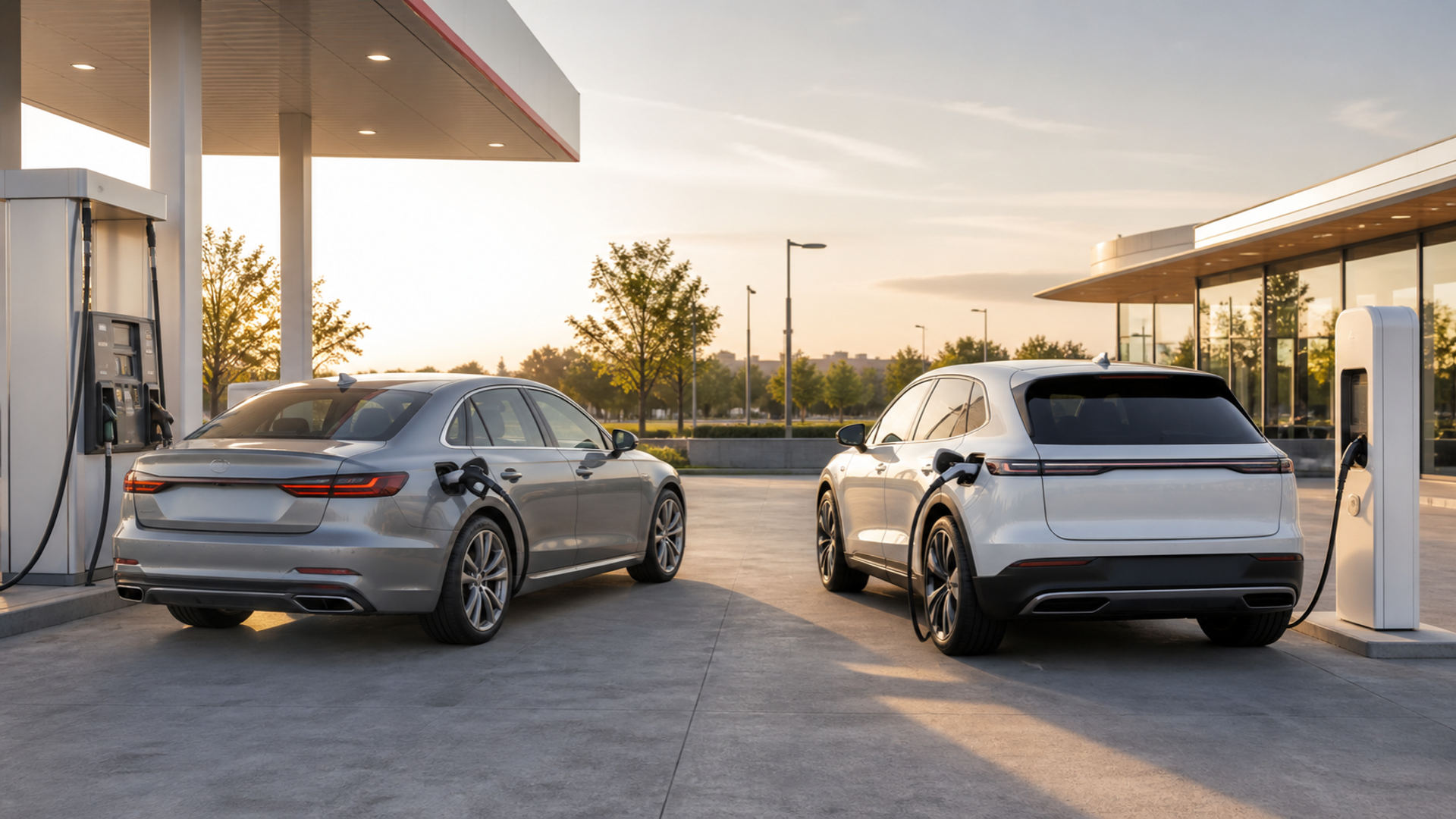
A conventional hybrid and a battery-electric vehicle solve efficiency through different energy systems. A hybrid combines an engine, battery and electric motor without routine plug-in charging. A battery-electric vehicle relies on external charging and has no combustion engine. Home charging, daily distance, long routes, climate, towing, parking and local prices determine which convenience is real.
Start with where the car sleeps
Choose a battery-electric vehicle when reliable home or workplace charging covers most use and the exact car's range, charging curve and route network fit difficult trips. Choose a conventional hybrid when charging access is weak or travel patterns reward fast liquid-fuel stops. Keep the current vehicle while logging routes when either conclusion rests on assumptions.
| Decision factor | Conventional hybrid | Battery-electric vehicle | Keep the current vehicle while measuring the route |
|---|---|---|---|
| Home base | No plug is needed for normal operation | A dependable overnight charging route exists | Measure parking and electrical options first |
| Daily route | Efficiency improves without behaviour change | Daily use fits a comfortable state-of-charge window | Log distance and dwell time for a month |
| Long trips | Fuel stops remain rapid and widespread | Verified chargers fit stops, weather and occupancy | Rent or retain a different trip vehicle |
| Climate | Engine and hybrid controls cover seasonal extremes | Cold or heat range loss remains acceptable | Test the exact model in local conditions |
| Loads | Payload and towing data fit the duty | Range under load remains workable | Choose by the hardest recurring load |
| Ownership | Fuel, servicing and depreciation fit the horizon | Energy, charging and service fit the horizon | Delay until incentives and infrastructure are verified |
This hybrid vs electric car matrix is the article's working value object. Read the hybrid vs electric car rows together: the decisive failure mode depends on this topic's evidence, operating context and reader objective.
What the powertrains change
Evidence 1. The US Alternative Fuels Data Center describes hybrid electric vehicles as using an internal-combustion engine plus electric propulsion and regenerative braking without plug-in charging.
Evidence 2. AFDC describes battery-electric vehicles as powered by one or more electric motors using energy stored in batteries that are charged from an external source.
Evidence 3. Published range is a test result; speed, temperature, cabin conditioning, elevation, load and towing can change real route consumption.
Evidence 4. A charger map does not prove that the right connector, power, access, uptime and payment route will be available at the needed time.
Reader-visible sources checked for this article:
afdc.energy.gov — reader-visible current or official evidence
afdc.energy.gov — reader-visible current or official evidence
For hybrid vs electric car, these sources establish only the claims inside their documented scope. Recheck every changeable specification, availability condition, price, policy or service term in the relevant market before acting.
Model a month, not one test drive
The home base row exposes a practical boundary. Route one assumes no plug is needed for normal operation, while route two is defensible only when a dependable overnight charging route exists. Route three depends on measure parking and electrical options first. If that evidence is absent, keep the more reversible option.
Read daily route as a stop/go test: efficiency improves without behaviour change supports the first option; daily use fits a comfortable state-of-charge window supports the second; and log distance and dwell time for a month supports the third. Record which source proves the condition and when it was checked.
A buyer can resolve long trips without starting from a brand preference. Ask whether fuel stops remain rapid and widespread; compare that with whether verified chargers fit stops, weather and occupancy; then use rent or retain a different trip vehicle as the third route's safeguard. An unknown condition stays unknown.
On climate, popularity is not enough. The evidence for option one is that engine and hybrid controls cover seasonal extremes. Option two means cold or heat range loss remains acceptable. Option three is rational where test the exact model in local conditions. Recheck any changeable term immediately before commitment.
The decision changes at loads. Choose the first path only if payload and towing data fit the duty; move to the second when range under load remains workable; use the third when choose by the hardest recurring load. Save the downside that would make this row fail.
For ownership, the first route works when fuel, servicing and depreciation fit the horizon; the second requires energy, charging and service fit the horizon. The control for the third is delay until incentives and infrastructure are verified. Verify this row against the exact product, property, account or environment before it can reverse the decision.
Facts that would reverse the current choice
Reversal control 1 — Home base. Before choosing Conventional hybrid, write down how the decision changes if “No plug is needed for normal operation” proves false. Do the same for Battery-electric vehicle and “A dependable overnight charging route exists”. Keep the Keep the current vehicle while measuring the route route available until “Measure parking and electrical options first” is verified. This control belongs to hybrid vs electric car; update it from the cited source or exact supplier rather than copying a generic checklist.
Reversal control 2 — Daily route. Before choosing Conventional hybrid, write down how the decision changes if “Efficiency improves without behaviour change” proves false. Do the same for Battery-electric vehicle and “Daily use fits a comfortable state-of-charge window”. Keep the Keep the current vehicle while measuring the route route available until “Log distance and dwell time for a month” is verified. This control belongs to hybrid vs electric car; update it from the cited source or exact supplier rather than copying a generic checklist.
Reversal control 3 — Long trips. Before choosing Conventional hybrid, write down how the decision changes if “Fuel stops remain rapid and widespread” proves false. Do the same for Battery-electric vehicle and “Verified chargers fit stops, weather and occupancy”. Keep the Keep the current vehicle while measuring the route route available until “Rent or retain a different trip vehicle” is verified. This control belongs to hybrid vs electric car; update it from the cited source or exact supplier rather than copying a generic checklist.
Reversal control 4 — Climate. Before choosing Conventional hybrid, write down how the decision changes if “Engine and hybrid controls cover seasonal extremes” proves false. Do the same for Battery-electric vehicle and “Cold or heat range loss remains acceptable”. Keep the Keep the current vehicle while measuring the route route available until “Test the exact model in local conditions” is verified. This control belongs to hybrid vs electric car; update it from the cited source or exact supplier rather than copying a generic checklist.
Reversal control 5 — Loads. Before choosing Conventional hybrid, write down how the decision changes if “Payload and towing data fit the duty” proves false. Do the same for Battery-electric vehicle and “Range under load remains workable”. Keep the Keep the current vehicle while measuring the route route available until “Choose by the hardest recurring load” is verified. This control belongs to hybrid vs electric car; update it from the cited source or exact supplier rather than copying a generic checklist.
Reversal control 6 — Ownership. Before choosing Conventional hybrid, write down how the decision changes if “Fuel, servicing and depreciation fit the horizon” proves false. Do the same for Battery-electric vehicle and “Energy, charging and service fit the horizon”. Keep the Keep the current vehicle while measuring the route route available until “Delay until incentives and infrastructure are verified” is verified. This control belongs to hybrid vs electric car; update it from the cited source or exact supplier rather than copying a generic checklist.
Log the difficult month
Record every journey, overnight parking place, longest same-day distance, dwell period, passengers and cargo. Mark trips that occur in poor weather or under deadline. Use this log to size the vehicle and charging routine; an average commute can hide the monthly journey that determines the purchase.
Verify charging as infrastructure
For an electric vehicle, obtain a home electrical assessment, tariff and installation quote. Test public chargers along recurring routes at realistic arrival times. Record connector, power sharing, parking restrictions and backup sites. For a hybrid, map actual fuel access and urban restrictions rather than assuming universal convenience.
Compare energy with one unit system
Convert fuel and electricity into cost per realistic route using local prices and observed consumption ranges. Add charging losses, seasonal variation and paid parking where relevant. Keep incentives separate because eligibility, tax treatment and timing can change independently of the vehicle's engineering.
Protect the exit route
Check battery and hybrid-system warranties, service access, roadside support, tyre specification, insurance, software dependence and resale channels. The right powertrain should remain workable if a home move, tariff change or route change removes one expected advantage.
Three drivers, three answers
Home-charging commuter with predictable regional travel
A battery-electric vehicle can create the simplest daily energy routine when difficult trips are also verified. Define the fact that would reverse this recommendation before committing.
Apartment driver crossing sparse-charging regions
A conventional hybrid may reduce planning burden while still lowering fuel use in mixed driving. Define the fact that would reverse this recommendation before committing.
Infrequent driver with a sound present car
Keeping the existing vehicle while measuring routes can beat a premature purchase on both cost and material use. Define the fact that would reverse this recommendation before committing.
Action checklist
Log one month of routes.
Identify overnight parking.
Get electrical quote.
Test public chargers.
Model seasonal range.
Check towing and payload.
Compare local energy prices.
Read warranty terms.
Price insurance and tyres.
Define a no-charger fallback.
Continue the decision
The linked VERTU articles expand adjacent parts of the hybrid vs electric car decision. They do not substitute for the external evidence above.
The hybrid-electric verdict
Choose a battery-electric vehicle when reliable home or workplace charging covers most use and the exact car's range, charging curve and route network fit difficult trips. Choose a conventional hybrid when charging access is weak or travel patterns reward fast liquid-fuel stops. Keep the current vehicle while logging routes when either conclusion rests on assumptions.
Keep the hybrid vs electric car decision reversible until its material cost, safety, access, privacy and compatibility facts are verified. Unknown evidence stays unknown; it is never silently scored as favourable.
![How to Scan Receipts and Documents with Your Phone [Full Guide]](https://cdn.sanity.io/images/e0gp1l2g/production/0db13feec1d5e72b8a8a5f976d1f3e86619c9228-3840x1860.webp?w=180&h=180&q=78&auto=format&fit=crop)
![How to Scan Receipts and Documents with Your Phone [Full Guide]](https://cdn.sanity.io/images/e0gp1l2g/production/0db13feec1d5e72b8a8a5f976d1f3e86619c9228-3840x1860.webp?w=800&h=450&q=82&auto=format&fit=crop)
![Top 10 Two-Tone Carbon-Fibre Watches for Men [2026 List]](https://cdn.sanity.io/images/e0gp1l2g/production/18870799ba33fab0e038968359cd5772d7d7db30-1024x576.webp?w=800&h=450&q=82&auto=format&fit=crop)
![Top 10 Luxury Watches with Digital Complication Displays for Men [Latest]](https://cdn.sanity.io/images/e0gp1l2g/production/c4f6bf8c080f291c39f7cc85c7344ecff2fd3799-1024x553.webp?w=800&h=450&q=82&auto=format&fit=crop)