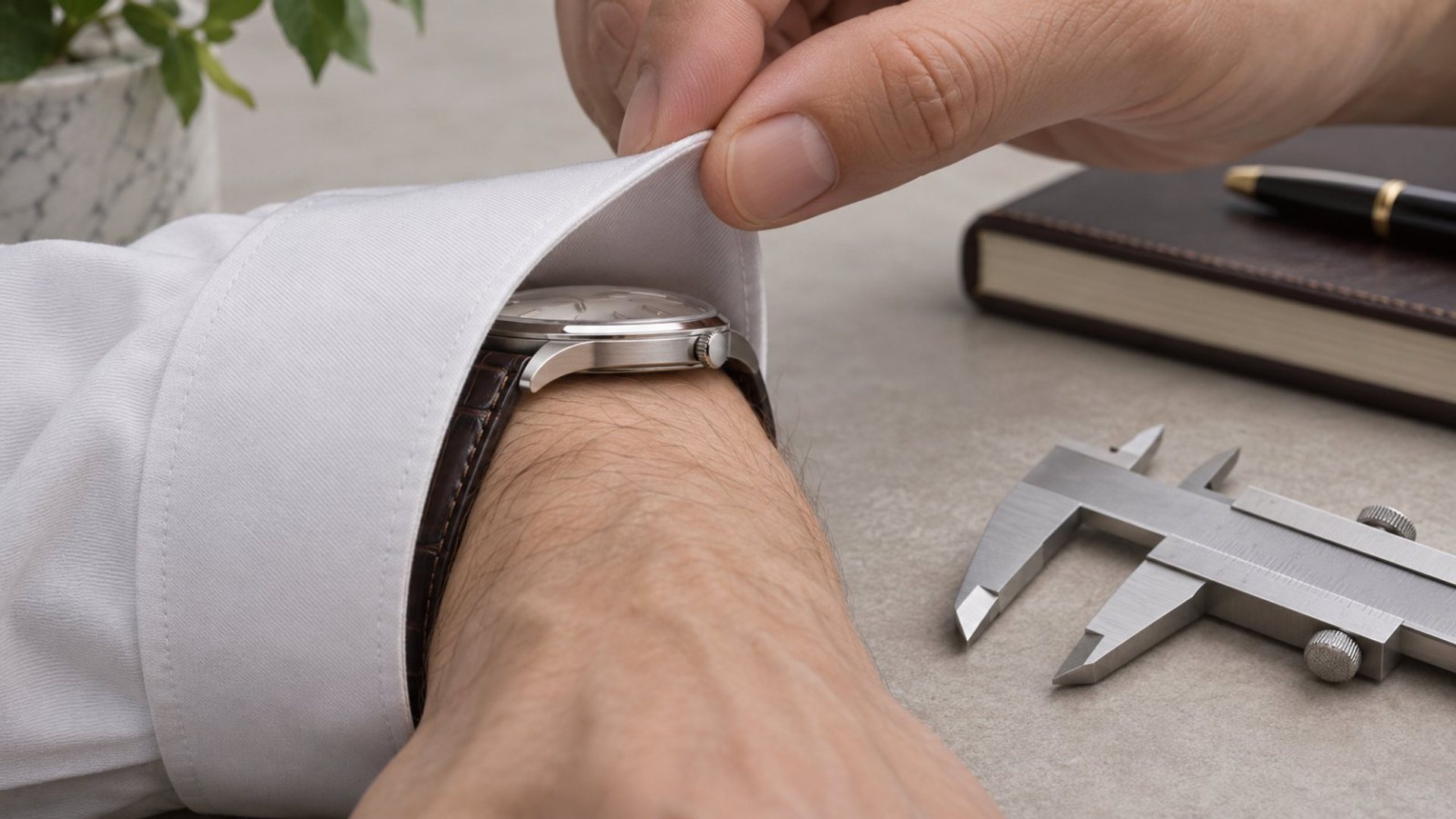
Watch case thickness is a useful starting measurement for shirt-cuff fit, but the decisive test is the watch under your actual cuff. Measure from the lowest point of the case back to the highest point of the glass or bezel, then try the watch with the shirt buttoned while moving your wrist. A slim watch can still catch on a tight cuff, while a thicker case may slide beneath a more generous, softer sleeve. There is no single millimetre limit that works for every shirt.
What does case thickness include?
A product's thickness figure usually describes the watch case from back to front, but manufacturers may measure particular models differently. Before comparing two figures, ask whether the stated dimension includes a raised crystal, a protruding case back or other high point. A side profile photograph can reveal the shape, yet it cannot replace a measured value. The crown is normally a width issue rather than a thickness measurement, but it may still catch the edge of a cuff as the wrist moves.
Use a caliper carefully if you own the watch, avoiding pressure on a delicate finish or crystal. If you do not have one, ask the maker or retailer for the exact reference's case-height specification. Record the number in millimetres and note where it was measured. Watchfinder's watch guide distinguishes diameter and other sizing terms; a 40 mm case diameter does not tell you how far the watch projects above the wrist.
Even a precise number is only one dimension. A domed crystal can meet fabric differently from a flat one. A sharply stepped bezel may catch a cuff edge, while a smoothly sloped case can pass under it more readily. Case-back shape influences how high the whole assembly sits on your arm. Treat any published height as a screening figure, then confirm with a physical try-on.
How do you measure the shirt cuff?
Button the shirt as you normally wear it and slide two fingers beneath the cuff at the watch position. This is a rough feel check, not a universal sizing rule. Notice whether the opening is circular, tapered or pulled into an oval by the button. Measure the inside circumference or lay the cuff flat to compare your own shirts, but remember that flat width does not perfectly describe a three-dimensional opening around wrist and watch.
Fabric changes the result. A soft cotton cuff may drape over a case, whereas a stiff, heavily fused cuff may ride up and then stop at the bezel. A French cuff, a barrel cuff and a narrow tailored cuff can all have different openings even on shirts with the same collar size. If you wear cufflinks, the fastening and fold add another shape to consider; our watch and cufflinks guide explains where the contacts usually occur.
Do not measure an unbuttoned shirt on a table and call that the usable clearance. The wrist fills part of the opening. Your watch also moves slightly as you bend the hand or raise the arm. Put on the actual shirt, fasten it and watch what happens through ordinary movement. If the cuff pulls at the button or bunches behind the watch, the arrangement may be uncomfortable even if the watch can be forced underneath.
Run a three-position fit test
First, stand with your arm relaxed and let the sleeve fall naturally. Does the cuff pass over the watch without help? Second, bend your elbow and bring the wrist towards your chest, as you might when reading the time. Does the cuff move freely back? Third, reach forward across a desk and let the sleeve return. A cuff that catches once is not necessarily a failure, but repeated snagging, pressure at the button or a case exposed all day may defeat the look and comfort you wanted.
Repeat the test with the watch in its normal wearing position just above the wrist joint. A loose strap lets the case slide down towards the hand, where the cuff narrows and the crown can meet the fabric. Tightening a strap merely to force a watch under a cuff is not a good fit solution if it causes discomfort. Adjust within the maker's guidance and retest. Our right-wrist watch guide gives a similar movement-based approach for crown and strap comfort.
Try the test at the time of day you would actually wear the outfit. Wrist size and comfort can shift slightly with warmth and activity. If one shirt clears the watch and another does not, the issue may be the cuff rather than the watch. A tailor can advise whether the cuff can be adjusted without disturbing the shirt's balance; do not assume a button can simply be moved far enough on every design.
What do published numbers tell you?
A published case height can eliminate a clearly unsuitable candidate before a fitting. It cannot guarantee compatibility with your wardrobe. Rolex's official Cosmograph Daytona presentation gives a 12.20 mm thickness for the referenced model. That is a verified model-specific example of how precise a specification can be. It is not a “safe under every cuff” threshold, and another watch with the same height can wear differently because its shape is different.
When comparing candidates, make a small note of case height, diameter or width, lug-to-lug length and strap material. These influence how the case sits and how the sleeve meets it. A broad watch may pull a cuff sideways even if its profile is low. A thick strap can lift the case farther from the wrist. The combined watch-and-strap geometry is what your shirt encounters.
How should a VERTU Agent Watch buyer assess fit?
VERTU's knowledge base describes Agent Watch with a crystal case, tonneau silhouette and fluoroelastomer strap, but the available knowledge-base entry does not give a verified case-thickness figure. Do not infer its cuff fit from photographs or compare it numerically with another watch without an exact measurement for the selected version. Ask VERTU for the full case height and try it with the shirts you wear most often.
Because the case has a distinctive shape, look at where its upper edge meets the cuff, not only the centre of the dial. Check whether the strap holds it steadily and whether the shirt returns smoothly after you raise your arm. If a formal shirt does not clear, you might choose a roomier cuff or wear the watch visibly outside the sleeve line; that is a styling choice, not evidence that the product is incorrectly sized. Avoid claiming that every Agent Watch configuration has identical dimensions until the maker confirms it.
Frequently asked questions
What watch thickness fits under a dress shirt?
There is no universal figure. Measure the case and test it under the actual buttoned cuff with your wrist moving normally.
Does case diameter predict cuff fit?
No. Diameter describes the face-to-face width; height, shape, strap and cuff opening also determine whether the watch passes beneath fabric.
Should the cuff cover the watch all the time?
Not necessarily. Some people prefer a watch that appears when the arm bends. The practical test is whether the cuff moves and returns without persistent catching or pressure.
Can a tailor enlarge a tight cuff?
Possibly, depending on the fabric and construction. Ask a tailor to assess the exact shirt rather than moving a button blindly.
Conclusion
Measure case thickness to narrow the field, then let the real shirt decide. A successful fit allows the cuff to move over the watch without strain and the watch to sit comfortably on the wrist. Shape, strap and fabric explain why a single number can guide the search but cannot finish it.