Smart ring battery life can shorten after 18 months, but age alone cannot tell you how much capacity a particular ring has lost. Rechargeable cells gradually wear, while settings, software, charging contacts, temperature and use can change the time between charges. Compare several cycles under similar conditions before deciding that the battery has degraded. A sudden drop, charging failure or heat warrants model-specific support rather than a guessed “normal” percentage.
What changes inside a rechargeable ring?
A smart ring houses a small rechargeable cell in a narrow enclosure. Like other rechargeable batteries, it has a limited service life. As it ages through time and charging cycles, its usable capacity can diminish. That means the same activity and settings may leave less time between charges. It does not mean every ring reaches a defined failure point after 18 months. Cell chemistry, size, usage and environmental conditions differ.
Oura's official battery tips state that rechargeable batteries are consumables whose capacity and performance gradually decline, and that actual runtime depends on ring size, app settings, feature configuration, activity, age and use. Its published day ranges apply to Oura's own new models, not to VERTU or another maker. Use that source to understand the general pattern; use your ring maker's figures and support policy for your device.
A change in charging frequency is only a symptom. The case or dock may not be delivering power, contacts may be dirty or the app may report the battery incorrectly. A firmware change or an enabled feature may alter consumption. Conversely, a ring that becomes hot, swells, is cracked or smells unusual should not be put through repeated “test cycles”. Stop using and charging it and ask the maker for safe handling instructions.
How can you measure your own runtime?
Start with a full charge using the compatible charger and note the time, displayed charge level, app version and enabled features. Wear the ring as you normally do, then note when you next charge it and the remaining percentage. Repeat over several ordinary cycles. The goal is not a laboratory battery-health estimate; it is a useful personal baseline that support can interpret.
Try to compare like with like. A week of heavy activity, frequent syncing or extra features cannot be fairly compared with a quiet week using different settings. Note whether the ring stayed connected to the phone and whether a software update occurred. If you recently changed phone, account or operating-system version, include that in your record. A single unexpectedly short cycle may reflect a temporary connection problem rather than cell wear.
Do not run a ring to zero repeatedly simply to collect a precise number unless the maker specifically asks you to do so. Follow its charging advice. Oura suggests particular firmware and charge-cycle checks for its own models; those are not universal instructions. If your ring's app offers a battery diagnostic, record the result and its date. An advertised “up to” figure should be treated as a best-case condition, not the minimum runtime guaranteed to every owner after a year and a half.
Which checks should come before a replacement request?
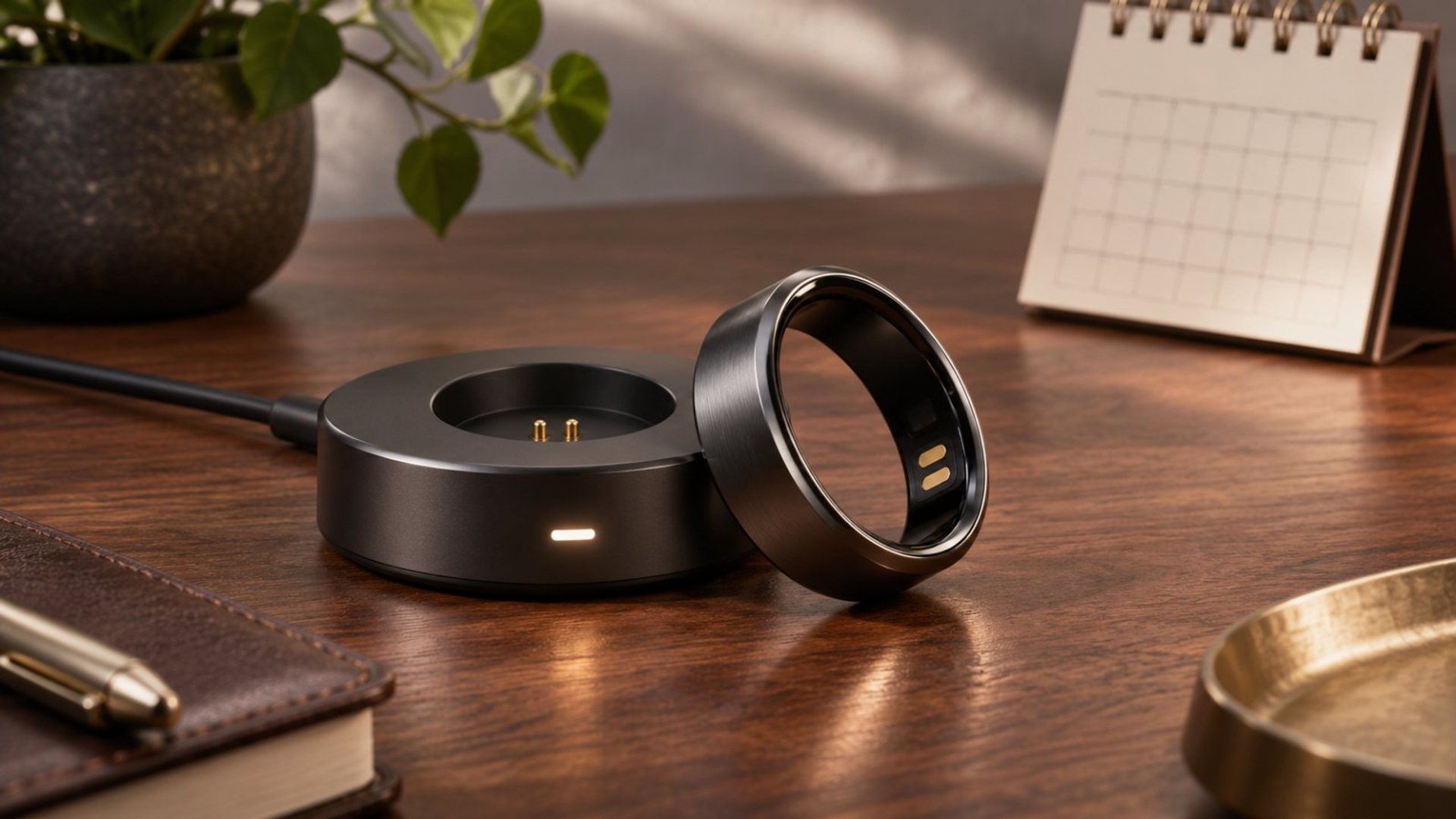
Inspect the charger and ring for visible dirt, misalignment or damage. Clean only as the maker instructs, keeping charging surfaces dry before use. Test the recommended cable and power source. If the ring does not begin charging reliably, a case, dock or contact issue may be more relevant than battery capacity. A ring that reaches a displayed 100% but discharges quickly presents a different symptom from one that never receives a full charge.
Check the official app and firmware guidance for your exact model. Updates can change power management, but also change which features are active. Record the version before and after so support can distinguish a persistent hardware issue from a software change. Do not factory-reset the device without checking the data and account implications. If the maker recommends a reset, follow its sequence and confirm whether your records are synced first.
Check fit and wearing habits too. A ring worn loosely can lose consistent contact with the finger, which may affect what data is collected, though that does not by itself prove battery degradation. A very tight ring can be uncomfortable and should not be worn simply to improve a sensor reading. Our ring-and-watch sleep guide explains why two devices and their settings may report different patterns; do not treat a change in a wellness chart as a direct battery-health test.
Is battery replacement available?
Do not assume a sealed smart ring has a user-replaceable cell. Oura's product safety information describes its own ring battery as non-replaceable. That does not establish the design or service route for every other brand. Ask your maker whether it offers a battery repair, exchange of the complete ring, warranty assessment or another option for your exact generation and market.
Before contacting support, collect the model, size, order date, serial number if provided, app and firmware versions, charging observations and the cycle notes. Ask whether the problem is covered, whether a diagnostic fee applies, what you must return and how your data should be handled. A written answer is more useful than assuming that a product warranty automatically covers normal battery wear. Do not pry open a ring or use an unverified cell: the enclosure, battery and sensors can be damaged.
What does this mean for VERTU COR RING?
The current VERTU COR RING V Star listing states up to seven days of battery life for that product, with actual life varying by use. The VERTU knowledge base explicitly says battery life and charging time can vary by model, settings, usage, battery age and environmental conditions. It does not state a fixed capacity-retention figure at 18 months or a universal user-replacement procedure. Do not apply another ring's service terms to COR RING.
Compare your COR RING's recent runtime with your own earlier record under similar settings. Confirm the correct charging accessory for your selected set and ask VERTU for diagnosis if the change is sharp, the ring fails to charge or the enclosure appears damaged. The COR RING battery guide explains the published “up to” claim and its limits. COR RING's supported insights are for general wellness and personal understanding, not for diagnosing, treating, curing or preventing disease; a battery issue should be handled as a device-support question.
Frequently asked questions
Is shorter runtime after 18 months normal?
Some decline can be normal for a rechargeable battery, but there is no universal percentage or deadline. Compare repeatable cycles and ask the maker about a sudden or severe change.
Does more frequent charging prove the cell is worn out?
No. Settings, firmware, connection and charger problems can also shorten apparent runtime. Check those factors before concluding the cell has degraded.
Can I replace a smart ring battery myself?
Do not assume so. Check the model-specific service policy; sealed rings may not offer user cell replacement, and opening one can be unsafe or damaging.
Should I stop using a warm or swollen ring?
Yes. Stop wearing and charging a ring that appears swollen, damaged or unusually hot, and contact the maker for safe handling guidance.
Conclusion
At 18 months, the useful question is not “What percentage should be left?” but “How does this ring perform under comparable conditions, and what does its maker support?” Keep a short runtime record, rule out charger and settings changes, then seek a model-specific service answer. That approach separates expected ageing from a fault without inventing a universal battery timeline.