

-926dqesd.webp)
Introduction
Hand-set high jewellery is what happens when a device stops being “finished” at the factory and starts being finished at the bench. Stones are seated, raised, and secured by a setter’s hands—then refined until metal and gem read as one surface.
In luxury tech accessories, this matters because our most-used objects have changed. Earbuds, watches, and phones now live on the body, not in a drawer. They collect micro-scratches, edge impacts, and a kind of intimate wear that mass-market finishing was never designed to romanticize.
What elevates a device to heirloom-grade isn’t sparkle alone. It’s craft precision that survives daily contact, rare materials chosen for how they age (not just how they photograph), and stewardship—service, verification, and documentation that keeps value legible years later.
This guide is organized around the parts that actually determine longevity: craftsmanship, materials, exemplars worth studying, and the care routines that protect both function and brilliance.
Craft elevates function
Stone-setting on curved surfaces
Curved housings are where jewellery craft either becomes engineering—or becomes fragile.
Unlike a flat ring shank, an earbud shell has compound curves, edges you touch, and surfaces that slide against fabric and leather. A clean-looking pavé field can only survive that life if the setting is planned around curvature from the start.
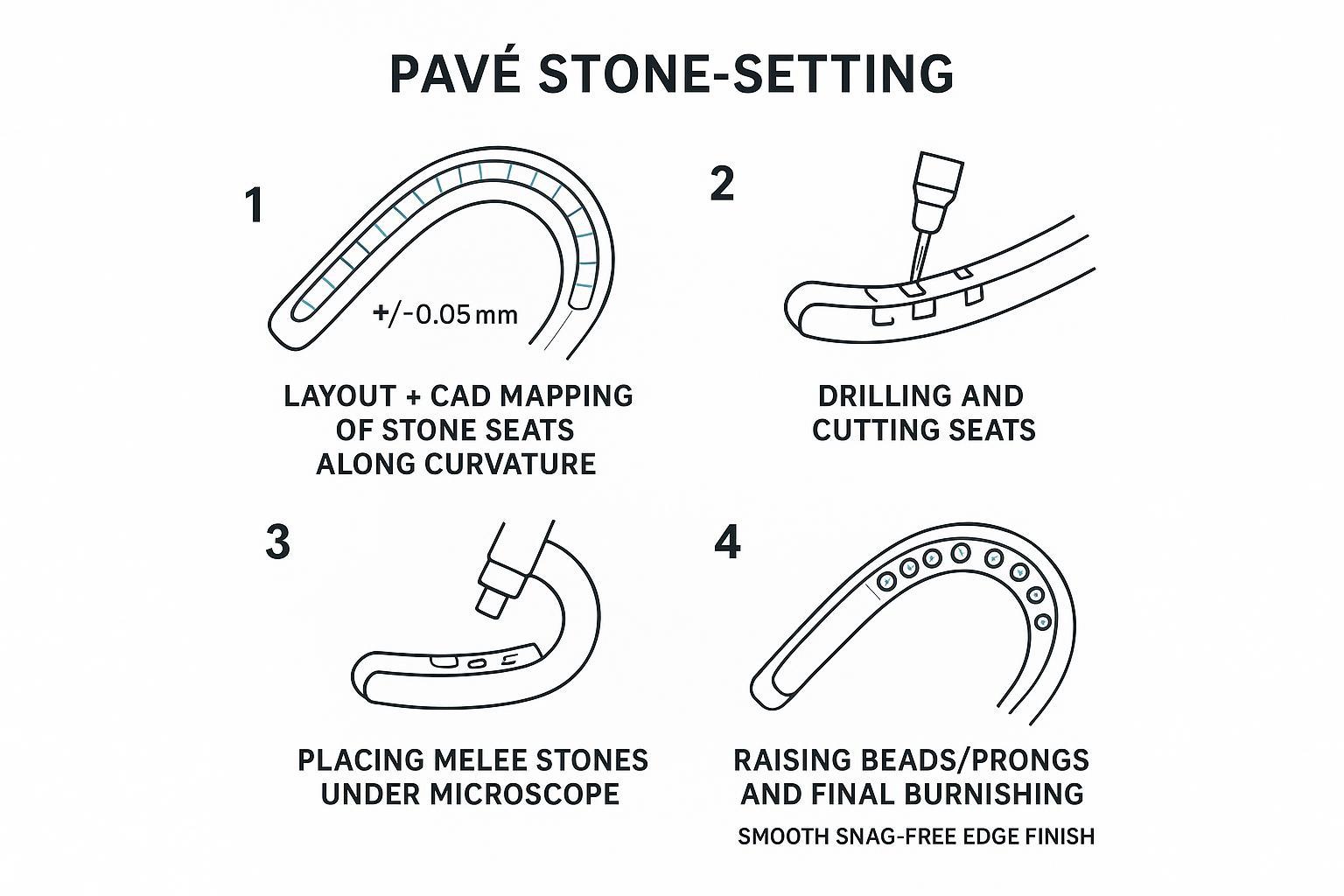
Micro pavé is held by tiny beads/prongs raised from the surrounding metal. The beads need enough mass to hold the stone, but not so much that the surface turns lumpy. The failure mode is equally specific: too little pressure leaves microscopic gaps where fibers and dirt snag; too much pressure risks chipping stones during setting. Leon Megé’s explanation of bead geometry and snagging is one of the clearest references on this point in “The Art of Micro Pavé”.
On wearables, the best setters treat the edge like a safety boundary. They’ll keep stones back from high-contact ridges, bias the pattern so rows “flow” with the curve, and finish beads so they feel almost melted into the surface.
Collector’s note: The most convincing pavé on tech isn’t the brightest under showroom lights. It’s the one that stays quiet to the fingertip—no hooks, no roughness—because that smoothness is usually the byproduct of careful finishing.
From CAD to bench finishing
Hand-setting doesn’t replace modern design tools; it depends on them.
A serious commission usually starts with CAD that maps stone seats across curvature and sets guardrails: spacing, stone size calibration, and where metal must remain structural. The bench then takes over—cutting seats, setting stones under magnification, and burnishing surfaces until the metal disappears.
The key transition is where digital “perfect” becomes physical “secure.” Real stones have slight variance. Real metal moves. A setter’s job is to keep the mosaic consistent while still building enough mechanical bite to survive motion, pressure, and time.
Security, wear, and snag prevention
In jewellery, pavé is often discussed as an aesthetic. In wearables, it’s a contact surface.
If a pavé field is on a pocket-facing edge or a watch case flank, it’s constantly negotiating friction. That’s why “snag prevention” is not a minor comfort detail—it’s a retention strategy.
VRAI’s practical warning about pavé rings is also a useful mental model for wearables: pressure and everyday impacts can push settings out of alignment and loosen stones if you treat pavé like a rugged surface. Their reminder that pavé should be kept clean and periodically checked is worth reading in their pavé guide.
Metals and gems that endure
Platinum vs 18k gold for settings
There’s a quiet truth about settings: the “best” metal depends on what you’re asking the metal to do.
Platinum has a reputation for stone security because it’s dense and tends to deform rather than snap under shock, which can help keep a setting intact through small impacts.
18k gold, meanwhile, is a bench favorite for detail work. It’s easier to shape cleanly, which matters when you’re building a precise micro-setting pattern. The tradeoff is that softer alloys and thin details can wear or deform over time depending on where the piece rubs.
For luxury tech accessories, the decision often comes down to geometry:
If the design relies on ultra-fine beads and delicate edges, you want a metal the atelier can execute cleanly—and service later without drama.
If the design puts stones near edges that might see knocks, you prioritize a setting architecture (and metal choice) that tolerates minor deformation without losing grip.
Sapphire crystal, ceramic, and titanium
Wearables live in an abrasive world: desk edges, door frames, zippers, grit in pockets.
Sapphire crystal is prized because it resists scratching exceptionally well, but it has two caveats that matter in real ownership. First, sapphire can still chip or crack under a significant impact. Second, what looks like a “scratch” is sometimes the anti-reflective coating wearing or scuffing, not the sapphire itself—Momentum Watches explains this AR-coating confusion in their sapphire crystal overview (2024).
Ceramic tends to stay visually fresh because it resists scratching and doesn’t oxidize the way metals can. The tradeoff is brittleness; it can chip under hard impact.
Titanium is the opposite: it’s tough and light, comfortable on-body, and forgiving in knocks—yet it can show surface scratches more readily. Finishing matters here: brushed textures age more gracefully than mirror polish.
Gem selection and treatments
In hand-set wearable pieces, gem choice is less about rarity—and more about resilience.
Diamonds and sapphires are popular for a reason: they handle daily wear well. Emeralds, by contrast, can be more delicate and are often treated, which can impose stricter cleaning rules.
Treatments aren’t automatically a negative; undisclosed treatments are. In the U.S., the FTC’s jewelry guides make the principle clear: sellers should disclose gemstone treatments when a treatment is not permanent, creates special care requirements, or has a significant effect on value (see 16 CFR § 23.24).
A practical takeaway: when stones are small and numerous (as in pavé), you should ask more questions, not fewer—because you’re buying a field of tiny decisions.
Personalization and brand standards
Bespoke design and parametric modeling
Bespoke in this category isn’t just engraving. It’s fit.
Parametric modeling lets an atelier tweak a pattern without breaking the underlying logic—stone size, row spacing, edge setbacks, and even how the design “lands” on a curved housing. That matters because the most expensive-looking setting can still fail if the geometry fights the object’s real contact points.
The strongest bespoke work treats personalization like architecture:
aesthetics are mapped to function (where you touch, where you drop, where you store)
service is designed in (how stones are replaced, how modules are accessed)
documentation is created as part of the build, not as an afterthought
Concierge-backed commissioning
High jewellery commissioning is rarely a single decision. It’s a sequence of approvals—materials, CAD, stone selection, prototype finishing, final setting—followed by ongoing support.
In practice, concierge-backed commissioning adds two things that matter for long-term ownership:
- Continuityone thread that carries your preferences across design, build, and aftercare.
- Verificationa disciplined record of what was chosen and how it was executed.
This is where brands with established service infrastructure can be useful as a reference point. For example, VERTU’s framing of VERTU Concierge and its “human-in-the-loop” approach to personalization described in the Official Personalization Store reflects an ownership model where service and verification aren’t bolt-ons—they’re part of the craft story.
If you’re commissioning gem-set tech accessories, borrow that standard: insist on clear checkpoints, documented materials, and a defined service path before you sign off.
Responsible sourcing and provenance
Provenance is the difference between “beautiful” and “defensible.”
The hard part is that jewelry supply chains are fragmented. Certifications can signal intent, but they don’t always prove full traceability on their own. Human Rights Watch’s report “The Hidden Cost of Jewelry” (2018) is a useful reminder to ask what a given certification actually covers.
For your own commissioning file, aim to collect:
written disclosure of gem treatments (and any special care implications)
invoices or documentation that supports chain-of-custody where available
photos or videos of key build stages (CAD preview, pre-polish, post-setting)
a service card: inspection cadence, cleaning rules, and repair turnaround expectations
For VERTU-specific purchases, their broader verification framing in the Custom Luxury Phone Guide: Personalization That Matters is a practical example of the kind of documentation mindset you want in any bespoke order.
Exemplars shaping the niche
High jewelry audio and wearables
The category is still young, which means the most instructive exemplars are often hybrids: a traditional maison partnering with a specialist workshop, or a jeweler adapting heritage techniques to new objects.
When you assess an exemplar, look past the headline materials. Ask:
Is the setting designed around contact surfaces, or just applied to them?
Are edges and openings finished for snag resistance?
Is there a service plan for stone replacement and refinishing?
Maison collaborations and ateliers
The most credible collaborations respect both sides of the craft.
Maisons bring design language and finishing expectations. Specialist ateliers bring setting expertise and the practical know-how to make a curved housing behave like a jewelry surface.
When the collaboration works, you can usually see it in the “boring” details: consistent stone height, clean transitions at seams, and a design that anticipates repair without visible compromise.
The rise of jewel-like earbuds
Earbuds are becoming the new signet ring: small, visible, carried everywhere.
They also introduce a strict constraint jewelry doesn’t: you still need function—mic ports, charging contacts, fit tolerances. That’s why the most interesting work in this niche isn’t maximalism. It’s restraint: placing the brilliance where it will survive.
Care, service, and value retention
Inspection cadence and setting integrity
For pavé and micro-settings, inspection is part of ownership.
A sensible cadence is to do a quick visual check monthly (under bright light) and schedule a professional inspection on a predictable rhythm—especially if the piece sees daily wear. The point is to catch lifted beads and edge wear before stones loosen.
Cleaning methods by material and gem
Clean like you’re protecting both mechanics and optics.
Pavé surfaces: soft brush, lukewarm water, mild soap; avoid harsh chemicals.
Sapphire crystal: treat coatings gently; a microfiber cloth often does more than aggressive cleaners.
Ceramic: generally easy to wipe clean; avoid sharp impacts.
Titanium: a soft cloth and mild cleanser; accept patina as character unless you prefer refinishing.
If you don’t have a treatment disclosure for colored stones, default to conservative cleaning. Some treatments can create special care needs—exactly why disclosure standards exist.
Storage, documentation, and insurance
Value retention is rarely about resale hype. It’s about proving what you own.
Store gem-set wearables like jewelry, not like earbuds:
keep them separated from harder objects that abrade settings
retain commissioning records, service receipts, and any lab documentation
photograph the piece in consistent lighting once a year as a condition record
Insurance is easiest when your documentation is complete: materials, build details, and service history.
Conclusion
Craft comes first, because craft determines whether brilliance stays attached. Materials come second, because they determine how that craft ages. Care is always, because the smallest failures in micro-setting are the ones you don’t feel until a stone is missing.
Choosing hand-set high jewellery for luxury tech accessories is ultimately a decision to treat a device like an object worth keeping—something you maintain, document, and service, rather than replace on a cycle.
If you’re exploring a bespoke commission, the next step is simple: start with a consultation that covers both design and service, then commit to periodic inspection the way you would with any fine watch or high jewellery piece.
Disclosure: This article references VERTU pages. Editorial judgment remains the priority.
![Top 10 Tourbillon Watches for Men [2026 Latest]](https://cdn.sanity.io/images/e0gp1l2g/production/8cb6bc45133cf9453382fc7d074465af588bb610-1800x1080.webp?w=800&h=450&q=82&auto=format&fit=crop)