-929tn3xj.webp)
Key takeaways: True craftsmanship shows up in technique (and its visible cues), honest materials and purity, clear marks/disclosures, and verifiable paperwork.
Introduction
Artisanal jewellery craftsmanship is the discipline of making fine jewellery with a high degree of bench work—shaping, joining, setting, finishing, and detailing done by a trained maker rather than being fully standardized by mass production. It matters because craftsmanship is what you actually live with: comfort, durability, repairability, and the way a piece ages.
What this guide covers is deliberately practical: techniques and the visible cues they leave behind, materials and purity, stamps and disclosures, and the documentation that protects you when the piece is valuable enough to be copied.
Use it in two passes. First, a quick in-hand scan (weight, edges, prongs, symmetry, stamps). Then, a deeper due-diligence check (invoices, lab reports, treatment disclosures, and a clean chain of custody). The perspective is US-first, with international context where it changes what you should look for.
Hallmarks of True Craft
The maker’s hand
The “maker’s hand” is not about romantic imperfection. It’s about intent. A good workshop makes consistent choices: proportions that sit correctly on the body, settings built for wear, and finishing that doesn’t chase shine at the expense of structure.
You often feel it before you can explain it. A well-made ring doesn’t snag. A clasp closes with confidence. A pendant hangs centered instead of fighting to twist.
Collector’s note: In fine jewellery, “handmade” can mean anything from fully hand-fabricated to cast components that are then finished and set by hand. Your job is to ask which steps were done at the bench.
Fit, finish, and wearability
Great jewellery is engineered for skin and fabric. Look for:
Smooth interior surfaces and edges (no “wire” feeling, no sharp transitions).
Consistent polish in hard-to-reach places (under galleries, inside links, around prongs).
Prongs and bezels that don’t bite, snag, or feel uneven.
Finish should be deliberate. Over-polishing can soften details, thin prongs, and blur crisp lines—especially on vintage or pre-owned pieces.
Weight, balance, proportions
Weight alone isn’t quality, but it’s a signal. Too light can mean hollow construction where it shouldn’t be, thin walls, or shortcuts in structural areas. Too heavy can mean a design that relies on bulk instead of engineering.
Balance is the tell. Earrings should sit without dragging. Bracelets shouldn’t roll aggressively. Rings should feel centered, not top-heavy.
Core Techniques, Visible Cues
Hand forging and shaping
Hand-forging (or hand-fabrication) generally means the maker starts from stock (wire, sheet, or an ingot) and shapes it by rolling, pulling, hammering, bending, and joining.
In practical terms, this process can “work-harden” metal through deformation, which can improve toughness compared with poorly executed casting. But don’t let the process label do all the work: excellent casting exists, and mediocre bench work exists.
If you’re comparing hand-forged vs cast jewelry, focus less on ideology and more on risk points: thin prongs, sharp transitions, and any evidence of weak geometry in high-stress areas.
Visible cues you can look for
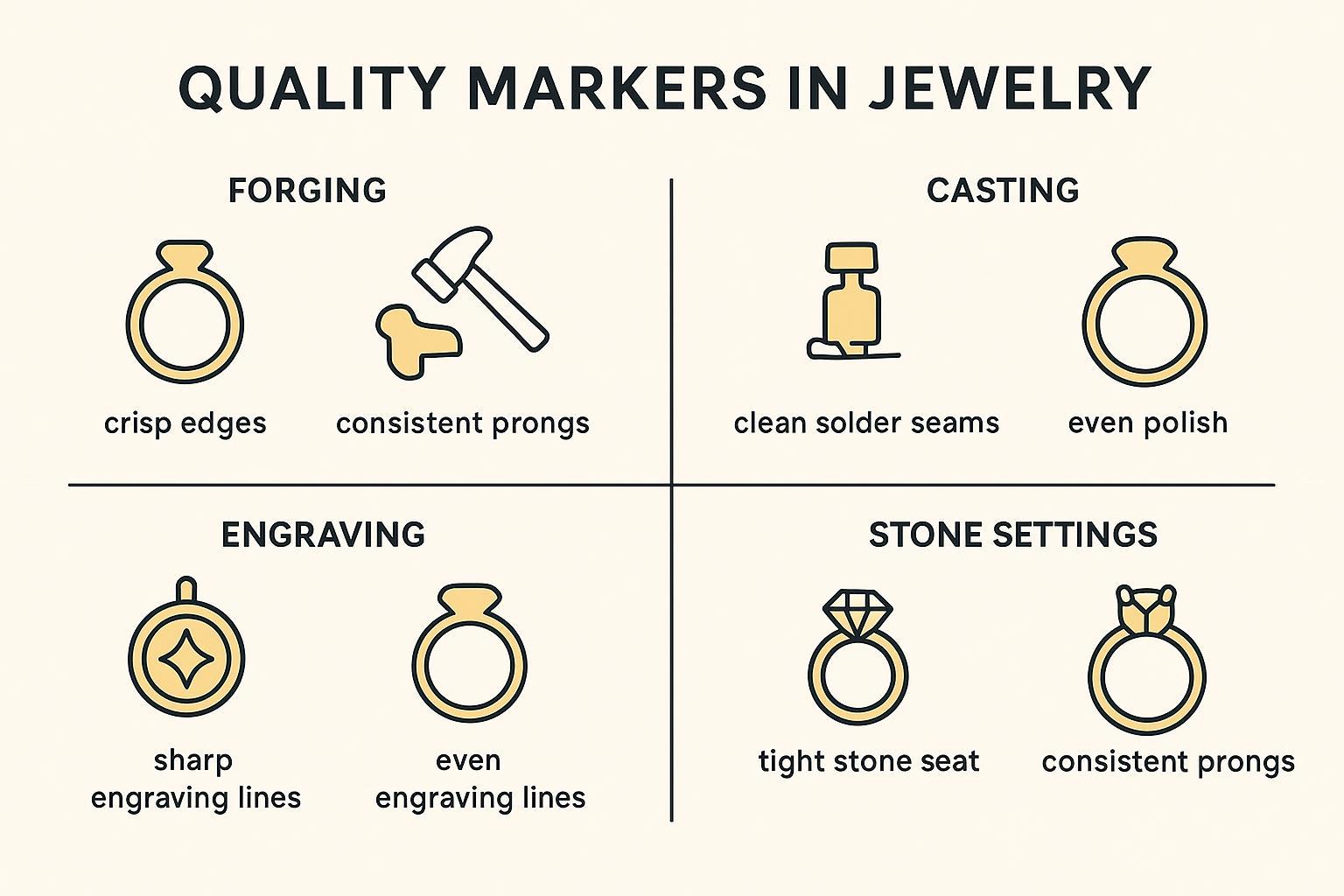
Crisp transitions at edges and corners (not mushy).
Symmetry that still feels “alive” (not overly uniform, but not sloppy).
Clean joins: seams that are tight and finished, not gapped or lumpy.
For an accessible comparison of fabrication versus casting and what each excels at, see ZoeZoe Jewelry’s explanation of hand‑fabricated vs cast jewelry.
Casting and hand finishing
Casting creates a piece by pouring molten metal into a mold (often lost-wax casting). It’s ideal for complex shapes, repeatability, and sculptural detail.
The risk is not “casting” itself—it’s poor casting and careless finishing. Casting can trap porosity (tiny voids) if the process is not controlled, and thin cast prongs or shanks are less forgiving if they’re underbuilt.
Visible cues you can look for
Pits, pinholes, or “orange peel” texture where the surface should be smooth.
Over-buffed details (engraving softened, edges rounded unintentionally).
Prongs that look bulky but still feel weak—often a sign of compromised geometry.
A balanced overview of when each method is appropriate is Mark Schneider Design’s guide to cast vs hand‑fabricated jewelry.
Engraving, wirework, enameling
These techniques are where craft becomes legible.
Engraving: Hand engraving tends to show decisive line work, controlled depth, and clean starts/stops. Machine engraving can be beautiful, but it often looks uniform in depth and spacing. Either is fine—what you don’t want is hesitant, fuzzy lines or burrs.
Wirework (including filigree): Look for even thickness, consistent curvature, and tidy joins. The underside matters: messy solder blobs and sharp tails are a wearability problem and a repairability problem.
Enameling: Quality enamel sits evenly within its boundaries, with clean edges where color meets metal. Watch for pits, cloudy areas, or hairline cracks (some can be normal with age, but they change care and durability).
Materials and Metal Purity
Gold, platinum, and silver grades
In the US you’ll commonly see gold marked in karats (10K, 14K, 18K) and sometimes in millesimal fineness (for example, 585 for 14K or 750 for 18K). Sterling silver is often stamped 925. Platinum is commonly marked 950, sometimes with PT/PLAT abbreviations.
If you’re trying to decode metal purity stamps, start with the straightforward ones (14K/585, 18K/750, 925, 950) and then watch for modifiers that change the category entirely (plated, filled, vermeil).
A practical reference for these stamps (including distinctions like gold plated vs gold filled) is the Plumb Club’s guide to common jewelry stamps and what they mean.
How to verify: If a listing says “18K” but the piece is stamped with plating marks (such as GP) or filled marks (such as GF), treat that as a different product category—not a minor detail.
Stone quality and settings
Stone quality is not only “the stone.” It’s also how it’s held.
Settings that signal competence
Prongs that are consistent in thickness and contact the stone evenly.
Seats (the cut area under the stone) that look clean, not hacked out.
No rattle: the stone should not move.
For pavé: consistent bead size and even spacing.
If the setting is the weak point, the stone becomes a liability—because repairs on delicate settings can be intrusive.
Ethical and recycled inputs
Ethical sourcing is not a vibe; it’s a paper trail. If a brand claims recycled gold, traceable stones, or responsible sourcing, ask what they can document: recycled content claims, supplier certifications, or provenance records.
Sustainability in fine jewellery has also become design-led: repairability, service access, and the ability to resize or restore without destroying the piece are increasingly part of what “quality” means.
Marks, Standards, and Disclosures
US stamps and maker’s marks
In the US, stamps are common, but the system is not the same as countries with mandatory assay-office hallmarking. That reality changes the buyer’s approach: the stamp is a clue, not the final proof.
What to look for:
A fineness mark (e.g., 14K / 585, 925, 950).
A maker’s mark (a manufacturer or jeweler identifier).
In everyday conversation, buyers often call these jewelry hallmarks, even though the US system doesn’t mirror European hallmarking offices. Treat the marks as part of your evidence set—useful, but not sufficient on their own.
For a broader overview of marks and signatures—including platinum fineness conventions—M.S. Rau Antiques provides a useful primer on marks and signatures in jewelry.
Treatment and lab-grown terms
Two principles keep you safe:
Words should match material reality.
Any treatment that affects value, permanence, or care should be disclosed.
If you want one phrase to remember, it’s gemstone treatment disclosure: you’re entitled to know what was done, whether it’s stable, and what care it requires.
The Federal Trade Commission outlines when sellers should disclose treatments and how to describe lab-created stones in its guidance, In the Loupe: Advertising Diamonds, Gemstones and Pearls.
Also, Jewelers of America’s consumer-facing Gemstone Buying Guide is a clean checklist for what you’re entitled to ask (treatments, stability, special care, and documentation).
International hallmark context
If you buy internationally (or buy vintage pieces made abroad), you may encounter hallmarking systems with assay offices and additional symbols beyond purity. These can be helpful—when they’re authentic—but don’t treat unfamiliar marks as automatically trustworthy.
If you can’t decode a mark confidently, your safest path is verification: identify the maker, confirm the metal content, and match the story to documents.
Authenticate and Evaluate
Paperwork and lab reports
For meaningful purchases, paperwork is part of the object.
Minimum expectations:
Original purchase documentation (invoice/receipt) where possible.
Any service records (especially for vintage or pre-owned pieces).
Lab reports when stones are significant or when treatments materially affect value.
How to verify: A PDF is shareable, not authoritative. Verify lab reports directly with the issuing lab if the lab provides a report-check tool.
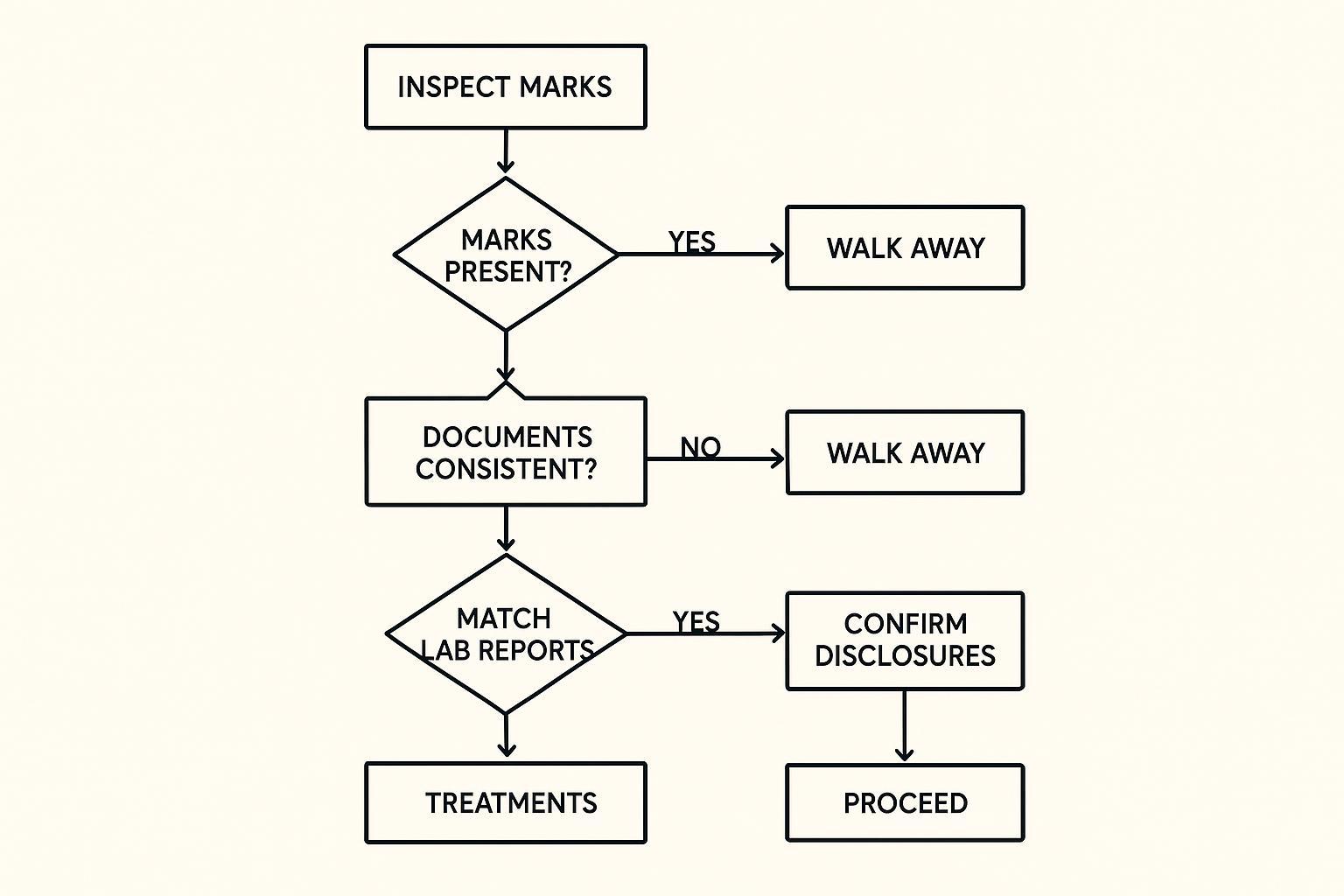
Step-by-step inspection
Start with what you can verify in your hand, then move to what you can verify in systems.
Overall geometry: symmetry, balance, comfort, and whether the piece sits correctly.
Edges and contact points: anything that snags now will irritate you later.
Settings: check prongs/bezel edges, movement, and consistency.
Surface under light: look for pits, cracks, uneven polish, and over-buffing.
Marks: confirm fineness and maker’s marks are present and legible.
Match to paperwork: do metal description, stone description, and any identifiers align?
Red flags to avoid
Red flags are usually boring—and that’s the point.
Stamps that don’t match the listing language.
Vague answers about treatments (“I think it’s natural” is not a disclosure).
No meaningful paperwork for a supposedly high-value piece.
Loose stones, rough prongs, or visible repairs presented as “patina.”
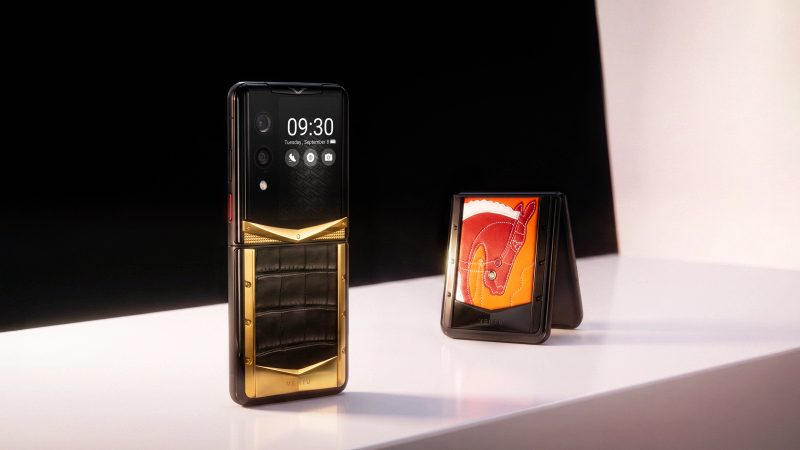
In practice, many collectors treat authentication as a managed workflow: someone coordinates the document chase, schedules independent checks, and keeps a clean record of what was verified and when. In that sense, a concierge model like VERTU can be a useful reference point—not as a jewellery authority, but as an example of how high-end buyers often want verification handled: discreetly, methodically, and with fewer loose ends.
If you’re buying pre-owned or cross-border, consider creating a simple “provenance packet” for yourself: photos at receipt (including close-ups of marks), seller communications, invoice, and any lab documents—organized so a third party can re-check it later. VERTU’s broader writing around “verification-first” luxury buying (for example, its guide on demanding a provenance packet in Most Expensive Phones in the World 2026) illustrates the mindset: treat verification as part of the purchase, not an afterthought.
Trends and Longevity
2023–2026 craftsmanship trends
Three trends matter because they affect what you’ll see—and what you should ask for.
First, provenance is getting more explicit. Luxury is moving from narrative (“ethically sourced”) to proof (traceability, documentation, verification). Lombard Odier frames this shift as traceability moving “from trust to proof” in its 2026 perspective on sustainability and innovation in luxury jewellery.
Second, mixed methods are normal now. CAD and precise manufacturing can coexist with true craft—especially when the hand-work shows up where it counts: setting, finishing, engraving, and final quality control.
Third, durability is trending upward as a value signal. Repairability, service access, and thoughtful metal choices are becoming part of the craftsmanship conversation, not separate from it.
Care, service, and maintenance
A piece is only as valuable as its future.
Ask:
Who will service it—and for how long?
Is resizing straightforward, or structurally risky?
Are stones easy to re-secure without rebuilding the setting?
Clean gently unless you know the stone and any treatments. Some treatments and some stones have special-care requirements; the FTC’s guidance on disclosures exists for a reason.
Personalization and value
Personalization can add meaning without harming value—if it’s reversible or if it’s done at a level that matches the piece.
Engraving, monograms, and subtle custom details are at their best when they’re integrated into the design, not added as an afterthought. The quality test is simple: does the personalization look inevitable?
Conclusion
True quality in artisanal jewellery craftsmanship is legible if you know where to look.
Techniques tell you how a piece was made; materials tell you what it is; markings and disclosures tell you whether the story matches the object; and documents protect you when value and authenticity matter.
Your action plan is intentionally straightforward: inspect the piece in-hand, verify the marks, demand clear disclosures, match paperwork to reality, and then maintain what you own so it ages with dignity.
Disclosure: This article references VERTU pages. Editorial judgment remains the priority.