

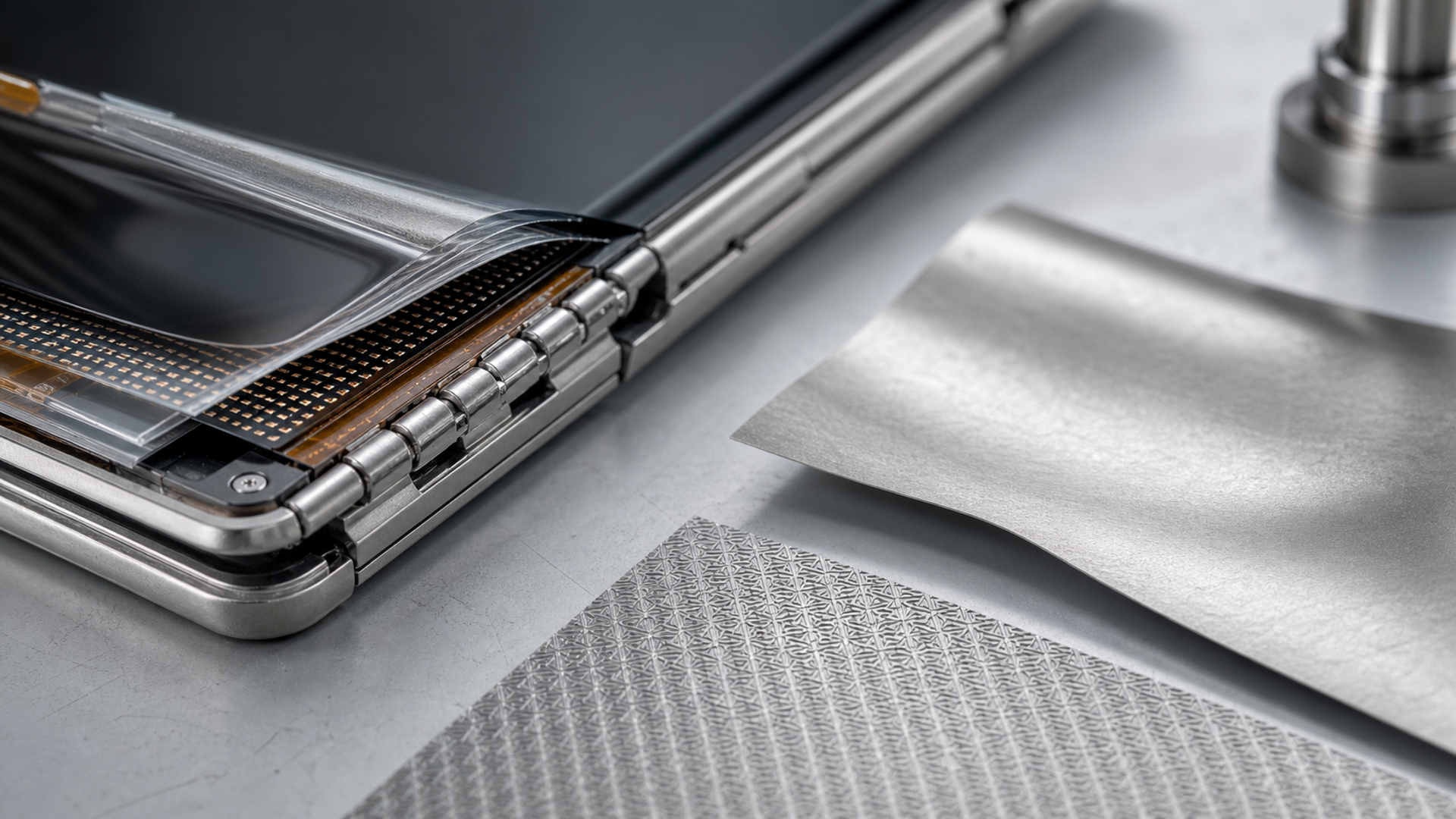
Samsung announced Flex Titanium on 15 July 2026 for its next generation of Galaxy foldables. The new display structure combines a titanium-alloy film with a micro-patterned titanium plate, which Samsung says can balance thinness, flexibility and strength while reducing crease visibility. It is a credible engineering story. It is not yet a complete buying answer.
Materials inside a foldable matter only through the outcomes owners can observe: a flatter-looking display, reliable touch response, resistance to repeated use, manageable repair costs and useful battery life. Until shipping devices are tested, buyers should separate what has been announced from what remains unmeasured.
Announced claim vs buyer evidence
| Samsung’s announced direction | What it could improve | Evidence buyers still need |
|---|---|---|
| Titanium-alloy film and titanium plate | Support under the flexible panel | Drop, pressure and repeated-fold testing on the complete device |
| Micro-patterned holes in the folding section | Flexibility without a solid rigid plate | Long-term fatigue behaviour and debris exposure |
| Tighter display-module bonding | More stable support and fewer air gaps | Repairability, protector behaviour and heat-cycle results |
| Reduced crease visibility | Flatter appearance and better immersion | Side-light, dark-screen and touch tests on used retail units |
| New organic display materials and architecture | Higher resolution and lower power use | Measured battery effect at equal brightness and workload |
The source matters. Samsung’s UK Flex Titanium announcement describes the structure and says it will debut in next-generation Galaxy foldables. Samsung’s global newsroom listing confirms the 15 July release in the run-up to Galaxy Unpacked. Neither page provides a repair price, dust rating, fold-cycle number or independent endurance result.
Test 1: crease visibility after use, not under launch lighting
A crease can be measured in several ways: depth, width, reflected-light distortion, touch sensation and visibility at an angle. “Reduced visibility” does not necessarily mean the fold disappears.
When retail units arrive, compare them under three conditions:
a white document at normal brightness;
a dark video scene under overhead lighting;
an oblique view beside a current-generation foldable with similar use.
Then repeat after the demo device has accumulated real openings. Launch photography can control angle and reflection. Owners use phones beneath office lights, near windows and outdoors.
Also draw slowly across the fold in a note or illustration app. A visual improvement should not introduce a touch discontinuity. Record whether a stylus is supported and whether pressure limits apply.
Test 2: complete-device durability
Titanium is not a magic word. Alloy, thickness, geometry, joining and surrounding materials decide performance. Flex Titanium sits inside a system that includes flexible organic layers, adhesives, protective films, hinge components, frame and seals.
Ask for complete-device evidence:
published water and dust ratings;
drop-test method and orientation;
repeated-fold method, temperature and pass criteria;
pressure resistance when the phone is closed in a bag;
behaviour after fine-particle exposure;
warranty treatment of inner-screen protector lifting.
A stronger support plate can improve one failure mode while leaving another unchanged. The buyer needs system reliability, not the strength of an isolated sample.
Test 3: repair pathway and parts price
Tighter bonding and more integrated layers can improve feel. They can also affect how much of the display module must be replaced after damage. Before ordering, find the current local price for:
| Repair event | Price to obtain | Service question |
|---|---|---|
| Inner display damage | Is the hinge or frame included in the module? | |
| Protector lifting or bubbling | Is one replacement covered? | |
| Outer display damage | Can it be replaced independently? | |
| Hinge contamination or failure | Is data retained and water resistance restored? | |
| Battery service | Does the display assembly need removal? |
Check accidental-damage cover, excess, claim limits and turnaround. A material advance that reduces failure probability may still live inside an expensive replacement assembly.
Test 4: power efficiency at equal conditions
Samsung says the new display combines a high-resolution architecture with next-generation organic materials to reduce power consumption. The meaningful metric is not panel efficiency in isolation; it is device endurance at equal brightness, refresh behaviour, network conditions and workload.
Look for tests that hold these variables steady:
200-nit document reading on the inner display;
video streaming at matched resolution;
split-screen navigation and messaging;
video call while half open;
outer-screen-only mixed use;
standby after repeated open-close transitions.
If the next device is thinner, any panel saving could be spent on a smaller battery or higher brightness. Only whole-device measurement shows what reaches the owner.
Test 5: daily friction
The best display technology cannot fix poor ergonomics. Handle the shipping device with its real case. Open it one-handed, type on the cover screen, use it on a table and put it in a normal pocket. Check whether hinge protection makes it too bulky and whether the new structure changes weight distribution.
Use our three-year foldable versus slab test to score task utility, service, battery and resale together. The inner display should earn its additional complexity several times a week.
Who should wait for retail tests?
Wait if your current phone is reliable, you work in dusty environments, repair downtime is costly or crease reduction is the main reason to upgrade. A launch event can establish specifications; it cannot show ageing.
Early adoption is more defensible if a foldable already transforms your document, travel or creative workflow, local service is strong and the protection plan makes the downside acceptable. Even then, order against the published warranty and return period, not an assumed material advantage.
Verdict
Flex Titanium is more specific than a vague “stronger screen” claim: Samsung has identified two titanium-based components, the bonding approach and the intended crease and efficiency benefits. That specificity deserves attention.
Buyers should still demand five forms of evidence: used-unit crease behaviour, complete-device durability, repair economics, matched-condition battery tests and daily ergonomics. Titanium can be an important part of the engineering. The product decision begins where the materials announcement ends.
Save retail test results and the written repair terms. They will remain useful after launch coverage moves on to the next headline feature.
![How to Scan Receipts and Documents with Your Phone [Full Guide]](https://cdn.sanity.io/images/e0gp1l2g/production/0db13feec1d5e72b8a8a5f976d1f3e86619c9228-3840x1860.webp?w=180&h=180&q=78&auto=format&fit=crop)
![How to Scan Receipts and Documents with Your Phone [Full Guide]](https://cdn.sanity.io/images/e0gp1l2g/production/0db13feec1d5e72b8a8a5f976d1f3e86619c9228-3840x1860.webp?w=800&h=450&q=82&auto=format&fit=crop)
![Top 10 Two-Tone Carbon-Fibre Watches for Men [2026 List]](https://cdn.sanity.io/images/e0gp1l2g/production/18870799ba33fab0e038968359cd5772d7d7db30-1024x576.webp?w=800&h=450&q=82&auto=format&fit=crop)
![Top 10 Luxury Watches with Digital Complication Displays for Men [Latest]](https://cdn.sanity.io/images/e0gp1l2g/production/c4f6bf8c080f291c39f7cc85c7344ecff2fd3799-1024x553.webp?w=800&h=450&q=82&auto=format&fit=crop)