

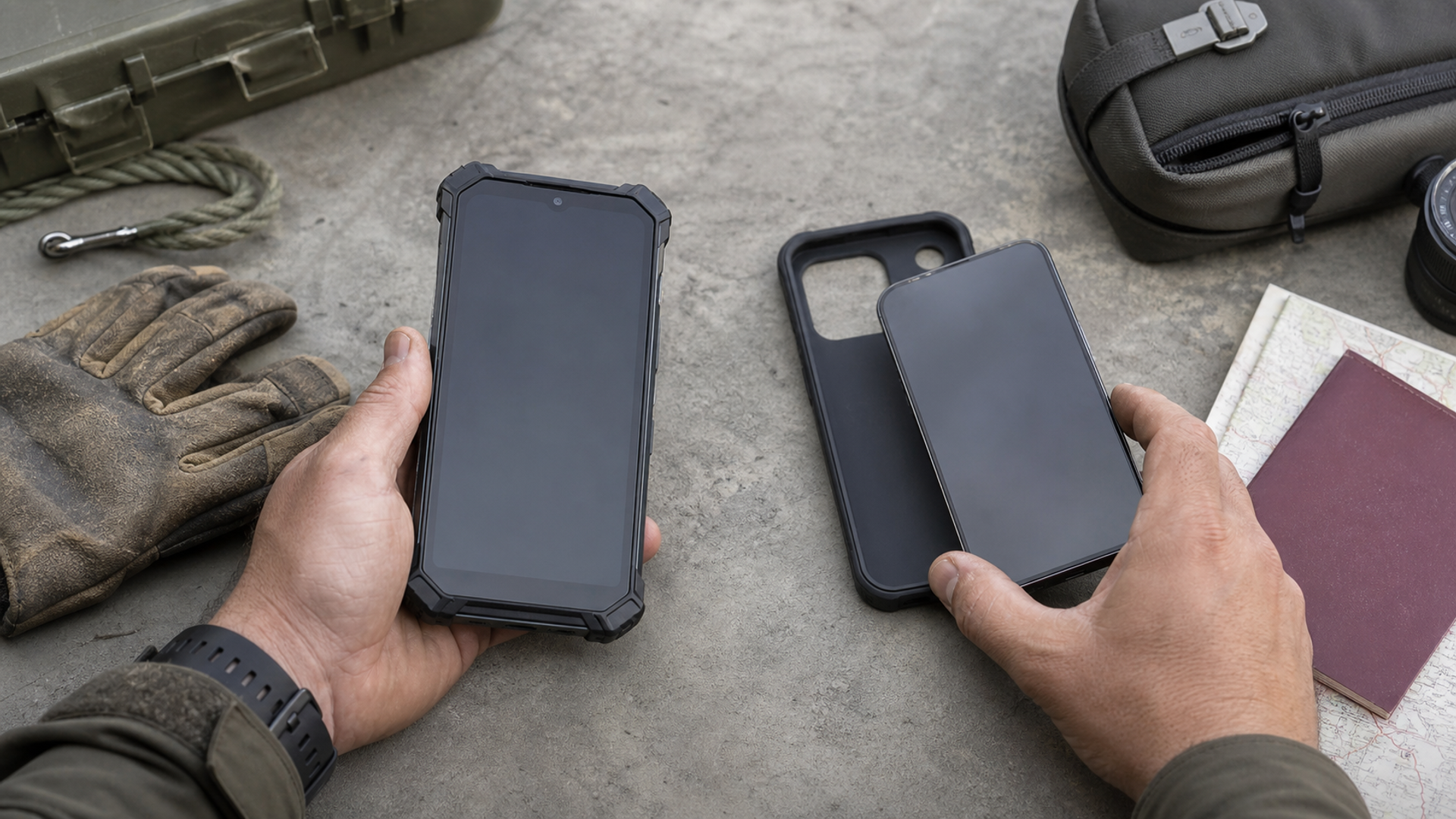
A purpose-built rugged phone is the better choice when physical exposure is frequent, predictable and central to the job. A mainstream flagship in a well-designed case is usually better when damage is occasional and camera quality, software support, repair access, pocketability and resale value matter every day.
That answer is less dramatic than “buy the toughest phone”, but it reflects the real decision. Durability is not one number. It is the probability of failure multiplied by the consequences of failure, plus the compromises and costs you carry even when nothing breaks.
Existing VERTU coverage largely explains ratings or lists products; this guide addresses the separate decision of whether protection should be built into the phone or added around a mainstream flagship.
Start with your failure, not the marketing label
Picture the most credible bad day for the phone.
For a field engineer, it may be a repeated drop onto concrete followed by dust and rain, hours from a replacement device. For a frequent traveller, it may be one fall at an airport, a cracked screen and an urgent need for local repair. For a parent, it may be repeated low-height drops, drink spills and a case that must remain comfortable enough to use every day.
These are different risk profiles. A thick enclosure, recessed screen and glove-friendly controls may be essential in the first. The same design may impose unnecessary weight, weak cameras and poor long-term software support in the second. A replaceable case can absorb routine impacts in the third, but only if it fits correctly and the phone’s exposed ports, camera lenses and screen are still protected.
Our earlier explanation of testing phone durability beyond a “military grade” label is useful background. The buying decision here goes further: every protective claim must be connected to your likely failure and to the cost of recovery.
What the evidence can—and cannot—tell you
IP ratings cover ingress under defined conditions
IEC 60529 is the international standard behind the familiar IP code. The IEC publication record for IEC 60529 describes classification of protection provided by enclosures against access, solid foreign objects and water. The two digits answer defined ingress questions; they do not certify drop survival, saltwater resistance, screen strength or permanent sealing after years of impacts and repairs.
Even a high IP rating needs model-specific conditions. Apple states in its liquid-resistance guidance that supported iPhones were tested under controlled laboratory conditions, that resistance is not permanent and that it may decrease through normal wear. Apple also says liquid damage is not covered by its standard warranty, subject to consumer-law rights. Samsung likewise says in its Galaxy IP guidance that water resistance can diminish over time through wear and that the exact rating depends on the device.
A case can improve impact protection, grip and coverage around vulnerable edges. It cannot raise the phone’s official IP rating unless the entire phone-and-case system has its own documented test result. Port covers can help in dirty environments, but poor seals or grit trapped inside a case can create different risks.
MIL-STD-810H is a tailored test-method framework
The official US Defense Logistics Agency ASSIST record for MIL-STD-810H Change 1 makes an important point that marketing often loses: the document provides environmental engineering direction and test methods, but does not itself impose one universal design or test specification. The programme is meant to tailor environmental stresses and methods to a system’s requirements.
Therefore, “tested to MIL-STD-810H” is incomplete information. Ask which methods were used, with what procedures, units, orientations, heights, temperatures and acceptance criteria; whether the test covered a production phone; and whether an independent laboratory or the manufacturer performed it. One passed method does not mean the phone passed every environmental method in the standard.
That is why this guide does not repeat a generic list of MIL-STD procedures or rank phones by the number of badges. The decision depends on the relevance and transparency of the test evidence.
The EU label broadens the durability picture
For smartphones placed on the EU market within scope, Commission Delegated Regulation (EU) 2023/1669 requires an energy label and product information that include battery endurance, repeated-free-fall reliability class, repairability class, battery cycle endurance and ingress-protection information. The regulation’s technical documentation also covers screen scratch resistance and the minimum guaranteed availability of software updates.
This is valuable because it separates several dimensions that the word “rugged” compresses. A phone can resist repeated drops yet be difficult to repair. It can have strong ingress protection but short software support. It can survive an accident but create long downtime if parts and authorised service are unavailable.
No single label answers the full purchase question, but the EU framework gives buyers a more comparable evidence set than an isolated toughness claim.
Total ownership and failure-risk matrix
Use this matrix to compare an actual rugged model with an actual flagship-and-case combination. Replace assumptions with model-specific evidence before buying.
| Decision factor | Purpose-built rugged phone | Mainstream flagship + protective case | What to verify |
|---|---|---|---|
| Repeated drops | Enclosure, corners and controls may be designed as one protective system | Performance depends heavily on case fit, lip height, screen protector and exposed camera area | Exact drop procedure, height, surface, orientations, number of drops and pass criteria |
| Dust and water | Often includes port protection and an IP rating, but conditions still matter | Many flagships have strong IP ratings; a case may not preserve access or sealing after damage | Official IP rating, immersion conditions, salt/chemical exclusions and wear caveats |
| Screen failure | Recessed or smaller display can reduce exposure | Larger edge-to-edge display may be more exposed; replaceable case lip and protector can help | Screen material, replaceability, protector compatibility and repair price |
| Gloves, rain and field controls | Physical or programmable buttons may suit field work | Touch-first design may be harder with gloves or a wet screen | Actual glove mode, wet-screen behaviour, button mapping and accessory support |
| Camera and performance | May prioritise robustness over imaging, weight or processor efficiency | Usually offers stronger cameras, displays and mainstream accessories | Sustained performance, camera needs and whether protective accessories obstruct sensors |
| Weight and pocketability | Protection is always attached and can be bulky | Protection can be selected or removed for different contexts | Full system weight and dimensions, not phone-only figures |
| Repair and parts | Specialist device may have fewer local repair options | Mainstream models often have wider service networks, but repair costs can be high | Parts availability, repair time, local service, loan device and data-handling policy |
| Software support | Varies widely and can be shorter than the hardware’s physical life | Leading flagships may offer longer, clearer update commitments | Named support end date and security-update cadence |
| Case lifecycle | Integrated enclosure cannot be replaced independently | Worn case or screen protector can be replaced cheaply | Replacement-case availability for the years you plan to keep the phone |
| Resale and redeployment | Specialist demand may be narrower | Mainstream models often have a broader resale and accessory market | Real trade-in value, condition rules and enterprise redeployment plan |
| Downtime consequence | Best when preventing one failure outweighs daily compromises | Best when fast repair or replacement limits the consequence of a rare failure | Replacement lead time, backup device and restoration process |
Choose a rugged phone when exposure is the normal condition
A rugged phone becomes rational when several of these statements are true:
The device regularly encounters concrete, dust, vibration, rain or temperature extremes.
A broken phone creates a safety, operational or revenue problem rather than an inconvenience.
Workers use gloves, mounted equipment or programmable hardware controls.
The organisation can validate the exact environmental tests against its own exposure profile.
The additional size and weight do not discourage correct use.
The supplier can provide acceptable software support, parts and replacement logistics.
The last point is essential. Hardware that survives five years but stops receiving security fixes after two is not a durable business asset. Nor is a phone resilient if a damaged proprietary component creates weeks of downtime.
Carrier compatibility also needs a separate check. Our guide to rugged-phone carrier support explains why a tough enclosure does not guarantee the right radio bands, certifications or operator features.
Choose a flagship and case when flexibility lowers total risk
The flagship-plus-case route is generally stronger when:
The main hazards are occasional hand-height drops, scratches and everyday spills.
Camera quality, display quality, accessibility or high sustained performance matters more often than extreme exposure.
A wide service network and rapid replacement reduce the consequence of failure.
You want to replace worn protection without replacing the phone.
You need long, explicit software support or a mature enterprise-management ecosystem.
Weight and pocketability affect whether the device is actually carried and used.
Do not treat the case as decoration. Check that the corners deform to absorb energy, the screen and camera sit below protective lips on a flat surface, buttons remain usable, charging and microphones are unobstructed, and the case does not trap grit against a polished frame. A screen protector can reduce scratch or impact exposure, but it is another replaceable layer—not a guarantee that the display cannot break.
Case materials matter, but performance depends on geometry, fit and the specific impact. Treat unsourced material claims as marketing until the complete phone-and-case system has relevant test evidence. If the phone’s exposed display is your largest financial risk, compare repair terms and replacement cost alongside material language. Readers considering premium screen materials can use our guide to phones with sapphire crystal screens as a starting point, while still checking the complete device design.
Calculate the cost of failure, not only the purchase price
Use a three-year horizon and estimate five numbers:
Initial system cost: phone, case, screen protector, mount and required accessories.
Expected damage cost: credible failures multiplied by their probability and repair or replacement price.
Downtime cost: lost work, emergency shipping, temporary-device setup and data restoration.
Daily compromise cost: extra weight, weaker camera, reduced performance or poor usability carried across every working day.
End-of-life value: resale, redeployment, parts availability and the security-support end date.
This calculation can reverse the obvious answer. A costlier rugged phone may be cheaper for a remote technician if it prevents one operational outage. A premium flagship may be cheaper for a travelling executive if it is more productive every day and can be repaired or replaced within hours in major cities.
A five-minute pre-purchase evidence check
Before choosing either route, collect the following:
The phone’s full IP rating and manufacturer-stated test conditions.
Any MIL-STD-810H methods, procedures and acceptance criteria actually completed.
Repeated-drop evidence, including orientations and test surface.
Full weight and dimensions with the intended case and protector installed.
Security and operating-system support commitment.
Screen, battery and port repair price; parts availability; expected turnaround.
Warranty exclusions for liquid, impact and third-party accessories.
Bands, eSIM/SIM support and operator certification in the markets that matter.
A backup and restoration plan for the day protection fails.
If a seller cannot provide enough detail to connect a claim to your use case, treat the claim as unverified rather than assuming the strongest interpretation.
The VERTU perspective: protection should preserve the experience
For a premium phone owner, resilience includes more than surviving a drop. The device must remain comfortable to carry, effective for communication and photography, secure over time and serviceable without avoidable uncertainty. Materials and craftsmanship can reduce risk, but only when they are part of a coherent design and supported by clear care and repair arrangements.
That leads to a more useful definition of luxury durability: protection that preserves the intended experience instead of overwhelming it. In a harsh work environment, that may mean a purpose-built rugged enclosure. In executive travel and everyday ownership, it may mean a refined phone, a carefully chosen protective system and a reliable recovery plan.
The verdict
Buy a rugged phone when extreme exposure is routine and the evidence matches that exposure. Buy a flagship with a case when accidents are occasional and software support, cameras, service access and daily usability lower your total risk.
Ignore the loudest badge. Compare the complete system: phone, protection, support, repair, replacement and the cost of being without it. The most durable purchase is the one that survives your real life—and recovers quickly when it does not.
![How to Scan Receipts and Documents with Your Phone [Full Guide]](https://cdn.sanity.io/images/e0gp1l2g/production/0db13feec1d5e72b8a8a5f976d1f3e86619c9228-3840x1860.webp?w=180&h=180&q=78&auto=format&fit=crop)
![How to Scan Receipts and Documents with Your Phone [Full Guide]](https://cdn.sanity.io/images/e0gp1l2g/production/0db13feec1d5e72b8a8a5f976d1f3e86619c9228-3840x1860.webp?w=800&h=450&q=82&auto=format&fit=crop)
![Top 10 Two-Tone Carbon-Fibre Watches for Men [2026 List]](https://cdn.sanity.io/images/e0gp1l2g/production/18870799ba33fab0e038968359cd5772d7d7db30-1024x576.webp?w=800&h=450&q=82&auto=format&fit=crop)
![Top 10 Luxury Watches with Digital Complication Displays for Men [Latest]](https://cdn.sanity.io/images/e0gp1l2g/production/c4f6bf8c080f291c39f7cc85c7344ecff2fd3799-1024x553.webp?w=800&h=450&q=82&auto=format&fit=crop)