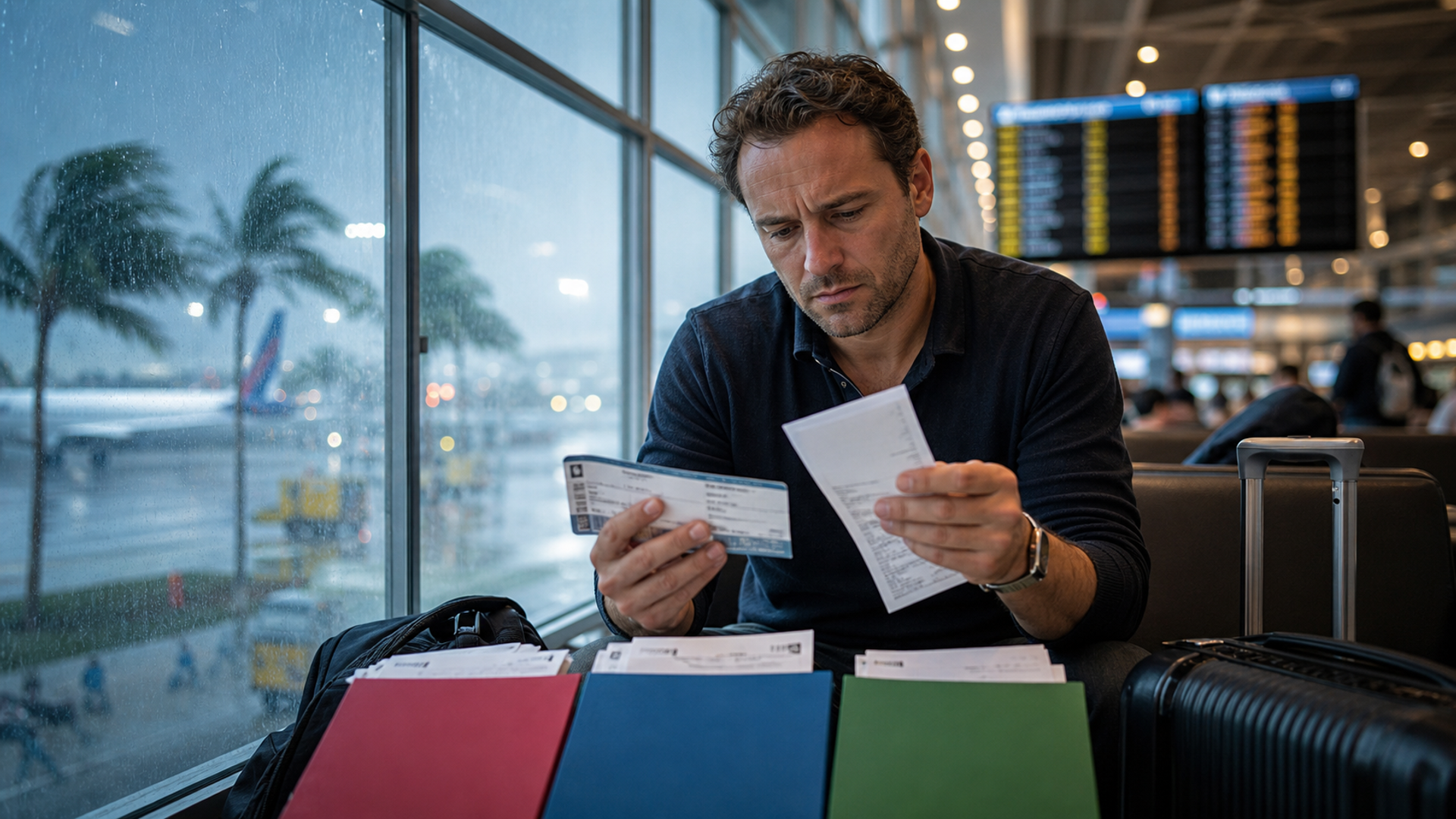
Tropical Storm Bertha is moving across the US Gulf Coast while “Houston weather” is surging in current searches. For travellers, the urgent question is not simply whether a flight is late. It is whether the disruption gives you a refund, a new flight, meals or a hotel, repayment of reasonable expenses, fixed cash compensation, or only whatever your insurance policy covers.
Those are different rights. In the United States, an airline cancellation or significant change can create a refund right when you choose not to travel, but federal rules do not create a broad EU-style weather-delay compensation payment. Under UK261 and EU passenger-rights rules, care and re-routing rights can apply during long delays, while fixed compensation normally depends on arrival delay, route and whether the cause was within the airline’s control. Severe weather is commonly treated as an extraordinary circumstance, so care can be due even when cash compensation is not.
This guide is a decision tool, not individual legal advice. It reflects official sources checked on 23 July 2026. Rules, enforcement status and your itinerary can change the result. Use the regulator linked for your jurisdiction and keep the airline’s written explanation.
The five remedies people incorrectly call “compensation”
| Remedy | What it means | Typical trigger | The evidence to keep |
|---|---|---|---|
| Refund | Return of the unused ticket price and eligible ancillary fees | Airline cancels or makes a qualifying significant change and you decline the alternative | Original itinerary, cancellation or change notice, payment record and your rejection of alternatives |
| Re-routing or rebooking | Transport to the ticketed destination on another service | Cancellation or material disruption where the applicable rules require a choice | Airline offers, timestamps, alternative routes you proposed and agent chat transcripts |
| Care | Meals, communication and sometimes hotel/transport while waiting | Delay length crosses a route-specific threshold under UK/EU rules | Boarding pass, scheduled and actual times, itemised reasonable receipts |
| Fixed compensation | Standard payment for inconvenience, separate from ticket price | Qualifying delay/cancellation under UK/EU rules when no extraordinary-circumstance defence applies | Arrival time, notice date, operating carrier, cause explanation and claim record |
| Insurance reimbursement | Payment under your private policy for covered delay, missed connection or extra costs | Policy-specific delay period and covered cause | Carrier delay certificate, receipts, policy wording, proof of loss and other reimbursements |
Do not accept a voucher before understanding whether doing so waives a refund or affects another claim. Do not describe a meal receipt as “compensation” when submitting it; claim it as care or reasonable expense. Clear categories reduce avoidable rejection.
Step one: identify which regime governs the flight
Passenger nationality is usually not the deciding factor. Route and operating carrier matter.
For a flight to, from or within the United States, start with the US Department of Transportation refund rules and the airline’s customer-service commitments. For UK261, the UK Civil Aviation Authority delay guidance covers flights departing a UK airport and certain flights arriving in the UK on a UK or EU carrier. For the European Union, the official Your Europe air-passenger-rights tool explains coverage for flights within the EU, flights departing the EU and some arrivals on EU airlines.
Codeshares complicate the answer. Record the operating carrier, not just the marketing airline printed first on the booking. A single reservation with a connection can also change which airport counts as the final destination when measuring arrival delay.
United States: refund is not the same as delay compensation
The DOT says a consumer is entitled to a refund if the airline cancels a flight and the traveller chooses not to take the replacement or another form of compensation. A qualifying significant delay or schedule change can also create a refund right when the traveller declines to continue. The DOT page defines significant changes through factors such as timing, airport and accessibility consequences; apply the current official definition to your exact itinerary.
If you accept the changed flight and travel, the ticket-refund right generally disappears. You may still receive meals, hotel accommodation, transport or travel credits under the carrier’s commitments when the cause is within its control. Weather usually sits outside that category. The DOT Airline Customer Service Dashboard shows current commitments, but it is not a promise that a carrier will pay every cost during a storm.
US travellers should make the first decision explicitly: Do I still want the trip? If no, ask the airline to confirm cancellation or significant change and request the form of refund the rule provides. If yes, seek rebooking first and do not cancel the ticket yourself without understanding the fare conditions. A voluntary cancellation of an operating flight can produce a very different outcome from an airline cancellation.
Automatic refunds under DOT rules are generally tied to rejecting the alternative. The official guidance states that refunds owed after that decision should be returned within seven business days for credit-card purchases or twenty calendar days for other payment methods. Save the date you declined the alternative and the refund confirmation.
United Kingdom: care can survive the weather defence
The UK CAA says an airline must look after passengers when a covered flight is delayed beyond the applicable threshold. Care can include food and drink, communication and, for an overnight delay, hotel accommodation and transport. If the airline cannot organise care, the CAA advises passengers to make reasonable arrangements and keep itemised receipts.
Compensation is a separate question. Arrival more than three hours late can qualify, but not when the airline proves the disruption resulted from extraordinary circumstances. The CAA’s compensation eligibility guidance lists severe weather and air-traffic-control restrictions among circumstances that can fall outside the airline’s responsibility.
That does not erase the duty of care. A weather event can block fixed compensation while leaving meals and accommodation due after the relevant waiting period. This distinction is the most common source of passenger confusion.
The CAA also states that a delay exceeding five hours can allow a passenger to choose not to travel and receive a refund. If you are part-way through a connected itinerary, use the official guidance before booking your own replacement because the right to a return flight or re-routing can depend on the reservation structure.
European Union: route, arrival time and cause all matter
EU rules distinguish assistance, reimbursement or re-routing, and fixed compensation. The European Commission’s air-passenger page links the governing regulation, current interpretative material and enforcement bodies. Your Europe explains that passengers delayed at departure can receive assistance based on duration and distance, and that arrival delay of three hours or more can create compensation when extraordinary circumstances do not apply.
Adverse weather can be extraordinary, but the operating carrier must connect the event to the cancellation or delay and show that reasonable measures could not have avoided the outcome. “Weather” typed into an automated message is evidence of the carrier’s position, not necessarily the complete proof. Ask for a written cause and retain airport or air-traffic notices if available.
The rulebook is also changing. The Council’s July 2026 passenger-rights summary describes newly approved measures and stronger information, care and reimbursement provisions. The European Parliament announced an upgrade earlier in July. Travellers should check whether a new provision is legally in force for the disruption date rather than assuming every press-release summary already applies. This article therefore uses the current regulator tools as the claim route and flags the reform separately.
The Bertha decision tree
Use this sequence when weather threatens a US, UK or EU itinerary.
Confirm the operating status. A forecast is not a cancellation. Check the operating carrier, airport and regulator or weather authority. For Gulf Coast conditions, the National Weather Service and National Hurricane Center are authoritative; screenshots from social media are not.
Keep the original itinerary. Save flight numbers, connection, scheduled times, ticket number and payment method before an app overwrites them.
Ask for the cause in writing. Record whether the carrier cites weather, air-traffic restrictions, crew, aircraft or a knock-on delay. Different segments can have different causes.
Choose travel or refund. In the US especially, accepting rebooking and taking the flight can close the ticket-refund path. Do not make the choice accidentally by clicking a voucher.
Request the airline remedy first. Ask the carrier to re-route, provide care or confirm the refund. Self-book only after documenting that assistance was unavailable or unsuitable under the applicable rule.
Spend reasonably. A practical airport meal and ordinary hotel are easier to defend than luxury purchases. Keep itemised receipts, not only card totals.
Record arrival, not just departure. UK/EU fixed compensation commonly turns on arrival at the final destination. Note when an aircraft door opens or the regulator’s defined arrival event.
Claim in the correct order. Airline first, regulator or alternative-dispute body second, insurer for remaining covered loss. Declare other reimbursements to avoid double recovery.
What to store on your phone before disruption
Create an offline folder containing passports, visas, insurance, ticket receipts, the full itinerary, loyalty numbers and the phone number for the issuing agent. Save regulator pages as PDFs because airport Wi-Fi can fail. Add an unedited screenshot of every rebooking offer with time and date visible.
For high-value or multi-city travel, keep a short decision note: “If delay exceeds X hours, I will still travel / I will request refund.” The point is not automation; it is preventing fatigue from turning a voucher notification into an unintended waiver. Our international eSIM decision guide can help preserve communications, while the Bertha phone-preparation checklist covers power and emergency information. Neither changes airline rights.
Common claim failures
The first failure is claiming fixed compensation for every weather delay. Weather can remove that payment while leaving care or refund rights intact. The second is cancelling voluntarily before the carrier acts. The third is losing proof because an airline app replaces the original itinerary. The fourth is submitting non-itemised or excessive expenses. The fifth is claiming from the insurer without an airline delay certificate or explanation of what the carrier already paid.
Another failure is using a claims company before checking the regulator’s free process and the fee or data-sharing terms. A third party may be useful in a contested claim, but the service cost and authority it receives should be explicit.
Bottom line
During Bertha or any weather disruption, ask four separate questions: Will I still travel? Which legal regime covers the flight? What remedy am I seeking? What evidence proves it? In the US, focus first on cancellation or significant-change refunds and the airline’s commitments. In the UK and EU, separate care and re-routing from fixed compensation, because extraordinary weather can defeat the latter without eliminating the former.
The best immediate action is documentary: preserve the itinerary, get the cause in writing, save each offer and keep reasonable receipts. Speed helps with rebooking, but precision wins the claim.