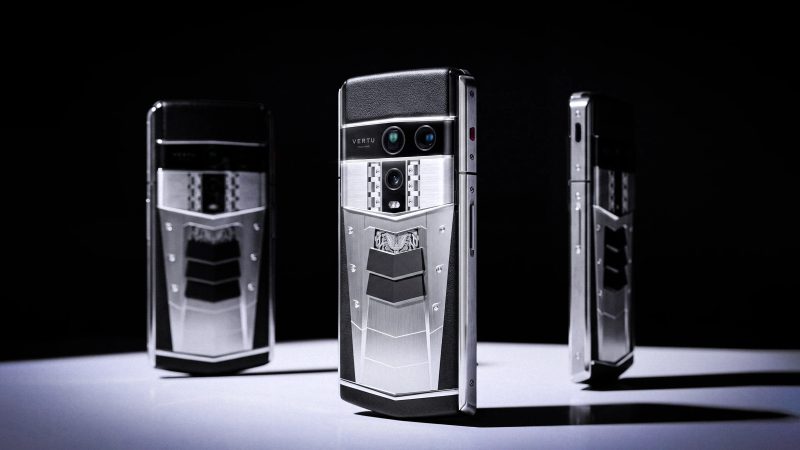
If you’re researching AlphaFold, you’re not really comparing phones.
You’re comparing operating models:
a smartphone that runs apps,
versus an “agent” device that can prepare actions across your communications, documents, and business systems — with your approval.
This guide is written for the consideration stage: what to look for, what to test, and where Hermes Agent should earn its place on an executive shortlist.
What Hermes Agent is trying to change
Most mobile “AI” features live inside an app: you prompt, it replies, you copy/paste.
VERTU positions Hermes Agent differently — as a system-level agent designed to bring voice, intent, memory, and action into one workflow on AlphaFold, with execution gated by your authorization. The value of an executive agent is not the wording of a summary.
It’s what happens after the summary:
the follow-up messages,
the approvals,
the expense capture,
the handoff to your team,
the audit trail.
According to the official product page, Hermes Agent is framed as an “intelligent command terminal” for your phone, apps, and business systems — with examples including meeting capture (record/transcribe/summarise), document review, and dashboard-style business oversight.
Key TakeawayTreat Hermes Agent like an executive workflow layer — not a chatbot. Your evaluation should focus on permissions, traceability, and reliability under real travel + privacy constraints.
A buyer’s checklist for any agent phone
You don’t need to accept any marketing claim to run a serious evaluation. You need a repeatable checklist — especially if you’re comparing a Hermes Agent phone against more traditional options.
1) Define scope in plain language
Start with boundaries.
Ask for three lists:
What it can do (actions it can reliably perform)
What it can’t do (explicitly out of scope)
What it will only do with approval (every time vs. configurable)
Because an agent is expected to act, scope definition is non-negotiable: execution without tight scope is where misfires become expensive.
2) Look for visible uncertainty signals
When an agent is unsure, you want it to behave differently — slowing down, asking, drafting, escalating.
A useful mental model comes from AlphaFold’s scientific ecosystem: modern AI credibility is often tied to confidence indicators that tell you when an output should not be treated as reliable. A 2024 review in Nature Chemical Biology notes that AlphaFold provides confidence metrics (including pLDDT and PAE), and warns against assigning relevance to low-confidence regions; even high-confidence metrics do not guarantee agreement with reality (“The power and pitfalls of AlphaFold2 for structure prediction” (2024)).
You’re not buying a protein model. But the principle transfers cleanly:
Does the agent flag uncertainty when it’s guessing?
Can you force a draft-only mode?
Does it ask clarifying questions before acting?
If an “agent” interface never admits uncertainty, assume the uncertainty is hidden — not solved.
3) Map data flow and retention, not slogans
For a privacy-sensitive buyer, “secure” is not a statement; it’s a diagram.
You want to know:
what stays on-device,
what is transmitted,
what is stored,
and how deletion works.
VERTU’s positioning includes a multi-layer security chain (hardware enclave, encryption, storage, erasure) and also notes that availability and protections can vary with configuration, network conditions, software version, user authorization, and regional constraints.
Your job is to turn that into operational questions for a briefing:
“Show me what is processed locally vs remotely for meeting capture.”
“Show me retention controls and a deletion workflow.”
“Show me what is logged, and what is explicitly not logged.”
How to verify: Ask for a one-page data-flow diagram for your top 2 workflows (meeting notes + approvals). If they can’t provide it, treat the privacy posture as unproven.
4) Require approvals and an audit trail for executive actions
The moment an agent touches approvals, payments, contracting, or official communications, you need traceability.
Ask:
Is there an action log you can review?
Can you export it?
Can you revoke permissions quickly?
Can you enforce “human-in-the-loop” for sensitive steps?
VERTU describes advanced enterprise-style capabilities (dashboards, approvals, integrations) as depending on authorization and, in some cases, private deployment and professional configuration. That’s not a drawback — it’s a reminder that serious workflows should not be casual.
5) Test failure modes under travel conditions
Executives don’t operate in lab conditions.
Your shortlist test should include:
weak connectivity,
time zones,
multi-calendar complexity,
and “wrong recipient” scenarios.
You’re looking for behavior under pressure:
Does it slow down and confirm?
Does it present a safe draft?
Does it provide an undo path?
What to evaluate specifically on this device
Keep this section practical. You are not trying to prove the device is “the best.” You’re trying to decide whether Hermes Agent is worth a live evaluation.
Executive workflow 1: meeting capture that turns into action
The product page describes a meeting flow that can be started by voice and includes recording, transcription, and AI summarisation.
Your evaluation should go beyond “can it summarise?”
Test the full loop:
Start capture with voice.
Verify consent and recording indicators.
Produce a summary.
Convert decisions into tasks.
Route tasks (to you, to an assistant, to a team channel) with explicit confirmation.
What you want to see:
clear approval prompts before messages are sent,
a searchable record of what was generated,
and the ability to correct or retract.
Executive workflow 2: voice control that reduces switching
VERTU states that Hermes Agent can control “over 64 native phone functions” by voice, with examples including alarms, hotspot, brightness, recordings, and reminders.
This isn’t a novelty feature if you travel constantly.
The real question is reliability:
Does it work consistently in noisy environments?
Does it confirm before doing anything irreversible?
Can you set different confirmation rules for different functions?
Executive workflow 3: business oversight via VPS
VERTU describes VPS (VERTU Professional System) as an AI-native executive dashboard concept that can connect Hermes Agent to authorised business systems — turning ERP/CRM/approvals/finance and messaging tools into a private “executive cockpit” on a foldable display (VPS).
For consideration-stage buyers, the most important question is not “how many modules.”
It’s deployment reality:
What systems can be connected in your environment?
What security review is required?
What does authorization look like?
What is the rollback plan?
If you want a clean starting point, begin with a single high-value action:
approve a routine request,
triage a dashboard view,
or capture and categorize an expense.
Then scale.
Collector’s note: In high luxury, the object is only half the value. The other half is the service relationship — what happens after purchase, during travel, and when something changes.
Executive workflow 4: the service layer
VERTU’s brand positioning centers on a concierge model, and the product page notes that concierge availability can vary by market, membership level, and partner availability.
For a serious buyer, the concierge layer should be evaluated like any critical service:
escalation path,
response expectations,
confidentiality handling,
and what “24/7” means in practice.
How this compares to a luxury AI foldable phone without an agent layer
A luxury AI foldable phone can be beautifully made and still behave like every other smartphone: you do the switching, you do the routing, you do the follow-through.
The reason to evaluate an agent-led model is different:
less app switching,
more structured follow-through,
and clearer governance for actions.
In practice, you should compare workflows, not spec sheets.
Red flags that should slow you down
Keep your shortlist disciplined. Walk away (or pause) if:
Boundaries are vague (“it can do anything”).
Data retention and deletion cannot be explained simply.
Approvals are inconsistent or easy to bypass.
There is no auditable action history.
The demo avoids failure modes and edge cases.
A short video to set expectations for Hermes Agent
You asked to embed YouTube. The most useful clip for consideration-stage buyers is one that shows Hermes Agent positioning and workflow framing, so you can compare it to what you see in a live briefing.
Key takeaways
Hermes Agent should be evaluated as an executive workflow layer: permissions, traceability, and reliability matter more than “AI outputs.”
Demand clear scope: what it can do, what it can’t, and what always requires approval.
Treat privacy as a diagram (data flow, retention, deletion) — not a tagline.
If VPS-style business dashboards are relevant, start with one workflow and validate deployment reality before scaling.
The service relationship is part of the product. Evaluate escalation and confidentiality like a critical system.
If privacy is a core driver, compare against your own checklist for a privacy phone for executives: explicit boundaries, controlled retention, and auditable actions.
Next steps
If you’re shortlisting this category, book a briefing with a single real scenario you run weekly (meeting capture → actions; approvals; travel orchestration). Ask to see the boundary controls and the audit trail, not just the interface.
If you want the official product framing as a reference point, start with AlphaFold.
Disclosure: This article references VERTU pages. Editorial judgment remains the priority.