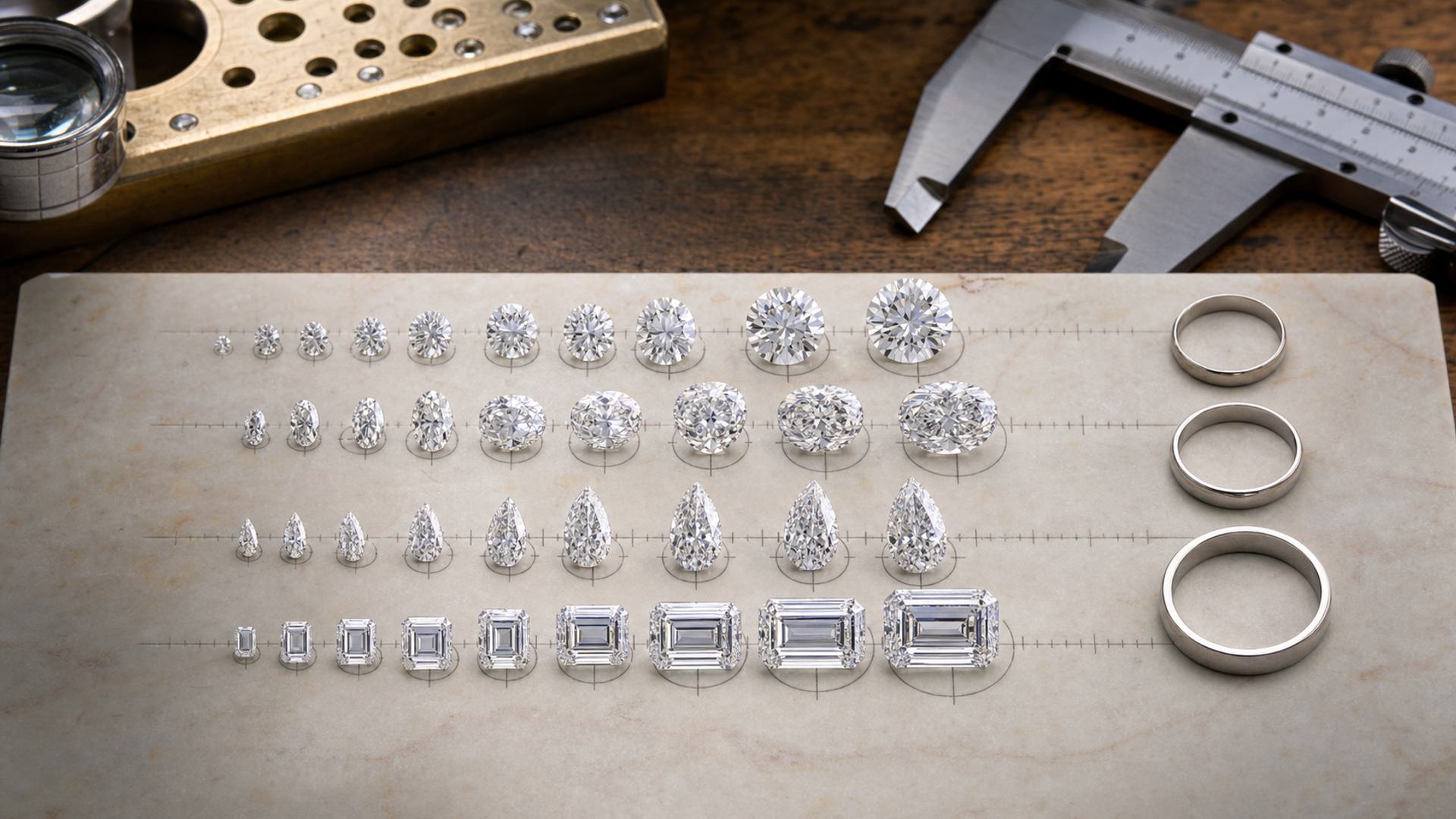
Diamond carat is weight, not face-up size. One metric carat equals 200 milligrams, but two one-carat diamonds can look different on the finger because shape, proportions, depth, setting and ring size change the visible spread. A diamond size chart is therefore an orientation tool, not a grading report or a promise that every stone of a given weight has the same dimensions.
The most reliable buying method is to compare the laboratory-report measurements in millimetres, inspect the actual stone and evaluate it in the intended setting. Use carat to understand weight and market thresholds; use length and width to understand coverage.
Carat, millimetres and coverage
The Gemological Institute of America's diamond buyer's guide treats carat as one of the 4Cs rather than a stand-in for visual size. Each carat is divided into 100 points, so a 0.50 ct diamond is a fifty-pointer. Millimetres describe physical dimensions. For a round diamond, a report normally gives minimum diameter, maximum diameter and depth. For a fancy shape, it gives length, width and depth.
Finger coverage is the width or length the stone and setting occupy when viewed from above. It depends on ring size, band width, halo, side stones and orientation. Coverage is visual; it is not a formal diamond grade.
Approximate round-brilliant reference
| Carat weight | Typical face-up diameter range | Visual use |
|---|---|---|
| 0.25 ct | about 4.0–4.2 mm | Delicate solitaire or accent |
| 0.50 ct | about 5.0–5.2 mm | Restrained everyday centre |
| 0.75 ct | about 5.7–5.9 mm | Noticeable without broad coverage |
| 1.00 ct | about 6.3–6.5 mm | Familiar one-carat scale |
| 1.50 ct | about 7.2–7.5 mm | Stronger finger presence |
| 2.00 ct | about 8.0–8.3 mm | Broad solitaire presence |
| 3.00 ct | about 9.2–9.5 mm | Statement scale |
These ranges are approximate examples for reasonably proportioned round brilliants, not acceptable-cut limits. Consult the individual grading report. A deep stone can carry weight below the girdle and face up smaller.
Why equal carat weights look different
Imagine two one-carat rounds. One has a 6.45 mm average diameter and balanced depth. Another is cut deep with a smaller diameter. Both weigh one carat, yet the first presents more visible surface. The second may hide weight where it contributes little to face-up size.
Visible spread should not be maximised at any cost. Proportions affect brightness, fire, pattern and durability. A shallow stone may look wide while leaking light or creating a vulnerable girdle. The goal is a considered balance of appearance, cut quality and structure.
GIA's explanation of how it grades diamonds shows how measurements, proportions, polish and symmetry feed into the assessment. GIA also states that its cut grade applies to standard round brilliants, an important boundary when comparing fancy shapes.
Fancy-shape size chart
| Shape at about 1 ct | Common approximate face-up dimensions | Coverage character |
|---|---|---|
| Oval | 7.5–8.2 × 5.5–6.0 mm | Elongated, visually lengthens finger |
| Pear | 8.0–8.7 × 5.3–5.8 mm | Directional length with tapered point |
| Marquise | 9.5–10.5 × 4.8–5.3 mm | Maximum length and narrow width |
| Emerald | 6.5–7.0 × 4.5–5.0 mm | Architectural rectangle |
| Radiant | 6.0–6.5 × 5.0–5.5 mm | Rectangular or square brilliance |
| Cushion | 5.8–6.4 × 5.8–6.4 mm | Soft square, depth varies widely |
| Princess | 5.4–5.7 × 5.4–5.7 mm | Compact square with pointed corners |
Ranges vary materially with length-to-width ratio and cut. Compare exact stones, not only chart averages.
Length-to-width ratio changes the look
For elongated shapes, divide length by width. An oval measuring 8.0 by 5.8 mm has a ratio around 1.38. A higher ratio looks longer and narrower; a lower ratio looks fuller. Neither is universally superior.
The ratio should work with the finger and setting. A very elongated stone may bow-tie visibly or become harder to protect at its ends. A short oval may resemble a rounded cushion. Pear and marquise shapes also require the setting to protect their points.
Ask to compare outlines at the same carat weight. The eye notices silhouette before it notices a certificate number.
Finger size and band width
The same 6.4 mm round occupies a greater proportion of a small finger than a large one. To estimate horizontal coverage, divide the stone width by the approximate top width of the finger, then consider the band and setting. Photographs are unreliable unless ring size, camera distance and lens are controlled.
A broad band can make a centre stone look more integrated and sometimes visually smaller. A fine band can make it appear more prominent but may need structural reinforcement. The setting's height affects side view and daily wear even when face-up coverage is unchanged.
Use a physical or accurately scaled mock-up on the correct ring size before choosing.
If the base size is uncertain, follow the ring measuring guide before judging coverage. An incorrect ring size changes both comfort and the apparent proportion of the centre stone.
Setting style can add or reduce apparent size
A halo adds visible diameter through smaller stones, but changes the design from a pure solitaire. A bezel creates a continuous outline that can make a stone look larger while offering edge protection. Prongs reveal more of the perimeter but their number, thickness and orientation alter the silhouette.
Cathedral shoulders can visually connect the centre to the band. Side stones spread coverage across the finger. A high setting may look airy from the side but catch on clothing. A low basket can be practical but may limit the way a wedding band sits.
Judge the complete ring, not a loose diamond chart in isolation.
“Magic sizes” and value
Prices can jump around familiar weights such as 1.00, 1.50 and 2.00 carats because demand and rarity change. GIA notes that the visual difference between 0.99 and 1.00 ct may be difficult to see even when the price differs. A well-proportioned stone slightly below a threshold can therefore offer strong visible value.
Do not assume it is automatically a bargain. Compare cut, colour, clarity, fluorescence, report, provenance and return terms. The correct question is “What am I paying for?” rather than “How do I get the largest number?”
The moissanite versus diamond guide is useful if material identity, not only diamond size, remains open.
How to read the laboratory report
Confirm the report number through the laboratory's own verification service. Read shape and cutting style, measurements, carat, colour, clarity and cut grade where applicable. Examine polish, symmetry, fluorescence and the proportions diagram. A report describes the stone; it is not a retail valuation and should not be called a certificate of investment performance.
Compare the laser inscription, if present, with the report through a qualified jeweller. Remember that a report for a loose stone may not capture later damage or alteration.
Use an independent appraiser when the value, provenance or transaction structure justifies it.
A coverage-first buying checklist
Choose the outline you enjoy.
Set a target millimetre width and length.
Decide an acceptable ratio range.
Compare report measurements before carat.
Review cut and optical performance.
Try an accurate mock-up on the correct finger.
Include band width, halo and side stones.
Check setting height and point protection.
Verify the report and return policy.
Photograph candidates under the same lighting and distance.
This sequence prevents carat from becoming a substitute for design judgement.
Chart limitations
Approximate dimensions cannot identify natural versus laboratory-grown origin, treatment, colour, clarity or cut quality. They cannot predict sparkle from a photo, and they do not establish price. Fancy shapes are especially variable.
Use the chart to decide which stones merit comparison. Then use actual measurements, videos, a grading report and an in-person view. If a seller quotes only carat and withholds dimensions, ask for the report before proceeding.
The refined choice is not always the largest face-up stone. It is the stone whose proportions, outline and setting remain satisfying in ordinary light and daily wear.
Photography and “on hand” comparisons
Online hand photographs are useful only when the seller states the ring size, stone measurements, camera method and whether the image has been scaled. Wide-angle phone lenses can enlarge the centre of the frame, while a close crop removes the finger proportions needed for comparison. Lighting can make a well-cut smaller stone appear more vivid than a larger but poorly lit stone.
Ask for a top-down photograph of each candidate on the same neutral hand model, at the same distance, beside a millimetre scale. Add a side view to reveal basket height and depth. Video should include ordinary diffuse light, not only spotlights designed to maximise sparkle.
For remote buying, print a calibrated outline or use a retailer's physical replica set. Confirm printer scale with a ruler. The exercise will not reproduce brilliance, but it can prevent a costly mismatch between expected and actual coverage.
Durability changes with shape and setting
Coverage is not the only daily-wear concern. Pear and marquise points need protection; princess corners can be vulnerable; very thin girdles deserve careful review. A broad, low-set design may be practical under gloves, while a high-profile elongated stone can catch on knitwear.
Discuss lifestyle with the setter: dominant hand, work, sport, childcare and how often the ring will be removed. The strongest solution may include more protective prongs, a bezel or a lower basket even if it changes the visual spread. A diamond size decision is complete only when the stone and setting work as one structure.