The best Business Class airline in 2026 is not a single brand. It is the airline that operates its strongest seat on your exact flight, gives you a realistic sleep window, and supports the journey with useful ground services. A celebrated cabin on the wrong aircraft is a poor purchase; a slightly less famous product with a dependable schedule and a direct route may be the better luxury.
As of July 2026, the latest completed Skytrax global Business Class ranking is the 2025 edition. It placed Qatar Airways first overall, followed by Singapore Airlines, ANA, Cathay Pacific and Air France. That is valuable evidence, but it is not a booking instruction. Skytrax also published different leaders for seat, lounge and catering, which shows why one league table cannot answer every traveller’s question.
The short list by traveller priority
| Traveller priority | Start with | Verify before paying |
|---|---|---|
| Maximum privacy for one or two people | Qatar Airways Qsuite-equipped flight | Operating aircraft and whether Qsuite is shown on the seat map |
| Consistent long-haul service and network | Singapore Airlines | Aircraft type, seat version and connection time in Singapore |
| Japanese service and a highly private seat | ANA on “The Room” routes | Route and aircraft assignment; not every ANA flight has the same seat |
| Hong Kong connection and strong lounge network | Cathay Pacific | Current lounge opening hours, terminal and aircraft |
| Refined dining and a strong European hub experience | Air France | Whether the latest suite is scheduled on the flight |
| Dubai connectivity and an integrated premium journey | Emirates | A380 versus 777 product, seat layout and chauffeur/lounge eligibility |
| Direct transatlantic convenience | The carrier with the best nonstop schedule | Flat-bed specification, aisle access and arrival time—not the logo |
This matrix is deliberately route-led. “Best airline” searches often end in a brand ranking; expensive mistakes occur at the flight-number level.
Why the operating aircraft matters more than the award
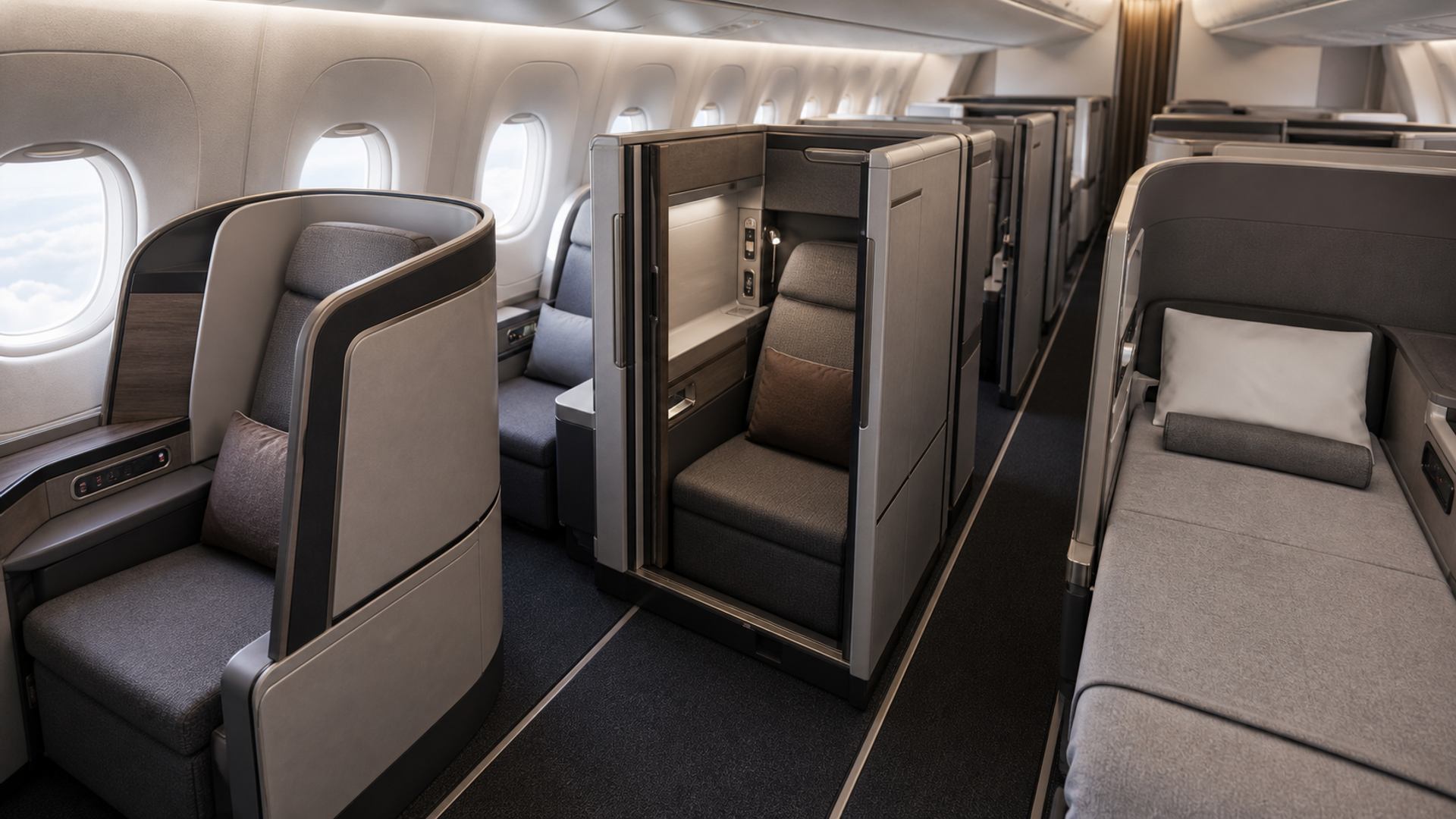
Airlines market a cabin as one product even when several generations of seat are flying. The differences can include direct aisle access, door height, bed length, storage and privacy. Aircraft substitutions also happen for operational reasons. A booking page may show a preferred product today and a different aircraft may operate later.
Before paying, record five items:
Flight number and date.
Scheduled aircraft type.
Seat-map configuration.
The airline’s published description for that aircraft.
The change and cancellation terms attached to the fare.
Take a screenshot of the seat map, but do not treat it as a guarantee. Recheck it at 30 days, seven days and 24 hours before departure. If the seat is the principal reason for a substantial fare premium, ask the airline or travel adviser what remedies apply after an equipment change. Usually the contract promises carriage in the purchased cabin, not a particular seat design.
Qatar Airways describes Qsuite as a Business Class product with privacy doors and configurable spaces, including double and group arrangements on equipped aircraft. That makes it compelling for couples and colleagues. It does not mean every Qatar Airways Business Class flight has Qsuite. The product page and the live seat map must agree.
The 100-point Business Class buyer score
Use a weighted score rather than a generic top-ten list.
| Dimension | Weight | What to measure |
|---|---|---|
| Sleep | 30 | Flatness, length, width, bedding, footwell and uninterrupted sleep window |
| Schedule | 20 | Nonstop versus connection, departure time, arrival time and total journey duration |
| Privacy and access | 15 | Direct aisle access, door or shell, companion arrangement and storage |
| Reliability of the promised product | 15 | Fleet consistency, seat-map clarity and substitution exposure |
| Ground experience | 10 | Check-in, security, lounge location, transfer ease and arrival support |
| Fare flexibility | 10 | Changes, refunds, rebooking, mileage earning and seat-selection terms |
Score each candidate from one to five in every category, multiply by the weight, then divide by five. The result is a score out of 100.
A traveller who must present at 09:00 after landing should heavily protect sleep, schedule and reliability. A leisure couple may value a paired centre suite, dining and lounge time. A traveller connecting through a complex hub should assign more value to minimum connection time and terminal geography than to champagne.
A route-and-product matrix for leading choices
The following is a decision framework, not a promise that the listed seat operates on every route.
Qatar Airways
Qatar led the 2025 Skytrax Business Class ranking, while Qsuite led the seat category and the Al Mourjan Garden lounge in Doha led the Business Class airline lounge category. Its strongest proposition is the combination of privacy, configurable suites and a broad connecting network.
Best for: travellers whose route is Qsuite-equipped and who can use Doha as an efficient connection.
Watch-outs: Qsuite availability varies. A long layover can erase some of the cabin benefit. Compare the total journey, not just the longest sector.
Singapore Airlines
Singapore ranked second overall in the latest completed Skytrax list. The carrier is a strong starting point for service, long-haul network design and a premium connection through Changi.
Best for: travellers to or through Southeast Asia who value service consistency and a strong hub.
Watch-outs: multiple seat generations and aircraft types exist. Some seats have sleeping positions or footwell geometries that suit one body type better than another. Verify the actual aircraft and read the seat plan carefully.
ANA
ANA ranked third overall and second for Business Class seat in the 2025 Skytrax results. “The Room” has developed a reputation for exceptional privacy and width on selected aircraft.
Best for: Japan itineraries where the desired product is confirmed.
Watch-outs: the route network and product deployment are narrower than the brand-level praise implies. A connection added solely to chase a seat may be a false economy.
Cathay Pacific
Cathay ranked fourth overall, and its Hong Kong lounge was the top Business Class lounge in Asia in the same awards.
Best for: Hong Kong journeys and Asia connections where lounge access and schedule align.
Watch-outs: choose the flight, not just the carrier. Confirm aircraft, lounge operating hours and terminal access.
Air France
Air France ranked fifth overall. It can be particularly attractive when a nonstop or well-timed Paris connection avoids a longer Gulf or Asian routing.
Best for: Europe-origin or Europe-bound travellers who value dining, design and a convenient schedule.
Watch-outs: newer suites are not universal. Paris connection time and terminal movement can matter more than the seat styling.
Emirates
Emirates ranked outside the latest overall top five but remains a relevant buyer choice because of its Dubai network, A380 experience and premium ground ecosystem. Its Business Class differs materially by aircraft and configuration.
Best for: journeys where Dubai is geographically sensible and the scheduled aircraft has the desired layout.
Watch-outs: an A380 and a 777 can produce different seat experiences. Confirm whether lounge, chauffeur or other services are included for the exact fare and city.
Calculate value per recovered hour
The most useful calculation is not fare per flight hour. It is the premium paid for time and capability recovered.
Net Business Class premium
= Business fare
extra positioning or connection costs
airport transfers not included
change-risk allowance
opportunity cost of a longer itinerary
minus miles or benefits you can reasonably value
Recovered hours
= additional sleep compared with the next cabin
+ ground time saved
+ productive time preserved on arrival
+ connection risk avoided
Cost per recovered hour
= Net premium ÷ recovered hours
Suppose Business Class is £2,600 more than Premium Economy. A nonstop Business flight provides five hours of usable sleep instead of two, saves a two-hour connection and avoids half a day of recovery. If you conservatively count six recovered hours, the premium is about £433 per recovered hour. That may be rational before a negotiation or board meeting. For a flexible holiday with no arrival obligation, the same number may be poor value.
Do not inflate the recovered-hours estimate. Lounge time is not automatically “saved time”; it has value only if you would otherwise buy food, rent workspace, queue, or struggle to work.
The ground experience can reverse the ranking
Skytrax’s category results illustrate the fragmentation. Qatar’s Doha lounge led the Business lounge list, while Air Canada’s Toronto Signature Suite led lounge dining and Turkish Airlines led onboard catering. A traveller with only 45 minutes in a lounge cannot extract the same value as one with three hours. A beautiful facility in another terminal is irrelevant.
Map the journey:
When does premium check-in open?
Is fast-track security available at this airport and time?
Is the lounge before or after an additional security check?
How long does it take to reach the gate?
Is arrival lounge access included?
Does the ticket include a useful transfer or chauffeur benefit?
For an overnight departure, prioritise a quiet dining option and a quick route to the gate. For a daytime flight, workspaces and connectivity may matter more. For a connection, shower availability and terminal location are often more useful than elaborate dining.
Points, upgrades and mixed cabins
An award ticket can transform the value calculation, but taxes, surcharges, change rules and availability matter. Compare the points required with the cash fare you would genuinely buy—not the most expensive flexible fare displayed.
Mixed-cabin itineraries require special care. A “Business Class” label may cover one premium long-haul sector and one Economy feeder, or vice versa. Expand every segment before payment. Confirm baggage rules, lounge access and through-checking across the entire itinerary.
Upgrades can also have different benefits from a full Business fare. Some exclude lounge access, chauffeur services, additional mileage or flexible rules. The upgrade price is only attractive after the resulting fare conditions are known.
A seven-step booking workflow
Define the arrival job. Sleep, work, celebrate, connect or minimise risk.
Find the best two schedules. Nonstop and arrival time come first.
Identify the aircraft and seat. Use the airline’s page and live seat map.
Score both options. Apply the 100-point model.
Calculate cost per recovered hour. Include connection and change exposure.
Read the fare rules. Capture refund, change, seat and mixed-cabin terms.
Reconfirm before travel. Check aircraft, lounge and transfers at set intervals.
The verdict
Qatar Airways is the strongest evidence-based starting point because it led the latest completed overall, seat and airline-lounge categories. It is not automatically the best purchase. Singapore Airlines, ANA, Cathay Pacific, Air France, Emirates and a well-timed nonstop competitor can win once the exact route, aircraft and traveller objective are scored.
The luxury is not choosing the most famous cabin. It is removing uncertainty from an expensive journey. Buy the flight whose schedule, operating aircraft, sleep potential and fare rules protect the purpose of the trip.