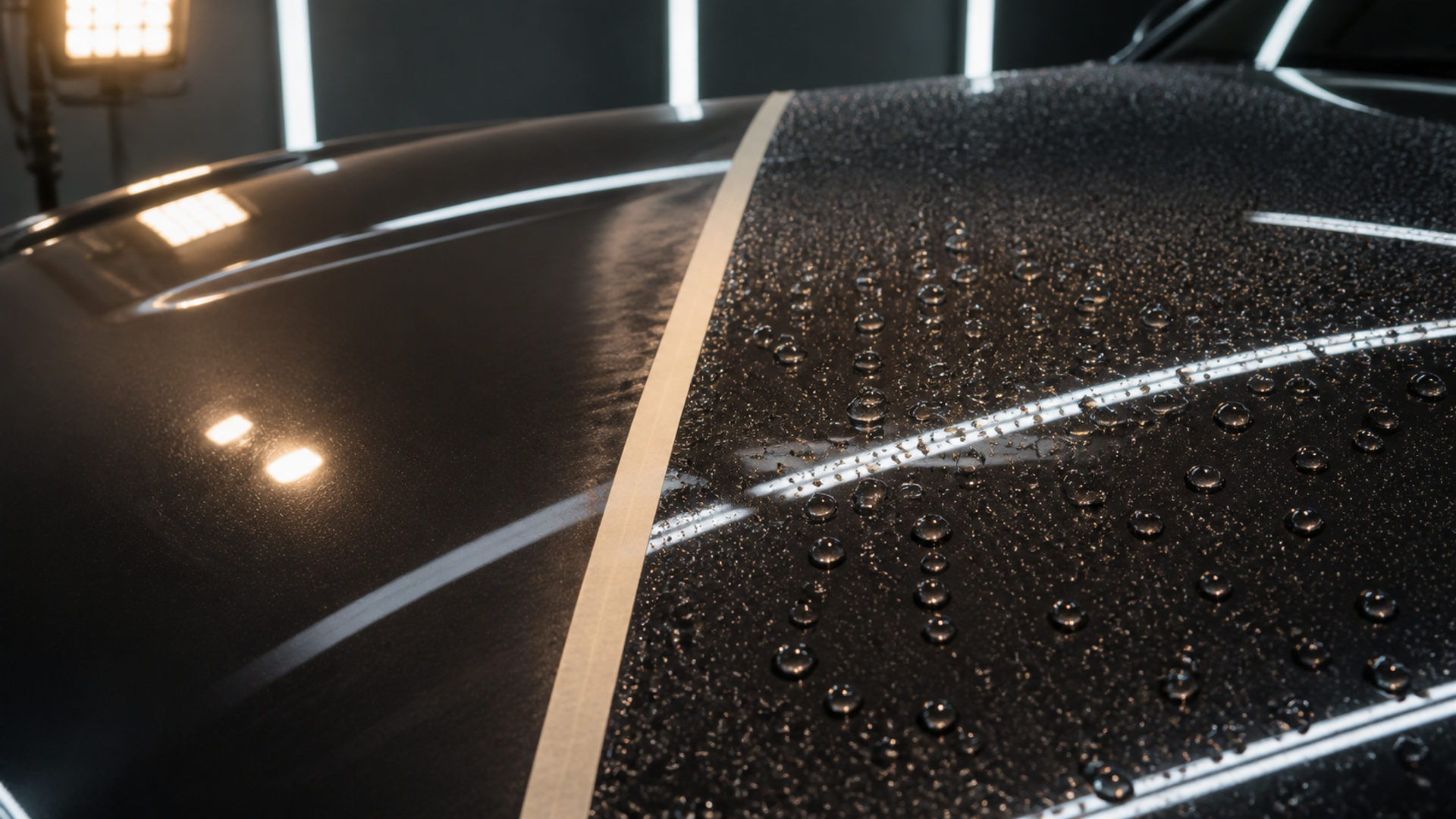
Ceramic coating and car wax are sacrificial paint-protection approaches with different chemistry, preparation and ownership commitments. A professionally applied coating can create a durable hydrophobic surface, but it does not make paint scratch-proof, chip-proof or maintenance-free. Wax is easier to apply, refresh and remove, but generally needs more frequent renewal. The largest visual change often comes from washing and paint correction before either product, so a coating applied over defects can preserve the wrong surface for longer.
Begin with paint condition
Choose a ceramic coating when the paint is correctly prepared, the vehicle will receive compatible maintenance and longer service intervals justify the cost. Choose wax when tactile application, easy renewal, lower commitment and seasonal flexibility fit the owner. Use a simpler sealant plan when the car is heavily used, regularly machine-washed or likely to need paintwork that would undermine an expensive coating.
| Decision factor | Ceramic coating | Car wax | Use a simpler sealant plan |
|---|---|---|---|
| Paint condition | Correction precedes coating because defects remain visible | Wax can temporarily enrich gloss without locking in a long plan | Repair chips before either |
| Durability | Longer claimed service requires controlled prep and cure | Shorter service makes renewal easy | Use a sealant with moderate commitment |
| Maintenance | Compatible wash chemistry and decontamination are required | Regular reapplication is expected | Choose the routine the owner will follow |
| Damage protection | Not a substitute for film against stone chips | Not a substitute for film against stone chips | Use paint-protection film where impact matters |
| Removal | Polishing may be needed to remove or level coating | Wax can usually be stripped more simply | Keep a service record for bodywork |
| Verification | Measure water behaviour and inspect under light | Record date, product and panel condition | Do not judge only by dramatic beading |
This ceramic coating vs wax matrix is the article's working value object. Read the ceramic coating vs wax rows together: the decisive failure mode depends on this topic's evidence, operating context and reader objective.
Preparation determines the finish
Evidence 1. Gtechniq distinguishes ceramic coatings from wax by bonding, durability and maintenance expectations while avoiding a claim of invulnerability.
Evidence 2. Vehicle-maker paint-care guidance typically prioritises gentle washing, prompt contaminant removal and compatible products.
Evidence 3. Water beading is not a complete measure of film thickness, scratch resistance, contamination or remaining service life.
Evidence 4. Paint correction removes material and should be performed conservatively by a competent operator when defects require it.
Reader-visible sources checked for this article:
gtechniq.com — reader-visible current or official evidence
volvocars.com — reader-visible current or official evidence
For ceramic coating vs wax, these sources establish only the claims inside their documented scope. Recheck every changeable specification, availability condition, price, policy or service term in the relevant market before acting.
Compare ownership, not just first-day gloss
A buyer can resolve paint condition without starting from a brand preference. Ask whether correction precedes coating because defects remain visible; compare that with whether wax can temporarily enrich gloss without locking in a long plan; then use repair chips before either as the third route's safeguard. An unknown condition stays unknown.
On durability, popularity is not enough. The evidence for option one is that longer claimed service requires controlled prep and cure. Option two means shorter service makes renewal easy. Option three is rational where use a sealant with moderate commitment. Recheck any changeable term immediately before commitment.
The decision changes at maintenance. Choose the first path only if compatible wash chemistry and decontamination are required; move to the second when regular reapplication is expected; use the third when choose the routine the owner will follow. Save the downside that would make this row fail.
For damage protection, the first route works when not a substitute for film against stone chips; the second requires not a substitute for film against stone chips. The control for the third is use paint-protection film where impact matters. Verify this row against the exact product, property, account or environment before it can reverse the decision.
The removal row exposes a practical boundary. Route one assumes polishing may be needed to remove or level coating, while route two is defensible only when wax can usually be stripped more simply. Route three depends on keep a service record for bodywork. If that evidence is absent, keep the more reversible option.
Read verification as a stop/go test: measure water behaviour and inspect under light supports the first option; record date, product and panel condition supports the second; and do not judge only by dramatic beading supports the third. Record which source proves the condition and when it was checked.
Facts that would reverse the current choice
Reversal control 1 — Paint condition. Before choosing Ceramic coating, write down how the decision changes if “Correction precedes coating because defects remain visible” proves false. Do the same for Car wax and “Wax can temporarily enrich gloss without locking in a long plan”. Keep the Use a simpler sealant plan route available until “Repair chips before either” is verified. This control belongs to ceramic coating vs wax; update it from the cited source or exact supplier rather than copying a generic checklist.
Reversal control 2 — Durability. Before choosing Ceramic coating, write down how the decision changes if “Longer claimed service requires controlled prep and cure” proves false. Do the same for Car wax and “Shorter service makes renewal easy”. Keep the Use a simpler sealant plan route available until “Use a sealant with moderate commitment” is verified. This control belongs to ceramic coating vs wax; update it from the cited source or exact supplier rather than copying a generic checklist.
Reversal control 3 — Maintenance. Before choosing Ceramic coating, write down how the decision changes if “Compatible wash chemistry and decontamination are required” proves false. Do the same for Car wax and “Regular reapplication is expected”. Keep the Use a simpler sealant plan route available until “Choose the routine the owner will follow” is verified. This control belongs to ceramic coating vs wax; update it from the cited source or exact supplier rather than copying a generic checklist.
Reversal control 4 — Damage protection. Before choosing Ceramic coating, write down how the decision changes if “Not a substitute for film against stone chips” proves false. Do the same for Car wax and “Not a substitute for film against stone chips”. Keep the Use a simpler sealant plan route available until “Use paint-protection film where impact matters” is verified. This control belongs to ceramic coating vs wax; update it from the cited source or exact supplier rather than copying a generic checklist.
Reversal control 5 — Removal. Before choosing Ceramic coating, write down how the decision changes if “Polishing may be needed to remove or level coating” proves false. Do the same for Car wax and “Wax can usually be stripped more simply”. Keep the Use a simpler sealant plan route available until “Keep a service record for bodywork” is verified. This control belongs to ceramic coating vs wax; update it from the cited source or exact supplier rather than copying a generic checklist.
Reversal control 6 — Verification. Before choosing Ceramic coating, write down how the decision changes if “Measure water behaviour and inspect under light” proves false. Do the same for Car wax and “Record date, product and panel condition”. Keep the Use a simpler sealant plan route available until “Do not judge only by dramatic beading” is verified. This control belongs to ceramic coating vs wax; update it from the cited source or exact supplier rather than copying a generic checklist.
Inspect before quoting
Wash safely and inspect swirls, etching, chips, previous repairs and trim under diffuse and point light. Use a paint-depth assessment where appropriate and agree which defects will remain. Record the exact product, material, room, garment, vehicle, water report or operating condition and the time of the check. Separate observed behaviour from marketing language, and repeat the comparison in the intended setting rather than an ideal demonstration. If correction risk exceeds the cosmetic gain, reduce the preparation scope. Preserve the evidence that would reverse the choice: a change in fit, specification, maintenance, safety, price or environment must reopen the decision rather than inherit an old conclusion.
Verify the system
Identify the exact coating, layer count, cure conditions, topper and maintenance products. Ask the installer for realistic service conditions, exclusions, warranty actions and body-shop implications. Record the exact product, material, room, garment, vehicle, water report or operating condition and the time of the check. Separate observed behaviour from marketing language, and repeat the comparison in the intended setting rather than an ideal demonstration. If the promise depends on undocumented annual visits, treat durability as unverified. Preserve the evidence that would reverse the choice: a change in fit, specification, maintenance, safety, price or environment must reopen the decision rather than inherit an old conclusion.
Compare full ownership
Price preparation, application, cure downtime, maintenance washes, decontamination and eventual removal. Compare that with several wax cycles using the owner's actual labour or professional rates. Record the exact product, material, room, garment, vehicle, water report or operating condition and the time of the check. Separate observed behaviour from marketing language, and repeat the comparison in the intended setting rather than an ideal demonstration. If the car's use prevents proper maintenance, the cheaper reversible route can win. Preserve the evidence that would reverse the choice: a change in fit, specification, maintenance, safety, price or environment must reopen the decision rather than inherit an old conclusion.
Test aftercare
Use a controlled wash and inspect sheeting, spotting, bonded contamination and gloss across panels. Record products and dates and avoid abrasive remedies before confirming compatibility. Record the exact product, material, room, garment, vehicle, water report or operating condition and the time of the check. Separate observed behaviour from marketing language, and repeat the comparison in the intended setting rather than an ideal demonstration. If beading weakens because of contamination, decontaminate before assuming coating failure. Preserve the evidence that would reverse the choice: a change in fit, specification, maintenance, safety, price or environment must reopen the decision rather than inherit an old conclusion.
Three vehicles, three answers
New dark luxury car kept for years
A well-prepared coating with disciplined care can fit. Define the fact that would reverse this recommendation before committing.
Collector car enjoyed through seasonal detailing
Wax may suit the ritual and reversible finish. Define the fact that would reverse this recommendation before committing.
Daily motorway vehicle facing stone chips
Film on impact zones plus simple chemical protection may be more rational. Define the fact that would reverse this recommendation before committing.
Action checklist
Inspect paint.
Document defects.
Define correction.
Verify coating system.
Plan cure.
Price maintenance.
Distinguish chips.
Keep bodywork record.
Wash compatibly.
Reassess annually.
Continue the decision
The linked VERTU articles expand adjacent parts of the ceramic coating vs wax decision. They do not substitute for the external evidence above.
The coating-versus-wax verdict
Choose a ceramic coating when the paint is correctly prepared, the vehicle will receive compatible maintenance and longer service intervals justify the cost. Choose wax when tactile application, easy renewal, lower commitment and seasonal flexibility fit the owner. Use a simpler sealant plan when the car is heavily used, regularly machine-washed or likely to need paintwork that would undermine an expensive coating.
Keep the ceramic coating vs wax decision reversible until its material cost, safety, access, privacy and compatibility facts are verified. Unknown evidence stays unknown; it is never silently scored as favourable.