

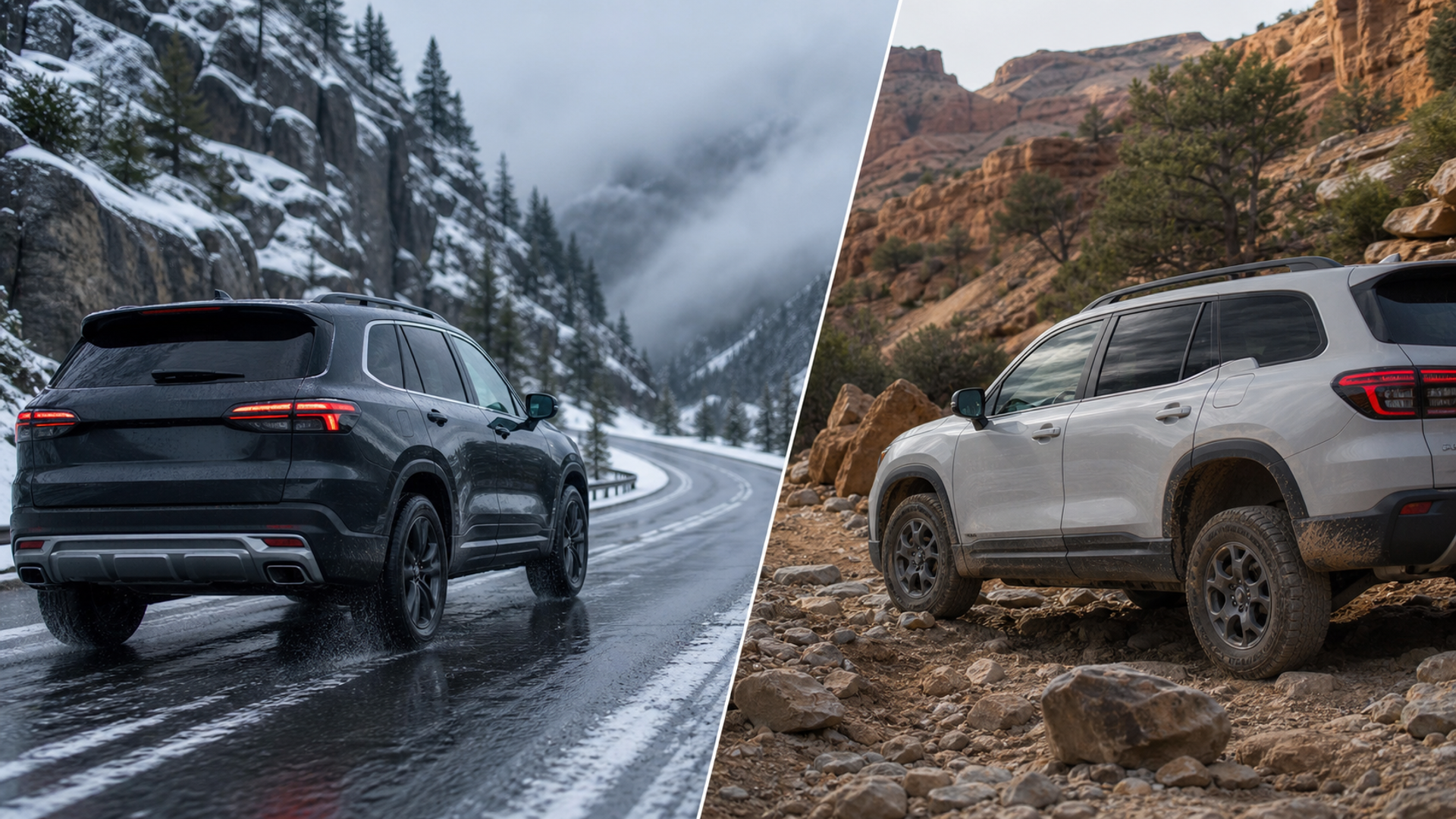
All-wheel drive and four-wheel drive both send torque to more than one axle, but they are not single standardised systems. AWD commonly manages torque automatically for road use, while selectable 4WD often adds a locked mode or low range for difficult terrain. Tyres, ground clearance, recovery skill and vehicle mass can decide more than the badge.
Define the surface, not the badge
Choose AWD for changing road weather and automatic everyday traction. Choose selectable 4WD when repeated low-speed off-road work, loose surfaces, towing access or low range is genuinely required. Choose two-wheel drive with suitable tyres when paved use, efficiency and lower complexity outweigh occasional traction anxiety.
| Decision factor | AWD | Selectable 4WD | Two-wheel drive with correct tyres |
|---|---|---|---|
| Primary surface | Wet, icy or mixed paved roads dominate | Ruts, rocks, sand or low-speed loose terrain recur | Paved roads and maintained access dominate |
| Driver operation | Automatic torque management is preferred | The driver can select modes within stated limits | Simple controls reduce misuse |
| Tyres | Four matching climate-appropriate tyres are budgeted | Off-road or all-terrain tyres suit the route | Correct seasonal tyres solve the primary risk |
| Ground clearance | Road-biased clearance is sufficient | Angles and clearance match obstacles | No additional clearance is needed |
| Towing and load | The exact rating covers planned use | Low-speed traction and cooling are specified | A lighter duty cycle avoids added hardware |
| Ownership | Fuel and tyre-replacement rules are accepted | Maintenance and recovery equipment are accepted | Lower mass and complexity have more value |
This awd vs 4wd matrix is the article's working value object. Read the awd vs 4wd rows together: the decisive failure mode depends on this topic's evidence, operating context and reader objective.
How AWD and 4WD send torque
Evidence 1. Subaru's explainer distinguishes automatic AWD behaviour from traditional selectable 4WD, but each manufacturer defines its own system and modes.
Evidence 2. Ford's 4WD guidance emphasises mode selection and operating conditions, which means the owner's manual for the exact vehicle remains authoritative.
Evidence 3. Neither AWD nor 4WD shortens braking distance by itself; tyre grip, speed, surface and driver inputs remain central.
Evidence 4. Mismatched tyre circumference can affect some drivetrains, so replacement rules, rotation and pressure belong in the ownership calculation.
Reader-visible sources checked for this article:
subaru.com — reader-visible current or official evidence
ford.com — reader-visible current or official evidence
For awd vs 4wd, these sources establish only the claims inside their documented scope. Recheck every changeable specification, availability condition, price, policy or service term in the relevant market before acting.
Test traction as a system
A buyer can resolve primary surface without starting from a brand preference. Ask whether wet, icy or mixed paved roads dominate; compare that with whether ruts, rocks, sand or low-speed loose terrain recur; then use paved roads and maintained access dominate as the third route's safeguard. An unknown condition stays unknown.
On driver operation, popularity is not enough. The evidence for option one is that automatic torque management is preferred. Option two means the driver can select modes within stated limits. Option three is rational where simple controls reduce misuse. Recheck any changeable term immediately before commitment.
The decision changes at tyres. Choose the first path only if four matching climate-appropriate tyres are budgeted; move to the second when off-road or all-terrain tyres suit the route; use the third when correct seasonal tyres solve the primary risk. Save the downside that would make this row fail.
For ground clearance, the first route works when road-biased clearance is sufficient; the second requires angles and clearance match obstacles. The control for the third is no additional clearance is needed. Verify this row against the exact product, property, account or environment before it can reverse the decision.
The towing and load row exposes a practical boundary. Route one assumes the exact rating covers planned use, while route two is defensible only when low-speed traction and cooling are specified. Route three depends on a lighter duty cycle avoids added hardware. If that evidence is absent, keep the more reversible option.
Read ownership as a stop/go test: fuel and tyre-replacement rules are accepted supports the first option; maintenance and recovery equipment are accepted supports the second; and lower mass and complexity have more value supports the third. Record which source proves the condition and when it was checked.
Facts that would reverse the current choice
Reversal control 1 — Primary surface. Before choosing AWD, write down how the decision changes if “Wet, icy or mixed paved roads dominate” proves false. Do the same for Selectable 4WD and “Ruts, rocks, sand or low-speed loose terrain recur”. Keep the Two-wheel drive with correct tyres route available until “Paved roads and maintained access dominate” is verified. This control belongs to awd vs 4wd; update it from the cited source or exact supplier rather than copying a generic checklist.
Reversal control 2 — Driver operation. Before choosing AWD, write down how the decision changes if “Automatic torque management is preferred” proves false. Do the same for Selectable 4WD and “The driver can select modes within stated limits”. Keep the Two-wheel drive with correct tyres route available until “Simple controls reduce misuse” is verified. This control belongs to awd vs 4wd; update it from the cited source or exact supplier rather than copying a generic checklist.
Reversal control 3 — Tyres. Before choosing AWD, write down how the decision changes if “Four matching climate-appropriate tyres are budgeted” proves false. Do the same for Selectable 4WD and “Off-road or all-terrain tyres suit the route”. Keep the Two-wheel drive with correct tyres route available until “Correct seasonal tyres solve the primary risk” is verified. This control belongs to awd vs 4wd; update it from the cited source or exact supplier rather than copying a generic checklist.
Reversal control 4 — Ground clearance. Before choosing AWD, write down how the decision changes if “Road-biased clearance is sufficient” proves false. Do the same for Selectable 4WD and “Angles and clearance match obstacles”. Keep the Two-wheel drive with correct tyres route available until “No additional clearance is needed” is verified. This control belongs to awd vs 4wd; update it from the cited source or exact supplier rather than copying a generic checklist.
Reversal control 5 — Towing and load. Before choosing AWD, write down how the decision changes if “The exact rating covers planned use” proves false. Do the same for Selectable 4WD and “Low-speed traction and cooling are specified”. Keep the Two-wheel drive with correct tyres route available until “A lighter duty cycle avoids added hardware” is verified. This control belongs to awd vs 4wd; update it from the cited source or exact supplier rather than copying a generic checklist.
Reversal control 6 — Ownership. Before choosing AWD, write down how the decision changes if “Fuel and tyre-replacement rules are accepted” proves false. Do the same for Selectable 4WD and “Maintenance and recovery equipment are accepted”. Keep the Two-wheel drive with correct tyres route available until “Lower mass and complexity have more value” is verified. This control belongs to awd vs 4wd; update it from the cited source or exact supplier rather than copying a generic checklist.
Build a route ledger
List winter roads, steep drives, unsealed tracks, launch ramps, towing points and the worst surface actually used each year. Separate a recurring requirement from one imagined adventure.
Read the exact system
Verify centre coupling, low range, locking behaviour, drive modes, speed limits, tyre rules and recovery points in the owner's manual rather than generalising from AWD or 4WD labels.
Test with the right tyres
Compare vehicles on equivalent, correctly inflated tyres and under safe conditions. An unsuitable tyre can erase the theoretical benefit of a more capable driveline.
Price the full capability
Include fuel, tyre matching, servicing, underbody protection, recovery equipment and training. Capability that cannot be used safely is not purchase value.
Three driving profiles
Snowy motorway commute
AWD with appropriate winter-rated tyres can minimise intervention while preserving normal road manners. Define the fact that would reverse this recommendation before committing.
Remote track and trailer access
Selectable 4WD may justify its weight and complexity when low-speed terrain and recovery are routine. Define the fact that would reverse this recommendation before committing.
Mild urban climate
Two-wheel drive with strong wet-weather tyres can be the more efficient, lower-cost system. Define the fact that would reverse this recommendation before committing.
Action checklist
List actual road surfaces.
Check local winter rules.
Read the exact manual.
Inspect tyre certification.
Verify towing rating.
Measure ground clearance.
Price matching tyres.
Locate recovery points.
Test drive safely.
Record the real upgrade trigger.
Continue the decision
The linked VERTU articles expand adjacent parts of the awd vs 4wd decision. They do not substitute for the external evidence above.
The drivetrain verdict
Choose AWD for changing road weather and automatic everyday traction. Choose selectable 4WD when repeated low-speed off-road work, loose surfaces, towing access or low range is genuinely required. Choose two-wheel drive with suitable tyres when paved use, efficiency and lower complexity outweigh occasional traction anxiety.
Keep the awd vs 4wd decision reversible until its material cost, safety, access, privacy and compatibility facts are verified. Unknown evidence stays unknown; it is never silently scored as favourable.
![How to Scan Receipts and Documents with Your Phone [Full Guide]](https://cdn.sanity.io/images/e0gp1l2g/production/0db13feec1d5e72b8a8a5f976d1f3e86619c9228-3840x1860.webp?w=180&h=180&q=78&auto=format&fit=crop)
![How to Scan Receipts and Documents with Your Phone [Full Guide]](https://cdn.sanity.io/images/e0gp1l2g/production/0db13feec1d5e72b8a8a5f976d1f3e86619c9228-3840x1860.webp?w=800&h=450&q=82&auto=format&fit=crop)
![Top 10 Two-Tone Carbon-Fibre Watches for Men [2026 List]](https://cdn.sanity.io/images/e0gp1l2g/production/18870799ba33fab0e038968359cd5772d7d7db30-1024x576.webp?w=800&h=450&q=82&auto=format&fit=crop)
![Top 10 Luxury Watches with Digital Complication Displays for Men [Latest]](https://cdn.sanity.io/images/e0gp1l2g/production/c4f6bf8c080f291c39f7cc85c7344ecff2fd3799-1024x553.webp?w=800&h=450&q=82&auto=format&fit=crop)