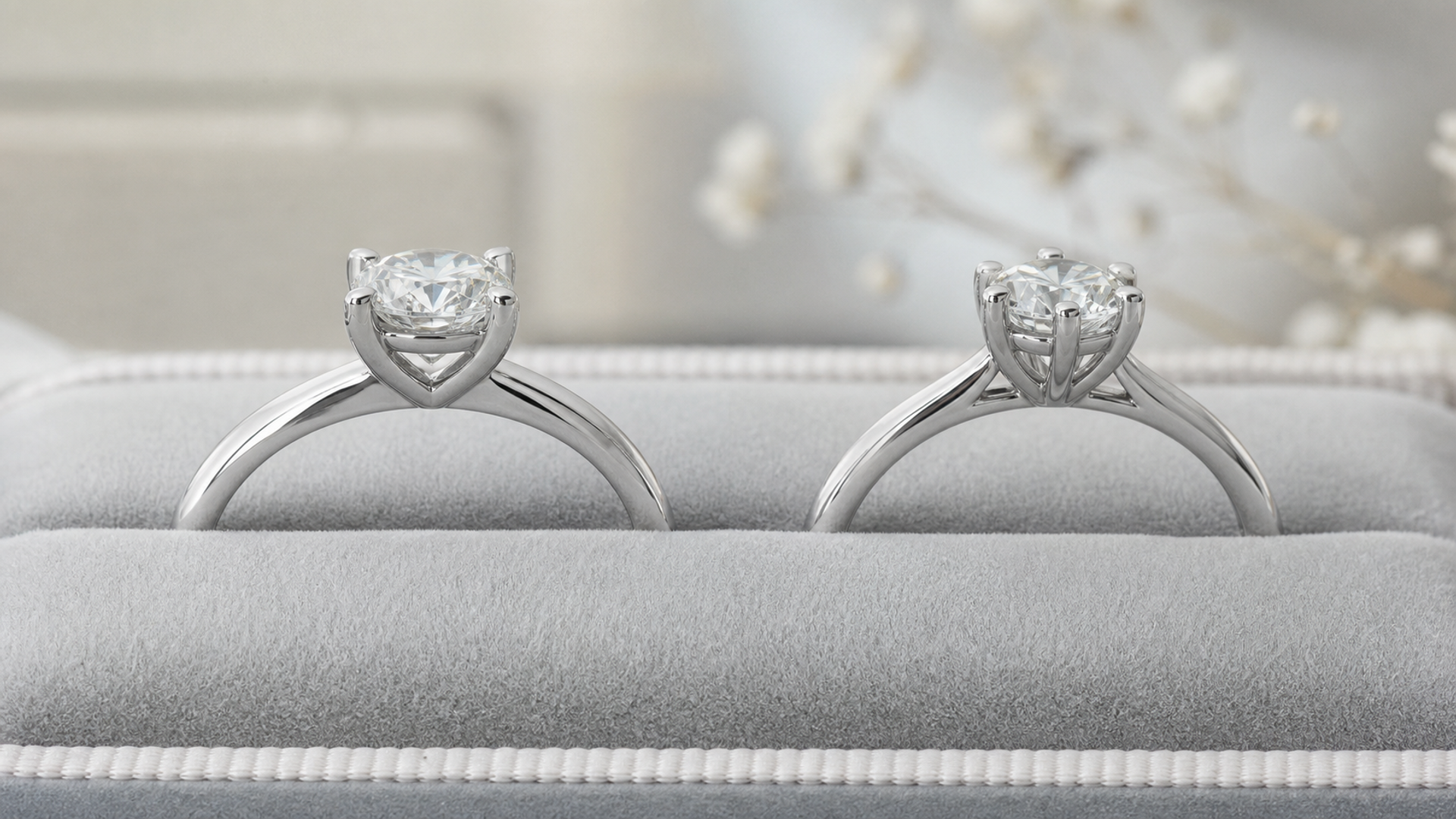
The Cartier 1895 and Tiffany Setting are both landmark solitaire engagement-ring designs, but their identities begin with different prong architecture. Cartier's Solitaire 1895 collection presents the centre stone through a four-prong setting in its classic round-brilliant expression. The Tiffany Setting, introduced in 1886, is defined by six prongs that lift a round brilliant diamond above the band. Choose by side profile, diamond presentation, band, service relationship and the recipient's taste—not by logo alone.
This guide compares the official design propositions and buying process. Exact carat, metal, price and availability change by market and selected stone. A collection page is not proof that every combination is immediately available.
Quick answer
Choose the Cartier 1895 if you prefer a four-prong presentation, a clean architectural profile and the ability to explore Cartier's broader Solitaire 1895 expressions. Choose the Tiffany Setting if the historic six-prong silhouette, elevated round brilliant and Tiffany's specific engagement-ring identity matter most.
Neither setting automatically makes an equivalent diamond more beautiful. Proportions, cut quality, prong execution, ring size and viewing angle all affect the result.
Solitaire decision matrix
| Decision factor | Cartier 1895 | Tiffany Setting | What to inspect |
|---|---|---|---|
| Signature architecture | Four-prong classic solitaire expression | Six-prong elevated solitaire | Side and top profile |
| Centre stone presentation | More open four-point framing | Six-point crown-like symmetry | Prong visibility and light return |
| Historical identity | Collection name references Cartier's 1895 archive | Design introduced in 1886 | Which story feels personal |
| Band and metal | Varies across collection and selected design | Iconic version in platinum; current variations should be verified | Width, height, finish and wedding-band fit |
| Service | Cartier boutique and brand service route | Tiffany boutique and brand service route | Sizing, cleaning, documentation and local terms |
| Best for | Buyer favouring four-prong openness and Cartier design language | Buyer wanting the archetypal Tiffany six-prong silhouette | Recipient preference, not social recognition |
Prong count changes the visual rhythm
Cartier's official Solitaire 1895 collection describes a design linked to the maison's 1895 archive and presents a centre diamond held by four prongs in the classic expression. From above, four prongs create a cardinal-point rhythm and can leave more of the stone's perimeter visually open.
Tiffany's official setting education identifies the Tiffany Setting as a six-prong design introduced in 1886. Six prongs create a crown-like frame around the round brilliant and are integral to the design's recognisable silhouette.
More prongs do not automatically mean “better”, and fewer do not automatically mean “brighter”. Prong shape, thickness, placement and finishing determine how much metal you perceive. Examine the exact ring from the top, side and at a normal conversational distance.
Side profile is more revealing than a front photograph
Online product imagery often emphasises a top view, but the wearer sees the ring from many angles. The side profile reveals how high the diamond sits, how the basket meets the shank and whether the architecture catches on clothing.
An elevated setting can make the centre stone feel more prominent and may allow some wedding bands to sit closer, depending on the basket and band. It can also expose the stone to more knocks. A lower profile may feel more secure in active daily life but interact differently with a straight wedding band.
Ask to try the ring with a representative wedding band. Do not assume flush fit. The engagement ring can be perfect alone and awkward as a pair.
Diamond cut matters more than the brand comparison
Both designs are meant to present a round brilliant prominently. The diamond's cut proportions, symmetry and polish drive optical performance. Carat describes weight, not apparent size or beauty. Colour and clarity should be balanced against what is visible to the unaided eye and meaningful to the buyer.
Use the diamond clarity value guide to avoid spending on a grade difference that is not visible in normal wear. Compare stones in similar lighting and ask for the applicable grading documentation and brand certificate.
A well-cut smaller diamond can appear more lively than a larger stone with compromised proportions. The setting cannot repair weak cut performance.
Metal and band proportion change the result
The iconic current Tiffany Setting product page presents the design in platinum with a round brilliant centre stone. Cartier's 1895 collection includes different precious-metal and design expressions depending on market and selection.
Platinum's density and naturally white appearance suit diamond settings, but it develops a patina with wear. Gold alloys have their own colour, hardness and maintenance behaviour. The recipient may prefer warm yellow or rose tones even if the campaign image uses platinum.
Band width affects apparent stone size and comfort. A fine band can visually enlarge the centre, while a broader band may feel more substantial. Inspect the underside: a narrow base can feel different after resizing, and small changes can affect comfort on adjacent fingers.
Security is a maintenance practice, not a prong-count slogan
Six prongs provide more contact points than four, but security depends on workmanship, wear, impact and inspection. Four well-made prongs can be entirely appropriate; six worn or damaged prongs still require service.
Check prongs periodically for movement, snagging or unevenness. Remove the ring for activities likely to strike, compress or chemically expose it. Follow the brand's cleaning and service guidance, and do not let an unqualified repairer alter the setting.
Insurance should reflect replacement conditions in your market. Photograph the ring, retain documents and understand whether the policy covers loss, damage and travel.
The buying experience is part of the decision
Luxury engagement-ring buyers are purchasing a service relationship as well as an object. Compare appointment quality, stone explanation, sizing process, delivery estimate, aftercare, cleaning and local return or exchange terms.
Ask both boutiques the same questions:
Which diamond and setting details will appear on the invoice and certificate?
What resizing range is safe for the selected ring?
How long do production and alteration take?
What aftercare and cleaning are available locally?
What happens if the ring size is wrong after the proposal?
How will the wedding band sit?
Are taxes, duties or cross-border service relevant?
Terms can vary by market. Do not transfer a US webpage's price or return rules to another country.
Brand story should belong to the couple
The Tiffany Setting has a particularly direct cultural identity: the six-prong solitaire is closely associated with the house's engagement tradition. For some couples, that recognisability is the point. For others, it can feel too expected.
Cartier's 1895 language connects the ring to the maison's jewellery archive and a four-prong visual restraint. It may appeal to someone who already wears Cartier or prefers the maison's broader design vocabulary.
Ask a private question: if the box were removed, which ring would the recipient choose on the hand? Brand story should reinforce preference, not substitute for it.
Lifestyle test
Consider the wearer's daily routine. Frequent gloves, clinical work, childcare, sport, instruments or hands-on design work can make height and snagging important. A high solitaire may need to be removed more often.
Also consider travel. A very recognisable ring may not be appropriate for every destination. Insurance, secure storage and discretion matter. Some wearers choose a simple travel band rather than taking the primary ring everywhere.
Comfort should be tested over at least several minutes. Finger size changes with temperature, and a top-heavy ring can rotate. Correct sizing and band geometry matter more than a few moments under boutique lighting.
Budget allocation
Set a total budget covering diamond, setting, tax, insurance and possible wedding band. Then decide which elements are non-negotiable. If the Tiffany or Cartier identity is essential, accept that brand service and design carry part of the price. If optical performance is the priority, compare the available diamonds carefully rather than selecting by carat alone.
Do not use an engagement ring as a short-term investment thesis. Resale markets are uncertain and emotional value is the primary purpose. Buy a ring that remains satisfying if its market value is never discussed.
The tennis bracelet guide offers a separate framework for inspecting settings, clasps and everyday wear in diamond jewellery, but bracelet construction should not be transferred directly to a ring.
Five buyer profiles
The design historian
Choose the story that resonates: Tiffany's 1886 six-prong archetype or Cartier's 1895 collection identity. Confirm the exact current ring rather than buying only the date.
The minimal-profile buyer
Compare both side by side. Prong count alone does not determine height; the exact basket and stone matter.
The brand-loyal wearer
Choose the maison already present in the wearer's jewellery wardrobe if its service and design language are genuinely preferred.
The diamond-first buyer
Prioritise cut performance and balanced quality. Let the chosen setting frame the strongest stone available within the total budget.
The surprise proposer
Use a temporary or safely resizable approach only after checking boutique policy. Involve the wearer in final sizing and wedding-band pairing whenever possible.
Boutique comparison checklist
View both rings from top, side and normal distance.
Compare similar diamond size and cut quality.
Ask how the wedding band will sit.
Confirm metal, prong shape and setting height.
Review certificates, invoice detail and laser inscription where applicable.
Confirm resizing range and turnaround.
Understand local return, exchange and service terms.
Price insurance and tax in the final budget.
Choose based on the wearer's hand and life, not only campaign imagery.
Final verdict
The Cartier 1895 is the stronger choice for a buyer who prefers an open four-prong presentation and Cartier's restrained solitaire vocabulary. The Tiffany Setting wins for someone who wants the historic six-prong crown and its unmistakable engagement-ring identity. Compare equivalent diamonds, inspect the side profile, test a wedding band and let the recipient's real life decide the setting.
Sources
Cartier, Solitaire 1895 collection, accessed 3 August 2026.
Tiffany & Co., The Tiffany Setting engagement ring, accessed 3 August 2026.
Tiffany & Co., Engagement-ring settings and styles, accessed 3 August 2026.