A tiger eye bracelet should be chosen as a piece of jewellery you can inspect and wear comfortably. Look for the stone's characteristic shifting band of light, examine bead polish and drill holes, ask about treatment, and check that the cord or clasp suits your wrist. Colour alone is not enough. Personal meaning may be part of the attraction, but it should not be presented as a proven health effect.
What is tiger's-eye stone?
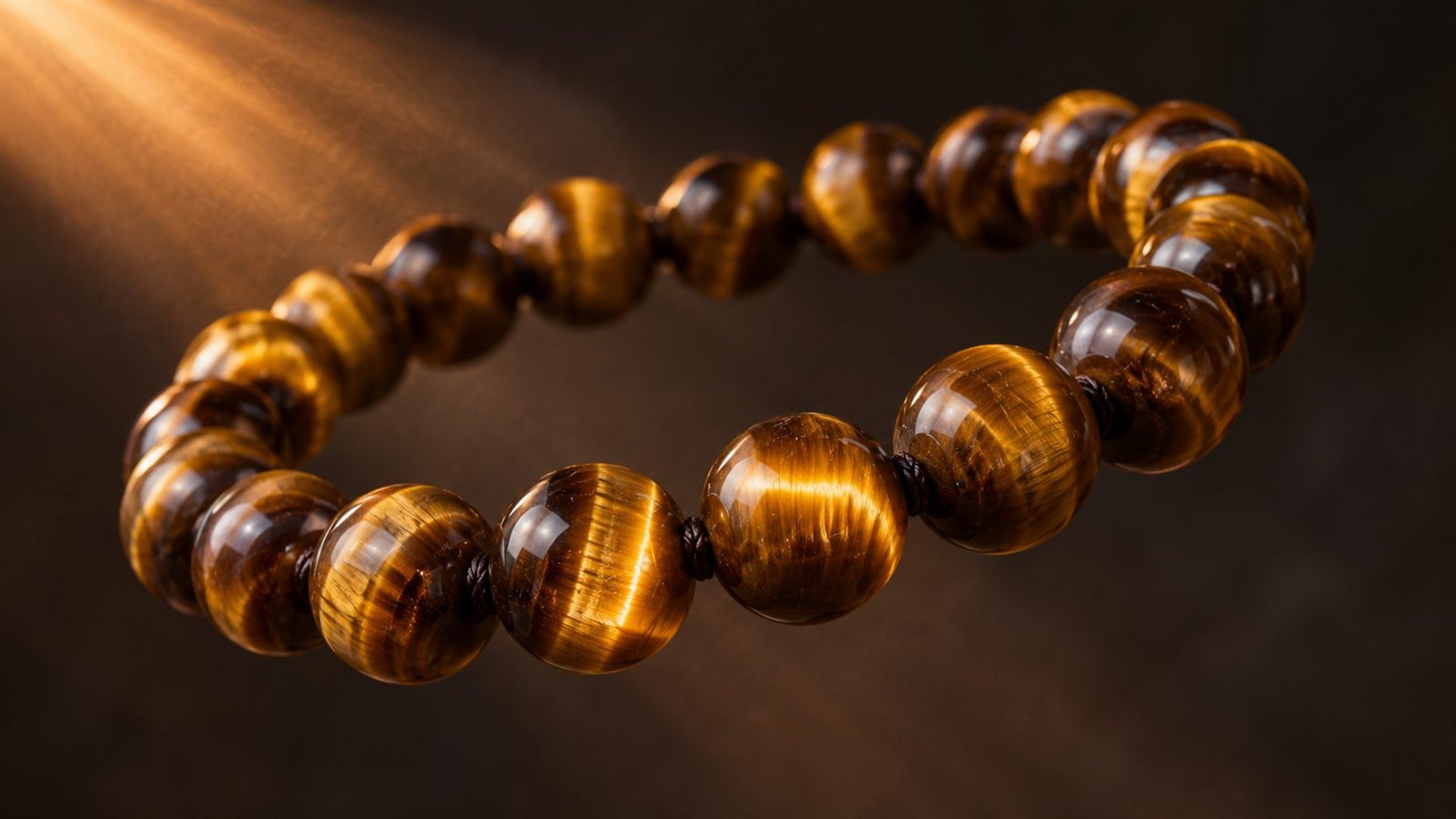
Tiger's-eye is a variety of quartz known for a silky, moving light effect called chatoyancy. GIA's gemological review explains how aligned fibrous inclusions produce the effect. On a polished bead, the bright band should seem to shift as the stone or light moves. That distinctive motion, more than an evenly brown colour, is what many buyers seek.
Natural variation is expected. Beads cut from different parts of a material can show different proportions of golden and dark bands. A perfectly identical appearance across every bead is not automatically a virtue, and visible variation is not proof of a defect. Judge the bracelet as a whole: whether the beads make a coherent sequence, whether the light effect is attractive to you and whether the seller's description matches the actual piece.
How can you examine the moving light band?
Hold the bracelet in diffused daylight and rotate it slowly. A narrow or broad band may move across the curved bead surface. Then view it under a second light source. Photos taken in one direction can exaggerate or conceal the effect. If buying online, request a short video of the exact bracelet turning in neutral light rather than relying only on a studio image of a different specimen.
GIA describes chatoyancy as a light band that appears to glide across a gemstone. The optical effect is a material property, not a ranking formula. Some wearers like a crisp line; others prefer softer golden movement. Ask for close images of several beads, especially if the piece is being sold at a premium for its visual character.
Do colour and treatment need checking?
Yes. Typical tiger's-eye appears in golden-brown tones, but treatment can alter gem materials. GIA's treatment introduction notes that some tiger's-eye quartz may be lightened. Ask the seller whether the beads are natural colour, heated, bleached, dyed or otherwise treated, and request the answer in writing. Do not assume a vivid colour is either natural or artificial based only on a screen photograph.
Colour accuracy is also affected by lighting and display settings. Compare the listing's images in natural and indoor light if available. A seller who uses the exact bracelet for each photograph gives you more useful information than a generic image attached to many size variants. If treatment matters to your purchase, consider an independent gemological assessment for a costly piece.
What should you inspect on the beads?
Look at each bead's polish, roundness and drill-hole edges. Rough openings can abrade a cord; chipped edges can catch on clothing or skin. A bead can be attractive even if its pattern differs from its neighbour, but a cracked bead or poorly finished hole may reduce daily durability. Roll the bracelet gently in your hand to check whether any bead feels sharp or unstable.
Ask for the bead diameter and the total bracelet circumference, not merely “small”, “medium” or “large”. Larger beads change weight and how the bracelet sits beneath a sleeve. Smaller beads may be easier to stack with a watch, though the exact setting and contact points matter. A bracelet is a wearable object; its construction deserves as much attention as its photographs.
Elastic cord or clasp: which should you choose?
Elastic is quick to wear but depends on the cord's condition and stretch. A clasped design may feel more secure to some owners, but it adds hardware that should be inspected and operated correctly. Ask what type of stringing is used, how the ends are secured, whether restringing is available and how the seller recommends storage. No stringing method lasts forever under repeated tension.
Do not stretch an elastic bracelet farther than needed to pass over the hand. Roll it on gently rather than pulling one side sharply. If a clasp is difficult to reach, practice over a soft surface and check that it closes completely. A bracelet that repeatedly opens or shows fraying should be serviced before outdoor wear. Losing a bead can be more costly than arranging preventive restringing.
How should a tiger's-eye bracelet fit?
Measure the wrist where you plan to wear it and compare with the maker's finished inner circumference. Bead size reduces the interior space available, so two bracelets with the same outside length may fit differently. The bracelet should not press tightly into the wrist or slide over the hand unexpectedly. Try the size while moving the arm and bending the wrist, not only while standing still.
If you plan to wear it beside a watch, check whether beads or a metal clasp strike the case repeatedly. The VERTU guide to wearing a bracelet with a watch discusses this contact issue. A separate wrist may be simpler if either piece has a vulnerable polished surface. The styling choice is yours, but protect the pieces from a collision pattern you can already see.
Does tiger's-eye have a fixed meaning?
No single symbolic meaning belongs to every wearer or culture. Some people choose the warm stripes for personal reasons, a gift memory or a colour association. Present those as individual interpretations rather than a universal tradition. Do not buy a bracelet on the expectation that it will improve health, concentration or mood. The observable properties are its quartz material, visual effect and construction.
A gift can still be meaningful without an unsupported claim. Ask the recipient's wrist size, preferred bead scale and whether they like warm brown tones. Include a note explaining why the pattern reminded you of them, if that feels appropriate. A thoughtful, specific choice is more persuasive than a generic promise about what a stone will do.
How does VERTU COR CHAIN relate to this choice?
VERTU COR CHAIN is a separate bead-style connected wearable. Its official botanical options include Hainan Huanghuali, Small-Leaf Red Sandalwood and Star-Moon Bodhi Seed; the listed options do not make it a tiger's-eye bracelet. It is relevant only as an example of how bead material, design and a technology module can change the buying question. Do not transfer tiger's-eye properties or symbolism to it.
If you want a simple stone bracelet, judge its gem material and stringing. If you are considering a connected bead form, check the exact material option, fit, app requirements and current product terms as a different decision. VERTU's COR CHAIN overview describes that adjacent category, but it does not replace inspection of a tiger's-eye item from its own maker.
What should you ask before paying?
Request the exact bracelet photographs, bead diameter, finished fit, material and treatment disclosure, stringing method, clasp metal if present, care instructions and return terms. Ask whether the beads in the shipped item match those shown. If the item is described as rare or valuable, request evidence for that claim rather than relying on adjectives. Keep the written description with the receipt.
On arrival, inspect the bracelet before wearing it outside. Check every bead, the thread path, knots and clasp. Move it gently in light and compare it with the listing. If the fit is wrong, use the seller's adjustment or return procedure rather than modifying it yourself before asking. This is especially important for a gift, where an unaltered item may be easier to exchange.
Frequently asked questions
Is every golden-brown bead tiger's-eye?
No. Colour alone is insufficient. Seek the characteristic shifting light effect and credible material information.
Does stronger chatoyancy mean better quality?
It can be visually desirable, but quality also depends on finish, construction, fit and what you personally prefer. Ask to see the exact beads in motion.
Can tiger's-eye be treated?
Yes, treatment of this material is possible. Ask the seller for a clear disclosure for the particular bracelet.
Is COR CHAIN made from tiger's-eye?
The current listed botanical options do not include tiger's-eye. Check the precise VERTU configuration rather than assuming all bead bracelets share a material.
Conclusion
Choose a tiger eye bracelet by examining its moving light band, bead finishing, treatment disclosure, stringing and fit. Compare the actual piece, not a representative photograph, and treat symbolic associations as personal. If a connected bead wearable is also on your shortlist, review VERTU COR CHAIN as a distinct material and technology choice rather than a tiger's-eye substitute.