Dubai's displayed gold rate is only one line in a jewellery purchase. The final amount can include the metal value, making charge, stones or other materials, tax treatment and seller-specific commercial terms. A disciplined buyer compares like with like: same fineness, same net gold weight, same moment and a written breakdown before payment.
The short answer for Dubai buyers
Check the Dubai Jewellery Group reference rate at the time of purchase, confirm karat or fineness and net gold weight, then ask the retailer to itemise metal value, making charge, stones, VAT and any other fee. Verify hallmarks and the seller's return or buyback terms in writing. Do not treat jewellery as equivalent to bullion or assume that a low making charge guarantees the best total purchase.
| Decision factor | Plain gold jewellery | Gem-set jewellery | Bullion or investment product |
|---|---|---|---|
| Price basis | Net gold weight and fineness anchor the metal value | Gold, stones and workmanship are separated | Product premium and investment rules are identified |
| Making charge | Per-gram or fixed labour charge is itemised | Complex setting labour is itemised | Minting or dealer premium is separated |
| Purity evidence | Hallmark and stated karat match the invoice | Metal hallmark and stone documents are checked separately | Fineness, weight and recognised product details are verified |
| VAT treatment | Retailer explains current treatment on each invoice line | Metal, stones and making components are treated correctly | Applicable investment-product treatment is confirmed |
| Resale | Buyback formula for metal and deductions is written | Stone and workmanship resale assumptions stay conservative | Dealer spread, custody and liquidity are understood |
| Use case | Wearability and durability lead | Design and stone quality lead | Investment exposure rather than adornment leads |
This buying gold in Dubai 2026 matrix is the article's working value object. Read the buying gold in Dubai 2026 rows together: the decisive failure mode depends on this topic's evidence, operating context and reader objective.
What the official sources establish
Evidence 1. Dubai Jewellery Group publishes a live retail gold-rate reference, but a buyer should record the displayed time, karat and rate because the metal price can change during the day.
Evidence 2. The UAE Federal Tax Authority publishes guidance on the VAT treatment of gold and diamond making charges; the treatment depends on the transaction and current rules, so the retailer's invoice must show the applied basis.
Evidence 3. The Federal Tax Authority's 2025 public clarification supersedes or updates earlier guidance for its stated scope, making the current document more reliable than an old blog summary or recycled invoice example.
Evidence 4. Dubai Municipality describes precious-metal testing and laboratory capabilities, supporting a verification ecosystem without turning a retailer's marketing statement into independent proof of every item.
Reader-visible sources checked for this article:
dubaijewellerygroup.com — reader-visible current or official evidence
tax.gov.ae — reader-visible current or official evidence
tax.gov.ae — reader-visible current or official evidence
dm.gov.ae — reader-visible current or official evidence
dm.gov.ae — reader-visible current or official evidence
For buying gold in Dubai 2026, these sources establish only the claims inside their documented scope. Recheck every changeable specification, availability condition, price, policy or service term in the relevant market before acting.
Build the invoice from first principles
The price basis row exposes a practical boundary. Route one assumes net gold weight and fineness anchor the metal value, while route two is defensible only when gold, stones and workmanship are separated. Route three depends on product premium and investment rules are identified. If that evidence is absent, keep the more reversible option.
Read making charge as a stop/go test: per-gram or fixed labour charge is itemised supports the first option; complex setting labour is itemised supports the second; and minting or dealer premium is separated supports the third. Record which source proves the condition and when it was checked.
A buyer can resolve purity evidence without starting from a brand preference. Ask whether hallmark and stated karat match the invoice; compare that with whether metal hallmark and stone documents are checked separately; then use fineness, weight and recognised product details are verified as the third route's safeguard. An unknown condition stays unknown.
On vat treatment, popularity is not enough. The evidence for option one is that retailer explains current treatment on each invoice line. Option two means metal, stones and making components are treated correctly. Option three is rational where applicable investment-product treatment is confirmed. Recheck any changeable term immediately before commitment.
The decision changes at resale. Choose the first path only if buyback formula for metal and deductions is written; move to the second when stone and workmanship resale assumptions stay conservative; use the third when dealer spread, custody and liquidity are understood. Save the downside that would make this row fail.
For use case, the first route works when wearability and durability lead; the second requires design and stone quality lead. The control for the third is investment exposure rather than adornment leads. Verify this row against the exact product, property, account or environment before it can reverse the decision.
Facts that would reverse the current choice
Reversal control 1 — Price basis. Before choosing Plain gold jewellery, write down how the decision changes if “Net gold weight and fineness anchor the metal value” proves false. Do the same for Gem-set jewellery and “Gold, stones and workmanship are separated”. Keep the Bullion or investment product route available until “Product premium and investment rules are identified” is verified. This control belongs to buying gold in Dubai 2026; update it from the cited source or exact supplier rather than copying a generic checklist.
Reversal control 2 — Making charge. Before choosing Plain gold jewellery, write down how the decision changes if “Per-gram or fixed labour charge is itemised” proves false. Do the same for Gem-set jewellery and “Complex setting labour is itemised”. Keep the Bullion or investment product route available until “Minting or dealer premium is separated” is verified. This control belongs to buying gold in Dubai 2026; update it from the cited source or exact supplier rather than copying a generic checklist.
Reversal control 3 — Purity evidence. Before choosing Plain gold jewellery, write down how the decision changes if “Hallmark and stated karat match the invoice” proves false. Do the same for Gem-set jewellery and “Metal hallmark and stone documents are checked separately”. Keep the Bullion or investment product route available until “Fineness, weight and recognised product details are verified” is verified. This control belongs to buying gold in Dubai 2026; update it from the cited source or exact supplier rather than copying a generic checklist.
Reversal control 4 — VAT treatment. Before choosing Plain gold jewellery, write down how the decision changes if “Retailer explains current treatment on each invoice line” proves false. Do the same for Gem-set jewellery and “Metal, stones and making components are treated correctly”. Keep the Bullion or investment product route available until “Applicable investment-product treatment is confirmed” is verified. This control belongs to buying gold in Dubai 2026; update it from the cited source or exact supplier rather than copying a generic checklist.
Reversal control 5 — Resale. Before choosing Plain gold jewellery, write down how the decision changes if “Buyback formula for metal and deductions is written” proves false. Do the same for Gem-set jewellery and “Stone and workmanship resale assumptions stay conservative”. Keep the Bullion or investment product route available until “Dealer spread, custody and liquidity are understood” is verified. This control belongs to buying gold in Dubai 2026; update it from the cited source or exact supplier rather than copying a generic checklist.
Reversal control 6 — Use case. Before choosing Plain gold jewellery, write down how the decision changes if “Wearability and durability lead” proves false. Do the same for Gem-set jewellery and “Design and stone quality lead”. Keep the Bullion or investment product route available until “Investment exposure rather than adornment leads” is verified. This control belongs to buying gold in Dubai 2026; update it from the cited source or exact supplier rather than copying a generic checklist.
Calculate the metal component
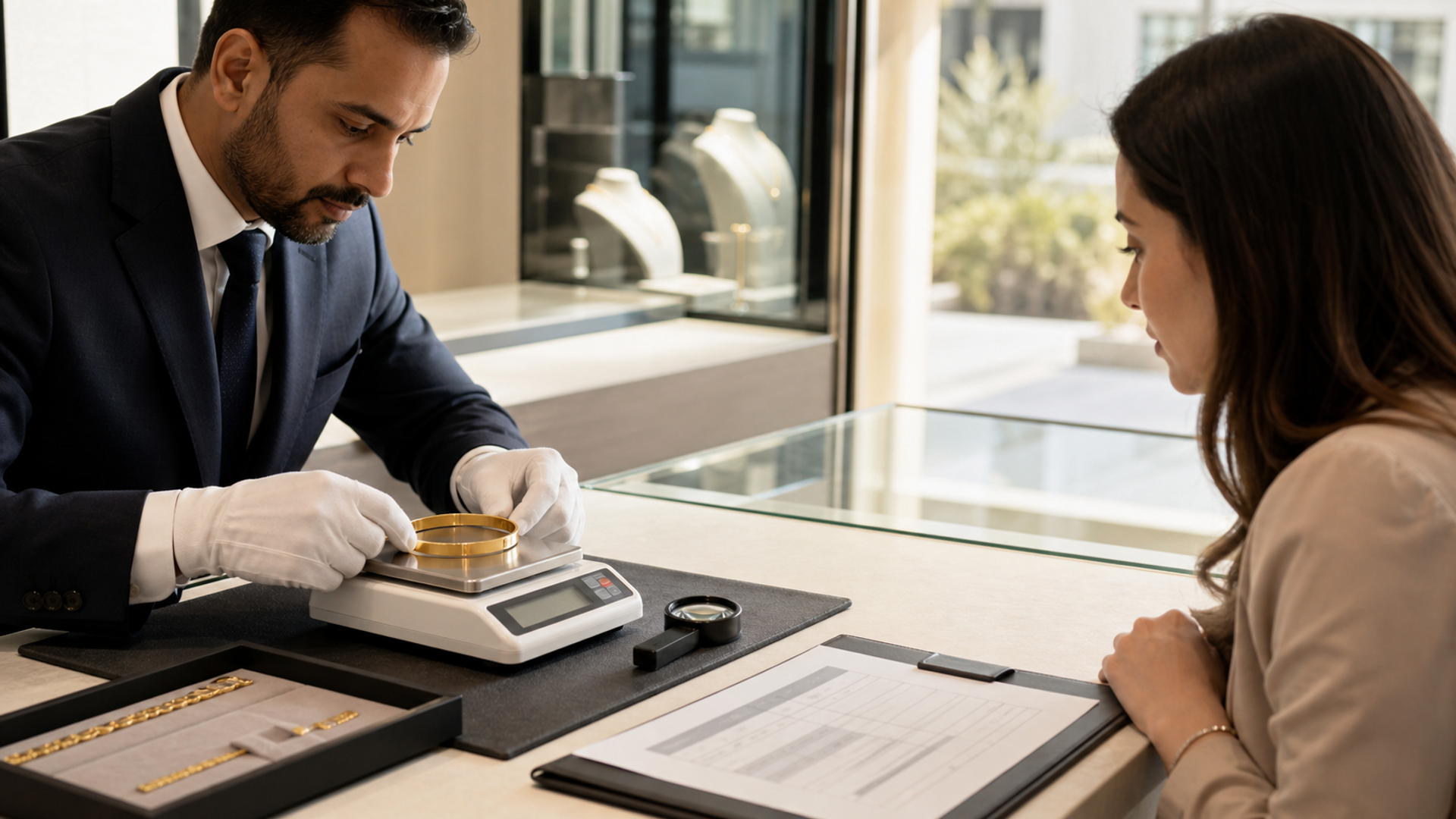
Ask for gross weight, stone weight or other non-gold components where relevant, net gold weight and fineness. Convert karat to the stated purity and multiply the net gold weight by the applicable rate for that fineness at the recorded time. The result is a reference metal component, not necessarily the complete retail price. Compare sellers only after normalising these inputs.
Separate workmanship from hidden ambiguity
Making charges can be quoted per gram, as a fixed amount or as a percentage. For intricate pieces, that labour can be a legitimate part of the design value, but it should be visible. Ask whether polishing, certification, card fees or other charges are included. A seller who discounts the making charge may use a different metal-rate basis, so compare the final itemised total rather than one promotional line.
Verify purity and documentation
Inspect the hallmark, karat or fineness mark, net weight and retailer identity on the invoice. For gem-set jewellery, treat the stone report and metal purity as separate evidence. If the value is material or the markings are unclear, use an appropriate independent testing or appraisal route before the return window closes. Keep photographs and the original invoice, but do not confuse an appraisal estimate with a guaranteed resale price.
Model exit value conservatively
Jewellery resale commonly values recoverable metal differently from design, retail labour and emotional value. Request the seller's written buyback formula, deductions and whether the policy applies only to exchange. For bullion, compare dealer premium and spread, storage and authenticity. Neither route is risk-free, and this guide does not provide investment or tax advice; personal circumstances require qualified advice.
Three purchases that need different checks
A simple 22K bracelet
Net gold weight, the 22K reference rate, itemised making charge, VAT and written buyback terms make the comparison tractable. The buyer should still inspect clasp construction and wearability. Define the fact that would reverse this recommendation before committing.
A diamond-set 18K piece
Gold is only part of the value. The invoice should separate metal, stones and workmanship, and any grading report should be checked against the stone and issuing laboratory. Define the fact that would reverse this recommendation before committing.
A buyer seeking price exposure
Jewellery may be an inefficient substitute for a recognised bullion or investment product because workmanship and retail margins may not return on resale. The buyer needs independent financial and tax advice before treating the purchase as an investment. Define the fact that would reverse this recommendation before committing.
Action checklist
Record the live rate, fineness and observation time.
Confirm gross and net gold weight.
Match the hallmark to the invoice.
Itemise metal, making, stones and other charges.
Ask how VAT was applied to each component.
Compare final totals using the same weight and purity.
Read return, exchange and buyback terms.
Verify stone reports independently where relevant.
Keep the original invoice and clear photographs.
Seek qualified advice before treating gold as an investment.
Continue the decision
The linked VERTU articles expand adjacent parts of the buying gold in Dubai 2026 decision. They do not substitute for the external evidence above.
The Dubai gold buying verdict
Check the Dubai Jewellery Group reference rate at the time of purchase, confirm karat or fineness and net gold weight, then ask the retailer to itemise metal value, making charge, stones, VAT and any other fee. Verify hallmarks and the seller's return or buyback terms in writing. Do not treat jewellery as equivalent to bullion or assume that a low making charge guarantees the best total purchase.
Keep the buying gold in Dubai 2026 decision reversible until its material cost, safety, access, privacy and compatibility facts are verified. Unknown evidence stays unknown; it is never silently scored as favourable.