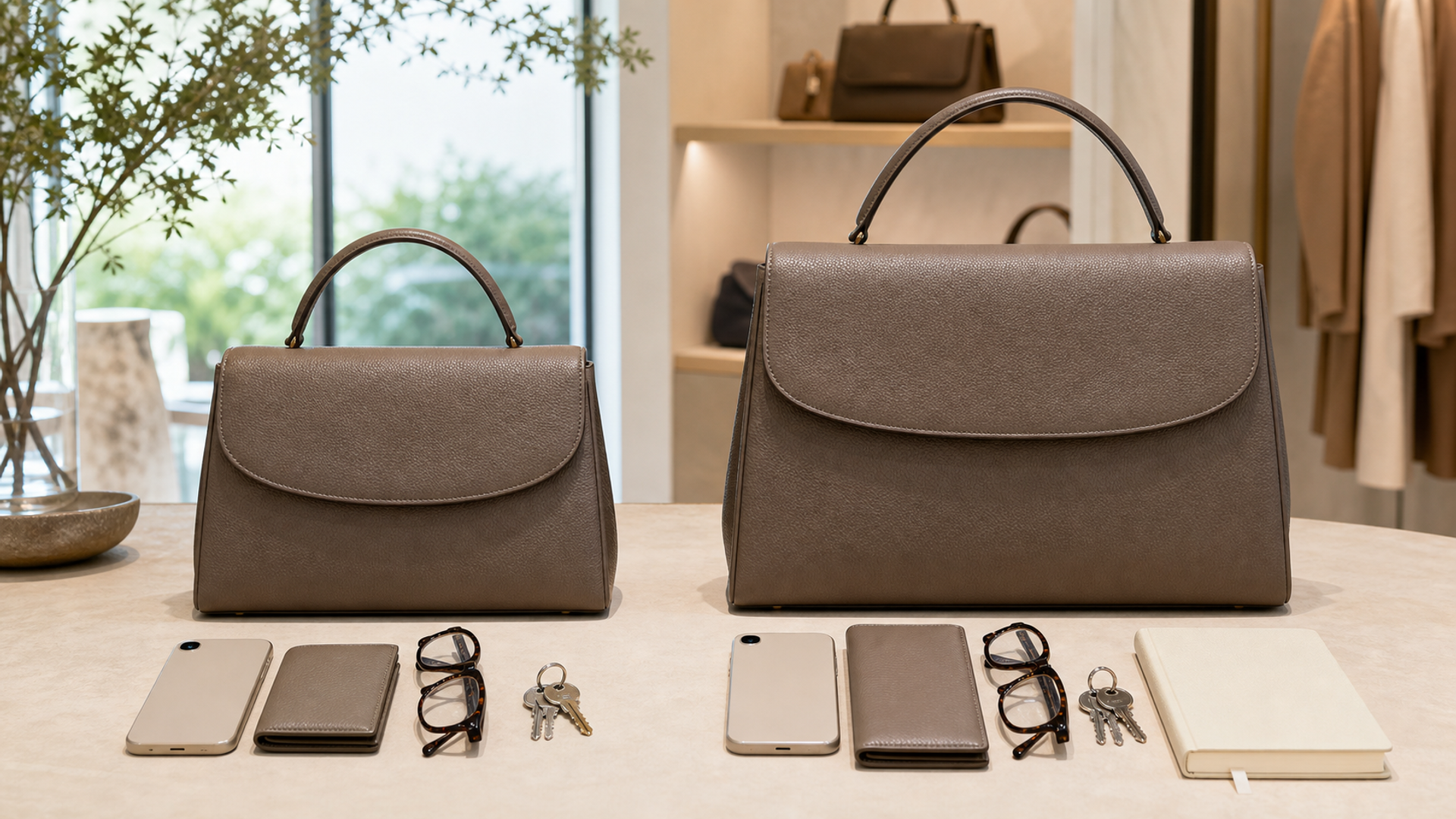
Birkin 25 and Birkin 30 are separated by five centimetres across the base, but the ownership difference is larger than that number suggests. The 25 is a compact hand-carried bag whose small handles and reduced opening reward a disciplined essentials list. The 30 is a more accommodating day bag that can carry a larger wallet, glasses, small notebook and additional personal items without immediately becoming a travel tote.
Sotheby's lists typical dimensions of about 25 × 20 × 13cm for the Birkin 25 and 30 × 22 × 16cm for the Birkin 30. Leather, Sellier or Retourne construction and stuffing change usable space, so the comparison must use real objects rather than external volume alone.
Quick answer
Choose the Birkin 25 when compact proportion, evening-to-day versatility and a curated carry are the priorities. Choose the Birkin 30 when the bag must support a full day, larger hands or a more comfortable wrist carry. Neither is a laptop bag in the modern work sense; buyers who need a computer should test the exact device and avoid distorting the bag.
Decision matrix
| Decision factor | Option A | Option B | Practical edge |
|---|---|---|---|
| Typical dimensions | 25 × 20 × 13cm | 30 × 22 × 16cm | 30 for capacity |
| Carry style | Hand; wrist fit can be limited | Hand or wrist for more users | 30 |
| Daily load | Phone, compact wallet, glasses, keys | Adds notebook, pouch and larger items | 30 |
| Evening use | Strong | Possible but more substantial | 25 |
| Body proportion | Compact visual scale | Balanced day-bag presence | Try in mirror |
| Opening access | Smaller and more exacting | More forgiving | 30 |
| Collecting role | Small-format focus | Versatile first Birkin | Owner-specific |
| Overfilling risk | High when used as full day bag | Lower but still material | Pack honestly |
Measure the objects, not the label
A size name does not describe the shape of a phone, sunglasses case or wallet.
Rigid cases and long objects consume space inefficiently. The Birkin's trapezoidal body and central closure also affect access.
Use this test: Create a paper footprint from the published base dimensions and arrange your actual essentials inside it.
The 25 asks for a curated carry
The compact bag works best when every object earns its place.
A large continental wallet, bulky keys and hard sunglasses case can fill it quickly. Small pouches protect the lining but consume more volume.
Use this test: Test the exact wallet and phone rather than using generic packing videos.
The 30 is a day-bag sweet spot
The additional width, height and depth make the 30 more forgiving without turning it into luggage.
It supports a notebook, power bank and personal pouch more comfortably. Weight rises quickly when the owner treats spare capacity as permission to overpack.
Use this test: Weigh the complete load and carry it for ten minutes.
Handle clearance can decide the purchase
The Birkin 25's smaller handles may not pass comfortably over every hand or wrist.
A bag that looks proportionally perfect can be frustrating during security, shopping or a phone call. The 30 usually offers easier wrist access.
Use this test: Try the bag while wearing the jewellery and outerwear normally used.
Sellier and Retourne change usable behaviour
A Sellier construction holds a sharper shape; Retourne is softer and can feel more accommodating.
Leather choice also affects structure, weight and how the opening moves. Two bags with the same nominal size may not pack identically.
Use this test: Compare the exact construction and leather, not only the centimetre number.
Body scale is visual, not prescriptive
Height alone cannot determine which bag looks balanced.
Shoulder width, clothing volume, hand size and styling intent all affect proportion. A small bag can be deliberate on a tall wearer; a 30 can look refined on a petite frame.
Use this test: Use front, side and seated mirror views with the bag filled.
Neither size should be forced into laptop duty
A modern laptop places rigid pressure on the base, corners and closure.
Even if a small tablet or compact computer appears to fit, repeated strain can deform the bag and concentrate weight in the handles.
Use this test: Use a purpose-built work bag when technology is a daily requirement.
Condition and provenance outweigh size trends
Secondary-market demand for small bags can change, while authenticity and condition remain fundamental.
Corners, handles, hardware, odour, colour transfer and unauthorised repair affect ownership. Documentation should be assessed by a trusted specialist.
Use this test: Do not let a popular size excuse weak provenance.
Climate belongs in the leather decision
Heat, humidity, sunlight and friction affect leather and hardware during real use.
A compact bag carried tightly against clothing can experience colour transfer; a larger bag may contact more surfaces. Storage discipline matters in both sizes.
Use this test: Follow specialist care guidance and store the bag upright, supported and dry.
Collection role should settle a close result
The 25 and 30 can coexist because they serve different load and visual roles.
For a first Birkin, versatility may favour the 30. For an existing collection of day bags, the 25 can add a more compact event-to-lunch option.
Use this test: Map the occasions not served by current bags before buying.
Who should choose what
| Traveller or owner | Better fit | Why |
|---|---|---|
| Phone, cardholder, keys and compact glasses | Birkin 25 | Disciplined essentials fit the compact format. |
| Full day with notebook, pouch and power bank | Birkin 30 | More forgiving access and volume. |
| First Birkin for mixed day use | Often Birkin 30 | Broadest functional range. |
| Collector seeking a smaller formal option | Birkin 25 | Distinct proportion and role. |
Common mistakes
Using external volume as if every cubic centimetre were usable.
Ignoring handle clearance and loaded weight.
Forcing a laptop into a bag not designed for rigid daily equipment.
Buying a size trend without verifying provenance and condition.
How to measure personal value
The useful value of Birkin 25 vs 30 is the change it produces in a repeated, observable situation. Start with the article's value object—the real-object packing, body-scale, carry and collection-role matrix—and mark which rows affect your own behaviour. In the Birkin 25 vs 30 decision, a feature that never changes a journey, security decision or ownership routine has little practical value even when technically impressive.
Use typical dimensions as the first controlled comparison: one side is 25 × 20 × 13cm, while the other is 30 × 22 × 16cm. Then add the frequency of the relevant trip or use, the cost of Birkin 25 vs 30 mistakes, and the friction introduced by the more demanding option. For a Birkin 25 vs 30 purchase, divide the meaningful premium by expected uses rather than calendar years; for privacy, include the time and support required to keep controls correctly configured.
Create a minimum-success condition for Birkin 25 vs 30. For this Birkin 25 vs 30 decision, success might be a full night's sleep, a watch still running on Monday, a phone policy that survives travel, or a bag carrying the real daily load without distortion. If neither Birkin 25 vs 30 option meets that condition, defer the purchase, choose another configuration or redesign the trip.
How to verify a changing specification
Facts surrounding Birkin 25 vs 30 can change after publication: airlines swap aircraft, manufacturers update references, software support terms move, and pre-owned condition differs from a catalogue description. Treat the current operator or manufacturer page as the Birkin 25 vs 30 starting point, not as a guarantee that every individual booking or object matches the general description.
Capture the exact date, model, route, configuration, material, firmware or fare family used for Birkin 25 vs 30. Save the official Birkin 25 vs 30 specification and ask the seller or operator to resolve contradictions in writing. If a material Birkin 25 vs 30 feature is not identified at transaction level, assign it zero value until confirmed rather than assuming the best possible version.
For Birkin 25 vs 30, repeat the check immediately before the cancellation, return or change window closes. That second Birkin 25 vs 30 check protects against substitutions and reveals whether the original decision relied on a benefit that is no longer available. Where Birkin 25 vs 30 involves authenticity, law, safety or security, independent specialist verification remains more important than an editorial comparison.
Keep an evidence-backed decision record
A short decision record makes Birkin 25 vs 30 auditable. Write the selected Birkin 25 vs 30 option, the rejected alternative, the three decisive facts, the sources checked and the condition that would reverse the choice. Attach a Birkin 25 vs 30 seat map, reference number, support policy, condition report or packing photograph where relevant. A Birkin 25 vs 30 record is especially useful when an assistant, travel coordinator, buyer or family member must act later without reconstructing the reasoning.
Separate measured Birkin 25 vs 30 facts from estimates. For Birkin 25 vs 30, published dimensions, official benefits and documented support dates are facts for the referenced configuration; predicted sleep, resale, comfort and future availability are estimates. Label Birkin 25 vs 30 uncertainty openly and avoid converting one reviewer's experience into a universal claim.
The decision record for Birkin 25 vs 30 should also name an exit path: cancellation, return, service inspection, account suspension or resale review. A Birkin 25 vs 30 option with a clear, affordable correction path can be safer than a theoretically superior option whose failure is difficult to reverse.
Review the outcome after real use
Review Birkin 25 vs 30 after one representative trip or 30 days of ownership. Record which Birkin 25 vs 30 benefits were used, what created friction, what failed to matter and what new constraint appeared. Do not ask only whether Birkin 25 vs 30 felt premium; ask whether it solved the problem named in the decision record.
For the Birkin 25 vs 30 review, travel decisions should note sleep, delays, connection effort and useful hours after arrival; watch decisions should note comfort, timing, reserve and frequency of wear. For Birkin 25 vs 30 mobile privacy, review updates, permissions, account events and recovery readiness; for bags, inspect load, access, shape, marks and how often the object stayed at home.
That review turns Birkin 25 vs 30 into evidence for the next decision instead of an isolated opinion. If the Birkin 25 vs 30 outcome was weak, change one variable at a time—route, configuration, size, material, policy or use pattern—so the next comparison produces a clear lesson.
A verification checklist before you commit
For Birkin 25 vs 30, confirm the exact reference, aircraft, fare, leather, device or service configuration rather than relying on a category label. Read the current Birkin 25 vs 30 manufacturer or operator page, preserve the quoted specification, and identify which facts can change before delivery or departure. Where Birkin 25 vs 30 involves money, safety or a high-value object, use a qualified seller, carrier, security team or specialist to verify the individual transaction.
Write the Birkin 25 vs 30 decision in one sentence: the option, the problem it solves and the condition that would change the choice. This keeps prestige, scarcity or one Birkin 25 vs 30 headline feature from replacing the actual use case. After Birkin 25 vs 30 ownership or travel, record what happened so the next decision uses evidence rather than memory.