Summer storage should keep a luxury handbag cool, moderately dry, supported and able to breathe. The highest-risk combination is prolonged warmth, relative humidity above roughly 65%, poor air movement and organic dust: conditions that encourage mould and can soften adhesives, distort structure or damage finishes.
Do not respond by sealing every bag in plastic with a large quantity of desiccant. Over-drying can make some leathers stiff, and sealed enclosures can trap moisture already present. The goal is a stable environment, not the driest possible environment.
The storage decision matrix
| Condition | Risk | Action now | Avoid |
|---|---|---|---|
| Relative humidity 45–55% | Generally stable for many leather collections | Maintain, monitor and inspect monthly | Constant unnecessary conditioning |
| Humidity 55–65% | Elevated mould and corrosion risk over time | Improve air circulation and dehumidification | Pushing bags tightly together |
| Humidity above 65% | Mould risk rises materially | Move to a cleaner, drier room; inspect frequently | Sealed damp dust bags and warm cupboards |
| Direct sun or hot window | Fading, drying and finish change | Move to an interior shaded position | Displaying the same bag all summer |
| Bag collapsing | Creasing and structural distortion | Support with acid-free tissue or clean cotton | Newspaper, coloured tissue or overstuffing |
| Suspected mould | Cross-contamination and health concern | Isolate, document and consult a conservator or specialist | Brushing spores through the wardrobe |
The Canadian Conservation Institute’s guidance for leather objects recommends a stable environment around 45–55% relative humidity and warns that high humidity above 65% encourages mould. Its broader care guidance for leather, skin and fur also emphasises careful handling, support and preventive conservation.
Start with measurement
A small digital hygrometer is more useful than guessing from how the room feels. Place it near the collection, not beside an air-conditioning outlet or bathroom door. Record daily high and low readings for a week. A wardrobe can be more humid than the room because it has less air movement.
If readings are persistently high, reduce the source: wet walls, an adjacent bathroom, an overfilled cupboard or an air-conditioning pattern that leaves the space damp. A dehumidifier can help, but direct hot airflow onto leather is not a conservation strategy. Aim for gradual, stable control.
Prepare the bag before storage
Empty the bag completely. Remove cosmetics, receipts, food, pens and batteries. Check pockets and seams for dust or organic debris. Handle pale or delicate leather with clean, dry hands; jewellery and long nails can mark surfaces.
Do not apply a new cleaner or conditioner merely because the bag is entering storage. Proprietary finishes, exotic skins, metallic coatings and painted edges can react differently. An inappropriate product may darken the surface, leave a sticky film or attract dust. Follow the maker’s current care instructions or consult a leather conservator for a valuable or unusual material.
Photograph the front, back, corners, handles, interior and hardware. A dated condition record makes it easier to spot change before it becomes severe.
Support without stretching
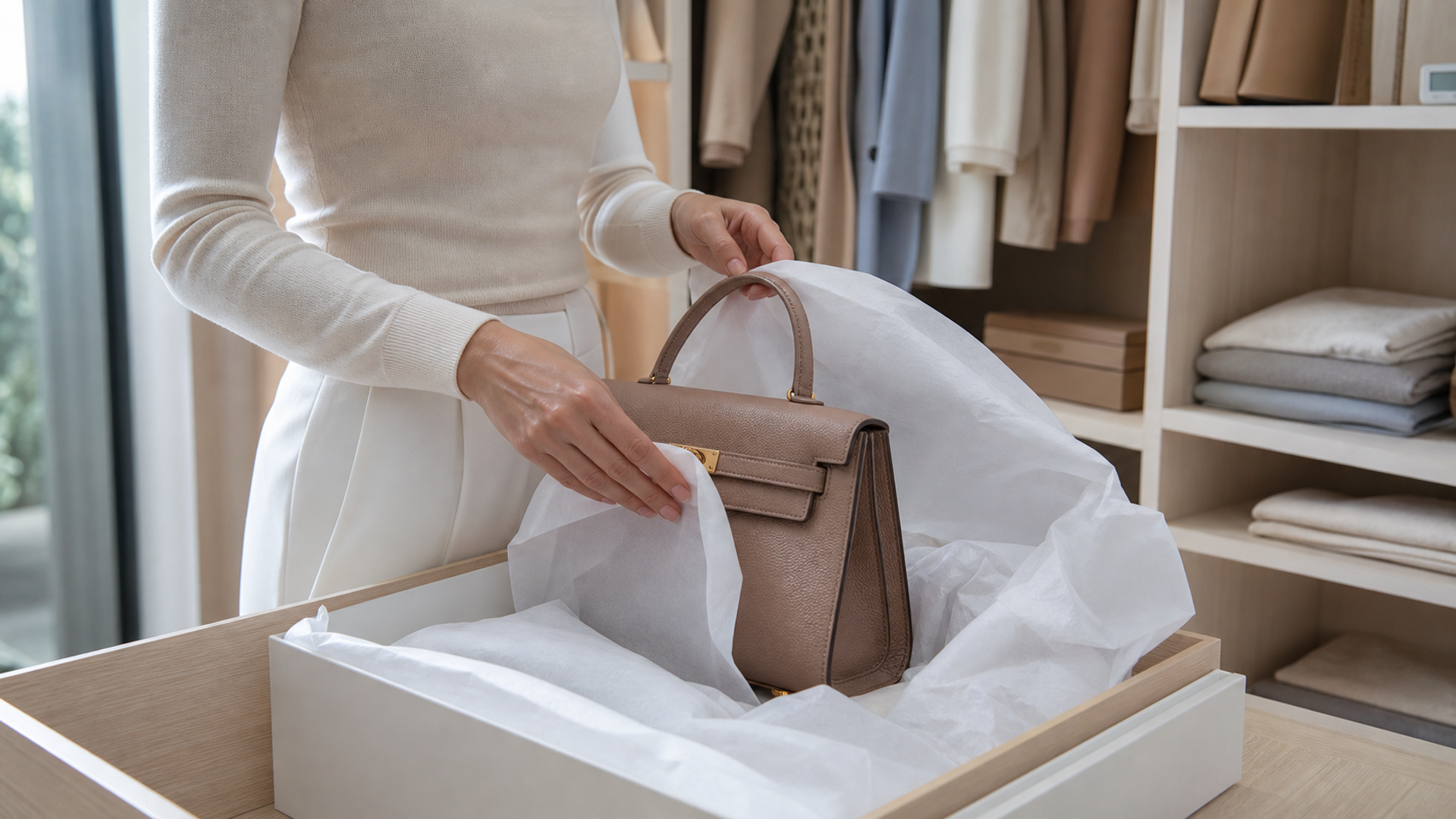
Use unprinted acid-free tissue or washed, undyed cotton to support the interior. Build a light form that holds the natural silhouette without pushing seams outward. Stuffing should yield when gently pressed. If the zip or flap must be forced over the support, remove material.
Support chains and heavy handles so they do not press into leather. Wrap metal hardware in stable, soft tissue where contact could emboss or scratch the body. Do not hang a heavy bag by its handles for months; gravity can stretch attachment points.
Place the bag upright or in its intended resting orientation on a clean shelf. Allow space around it. A breathable dust bag protects from light and dust while permitting air exchange. Keep the original box if it is clean and structurally sound, but do not assume decorative packaging is archival.
The 48-hour mould response
If you notice a musty smell, powdery growth or spreading spots, isolate the bag from the collection. Do not shake or brush it in the wardrobe. Photograph the affected areas, check nearby items and reduce room humidity.
The Canadian Conservation Institute’s mould-removal note describes the risks and the need for appropriate protection and careful treatment. For a high-value handbag, exotic leather, painted surface or widespread growth, professional assessment is the prudent route. Aggressive household cleaners, alcohol, bleach and heat can permanently alter the finish while failing to address spores in seams.
A monthly inspection card
| Area | Look for | Escalate when |
|---|---|---|
| Corners and piping | Abrasion, lifting finish, new colour change | Damage is spreading or exposing substrate |
| Interior and pockets | Odour, powder, dampness, staining | Mould is suspected |
| Handles and attachments | Stretching, cracks, adhesive movement | Load-bearing part is weakening |
| Hardware contact points | Green corrosion, dark transfer, imprint | Corrosion touches leather |
| Structure | New collapse, creases, warped base | Support does not restore natural form |
| Environment | RH trend, condensation, heat | Readings remain above 65% or fluctuate sharply |
Keep inspection brief and consistent. Constant handling creates its own wear. The purpose is early detection.
Insurance and provenance
Condition records, purchase documents and authorised service invoices should be stored separately from the bag, with secure digital copies. Do not keep the only receipt inside a bag at risk from mould or theft. Record any professional cleaning or repair, including the date and provider.
This evidence is not only for resale. It helps a conservator understand prior treatments and helps an insurer distinguish gradual wear from a documented incident. For broader collector context, the 2026 luxury designer-handbag guide provides a useful category view.
The considered summer setup
Travel and seasonal rotation
After carrying the bag in rain or high humidity, do not place it immediately into a closed box. Empty it, wipe only according to the maker’s instructions and allow it to acclimatise in a clean, shaded room with gentle air movement. Keep wet umbrellas, bottled drinks and chilled items away from the interior.
Rotate display and use so one bag is not exposed to the same sunlight or handle load throughout the season. When moving between air-conditioned interiors and hot outdoor conditions, avoid leaving the bag in a parked car. Vehicle cabins can reach temperatures that are far beyond normal storage conditions and can affect adhesives, edge paint and contents.
Keep the bag in a shaded interior space with stable moderate humidity, gentle air movement, breathable protection and light structural support. Measure rather than guess. Isolate suspected mould. Use specialist advice before applying a chemical treatment to a valuable surface.
Luxury care is often less about adding products than controlling the environment. A cool, clean, stable wardrobe and a disciplined inspection record will usually do more for long-term condition than a shelf of unverified conditioners.