

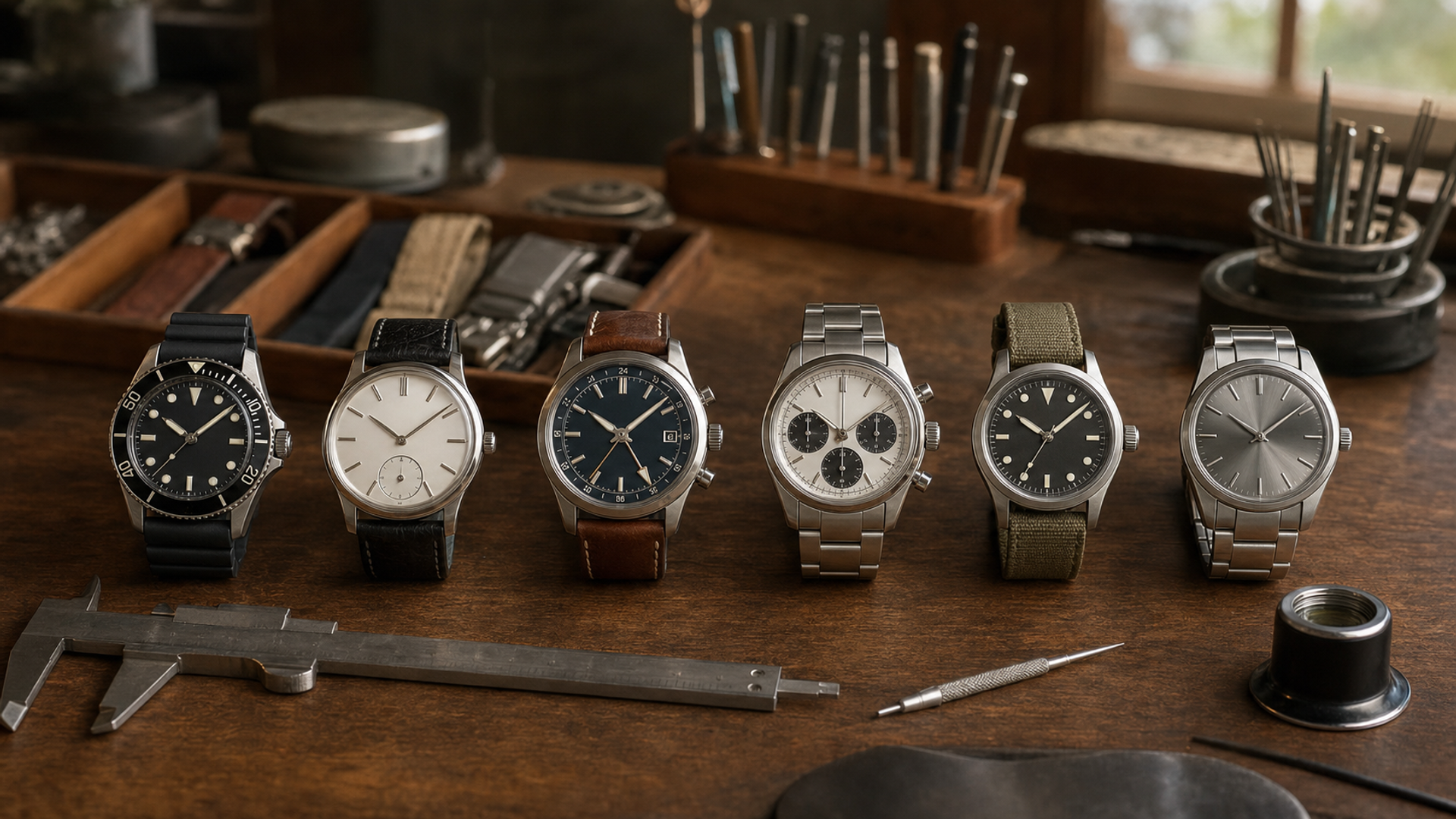
A $10,000 watch budget is large enough to access serious mechanical movements, strong case finishing and designs that can anchor a collection, but it is not a reason to spend the full amount. The best watch under $10,000 is the one that fulfils a clear role, fits correctly and leaves enough budget for tax, insurance, straps and future service.
This guide uses model families rather than pretending one global price list exists. Currency, tax, configuration and regional availability change the result. Treat the threshold as a delivered-cost ceiling and verify the exact reference on the day of purchase.
Shortlist by purpose
| Purpose | Model families worth inspecting | Core strength | Watch-out |
|---|---|---|---|
| Daily sports watch | Tudor Black Bay, Pelagos or Ranger | Robust cases and clear tool-watch identity | Size and thickness vary widely |
| Versatile luxury daily watch | Omega Aqua Terra or selected Seamaster references | Movement technology and broad configurations | Some references exceed the ceiling |
| Dress and design | Cartier Tank or Santos configurations | Distinctive shape and strong wardrobe range | Movement and water guidance vary |
| Quiet finishing | Grand Seiko Heritage or Sport selections | Dial, polishing and movement choice | Bracelet preference is personal |
| Independent-feeling minimalism | NOMOS Tangente, Metro or Club | In-house design language and restrained scale | Long lugs on some references |
| Chronograph | Selected TAG Heuer Carrera or Tudor chronographs | Recognisable function with modern service network | Weight and service cost |
| Travel watch | Selected GMT references from Tudor, Grand Seiko or Longines | Useful second time zone | Confirm local-hour operation |
No family is wholly below $10,000. Precious metal, diamonds, complications and limited editions can move far beyond it. Filter by the exact reference and delivered price.
What “value” means at this level
Value is not the greatest number of complications per dollar. A simpler watch with a coherent case, reliable movement and strong bracelet can deliver more long-term satisfaction than a crowded specification sheet. At this budget, assess six elements: design originality, movement suitability, finishing, ergonomics, service access and the likelihood of repeated wear.
The acquisition price is only the first line. Add sales tax or VAT, insurance, any immediate strap or link work and a conservative service reserve. If a $9,900 watch leaves no room for those costs, a $6,500 alternative may be the more luxurious ownership experience.
Secondary-market value can reduce downside, but it is not fixed. Dealer spread, condition, completeness and market cycles can absorb an apparent gain. Buy the object, not a forecast.
Best daily sports-watch candidates
Tudor’s current watch catalogue is a useful starting point because Black Bay, Pelagos and Ranger families cover different forms of robustness. A Black Bay emphasises vintage-influenced design, Pelagos leans more technical, and Ranger is simpler. Compare diameter, thickness, material, clasp and movement rather than treating them as one tier.
For a daily sports watch, water resistance is only one requirement. The crown should be easy to operate, the clasp should accommodate wrist expansion and the dial should remain legible in changing light. A rotating bezel is valuable only if you use it; otherwise it adds height and visual complexity.
Try the watch with the clothes and activities it must support. A thick diver can be excellent on holiday and awkward under a shirt cuff. A smaller field watch may cover more of the week.
Best versatile luxury candidates
Omega’s broad catalogue contains Aqua Terra and Seamaster configurations that may fall within the budget depending on market and material. Aqua Terra is often the more neutral one-watch proposition; Seamaster designs offer stronger sport and diving identities. Use the official Omega watch catalogue to confirm the reference and current local price.
Movement certification, magnetic resistance and power reserve are useful, but comfort still wins. Compare the bracelet taper, clasp, caseback shape and how the watch balances on the wrist. A technically accomplished watch that is top-heavy will not become easier to wear because the calibre is impressive.
Buyers cross-shopping Rolex should be realistic about access. The under-$10,000 theoretical list-price discussion is not useful when the desired reference cannot be obtained on acceptable terms. Do not let scarcity force a compromise in size, dial or seller quality.
Best shaped and dress-watch candidates
Cartier Tank and selected Santos references introduce a design language that differs from round sports watches. The official Cartier Tank collection includes multiple sizes, metals and movements, some below and some above the ceiling. A Tank can be a powerful first luxury watch if its formality matches the owner’s life.
The movement question deserves restraint. Quartz can support a slim, ready-to-wear formal watch; automatic or hand-wound options offer more mechanical engagement. Choose by use, not hierarchy. Check strap replacement cost and water-exposure guidance, especially if the watch will be worn daily.
NOMOS provides another route: clean German design, thin movements and a quieter social signal. Long lugs can make some models wear larger than their diameter, so the wrist test is essential.
Best quiet-craft candidates
Grand Seiko’s official collection spans quartz, mechanical and Spring Drive watches across a wide price range. Selected references can offer detailed dials and highly polished case surfaces within the cap. The visual reward is strongest in natural light, where texture and edge finishing become clear.
Do not buy only the dial. Inspect bracelet articulation, clasp adjustment, thickness and the local service route. Some buyers prefer Grand Seiko on leather; others value the full steel proposition. The correct answer is reference-specific.
A high-accuracy quartz Grand Seiko can be a deliberate enthusiast choice, not a concession. It may suit a buyer who values precision, finishing and low daily friction more than a visible rotor or winding ritual.
Chronographs and GMT watches
A chronograph adds mechanical and visual complexity. Under $10,000, strong candidates exist, but the buyer should test pusher feel, dial legibility and case weight. The complication also affects service cost. If timing is rarely used, a three-hand model may provide a cleaner and more versatile purchase.
A GMT can be genuinely useful for travel. Distinguish a watch that lets the local hour hand jump independently from one that mainly adjusts the 24-hour hand. Both display another time zone, but the first is more convenient when crossing borders. The GMT watch guide explains the difference in an ownership context.
A budget allocation model
For a hard $10,000 ceiling, consider allocating no more than about 85 to 90 per cent to the watch itself. Reserve the remainder for tax, insurance, a preferred strap, sizing and the first years of ownership. The exact percentage depends on jurisdiction, but the principle prevents a “within budget” price from becoming an over-budget purchase at checkout.
Compare three totals:
Delivered acquisition cost: watch, tax, shipping and immediate work.
Five-year care cost: insurance, pressure test, straps and a service reserve.
Exit friction: realistic dealer spread and transaction cost if tastes change.
The model does not predict resale. It makes hidden ownership costs visible before emotion takes over.
New, authorised pre-owned or independent seller?
New from an authorised retailer provides the clearest warranty and provenance path. Authorised pre-owned programmes can add inspection and support while opening discontinued references. Independent sellers may offer price or selection advantages, but the burden of verifying identity, condition and return rights increases.
Require a complete reference number, serial handling appropriate to the transaction, condition report, service history and written return policy. For high-value purchases, use an independent qualified watchmaker or brand service centre where possible. Photographs alone cannot establish internal condition.
The three-watch collection framework can reveal whether the candidate fills a real gap. A second black-dial diver may feel exciting in the shop and redundant at home.
The final inspection checklist
Confirm the exact reference, movement and included bracelet links.
Check alignment, winding, setting, clasp and bezel where relevant.
Inspect the case under neutral light and ask whether it has been refinished.
Verify warranty activation and the local service destination.
Wear the watch while typing and walking for at least fifteen minutes.
Calculate delivered cost and five-year ownership before paying.
Sleep on the decision unless a documented deadline is genuinely material.
Colour and strap choice can extend the value of the final watch. A restrained dial on a bracelet may become more formal on leather and more casual on fabric, provided the case accepts practical changes. Confirm lug width, spring-bar access and whether the brand restricts water-resistance guidance with alternative straps. One adaptable watch can cover several roles without buying a second piece.
Final decision
The best watches under $10,000 in 2026 come from several paths. Tudor offers robust sports choices; Omega offers technical breadth; Cartier delivers shaped design; Grand Seiko rewards close inspection; NOMOS provides quiet modernism; and selected chronographs or GMTs serve specialised needs.
Set the role first, shortlist three exact references, test them on the wrist and keep ownership costs inside the cap. The strongest purchase is rarely the watch that consumes every available dollar. It is the one that earns the most days on the wrist.
Sources
Tudor, Official Watch Collection, accessed 1 August 2026.
Omega, Official Watch Catalogue, accessed 1 August 2026.
Cartier, Tank Collection, accessed 1 August 2026.
Grand Seiko, Official Collections, accessed 1 August 2026.
![How to Scan Receipts and Documents with Your Phone [Full Guide]](https://cdn.sanity.io/images/e0gp1l2g/production/0db13feec1d5e72b8a8a5f976d1f3e86619c9228-3840x1860.webp?w=180&h=180&q=78&auto=format&fit=crop)
![How to Scan Receipts and Documents with Your Phone [Full Guide]](https://cdn.sanity.io/images/e0gp1l2g/production/0db13feec1d5e72b8a8a5f976d1f3e86619c9228-3840x1860.webp?w=800&h=450&q=82&auto=format&fit=crop)
![Top 10 Two-Tone Carbon-Fibre Watches for Men [2026 List]](https://cdn.sanity.io/images/e0gp1l2g/production/18870799ba33fab0e038968359cd5772d7d7db30-1024x576.webp?w=800&h=450&q=82&auto=format&fit=crop)
![Top 10 Luxury Watches with Digital Complication Displays for Men [Latest]](https://cdn.sanity.io/images/e0gp1l2g/production/c4f6bf8c080f291c39f7cc85c7344ecff2fd3799-1024x553.webp?w=800&h=450&q=82&auto=format&fit=crop)