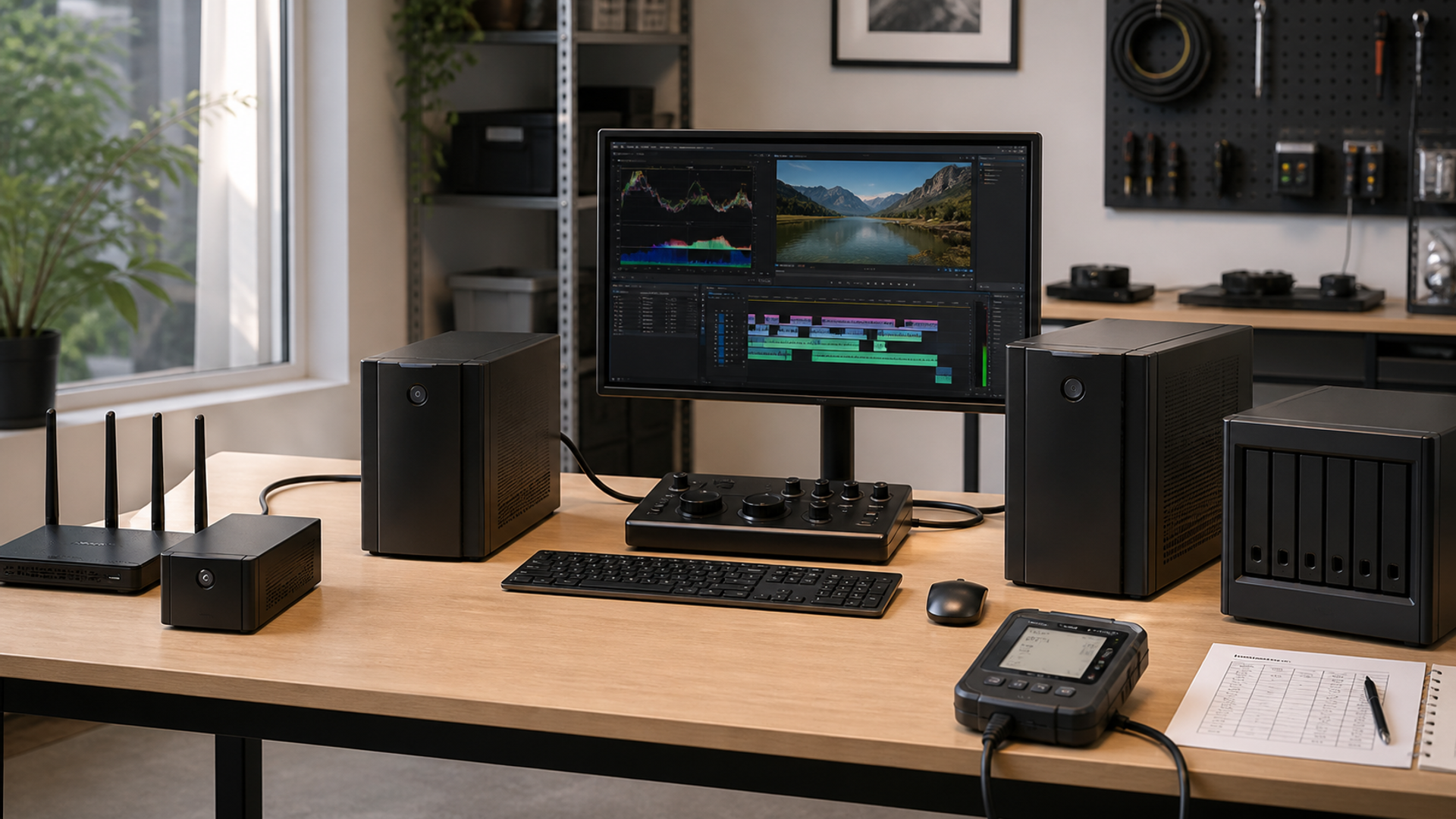
A UPS is not a small generator. It bridges short outages, conditions certain power events and gives equipment time to remain online or shut down safely. The best unit is the one sized from measured watts and required minutes, with the right output waveform and communication path for the protected equipment. Buying by VA alone can create false confidence.
The load comes before the UPS
Choose a compact standby or line-interactive unit for router and small electronics, a pure-sine line-interactive UPS for active-PFC workstations, or a managed UPS for NAS and network equipment that needs automated shutdown. Measure the real load, add headroom and verify runtime at that load.
| Decision factor | Compact network UPS | Pure-sine workstation UPS | Managed NAS and network UPS |
|---|---|---|---|
| Load | Router, modem and small hub remain modest | Desktop, display and peripherals are measured together | NAS, switch and gateway loads are documented |
| Runtime | Enough minutes cover brief outages | Work can be saved and shut down | Automation finishes an orderly shutdown |
| Waveform | Protected devices accept the unit's output | Pure sine is chosen for sensitive active-PFC loads | Compatibility is verified across power supplies |
| Communication | Audible alarm and local status are sufficient | USB shutdown protects one computer | Network or service integration protects several systems |
| Battery | User-replaceable battery is available | Replacement cost is planned | Maintenance and test schedule are documented |
| Safety | Ventilation and circuit load are appropriate | Surge and data-line needs are scoped | Rack, earthing and service access are managed |
This best uninterruptible power supply matrix is the article's working value object. Read the best uninterruptible power supply rows together: the decisive failure mode depends on this topic's evidence, operating context and reader objective.
Evidence behind VA, watts and waveform
Evidence 1. UPS apparent power in volt-amperes and real power in watts are different limits; both must exceed the connected load.
Evidence 2. Manufacturer runtime curves describe minutes at specific loads and are more useful than a single maximum-runtime headline.
Evidence 3. Battery capacity declines with age, temperature and discharge history, so a new-unit estimate should not be treated as a permanent guarantee.
Evidence 4. USB or network communication can convert remaining battery time into an orderly shutdown, which is often more valuable than chasing an extra few minutes.
Reader-visible sources checked for this article:
apc.com — reader-visible current or official evidence
apc.com — reader-visible current or official evidence
techradar.com — reader-visible current or official evidence
remotechance.com — reader-visible current or official evidence
For best uninterruptible power supply, these sources establish only the claims inside their documented scope. Recheck every changeable specification, availability condition, price, policy or service term in the relevant market before acting.
Build a runtime requirement
A buyer can resolve load without starting from a brand preference. Ask whether router, modem and small hub remain modest; compare that with whether desktop, display and peripherals are measured together; then use nAS, switch and gateway loads are documented as the third route's safeguard. An unknown condition stays unknown.
On runtime, popularity is not enough. The evidence for option one is that enough minutes cover brief outages. Option two means work can be saved and shut down. Option three is rational where automation finishes an orderly shutdown. Recheck any changeable term immediately before commitment.
The decision changes at waveform. Choose the first path only if protected devices accept the unit's output; move to the second when pure sine is chosen for sensitive active-PFC loads; use the third when compatibility is verified across power supplies. Save the downside that would make this row fail.
For communication, the first route works when audible alarm and local status are sufficient; the second requires uSB shutdown protects one computer. The control for the third is network or service integration protects several systems. Verify this row against the exact product, property, account or environment before it can reverse the decision.
The battery row exposes a practical boundary. Route one assumes user-replaceable battery is available, while route two is defensible only when replacement cost is planned. Route three depends on maintenance and test schedule are documented. If that evidence is absent, keep the more reversible option.
Read safety as a stop/go test: ventilation and circuit load are appropriate supports the first option; surge and data-line needs are scoped supports the second; and rack, earthing and service access are managed supports the third. Record which source proves the condition and when it was checked.
Facts that would reverse the current choice
Reversal control 1 — Load. Before choosing Compact network UPS, write down how the decision changes if “Router, modem and small hub remain modest” proves false. Do the same for Pure-sine workstation UPS and “Desktop, display and peripherals are measured together”. Keep the Managed NAS and network UPS route available until “NAS, switch and gateway loads are documented” is verified. This control belongs to best uninterruptible power supply; update it from the cited source or exact supplier rather than copying a generic checklist.
Reversal control 2 — Runtime. Before choosing Compact network UPS, write down how the decision changes if “Enough minutes cover brief outages” proves false. Do the same for Pure-sine workstation UPS and “Work can be saved and shut down”. Keep the Managed NAS and network UPS route available until “Automation finishes an orderly shutdown” is verified. This control belongs to best uninterruptible power supply; update it from the cited source or exact supplier rather than copying a generic checklist.
Reversal control 3 — Waveform. Before choosing Compact network UPS, write down how the decision changes if “Protected devices accept the unit's output” proves false. Do the same for Pure-sine workstation UPS and “Pure sine is chosen for sensitive active-PFC loads”. Keep the Managed NAS and network UPS route available until “Compatibility is verified across power supplies” is verified. This control belongs to best uninterruptible power supply; update it from the cited source or exact supplier rather than copying a generic checklist.
Reversal control 4 — Communication. Before choosing Compact network UPS, write down how the decision changes if “Audible alarm and local status are sufficient” proves false. Do the same for Pure-sine workstation UPS and “USB shutdown protects one computer”. Keep the Managed NAS and network UPS route available until “Network or service integration protects several systems” is verified. This control belongs to best uninterruptible power supply; update it from the cited source or exact supplier rather than copying a generic checklist.
Reversal control 5 — Battery. Before choosing Compact network UPS, write down how the decision changes if “User-replaceable battery is available” proves false. Do the same for Pure-sine workstation UPS and “Replacement cost is planned”. Keep the Managed NAS and network UPS route available until “Maintenance and test schedule are documented” is verified. This control belongs to best uninterruptible power supply; update it from the cited source or exact supplier rather than copying a generic checklist.
Reversal control 6 — Safety. Before choosing Compact network UPS, write down how the decision changes if “Ventilation and circuit load are appropriate” proves false. Do the same for Pure-sine workstation UPS and “Surge and data-line needs are scoped”. Keep the Managed NAS and network UPS route available until “Rack, earthing and service access are managed” is verified. This control belongs to best uninterruptible power supply; update it from the cited source or exact supplier rather than copying a generic checklist.
Measure the complete protected load
Use a power meter where appropriate or current equipment telemetry. Include display, external drives, network equipment and any device expected to remain on. Exclude laser printers, heaters and other loads the UPS maker prohibits. Record typical and peak watts, then keep adequate headroom below both the watt and VA ratings.
Turn outage objectives into minutes
Router continuity during short flickers may need far less power than keeping a workstation productive. Decide whether the goal is ride-through, save-and-shutdown or sustained connectivity. Use the maker's runtime curve at the measured load, then derate for battery ageing and warm environments instead of treating the best-case figure as a service level.
Verify waveform and shutdown behaviour
Check the power-supply requirements of the exact workstation, NAS and network gear. Test USB or network shutdown with a controlled outage after configuration. Alarms, sleep behaviour and restart policy should be understood before the first real failure. A UPS that stays on while the computer crashes has not achieved the objective.
Plan batteries as consumables
Record battery part number, local availability, warranty, replacement procedure and recycling route. Set a self-test schedule and investigate a sudden runtime drop rather than silencing the alarm. Keep ventilation clear and do not enclose the battery in a hot cabinet. Lifetime cost includes at least one replacement cycle for long ownership.
Three backup-power profiles
Router and smart-home bridge
A compact unit works when the measured load is small and short continuity is enough. Define the fact that would reverse this recommendation before committing.
Creative or trading workstation
A pure-sine line-interactive UPS works when the objective is a stable save-and-shutdown window. Define the fact that would reverse this recommendation before committing.
NAS and network rack
A managed UPS works when multiple devices need ordered shutdown and monitored battery state. Define the fact that would reverse this recommendation before committing.
Action checklist
Measure typical and peak watts.
Check both watt and VA limits.
Choose the outage objective.
Read runtime at the measured load.
Verify output waveform.
Confirm prohibited loads.
Test USB or network shutdown.
Price replacement batteries.
Plan ventilation and alarms.
Schedule self-tests and recycling.
Continue the decision
The linked VERTU articles expand adjacent parts of the best uninterruptible power supply decision. They do not substitute for the external evidence above.
The UPS verdict
Choose a compact standby or line-interactive unit for router and small electronics, a pure-sine line-interactive UPS for active-PFC workstations, or a managed UPS for NAS and network equipment that needs automated shutdown. Measure the real load, add headroom and verify runtime at that load.
Keep the best uninterruptible power supply decision reversible until its material cost, safety, access, privacy and compatibility facts are verified. Unknown evidence stays unknown; it is never silently scored as favourable.