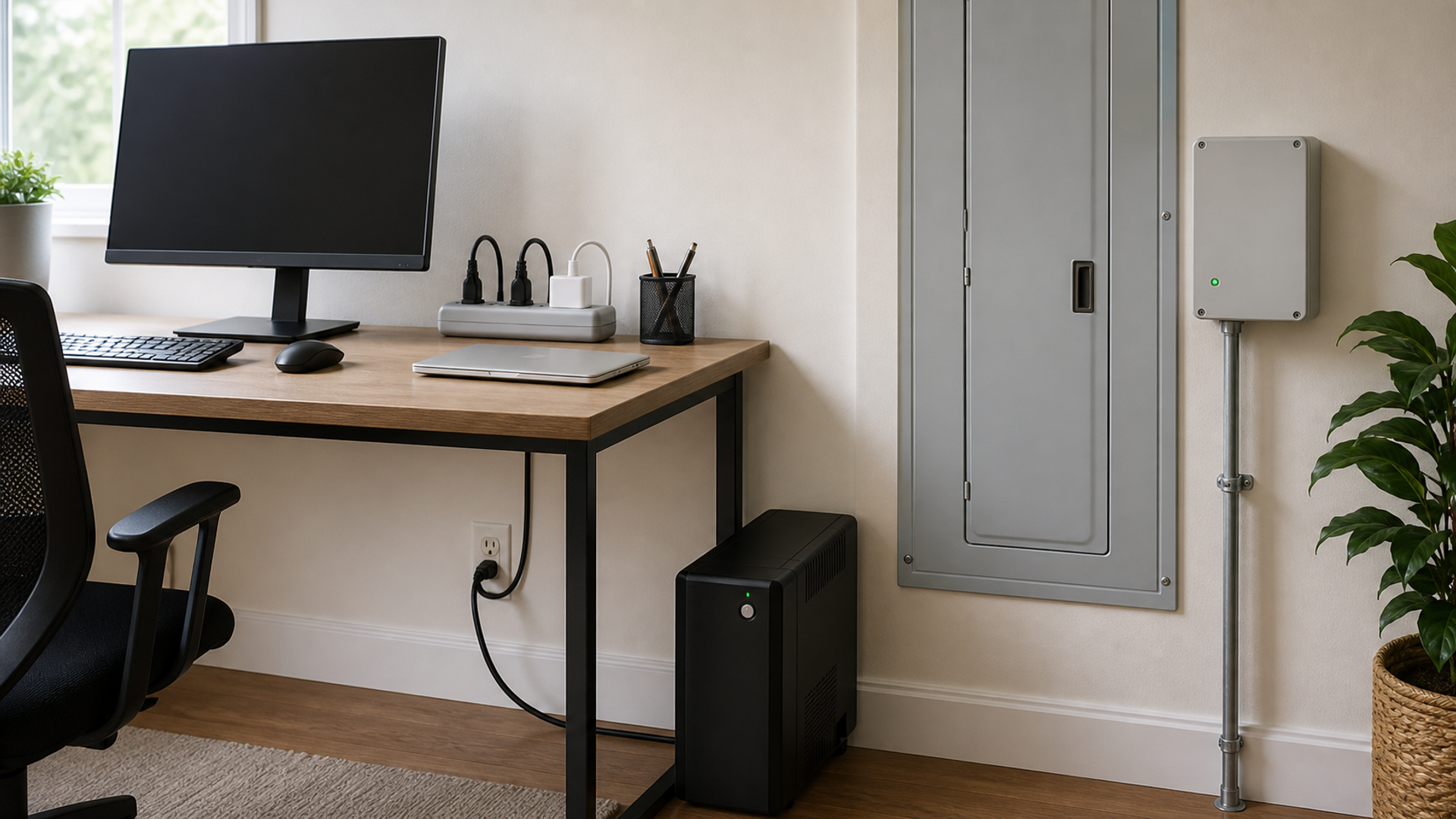
A surge protector is a consumable protection device, not a promise that electronics can survive every electrical event. The best choice matches the circuit and connected load, carries recognised certification for the market, provides enough physical spacing and makes end-of-life status understandable. High joule numbers alone do not prove a safe product.
Start with the load and electrical system
Choose a certified power-strip protector for desk electronics, a UPS for equipment that also needs orderly shutdown, or whole-home protection installed by a qualified electrician for service-level transients. Never daisy-chain strips, exceed the rating or keep using a product after damage or loss of protection status.
| Decision factor | Certified surge strip | UPS with surge protection | Whole-home surge protection |
|---|---|---|---|
| Load | Desk electronics stay within the rated current | Computer and network gear need runtime | Many circuits and hard-wired equipment need coverage |
| Event | Common transient protection is the aim | Transient plus short outage is the aim | Service-entry exposure is addressed |
| Status | Protection and ground indicators are visible | Self-test and battery health are monitored | Inspection and panel device status are maintained |
| Layout | Large adapters fit without obstruction | Critical loads receive battery outlets | Point-of-use layers remain where needed |
| Replacement | Age and events trigger replacement | Battery and surge components have schedules | Electrician inspection follows major events |
| Installation | Direct wall connection is possible | Ventilation and shutdown software are planned | Qualified installation and grounding review are required |
This best surge protector matrix is the article's working value object. Read the best surge protector rows together: the decisive failure mode depends on this topic's evidence, operating context and reader objective.
What safety evidence establishes
Evidence 1. A 2026 CPSC power-strip recall illustrates that products sold online can present serious electrical hazards and should be checked for current recalls and warnings.
Evidence 2. CPSC states that extension cords are subject to federal requirements and should be selected and used within their ratings; a power strip does not create additional circuit capacity.
Evidence 3. CPSC safety material warns against overloaded and damaged cords and power strips, reinforcing that physical condition and correct use are part of protection.
Evidence 4. A surge protective device does not provide the sustained backup power of a UPS, and whole-home protection does not remove the need to follow point-of-use and manufacturer instructions.
Reader-visible sources checked for this article:
cpsc.gov — reader-visible current or official evidence
cpsc.gov — reader-visible current or official evidence
cpsc.gov — reader-visible current or official evidence
nema.org — reader-visible current or official evidence
For best surge protector, these sources establish only the claims inside their documented scope. Recheck every changeable specification, availability condition, price, policy or service term in the relevant market before acting.
Distinguish surge protection from backup power
Read load as a stop/go test: desk electronics stay within the rated current supports the first option; computer and network gear need runtime supports the second; and many circuits and hard-wired equipment need coverage supports the third. Record which source proves the condition and when it was checked.
A buyer can resolve event without starting from a brand preference. Ask whether common transient protection is the aim; compare that with whether transient plus short outage is the aim; then use service-entry exposure is addressed as the third route's safeguard. An unknown condition stays unknown.
On status, popularity is not enough. The evidence for option one is that protection and ground indicators are visible. Option two means self-test and battery health are monitored. Option three is rational where inspection and panel device status are maintained. Recheck any changeable term immediately before commitment.
The decision changes at layout. Choose the first path only if large adapters fit without obstruction; move to the second when critical loads receive battery outlets; use the third when point-of-use layers remain where needed. Save the downside that would make this row fail.
For replacement, the first route works when age and events trigger replacement; the second requires battery and surge components have schedules. The control for the third is electrician inspection follows major events. Verify this row against the exact product, property, account or environment before it can reverse the decision.
The installation row exposes a practical boundary. Route one assumes direct wall connection is possible, while route two is defensible only when ventilation and shutdown software are planned. Route three depends on qualified installation and grounding review are required. If that evidence is absent, keep the more reversible option.
Facts that would reverse the current choice
Reversal control 1 — Load. Before choosing Certified surge strip, write down how the decision changes if “Desk electronics stay within the rated current” proves false. Do the same for UPS with surge protection and “Computer and network gear need runtime”. Keep the Whole-home surge protection route available until “Many circuits and hard-wired equipment need coverage” is verified. This control belongs to best surge protector; update it from the cited source or exact supplier rather than copying a generic checklist.
Reversal control 2 — Event. Before choosing Certified surge strip, write down how the decision changes if “Common transient protection is the aim” proves false. Do the same for UPS with surge protection and “Transient plus short outage is the aim”. Keep the Whole-home surge protection route available until “Service-entry exposure is addressed” is verified. This control belongs to best surge protector; update it from the cited source or exact supplier rather than copying a generic checklist.
Reversal control 3 — Status. Before choosing Certified surge strip, write down how the decision changes if “Protection and ground indicators are visible” proves false. Do the same for UPS with surge protection and “Self-test and battery health are monitored”. Keep the Whole-home surge protection route available until “Inspection and panel device status are maintained” is verified. This control belongs to best surge protector; update it from the cited source or exact supplier rather than copying a generic checklist.
Reversal control 4 — Layout. Before choosing Certified surge strip, write down how the decision changes if “Large adapters fit without obstruction” proves false. Do the same for UPS with surge protection and “Critical loads receive battery outlets”. Keep the Whole-home surge protection route available until “Point-of-use layers remain where needed” is verified. This control belongs to best surge protector; update it from the cited source or exact supplier rather than copying a generic checklist.
Reversal control 5 — Replacement. Before choosing Certified surge strip, write down how the decision changes if “Age and events trigger replacement” proves false. Do the same for UPS with surge protection and “Battery and surge components have schedules”. Keep the Whole-home surge protection route available until “Electrician inspection follows major events” is verified. This control belongs to best surge protector; update it from the cited source or exact supplier rather than copying a generic checklist.
Reversal control 6 — Installation. Before choosing Certified surge strip, write down how the decision changes if “Direct wall connection is possible” proves false. Do the same for UPS with surge protection and “Ventilation and shutdown software are planned”. Keep the Whole-home surge protection route available until “Qualified installation and grounding review are required” is verified. This control belongs to best surge protector; update it from the cited source or exact supplier rather than copying a generic checklist.
Inventory the actual load
Read the wattage or current of every device and compare the total with both the strip and circuit limits. High-draw heaters, kettles and cooking appliances generally belong directly on suitable outlets according to their instructions, not on a desk strip. Large power adapters should fit without covering switches or protection indicators.
Read certification and status, not decoration
Look for a recognised certification mark appropriate to the sales market and verify the listing where possible. Record nominal voltage, current rating, voltage-protection rating, joule rating and response information without treating any single number as a winner. Understand what each light means and whether power continues after surge protection is exhausted.
Set a replacement rule before the event
Surge components can degrade with repeated transients. Follow the manufacturer's replacement guidance, replace damaged or recalled products immediately and consider replacement after a significant electrical event. Photograph the label and purchase date. A strip hidden behind furniture is easy to forget after its protection indicator changes.
Layer protection around consequence
Sensitive networking, storage or workstation equipment may need a UPS for graceful shutdown, while a qualified electrician can assess service-entry protection and grounding. Lightning and wiring faults have different pathways. No plug-in device makes unsafe wiring safe, and no protector justifies working on an energised panel.
Three surge-protection decisions
Home office desk
A certified surge strip works when the connected load is modest and the indicator remains visible. Define the fact that would reverse this recommendation before committing.
Workstation and network cabinet
A UPS is rational when a short outage could corrupt work or disconnect critical equipment. Define the fact that would reverse this recommendation before committing.
Large connected home
Whole-home protection is considered with an electrician while point-of-use controls remain for sensitive devices. Define the fact that would reverse this recommendation before committing.
Action checklist
List every connected device.
Calculate total current and wattage.
Verify recognised certification.
Check current recalls and warnings.
Read protection and ground indicators.
Avoid daisy chains and extension misuse.
Keep high-draw appliances off desk strips.
Record purchase date and replacement rule.
Inspect after major electrical events.
Use an electrician for panel-level work.
Continue the decision
The linked VERTU articles expand adjacent parts of the best surge protector decision. They do not substitute for the external evidence above.
The surge-protector verdict
Choose a certified power-strip protector for desk electronics, a UPS for equipment that also needs orderly shutdown, or whole-home protection installed by a qualified electrician for service-level transients. Never daisy-chain strips, exceed the rating or keep using a product after damage or loss of protection status.
Keep the best surge protector decision reversible until its material cost, safety, access, privacy and compatibility facts are verified. Unknown evidence stays unknown; it is never silently scored as favourable.