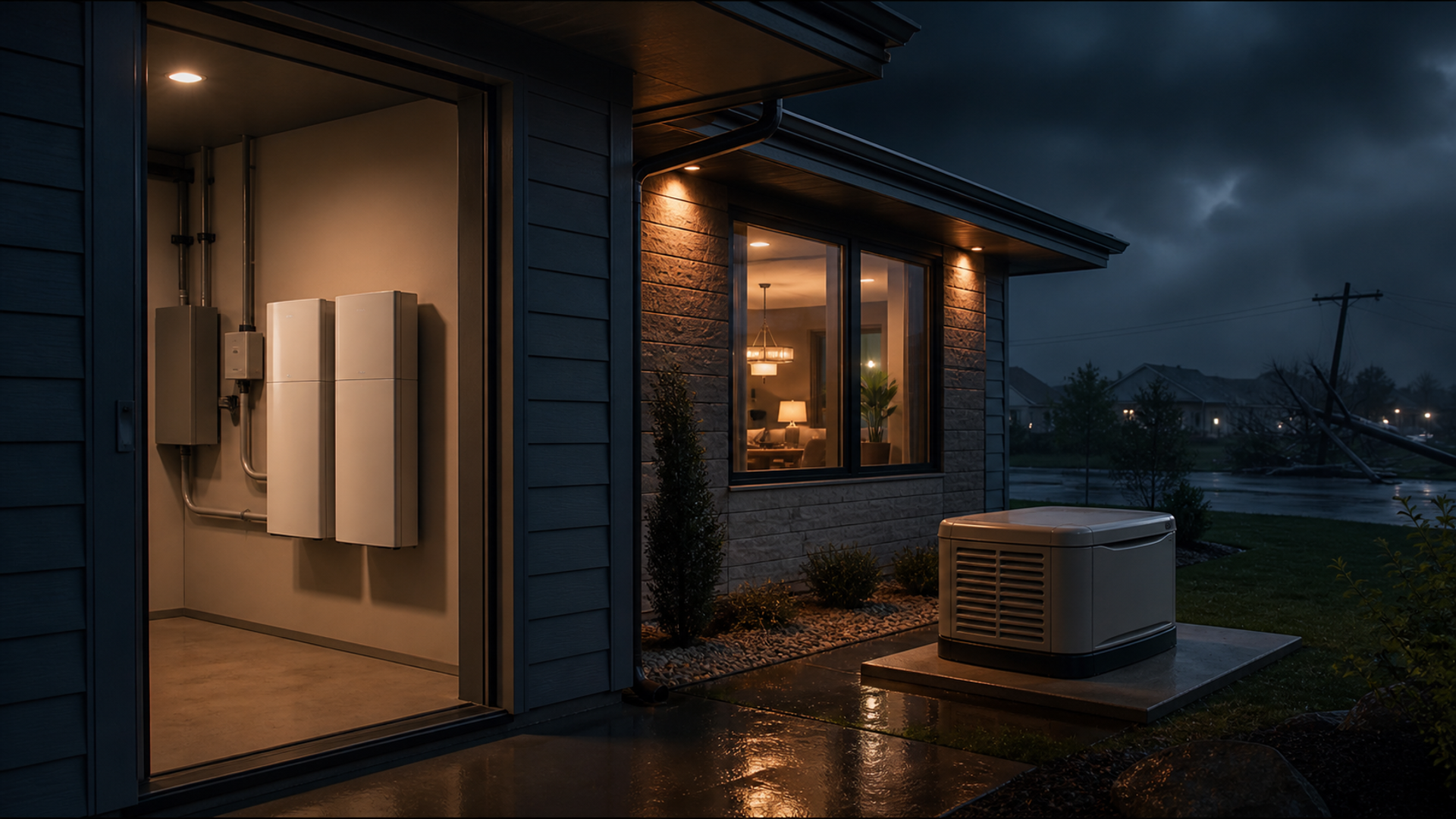
A home battery and a standby generator solve outages differently. A battery can transfer quietly and can integrate with solar, but runtime depends on stored energy and load. A generator can support long outages when fuel remains available, but adds combustion, noise and maintenance. A high-value home should start with critical loads and failure modes, not with the most expensive equipment.
Start with critical loads
Choose a battery-led plan for quiet automatic support, short outages and solar integration; a generator-led plan when long runtime and fuel logistics are acceptable; or a hybrid critical-load plan when essential systems need layered resilience. Final design requires a qualified local professional and current electrical, fire, emissions and planning rules.
| Decision factor | Battery-led backup | Generator-led backup | Hybrid critical-load plan |
|---|---|---|---|
| Outage pattern | Short or predictable outages dominate | Long outages dominate | Both occur and essential loads are known |
| Energy source | Stored electricity and solar are available | Fuel delivery and storage are dependable | Multiple sources reduce one failure point |
| Transfer | Near-instant quiet transfer matters | Engine start delay is acceptable | Critical circuits bridge the delay |
| Load | Selected circuits are prioritised | Large sustained loads are required | Loads are tiered by importance |
| Maintenance | Battery monitoring is acceptable | Engine testing and fuel care are acceptable | Two systems receive scheduled care |
| Site constraint | Indoor or discreet placement can comply | Noise and exhaust can comply | Space supports separation and controls |
This home battery backup vs generator matrix is the article's working value object. Read the home battery backup vs generator rows together: the decisive failure mode depends on this topic's evidence, operating context and reader objective.
What resilience evidence establishes
Evidence 1. The US Department of Energy describes a standby generator as a backup source commonly connected through an automatic transfer switch.
Evidence 2. DOE resilience guidance explains that solar panels alone do not provide outage resilience unless the system can island and has appropriate storage and controls.
Evidence 3. Battery runtime is a load calculation, not a universal number; heating, cooling, lifts, pumps and kitchens can change the result substantially.
Evidence 4. Generator safety depends on outdoor siting, exhaust separation, fuel, transfer equipment and local rules; professional design is not optional.
Reader-visible sources checked for this article:
energy.gov — reader-visible current or official evidence
energy.gov — reader-visible current or official evidence
For home battery backup vs generator, these sources establish only the claims inside their documented scope. Recheck every changeable specification, availability condition, price, policy or service term in the relevant market before acting.
Design for the actual outage
The decision changes at outage pattern. Choose the first path only if short or predictable outages dominate; move to the second when long outages dominate; use the third when both occur and essential loads are known. Save the downside that would make this row fail.
For energy source, the first route works when stored electricity and solar are available; the second requires fuel delivery and storage are dependable. The control for the third is multiple sources reduce one failure point. Verify this row against the exact product, property, account or environment before it can reverse the decision.
The transfer row exposes a practical boundary. Route one assumes near-instant quiet transfer matters, while route two is defensible only when engine start delay is acceptable. Route three depends on critical circuits bridge the delay. If that evidence is absent, keep the more reversible option.
Read load as a stop/go test: selected circuits are prioritised supports the first option; large sustained loads are required supports the second; and loads are tiered by importance supports the third. Record which source proves the condition and when it was checked.
A buyer can resolve maintenance without starting from a brand preference. Ask whether battery monitoring is acceptable; compare that with whether engine testing and fuel care are acceptable; then use two systems receive scheduled care as the third route's safeguard. An unknown condition stays unknown.
On site constraint, popularity is not enough. The evidence for option one is that indoor or discreet placement can comply. Option two means noise and exhaust can comply. Option three is rational where space supports separation and controls. Recheck any changeable term immediately before commitment.
Facts that would reverse the current choice
Reversal control 1 — Outage pattern. Before choosing Battery-led backup, write down how the decision changes if “Short or predictable outages dominate” proves false. Do the same for Generator-led backup and “Long outages dominate”. Keep the Hybrid critical-load plan route available until “Both occur and essential loads are known” is verified. This control belongs to home battery backup vs generator; update it from the cited source or exact supplier rather than copying a generic checklist.
Reversal control 2 — Energy source. Before choosing Battery-led backup, write down how the decision changes if “Stored electricity and solar are available” proves false. Do the same for Generator-led backup and “Fuel delivery and storage are dependable”. Keep the Hybrid critical-load plan route available until “Multiple sources reduce one failure point” is verified. This control belongs to home battery backup vs generator; update it from the cited source or exact supplier rather than copying a generic checklist.
Reversal control 3 — Transfer. Before choosing Battery-led backup, write down how the decision changes if “Near-instant quiet transfer matters” proves false. Do the same for Generator-led backup and “Engine start delay is acceptable”. Keep the Hybrid critical-load plan route available until “Critical circuits bridge the delay” is verified. This control belongs to home battery backup vs generator; update it from the cited source or exact supplier rather than copying a generic checklist.
Reversal control 4 — Load. Before choosing Battery-led backup, write down how the decision changes if “Selected circuits are prioritised” proves false. Do the same for Generator-led backup and “Large sustained loads are required”. Keep the Hybrid critical-load plan route available until “Loads are tiered by importance” is verified. This control belongs to home battery backup vs generator; update it from the cited source or exact supplier rather than copying a generic checklist.
Reversal control 5 — Maintenance. Before choosing Battery-led backup, write down how the decision changes if “Battery monitoring is acceptable” proves false. Do the same for Generator-led backup and “Engine testing and fuel care are acceptable”. Keep the Hybrid critical-load plan route available until “Two systems receive scheduled care” is verified. This control belongs to home battery backup vs generator; update it from the cited source or exact supplier rather than copying a generic checklist.
Reversal control 6 — Site constraint. Before choosing Battery-led backup, write down how the decision changes if “Indoor or discreet placement can comply” proves false. Do the same for Generator-led backup and “Noise and exhaust can comply”. Keep the Hybrid critical-load plan route available until “Space supports separation and controls” is verified. This control belongs to home battery backup vs generator; update it from the cited source or exact supplier rather than copying a generic checklist.
Build a critical-load schedule
List security, communications, refrigeration, medical needs, pumps, gates, lighting, climate zones and work equipment. Record starting and running loads and how many hours each must operate. Separate essential, comfort and deferrable circuits before requesting quotes.
Model the actual outage
Use recent local outages and credible weather or grid risks. Compare a six-hour event with a three-day event. Battery depth of discharge, solar recharge, fuel availability and maintenance state change the outcome. Require installers to show assumptions rather than only a product capacity.
Design transfer and isolation
A qualified professional should specify transfer equipment, protected circuits, islanding, grounding and shutdown. Test what happens if broadband, mobile service or a cloud app is unavailable. Manual controls and clear labels can matter during a stressful outage.
Operate the system after installation
Schedule battery health checks, generator exercise, fuel review and load tests. Keep service contacts and shutdown steps offline. Review the plan after adding an EV, sauna, lift, heat pump or other major load. Resilience is maintained behaviour, not a one-time purchase.
Three backup-power patterns
Quiet urban residence
A battery-led critical-load system can reduce noise and handle shorter interruptions where generator siting is difficult. Define the fact that would reverse this recommendation before committing.
Remote property with long outages
A generator may be rational when fuel and service are reliable and runtime matters more than silence. Define the fact that would reverse this recommendation before committing.
Residence with solar and essential systems
A hybrid plan can bridge transfer and extend resilience, provided controls and maintenance are designed together. Define the fact that would reverse this recommendation before committing.
Action checklist
Inventory critical loads.
Record motor starting loads.
Model six-hour and multi-day outages.
Check solar islanding capability.
Verify fuel logistics.
Review noise and exhaust siting.
Use qualified local design.
Test manual operation.
Schedule maintenance and load tests.
Keep shutdown instructions offline.
Continue the decision
The linked VERTU articles expand adjacent parts of the home battery backup vs generator decision. They do not substitute for the external evidence above.
The resilience verdict
Choose a battery-led plan for quiet automatic support, short outages and solar integration; a generator-led plan when long runtime and fuel logistics are acceptable; or a hybrid critical-load plan when essential systems need layered resilience. Final design requires a qualified local professional and current electrical, fire, emissions and planning rules.
Keep the home battery backup vs generator decision reversible until its material cost, safety, access, privacy and compatibility facts are verified. Unknown evidence stays unknown; it is never silently scored as favourable.