

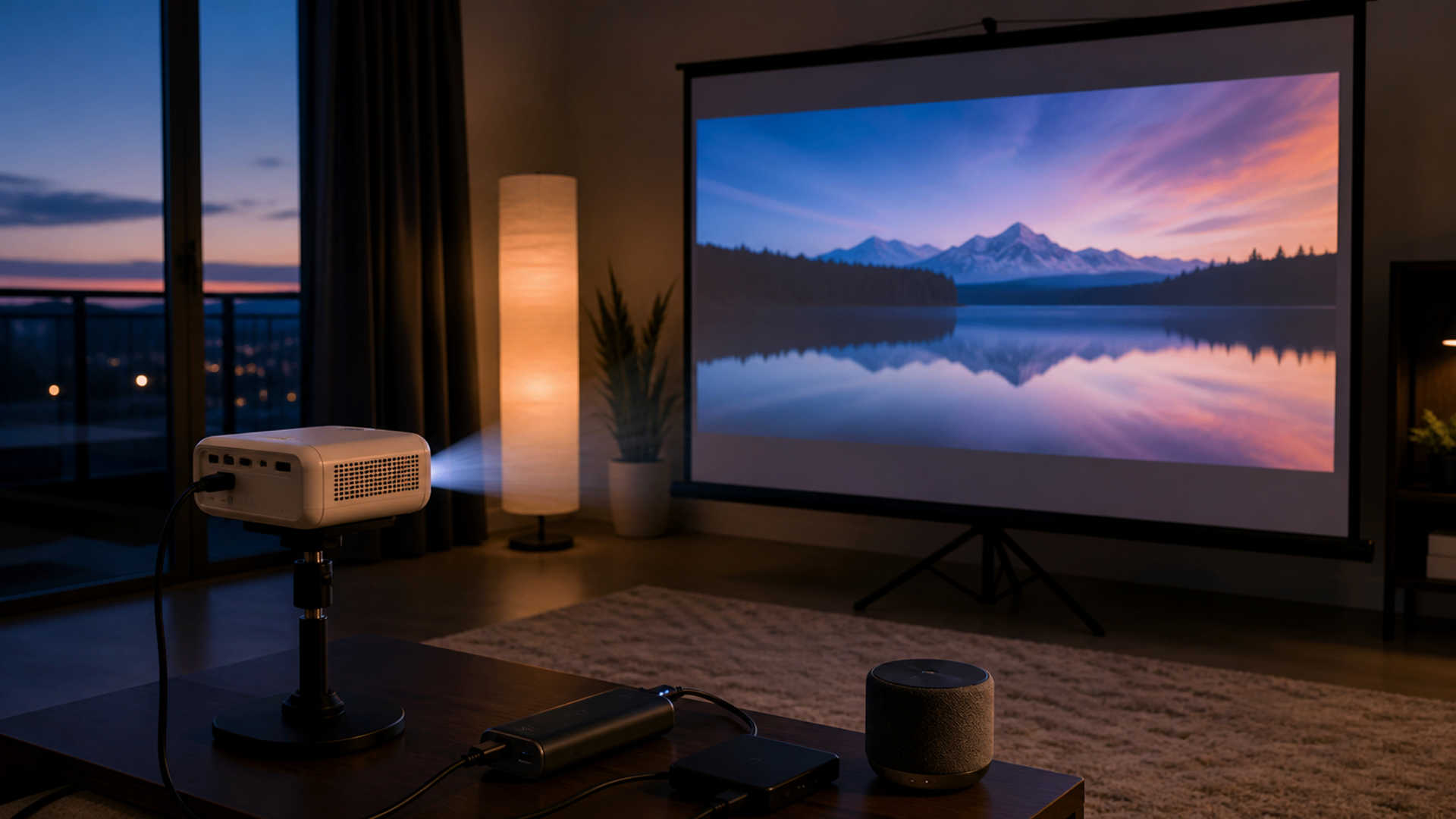
Portable projectors trade image brightness, battery life, speaker volume and installation control for mobility. The best choice is not automatically the smallest model. It is the projector that can make the required image at the available distance, in the real ambient light, with a legal and reliable source path.
Define where the image must work
Choose a battery mini projector for short dark-room sessions, a mains-powered compact projector for brighter and longer use, or a travel cinema kit when screen, stand, power and source can be carried together. Verify throw ratio, independently stated brightness units, input support and battery behaviour before purchase.
| Decision factor | Battery mini projector | Mains compact projector | Complete travel cinema kit |
|---|---|---|---|
| Ambient light | The room becomes genuinely dark | Some controlled light remains | A screen and blackout plan travel with the unit |
| Image size | A modest image at short range is sufficient | A larger image justifies more chassis and power | Throw distance is measured at each venue |
| Power | One film fits verified battery runtime | A reliable mains outlet is available | Battery pack and regional adapters are planned |
| Source | Built-in apps meet the required services | HDMI or USB-C handles the main source | A separate streamer avoids platform surprises |
| Sound | Near-field built-in audio is enough | An external speaker is part of the setup | Sound, delay and cable routing are tested together |
| Transport | Minimum mass matters most | A larger protected case is acceptable | Every accessory has a repeatable packing place |
This best portable projector matrix is the article's working value object. Read the best portable projector rows together: the decisive failure mode depends on this topic's evidence, operating context and reader objective.
What projector specifications prove
Evidence 1. HDMI Licensing states that HDMI 2.1 features are optional capabilities within the specification, so an input label alone does not prove every bandwidth, resolution or gaming feature.
Evidence 2. Projector throw ratio links image width to lens distance; the exact model's calculator or manual should be used because a portable chassis does not imply short throw.
Evidence 3. Manufacturer battery figures are measured under specified modes, and brighter picture modes, wireless streaming and speaker use can reduce practical runtime.
Evidence 4. Portable projection still depends on the surface, room light, focus and geometry; automatic correction improves setup speed but can reduce usable image area and does not create brightness.
Reader-visible sources checked for this article:
hdmi.org — reader-visible current or official evidence
benq.com — reader-visible current or official evidence
us.xgimi.com — reader-visible current or official evidence
epson.com — reader-visible current or official evidence
For best portable projector, these sources establish only the claims inside their documented scope. Recheck every changeable specification, availability condition, price, policy or service term in the relevant market before acting.
Build the complete portable setup
The ambient light row exposes a practical boundary. Route one assumes the room becomes genuinely dark, while route two is defensible only when some controlled light remains. Route three depends on a screen and blackout plan travel with the unit. If that evidence is absent, keep the more reversible option.
Read image size as a stop/go test: a modest image at short range is sufficient supports the first option; a larger image justifies more chassis and power supports the second; and throw distance is measured at each venue supports the third. Record which source proves the condition and when it was checked.
A buyer can resolve power without starting from a brand preference. Ask whether one film fits verified battery runtime; compare that with whether a reliable mains outlet is available; then use battery pack and regional adapters are planned as the third route's safeguard. An unknown condition stays unknown.
On source, popularity is not enough. The evidence for option one is that built-in apps meet the required services. Option two means hDMI or USB-C handles the main source. Option three is rational where a separate streamer avoids platform surprises. Recheck any changeable term immediately before commitment.
The decision changes at sound. Choose the first path only if near-field built-in audio is enough; move to the second when an external speaker is part of the setup; use the third when sound, delay and cable routing are tested together. Save the downside that would make this row fail.
For transport, the first route works when minimum mass matters most; the second requires a larger protected case is acceptable. The control for the third is every accessory has a repeatable packing place. Verify this row against the exact product, property, account or environment before it can reverse the decision.
Facts that would reverse the current choice
Reversal control 1 — Ambient light. Before choosing Battery mini projector, write down how the decision changes if “The room becomes genuinely dark” proves false. Do the same for Mains compact projector and “Some controlled light remains”. Keep the Complete travel cinema kit route available until “A screen and blackout plan travel with the unit” is verified. This control belongs to best portable projector; update it from the cited source or exact supplier rather than copying a generic checklist.
Reversal control 2 — Image size. Before choosing Battery mini projector, write down how the decision changes if “A modest image at short range is sufficient” proves false. Do the same for Mains compact projector and “A larger image justifies more chassis and power”. Keep the Complete travel cinema kit route available until “Throw distance is measured at each venue” is verified. This control belongs to best portable projector; update it from the cited source or exact supplier rather than copying a generic checklist.
Reversal control 3 — Power. Before choosing Battery mini projector, write down how the decision changes if “One film fits verified battery runtime” proves false. Do the same for Mains compact projector and “A reliable mains outlet is available”. Keep the Complete travel cinema kit route available until “Battery pack and regional adapters are planned” is verified. This control belongs to best portable projector; update it from the cited source or exact supplier rather than copying a generic checklist.
Reversal control 4 — Source. Before choosing Battery mini projector, write down how the decision changes if “Built-in apps meet the required services” proves false. Do the same for Mains compact projector and “HDMI or USB-C handles the main source”. Keep the Complete travel cinema kit route available until “A separate streamer avoids platform surprises” is verified. This control belongs to best portable projector; update it from the cited source or exact supplier rather than copying a generic checklist.
Reversal control 5 — Sound. Before choosing Battery mini projector, write down how the decision changes if “Near-field built-in audio is enough” proves false. Do the same for Mains compact projector and “An external speaker is part of the setup”. Keep the Complete travel cinema kit route available until “Sound, delay and cable routing are tested together” is verified. This control belongs to best portable projector; update it from the cited source or exact supplier rather than copying a generic checklist.
Reversal control 6 — Transport. Before choosing Battery mini projector, write down how the decision changes if “Minimum mass matters most” proves false. Do the same for Mains compact projector and “A larger protected case is acceptable”. Keep the Complete travel cinema kit route available until “Every accessory has a repeatable packing place” is verified. This control belongs to best portable projector; update it from the cited source or exact supplier rather than copying a generic checklist.
Calculate the image before buying
Measure the wall or screen width and the available lens distance. Use the exact model's throw ratio to calculate the image, then allow space for viewers, cables and ventilation. Digital zoom and keystone can make setup convenient, but heavy correction discards pixels and light. A tabletop position that looks easy in a product photograph may put the image too high or place the projector in the walking path.
Compare brightness without mixing units
Look for a recognised, clearly described brightness measurement and the operating mode used. Treat vague LED-lumen or equivalent-lumen phrases cautiously. A portable model can look compelling in a dark bedroom and washed out at dusk outdoors. Test the intended screen size under the worst realistic light, not only on a small white wall at night.
Audit streaming and connection rights
Confirm whether the required services are available on the current operating system in the target country. Check HDCP, HDMI, USB-C video, Wi-Fi and Bluetooth behaviour against the exact source. A licensed app can change, and hotel networks may require browser sign-in. A small external streamer can be the most predictable route if mains power is already available.
Pack the system, not just the projector
Include stand, screen or surface plan, power supply, regional adapter, source cable, remote, batteries and sound. Verify ventilation in the carrying case and operating position. If the setup takes twenty minutes and requires furniture rearrangement, it is transportable but not frictionless. Ownership quality is measured by the complete repeatable setup.
Three portable-projector decisions
Bedroom film night
A battery mini projector works when the room is dark and the desired image is moderate. Define the fact that would reverse this recommendation before committing.
Client presentation or rented house
A mains compact model is safer when brightness, long runtime and HDMI reliability matter. Define the fact that would reverse this recommendation before committing.
Outdoor evening cinema
A complete kit is required because screen, wind, power, sound and darkness determine the result. Define the fact that would reverse this recommendation before committing.
Action checklist
Measure lens distance and image width.
Record the darkest and brightest conditions.
Compare brightness units and modes.
Check battery runtime in the intended mode.
Verify every streaming service and region.
Test HDMI and USB-C sources.
Plan screen, stand and ventilation.
Check speaker delay and output.
Pack power and regional adapters.
Confirm warranty and replacement remote availability.
Continue the decision
The linked VERTU articles expand adjacent parts of the best portable projector decision. They do not substitute for the external evidence above.
The portable-projector verdict
Choose a battery mini projector for short dark-room sessions, a mains-powered compact projector for brighter and longer use, or a travel cinema kit when screen, stand, power and source can be carried together. Verify throw ratio, independently stated brightness units, input support and battery behaviour before purchase.
Keep the best portable projector decision reversible until its material cost, safety, access, privacy and compatibility facts are verified. Unknown evidence stays unknown; it is never silently scored as favourable.
![How to Scan Receipts and Documents with Your Phone [Full Guide]](https://cdn.sanity.io/images/e0gp1l2g/production/0db13feec1d5e72b8a8a5f976d1f3e86619c9228-3840x1860.webp?w=180&h=180&q=78&auto=format&fit=crop)
![How to Scan Receipts and Documents with Your Phone [Full Guide]](https://cdn.sanity.io/images/e0gp1l2g/production/0db13feec1d5e72b8a8a5f976d1f3e86619c9228-3840x1860.webp?w=800&h=450&q=82&auto=format&fit=crop)
![Top 10 Two-Tone Carbon-Fibre Watches for Men [2026 List]](https://cdn.sanity.io/images/e0gp1l2g/production/18870799ba33fab0e038968359cd5772d7d7db30-1024x576.webp?w=800&h=450&q=82&auto=format&fit=crop)
![Top 10 Luxury Watches with Digital Complication Displays for Men [Latest]](https://cdn.sanity.io/images/e0gp1l2g/production/c4f6bf8c080f291c39f7cc85c7344ecff2fd3799-1024x553.webp?w=800&h=450&q=82&auto=format&fit=crop)