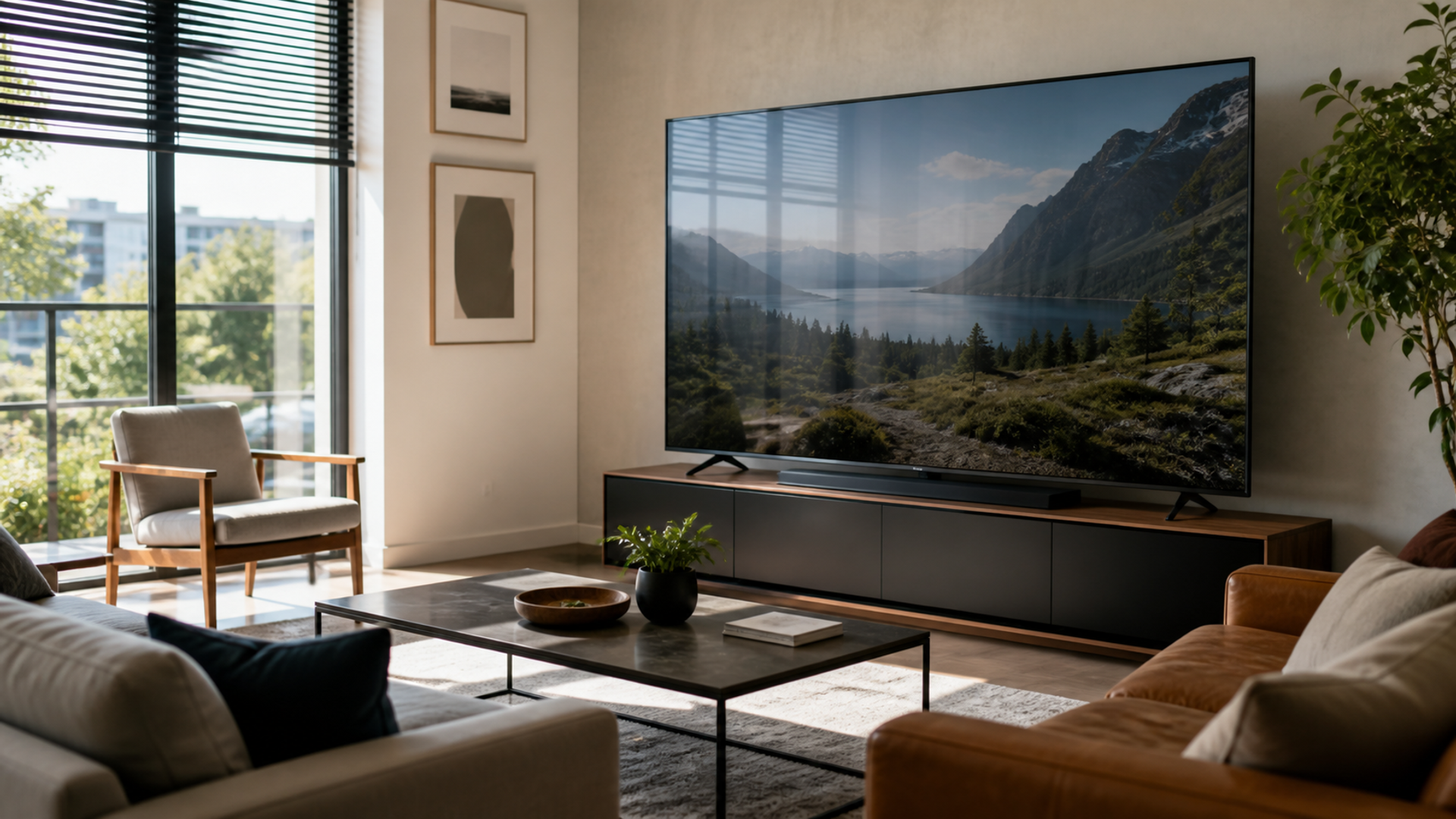
A bright-room television has to preserve contrast while windows, lamps and pale surfaces send light toward the screen. Peak brightness helps, but reflection handling, sustained full-screen output, viewing angle and the exact window position can matter more. The best set is the one that remains readable from the household's seats at the hours it is actually used.
Map the windows before choosing a panel
Choose a high-output mini-LED set for strong daylight and mixed content, an anti-reflection premium panel when direct reflections are the main problem, or an OLED when light can be controlled and wide-angle contrast matters. Test the exact room, picture mode and return window before treating any technology label as the answer.
| Decision factor | High-output mini-LED | Anti-reflection premium LCD | Light-controlled OLED |
|---|---|---|---|
| Window position | Daylight is strong but mostly diffuse | A defined reflection crosses the screen | Curtains can control direct light |
| Content | Sport and daytime television dominate | Mixed television needs consistent clarity | Films and evening viewing carry more weight |
| Viewing angle | Seats remain near the centre | Coating and panel preserve off-axis visibility | Wide seating rewards stable self-emissive contrast |
| Brightness behaviour | Sustained output matters across large scenes | Reflection control reduces the required output | Controlled light lowers the brightness burden |
| Energy | Higher output is accepted and measured | Automatic brightness settings are understood | Moderate output is part of the room plan |
| Ownership | Blooming trade-offs are acceptable | Coating care and room reflections are tested | Static-content and panel-care routines are acceptable |
This best tv for bright room matrix is the article's working value object. Read the best tv for bright room rows together: the decisive failure mode depends on this topic's evidence, operating context and reader objective.
What TV specifications can and cannot prove
Evidence 1. ENERGY STAR's current television programme measures energy use under defined test conditions, so efficiency labels can help compare sets but do not predict every household's brightness setting or viewing pattern.
Evidence 2. ENERGY STAR product listings are model-specific; a family name or panel technology does not establish the certified energy profile of every size.
Evidence 3. HDMI 2.1 is a suite of optional features, so gamers must verify the exact ports, bandwidth and modes rather than rely on the version label alone.
Evidence 4. Anti-reflection treatment changes the appearance of room light but cannot remove a bright source placed directly opposite the screen; furniture and window control remain part of the display system.
Reader-visible sources checked for this article:
energystar.gov — reader-visible current or official evidence
energystar.gov — reader-visible current or official evidence
hdmi.org — reader-visible current or official evidence
samsung.com — reader-visible current or official evidence
For best tv for bright room, these sources establish only the claims inside their documented scope. Recheck every changeable specification, availability condition, price, policy or service term in the relevant market before acting.
Test the room rather than the showroom
Read window position as a stop/go test: daylight is strong but mostly diffuse supports the first option; a defined reflection crosses the screen supports the second; and curtains can control direct light supports the third. Record which source proves the condition and when it was checked.
A buyer can resolve content without starting from a brand preference. Ask whether sport and daytime television dominate; compare that with whether mixed television needs consistent clarity; then use films and evening viewing carry more weight as the third route's safeguard. An unknown condition stays unknown.
On viewing angle, popularity is not enough. The evidence for option one is that seats remain near the centre. Option two means coating and panel preserve off-axis visibility. Option three is rational where wide seating rewards stable self-emissive contrast. Recheck any changeable term immediately before commitment.
The decision changes at brightness behaviour. Choose the first path only if sustained output matters across large scenes; move to the second when reflection control reduces the required output; use the third when controlled light lowers the brightness burden. Save the downside that would make this row fail.
For energy, the first route works when higher output is accepted and measured; the second requires automatic brightness settings are understood. The control for the third is moderate output is part of the room plan. Verify this row against the exact product, property, account or environment before it can reverse the decision.
The ownership row exposes a practical boundary. Route one assumes blooming trade-offs are acceptable, while route two is defensible only when coating care and room reflections are tested. Route three depends on static-content and panel-care routines are acceptable. If that evidence is absent, keep the more reversible option.
Facts that would reverse the current choice
Reversal control 1 — Window position. Before choosing High-output mini-LED, write down how the decision changes if “Daylight is strong but mostly diffuse” proves false. Do the same for Anti-reflection premium LCD and “A defined reflection crosses the screen”. Keep the Light-controlled OLED route available until “Curtains can control direct light” is verified. This control belongs to best tv for bright room; update it from the cited source or exact supplier rather than copying a generic checklist.
Reversal control 2 — Content. Before choosing High-output mini-LED, write down how the decision changes if “Sport and daytime television dominate” proves false. Do the same for Anti-reflection premium LCD and “Mixed television needs consistent clarity”. Keep the Light-controlled OLED route available until “Films and evening viewing carry more weight” is verified. This control belongs to best tv for bright room; update it from the cited source or exact supplier rather than copying a generic checklist.
Reversal control 3 — Viewing angle. Before choosing High-output mini-LED, write down how the decision changes if “Seats remain near the centre” proves false. Do the same for Anti-reflection premium LCD and “Coating and panel preserve off-axis visibility”. Keep the Light-controlled OLED route available until “Wide seating rewards stable self-emissive contrast” is verified. This control belongs to best tv for bright room; update it from the cited source or exact supplier rather than copying a generic checklist.
Reversal control 4 — Brightness behaviour. Before choosing High-output mini-LED, write down how the decision changes if “Sustained output matters across large scenes” proves false. Do the same for Anti-reflection premium LCD and “Reflection control reduces the required output”. Keep the Light-controlled OLED route available until “Controlled light lowers the brightness burden” is verified. This control belongs to best tv for bright room; update it from the cited source or exact supplier rather than copying a generic checklist.
Reversal control 5 — Energy. Before choosing High-output mini-LED, write down how the decision changes if “Higher output is accepted and measured” proves false. Do the same for Anti-reflection premium LCD and “Automatic brightness settings are understood”. Keep the Light-controlled OLED route available until “Moderate output is part of the room plan” is verified. This control belongs to best tv for bright room; update it from the cited source or exact supplier rather than copying a generic checklist.
Reversal control 6 — Ownership. Before choosing High-output mini-LED, write down how the decision changes if “Blooming trade-offs are acceptable” proves false. Do the same for Anti-reflection premium LCD and “Coating care and room reflections are tested”. Keep the Light-controlled OLED route available until “Static-content and panel-care routines are acceptable” is verified. This control belongs to best tv for bright room; update it from the cited source or exact supplier rather than copying a generic checklist.
Draw a reflection map
Sit in every regular seat during morning, afternoon and evening use. Photograph the blank screen and mark which windows, lamps and pale walls appear in it. A set can be very bright and still uncomfortable when a sharp window reflection covers faces or subtitles. Moving the television or changing one blind can outperform a costly panel upgrade.
Separate peak highlights from sustained visibility
Peak HDR measurements describe brief small highlights; a bright lounge may demand readable mid-tones and large bright scenes for hours. Check independent measurement methodology where available and compare the same picture mode. Store vivid mode is not a reliable ownership plan because colour, power and processing may be set for a retail floor.
Include angle, motion and subtitles
A family rarely watches from one centre seat. Check colour and contrast from the edges of the sofa, then test sport, dark drama and white subtitles over black bars. Strong local dimming can improve contrast but may reveal blooming around bright objects. The acceptable balance is a room and content decision, not a universal winner.
Use the return period as a controlled test
Keep packaging and document settings. Test daylight, night, standard television, sport, gaming and streaming compression before the return deadline. Disable or understand automatic energy-saving changes so comparisons are repeatable. Verify wall-mount clearances, cable access, warranty and service arrangements before the screen becomes difficult to move.
Three bright-room TV decisions
Glass-walled family room
A high-output mini-LED route works when diffuse daylight is continuous and central seating dominates. Define the fact that would reverse this recommendation before committing.
Single troublesome window
A premium anti-reflection set plus a targeted blind can solve the actual glare source. Define the fact that would reverse this recommendation before committing.
Wide sofa with controllable curtains
OLED becomes viable when direct light is managed and evening films matter most. Define the fact that would reverse this recommendation before committing.
Action checklist
Map windows at three times of day.
Test every regular seat.
Compare sustained rather than peak-only brightness.
Inspect coating with the screen off.
Check sports motion and subtitles.
Verify exact HDMI ports and modes.
Record automatic brightness settings.
Compare certified energy use by exact size.
Keep packaging through the return period.
Confirm mount, service and warranty access.
Continue the decision
The linked VERTU articles expand adjacent parts of the best tv for bright room decision. They do not substitute for the external evidence above.
The bright-room TV verdict
Choose a high-output mini-LED set for strong daylight and mixed content, an anti-reflection premium panel when direct reflections are the main problem, or an OLED when light can be controlled and wide-angle contrast matters. Test the exact room, picture mode and return window before treating any technology label as the answer.
Keep the best tv for bright room decision reversible until its material cost, safety, access, privacy and compatibility facts are verified. Unknown evidence stays unknown; it is never silently scored as favourable.