

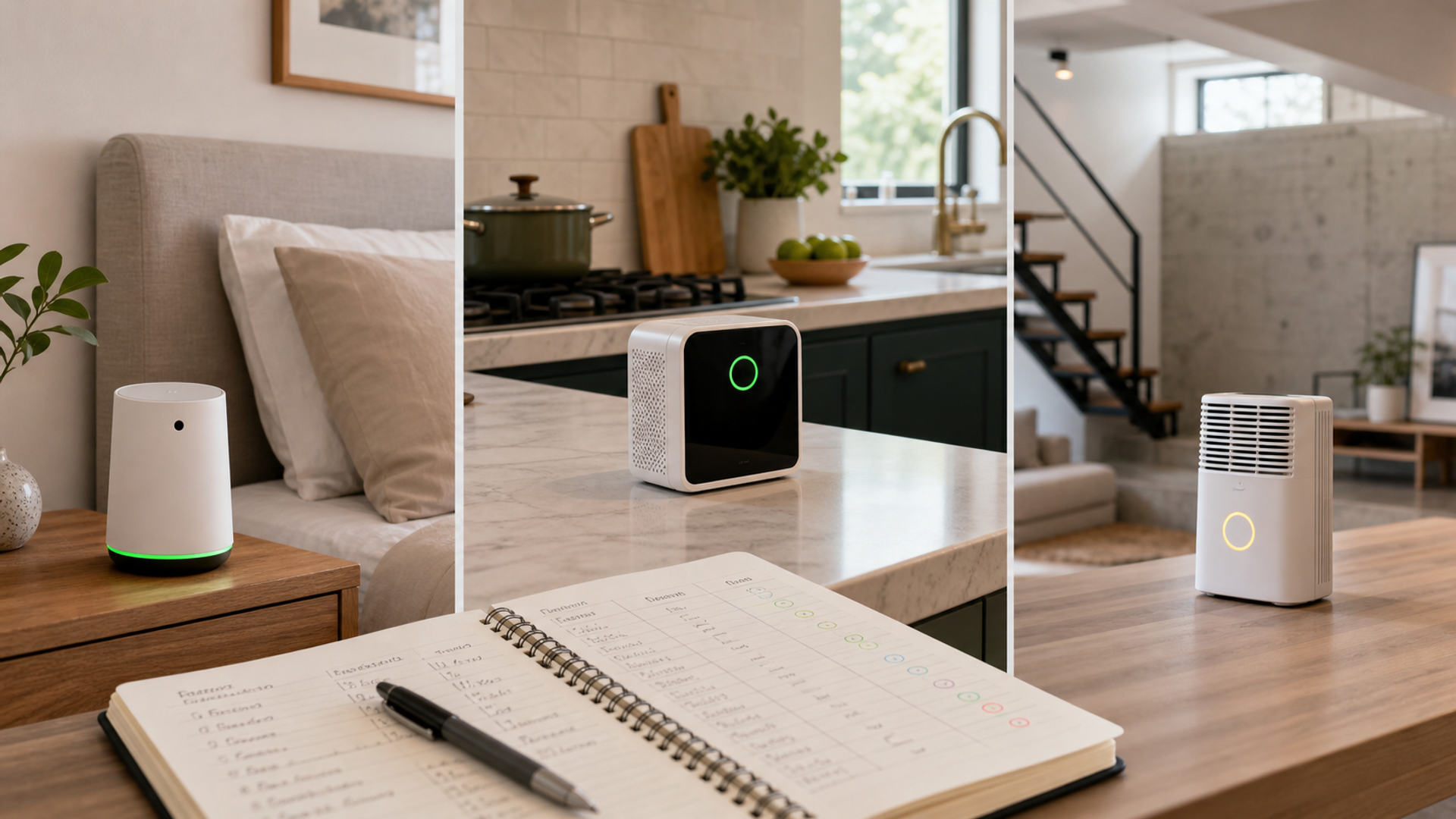
A single air-quality score can hide whether a device actually measures particles, carbon dioxide, volatile compounds, radon or only temperature and humidity. The best monitor is not the one with the longest dashboard. It is the one whose sensors answer a specific room question and whose data can be interpreted without creating false certainty.
Start with the pollutant question
Choose a particle-and-CO2 monitor for ventilation and combustion-adjacent questions, a radon-capable monitor where long-term radon screening matters, or a portable diagnostic unit when several rooms must be compared. Verify directly measured parameters, calibration, sampling interval, display, export and cloud dependence.
| Decision factor | Particle and CO2 monitor | Radon-capable long-term monitor | Portable multi-room diagnostic |
|---|---|---|---|
| Question | Ventilation and particle events are the priority | Long-term radon context is material | Differences between rooms or activities are being investigated |
| Sensors | PM and true CO2 channels are documented | Radon measurement and averaging period are documented | The carried sensor set matches each test |
| Time | Fast event response supports ventilation decisions | Days and weeks matter more than instant readings | Repeatable dwell time is used in each room |
| Display | Local values are visible without opening an app | Long-term trends are more important than constant display | Portable screen and notes support comparison |
| Data | Export and timestamps support event analysis | Long baselines can be retained | Room labels and test conditions are recorded |
| Privacy | Cloud collection and sharing are understood | Account continuity supports long records | A local-first workflow limits unnecessary uploads |
This best indoor air quality monitor matrix is the article's working value object. Read the best indoor air quality monitor rows together: the decisive failure mode depends on this topic's evidence, operating context and reader objective.
What an indoor monitor can and cannot establish
Evidence 1. EPA explains that indoor air quality includes many pollutant sources and that source control and ventilation are often central interventions, not merely monitoring.
Evidence 2. Carbon dioxide can help interpret occupancy and ventilation patterns but does not represent every indoor pollutant.
Evidence 3. Radon decisions rely on appropriate test duration and placement; an instant dashboard should not replace the relevant public-health guidance.
Evidence 4. Consumer monitors may combine directly measured channels into a proprietary score, so the underlying sensor list and units must remain visible.
Reader-visible sources checked for this article:
epa.gov — reader-visible current or official evidence
epa.gov — reader-visible current or official evidence
epa.gov — reader-visible current or official evidence
interiormedicine.com — reader-visible current or official evidence
For best indoor air quality monitor, these sources establish only the claims inside their documented scope. Recheck every changeable specification, availability condition, price, policy or service term in the relevant market before acting.
Separate measured values from estimated scores
The question row exposes a practical boundary. Route one assumes ventilation and particle events are the priority, while route two is defensible only when long-term radon context is material. Route three depends on differences between rooms or activities are being investigated. If that evidence is absent, keep the more reversible option.
Read sensors as a stop/go test: pM and true CO2 channels are documented supports the first option; radon measurement and averaging period are documented supports the second; and the carried sensor set matches each test supports the third. Record which source proves the condition and when it was checked.
A buyer can resolve time without starting from a brand preference. Ask whether fast event response supports ventilation decisions; compare that with whether days and weeks matter more than instant readings; then use repeatable dwell time is used in each room as the third route's safeguard. An unknown condition stays unknown.
On display, popularity is not enough. The evidence for option one is that local values are visible without opening an app. Option two means long-term trends are more important than constant display. Option three is rational where portable screen and notes support comparison. Recheck any changeable term immediately before commitment.
The decision changes at data. Choose the first path only if export and timestamps support event analysis; move to the second when long baselines can be retained; use the third when room labels and test conditions are recorded. Save the downside that would make this row fail.
For privacy, the first route works when cloud collection and sharing are understood; the second requires account continuity supports long records. The control for the third is a local-first workflow limits unnecessary uploads. Verify this row against the exact product, property, account or environment before it can reverse the decision.
Facts that would reverse the current choice
Reversal control 1 — Question. Before choosing Particle and CO2 monitor, write down how the decision changes if “Ventilation and particle events are the priority” proves false. Do the same for Radon-capable long-term monitor and “Long-term radon context is material”. Keep the Portable multi-room diagnostic route available until “Differences between rooms or activities are being investigated” is verified. This control belongs to best indoor air quality monitor; update it from the cited source or exact supplier rather than copying a generic checklist.
Reversal control 2 — Sensors. Before choosing Particle and CO2 monitor, write down how the decision changes if “PM and true CO2 channels are documented” proves false. Do the same for Radon-capable long-term monitor and “Radon measurement and averaging period are documented”. Keep the Portable multi-room diagnostic route available until “The carried sensor set matches each test” is verified. This control belongs to best indoor air quality monitor; update it from the cited source or exact supplier rather than copying a generic checklist.
Reversal control 3 — Time. Before choosing Particle and CO2 monitor, write down how the decision changes if “Fast event response supports ventilation decisions” proves false. Do the same for Radon-capable long-term monitor and “Days and weeks matter more than instant readings”. Keep the Portable multi-room diagnostic route available until “Repeatable dwell time is used in each room” is verified. This control belongs to best indoor air quality monitor; update it from the cited source or exact supplier rather than copying a generic checklist.
Reversal control 4 — Display. Before choosing Particle and CO2 monitor, write down how the decision changes if “Local values are visible without opening an app” proves false. Do the same for Radon-capable long-term monitor and “Long-term trends are more important than constant display”. Keep the Portable multi-room diagnostic route available until “Portable screen and notes support comparison” is verified. This control belongs to best indoor air quality monitor; update it from the cited source or exact supplier rather than copying a generic checklist.
Reversal control 5 — Data. Before choosing Particle and CO2 monitor, write down how the decision changes if “Export and timestamps support event analysis” proves false. Do the same for Radon-capable long-term monitor and “Long baselines can be retained”. Keep the Portable multi-room diagnostic route available until “Room labels and test conditions are recorded” is verified. This control belongs to best indoor air quality monitor; update it from the cited source or exact supplier rather than copying a generic checklist.
Reversal control 6 — Privacy. Before choosing Particle and CO2 monitor, write down how the decision changes if “Cloud collection and sharing are understood” proves false. Do the same for Radon-capable long-term monitor and “Account continuity supports long records”. Keep the Portable multi-room diagnostic route available until “A local-first workflow limits unnecessary uploads” is verified. This control belongs to best indoor air quality monitor; update it from the cited source or exact supplier rather than copying a generic checklist.
Write the room question in one sentence
Examples include whether cooking creates a particle spike, whether a crowded office needs more ventilation, or whether a basement needs long-term radon screening. Each question points to different sensors and time windows. If the question remains vague, the buyer is likely to pay for channels that look impressive but cannot guide an action.
Inspect the sensor disclosure
Look for the pollutant, unit, range, update interval, calibration method and expected service life. Distinguish true carbon dioxide measurement from an estimated equivalent and direct particle measurement from an overall index. An unavailable specification remains unknown, even when the app renders a precise decimal.
Place and compare without contaminating the test
Keep the monitor away from open windows, direct breath, steam and walls unless the test specifically concerns that source. Record room, height, occupancy, activity and ventilation state. Move a portable device only after allowing a consistent settling period, otherwise differences can reflect the test method rather than the room.
Connect readings to safe actions
Use the device to recognise patterns, then follow authoritative guidance for ventilation, source control, combustion safety or professional testing. Do not use a consumer monitor to declare a hazard absent when it lacks the relevant sensor. Set conservative alerts and document what action each threshold triggers.
Three room-monitoring plans
Bedroom ventilation
A CO2-and-particle monitor fits when overnight occupancy and purifier events are being compared. Define the fact that would reverse this recommendation before committing.
Basement ownership decision
A radon-capable long-term monitor fits when appropriate placement and averaging are understood. Define the fact that would reverse this recommendation before committing.
Whole-home investigation
A portable unit fits when the same method can be repeated across rooms before buying several devices. Define the fact that would reverse this recommendation before committing.
Action checklist
Define the pollutant question.
List directly measured sensors.
Check units and update interval.
Verify calibration guidance.
Confirm local display.
Review export and cloud dependence.
Plan placement.
Record activity and ventilation.
Map alerts to actions.
Use official guidance for high-stakes conclusions.
Continue the decision
The linked VERTU articles expand adjacent parts of the best indoor air quality monitor decision. They do not substitute for the external evidence above.
The indoor-air monitor verdict
Choose a particle-and-CO2 monitor for ventilation and combustion-adjacent questions, a radon-capable monitor where long-term radon screening matters, or a portable diagnostic unit when several rooms must be compared. Verify directly measured parameters, calibration, sampling interval, display, export and cloud dependence.
Keep the best indoor air quality monitor decision reversible until its material cost, safety, access, privacy and compatibility facts are verified. Unknown evidence stays unknown; it is never silently scored as favourable.
![How to Scan Receipts and Documents with Your Phone [Full Guide]](https://cdn.sanity.io/images/e0gp1l2g/production/0db13feec1d5e72b8a8a5f976d1f3e86619c9228-3840x1860.webp?w=180&h=180&q=78&auto=format&fit=crop)
![How to Scan Receipts and Documents with Your Phone [Full Guide]](https://cdn.sanity.io/images/e0gp1l2g/production/0db13feec1d5e72b8a8a5f976d1f3e86619c9228-3840x1860.webp?w=800&h=450&q=82&auto=format&fit=crop)
![Top 10 Two-Tone Carbon-Fibre Watches for Men [2026 List]](https://cdn.sanity.io/images/e0gp1l2g/production/18870799ba33fab0e038968359cd5772d7d7db30-1024x576.webp?w=800&h=450&q=82&auto=format&fit=crop)
![Top 10 Luxury Watches with Digital Complication Displays for Men [Latest]](https://cdn.sanity.io/images/e0gp1l2g/production/c4f6bf8c080f291c39f7cc85c7344ecff2fd3799-1024x553.webp?w=800&h=450&q=82&auto=format&fit=crop)