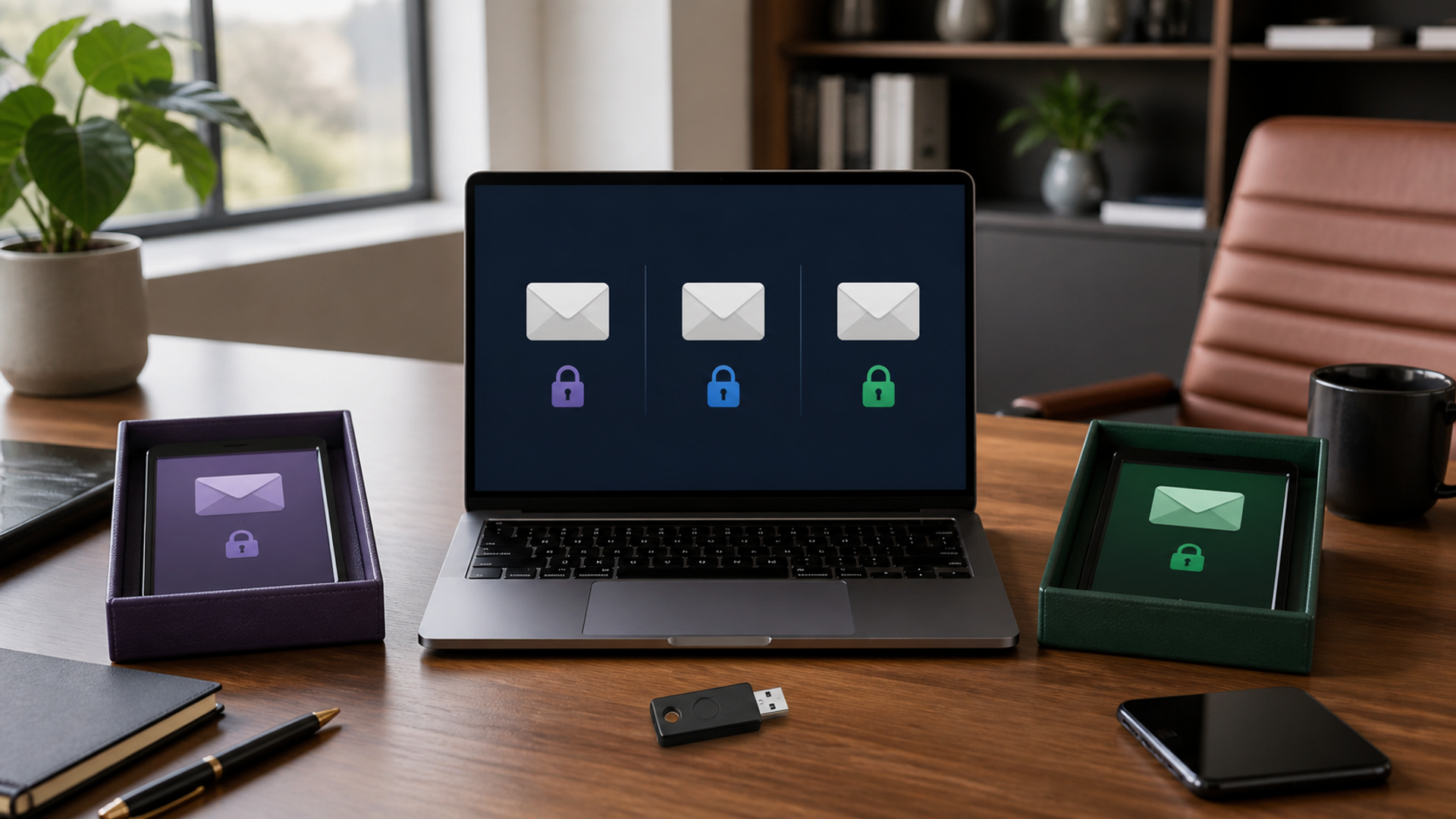
Secure email is not one switch. Message content, headers, routing metadata, contacts, device copies, recovery channels and the recipient's provider can each have different protections. The best provider is the one whose documented design matches the threat model and remains usable enough that people do not bypass it.
Start with the people and systems you email
Choose an end-to-end encrypted mailbox for sensitive communication within a compatible ecosystem, a managed business service when administration and domain controls dominate, or a compartmentalised setup when different identities require different trust boundaries. Verify encryption scope, metadata, recovery and export before migrating.
| Decision factor | Encrypted privacy mailbox | Managed business email | Compartmentalised multi-provider setup |
|---|---|---|---|
| Correspondents | Many contacts can use compatible encryption | Most contacts use ordinary business email | Sensitive identities can be separated |
| Content protection | Provider-readable content is minimised | Transport and administrative controls are prioritised | Different message classes use different protections |
| Metadata | Documented retention is acceptable | Legal and audit requirements govern retention | Exposure is reduced by identity separation |
| Recovery | Recovery is strong without a provider content backdoor | Administrators can restore authorised accounts | Each compartment has an independent recovery plan |
| Domain | Aliases or a private domain are supported | Central domain policy and logging are required | Domains and aliases separate public roles |
| Exit | Mailbox and keys can be exported | Retention and migration tools are proven | No single provider holds every dependency |
This best secure email provider matrix is the article's working value object. Read the best secure email provider rows together: the decisive failure mode depends on this topic's evidence, operating context and reader objective.
What secure-email standards establish
Evidence 1. NIST SP 800-177 Rev.1 describes technologies for trusted email and makes clear that transport protection, domain authentication and content security solve different problems.
Evidence 2. NIST guidance on email security distinguishes message confidentiality from authentication and transmission controls; a TLS indicator alone does not mean the recipient cannot read or forward content.
Evidence 3. CISA's phishing guidance reinforces that secure infrastructure does not remove social-engineering risk, account takeover or the need to verify unusual requests through another channel.
Evidence 4. A provider's current documentation remains the authority for key custody, encrypted search, recovery, aliases, custom domains, retention, legal jurisdiction and export behaviour.
Reader-visible sources checked for this article:
csrc.nist.gov — reader-visible current or official evidence
nvlpubs.nist.gov — reader-visible current or official evidence
cisa.gov — reader-visible current or official evidence
proton.me — reader-visible current or official evidence
For best secure email provider, these sources establish only the claims inside their documented scope. Recheck every changeable specification, availability condition, price, policy or service term in the relevant market before acting.
Compare the whole account lifecycle
The decision changes at correspondents. Choose the first path only if many contacts can use compatible encryption; move to the second when most contacts use ordinary business email; use the third when sensitive identities can be separated. Save the downside that would make this row fail.
For content protection, the first route works when provider-readable content is minimised; the second requires transport and administrative controls are prioritised. The control for the third is different message classes use different protections. Verify this row against the exact product, property, account or environment before it can reverse the decision.
The metadata row exposes a practical boundary. Route one assumes documented retention is acceptable, while route two is defensible only when legal and audit requirements govern retention. Route three depends on exposure is reduced by identity separation. If that evidence is absent, keep the more reversible option.
Read recovery as a stop/go test: recovery is strong without a provider content backdoor supports the first option; administrators can restore authorised accounts supports the second; and each compartment has an independent recovery plan supports the third. Record which source proves the condition and when it was checked.
A buyer can resolve domain without starting from a brand preference. Ask whether aliases or a private domain are supported; compare that with whether central domain policy and logging are required; then use domains and aliases separate public roles as the third route's safeguard. An unknown condition stays unknown.
On exit, popularity is not enough. The evidence for option one is that mailbox and keys can be exported. Option two means retention and migration tools are proven. Option three is rational where no single provider holds every dependency. Recheck any changeable term immediately before commitment.
Facts that would reverse the current choice
Reversal control 1 — Correspondents. Before choosing Encrypted privacy mailbox, write down how the decision changes if “Many contacts can use compatible encryption” proves false. Do the same for Managed business email and “Most contacts use ordinary business email”. Keep the Compartmentalised multi-provider setup route available until “Sensitive identities can be separated” is verified. This control belongs to best secure email provider; update it from the cited source or exact supplier rather than copying a generic checklist.
Reversal control 2 — Content protection. Before choosing Encrypted privacy mailbox, write down how the decision changes if “Provider-readable content is minimised” proves false. Do the same for Managed business email and “Transport and administrative controls are prioritised”. Keep the Compartmentalised multi-provider setup route available until “Different message classes use different protections” is verified. This control belongs to best secure email provider; update it from the cited source or exact supplier rather than copying a generic checklist.
Reversal control 3 — Metadata. Before choosing Encrypted privacy mailbox, write down how the decision changes if “Documented retention is acceptable” proves false. Do the same for Managed business email and “Legal and audit requirements govern retention”. Keep the Compartmentalised multi-provider setup route available until “Exposure is reduced by identity separation” is verified. This control belongs to best secure email provider; update it from the cited source or exact supplier rather than copying a generic checklist.
Reversal control 4 — Recovery. Before choosing Encrypted privacy mailbox, write down how the decision changes if “Recovery is strong without a provider content backdoor” proves false. Do the same for Managed business email and “Administrators can restore authorised accounts”. Keep the Compartmentalised multi-provider setup route available until “Each compartment has an independent recovery plan” is verified. This control belongs to best secure email provider; update it from the cited source or exact supplier rather than copying a generic checklist.
Reversal control 5 — Domain. Before choosing Encrypted privacy mailbox, write down how the decision changes if “Aliases or a private domain are supported” proves false. Do the same for Managed business email and “Central domain policy and logging are required”. Keep the Compartmentalised multi-provider setup route available until “Domains and aliases separate public roles” is verified. This control belongs to best secure email provider; update it from the cited source or exact supplier rather than copying a generic checklist.
Reversal control 6 — Exit. Before choosing Encrypted privacy mailbox, write down how the decision changes if “Mailbox and keys can be exported” proves false. Do the same for Managed business email and “Retention and migration tools are proven”. Keep the Compartmentalised multi-provider setup route available until “No single provider holds every dependency” is verified. This control belongs to best secure email provider; update it from the cited source or exact supplier rather than copying a generic checklist.
Write the threat model in plain language
Name who should not read the message: a network observer, provider operator, stolen-device user, abusive insider, criminal account-takeover group or legal adversary. Then list which contacts can realistically use compatible encryption. A provider can protect stored content while still exposing routing data, or secure transport while retaining access to the mailbox. Those are different promises.
Inspect keys, recovery and devices
Ask where encryption keys are created and stored, whether a password reset can restore old encrypted content, and what happens when every device is lost. Turn on strong multi-factor authentication and save recovery material offline. Check mobile notifications, local caches, backups and desktop clients because a well-designed mailbox can still leak through an unlocked endpoint.
Verify domain authentication and impersonation controls
For a custom domain, configure SPF, DKIM and DMARC carefully and monitor reports before enforcement. These controls reduce domain spoofing but do not make every incoming message truthful. Establish a second-channel rule for payment, password, itinerary and sensitive-document requests. Security that stops at the inbox interface is incomplete.
Plan portability before moving
Export a small mailbox, contacts and calendar before committing. Confirm aliases, forwarding, filters, search, retention and administrative audit functions. Decide what happens if the provider closes an account or changes terms. A private domain can improve portability, but only when DNS, registrar security and administrator succession are maintained.
Three secure-email decisions
Individual with sensitive correspondence
An encrypted privacy mailbox fits when frequent contacts can use the same protected workflow. Define the fact that would reverse this recommendation before committing.
Regulated or growing company
Managed business email is rational when policy, retention, administration and incident response are mandatory. Define the fact that would reverse this recommendation before committing.
Public and private roles
A compartmentalised setup limits correlation and blast radius when identities genuinely need separation. Define the fact that would reverse this recommendation before committing.
Action checklist
Write the threat model.
Map compatible recipients.
Read key-custody documentation.
Test account recovery.
Enable phishing-resistant MFA where supported.
Check notification and device leakage.
Configure SPF, DKIM and DMARC.
Review metadata and retention.
Test export and domain portability.
Create a second-channel verification rule.
Continue the decision
The linked VERTU articles expand adjacent parts of the best secure email provider decision. They do not substitute for the external evidence above.
The secure-email verdict
Choose an end-to-end encrypted mailbox for sensitive communication within a compatible ecosystem, a managed business service when administration and domain controls dominate, or a compartmentalised setup when different identities require different trust boundaries. Verify encryption scope, metadata, recovery and export before migrating.
Keep the best secure email provider decision reversible until its material cost, safety, access, privacy and compatibility facts are verified. Unknown evidence stays unknown; it is never silently scored as favourable.