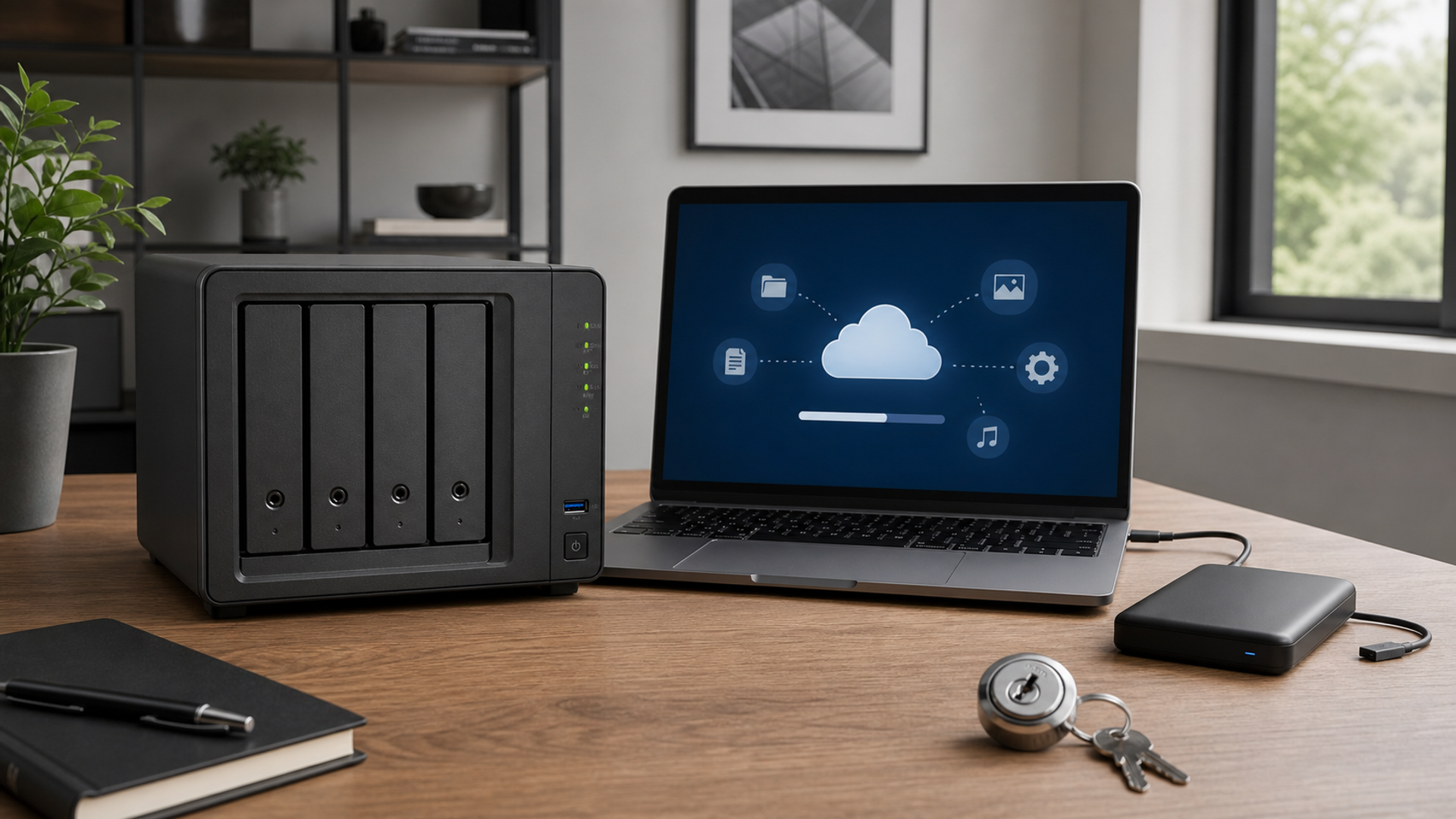
Network-attached storage and cloud storage solve overlapping but different parts of data custody. A NAS keeps storage hardware under the owner's control and serves files across a local network, with optional remote access. Cloud storage rents managed infrastructure and access from a provider. Neither is automatically a backup: synchronisation can copy deletion or ransomware, RAID does not create an off-site copy, and a cloud account can be locked or compromised. The useful decision begins with loss scenarios, recovery time, administration skill and the jurisdiction of the data.
Start with data loss, not device preference
Choose NAS when local performance, custody and controlled multi-user storage justify hardware, patching, power and off-site backup duties. Choose cloud storage when managed availability, broad remote access and predictable per-user operation matter more than direct hardware control. Use a hybrid 3-2-1 plan for important data: separate production, local backup and off-site recovery so one credential, building or device cannot erase every copy.
| Decision factor | NAS | Cloud storage | Use a hybrid 3-2-1 plan |
|---|---|---|---|
| Custody | Owner controls hardware and local administration | Provider controls infrastructure under contract | Document where every copy and key resides |
| Remote access | Requires secure configuration and resilient upstream link | Built for internet access but depends on account and provider | Keep an offline recovery path |
| Failure domain | Disks, controller, power and building are local risks | Provider, account, network and policy are external risks | Separate copies across domains |
| Ransomware | Snapshots help only if protected and tested | Versioning helps only within retention and account control | Use immutable or offline copies |
| Cost | Upfront hardware plus replacement and energy | Recurring storage, seat and egress charges | Model five years and growth |
| Administration | Owner patches, monitors and replaces | Provider manages infrastructure, not user governance | Assign named recovery responsibility |
This nas vs cloud storage matrix is the article's working value object. Read the nas vs cloud storage rows together: the decisive failure mode depends on this topic's evidence, operating context and reader objective.
Custody and accessibility move different risks
Evidence 1. NIST defines cloud computing by on-demand access to a shared pool of configurable resources; that definition does not promise a particular backup or privacy outcome.
Evidence 2. A NAS can provide a private-cloud interface, but secure remote access still depends on configuration, updates, credentials and network design.
Evidence 3. RAID improves availability against some disk failures but does not protect against deletion, ransomware, theft, fire or administrator error.
Evidence 4. Cloud sync and backup have different recovery semantics; retention, version history, export and egress must be tested rather than assumed.
Reader-visible sources checked for this article:
csrc.nist.gov — reader-visible current or official evidence
synology.com — reader-visible current or official evidence
For nas vs cloud storage, these sources establish only the claims inside their documented scope. Recheck every changeable specification, availability condition, price, policy or service term in the relevant market before acting.
Test a restore before trusting either system
A buyer can resolve custody without starting from a brand preference. Ask whether owner controls hardware and local administration; compare that with whether provider controls infrastructure under contract; then use document where every copy and key resides as the third route's safeguard. An unknown condition stays unknown.
On remote access, popularity is not enough. The evidence for option one is that requires secure configuration and resilient upstream link. Option two means built for internet access but depends on account and provider. Option three is rational where keep an offline recovery path. Recheck any changeable term immediately before commitment.
The decision changes at failure domain. Choose the first path only if disks, controller, power and building are local risks; move to the second when provider, account, network and policy are external risks; use the third when separate copies across domains. Save the downside that would make this row fail.
For ransomware, the first route works when snapshots help only if protected and tested; the second requires versioning helps only within retention and account control. The control for the third is use immutable or offline copies. Verify this row against the exact product, property, account or environment before it can reverse the decision.
The cost row exposes a practical boundary. Route one assumes upfront hardware plus replacement and energy, while route two is defensible only when recurring storage, seat and egress charges. Route three depends on model five years and growth. If that evidence is absent, keep the more reversible option.
Read administration as a stop/go test: owner patches, monitors and replaces supports the first option; provider manages infrastructure, not user governance supports the second; and assign named recovery responsibility supports the third. Record which source proves the condition and when it was checked.
Facts that would reverse the current choice
Reversal control 1 — Custody. Before choosing NAS, write down how the decision changes if “Owner controls hardware and local administration” proves false. Do the same for Cloud storage and “Provider controls infrastructure under contract”. Keep the Use a hybrid 3-2-1 plan route available until “Document where every copy and key resides” is verified. This control belongs to nas vs cloud storage; update it from the cited source or exact supplier rather than copying a generic checklist.
Reversal control 2 — Remote access. Before choosing NAS, write down how the decision changes if “Requires secure configuration and resilient upstream link” proves false. Do the same for Cloud storage and “Built for internet access but depends on account and provider”. Keep the Use a hybrid 3-2-1 plan route available until “Keep an offline recovery path” is verified. This control belongs to nas vs cloud storage; update it from the cited source or exact supplier rather than copying a generic checklist.
Reversal control 3 — Failure domain. Before choosing NAS, write down how the decision changes if “Disks, controller, power and building are local risks” proves false. Do the same for Cloud storage and “Provider, account, network and policy are external risks”. Keep the Use a hybrid 3-2-1 plan route available until “Separate copies across domains” is verified. This control belongs to nas vs cloud storage; update it from the cited source or exact supplier rather than copying a generic checklist.
Reversal control 4 — Ransomware. Before choosing NAS, write down how the decision changes if “Snapshots help only if protected and tested” proves false. Do the same for Cloud storage and “Versioning helps only within retention and account control”. Keep the Use a hybrid 3-2-1 plan route available until “Use immutable or offline copies” is verified. This control belongs to nas vs cloud storage; update it from the cited source or exact supplier rather than copying a generic checklist.
Reversal control 5 — Cost. Before choosing NAS, write down how the decision changes if “Upfront hardware plus replacement and energy” proves false. Do the same for Cloud storage and “Recurring storage, seat and egress charges”. Keep the Use a hybrid 3-2-1 plan route available until “Model five years and growth” is verified. This control belongs to nas vs cloud storage; update it from the cited source or exact supplier rather than copying a generic checklist.
Reversal control 6 — Administration. Before choosing NAS, write down how the decision changes if “Owner patches, monitors and replaces” proves false. Do the same for Cloud storage and “Provider manages infrastructure, not user governance”. Keep the Use a hybrid 3-2-1 plan route available until “Assign named recovery responsibility” is verified. This control belongs to nas vs cloud storage; update it from the cited source or exact supplier rather than copying a generic checklist.
Classify the data
List personal records, creative work, business documents, media, device backups and regulated material. Assign confidentiality, recovery-time and recovery-point objectives to each class. For this NAS versus cloud storage decision, record the exact room, garment, vehicle, drink, device or configuration and the time of the check. Separate measured behaviour from category shorthand, then repeat the comparison in the intended setting rather than an ideal demonstration. If all files receive one policy, the architecture is probably too blunt. Preserve the evidence that would reverse the choice: a material change in fit, specification, maintenance, safety, cost or environment must reopen the decision rather than inherit an old conclusion.
Build a threat model
Include accidental deletion, ransomware, credential theft, disk failure, controller failure, fire, theft and provider lockout. Map which option fails in each scenario and which independent copy remains. For this NAS versus cloud storage decision, record the exact room, garment, vehicle, drink, device or configuration and the time of the check. Separate measured behaviour from category shorthand, then repeat the comparison in the intended setting rather than an ideal demonstration. If one admin account can delete every copy, redesign before migration. Preserve the evidence that would reverse the choice: a material change in fit, specification, maintenance, safety, cost or environment must reopen the decision rather than inherit an old conclusion.
Model capacity and cost
Project usable capacity, parity overhead, backup copies, snapshots, provider tiers, seats and egress for five years. Include disks, UPS, replacement cadence, support time and internet upgrades. For this NAS versus cloud storage decision, record the exact room, garment, vehicle, drink, device or configuration and the time of the check. Separate measured behaviour from category shorthand, then repeat the comparison in the intended setting rather than an ideal demonstration. If growth makes the chosen plan unaffordable, define an archive tier now. Preserve the evidence that would reverse the choice: a material change in fit, specification, maintenance, safety, cost or environment must reopen the decision rather than inherit an old conclusion.
Harden access
Use unique credentials, multi-factor authentication, least privilege, patching and restricted exposure. Separate backup administration from daily accounts where the system permits. For this NAS versus cloud storage decision, record the exact room, garment, vehicle, drink, device or configuration and the time of the check. Separate measured behaviour from category shorthand, then repeat the comparison in the intended setting rather than an ideal demonstration. If remote access requires unsafe port exposure, use a different access design. Preserve the evidence that would reverse the choice: a material change in fit, specification, maintenance, safety, cost or environment must reopen the decision rather than inherit an old conclusion.
Prove recovery
Delete a test file, simulate a failed device and restore to clean hardware or an isolated location. Measure elapsed time, permissions, metadata and application usability after restore. For this NAS versus cloud storage decision, record the exact room, garment, vehicle, drink, device or configuration and the time of the check. Separate measured behaviour from category shorthand, then repeat the comparison in the intended setting rather than an ideal demonstration. If the restore is incomplete or undocumented, the system is not yet a backup. Preserve the evidence that would reverse the choice: a material change in fit, specification, maintenance, safety, cost or environment must reopen the decision rather than inherit an old conclusion.
Four data estates, four answers
Photography studio with large local media
NAS performance plus independent off-site backup can fit. Define the fact that would reverse this recommendation before committing.
Distributed team with standard documents
Managed cloud collaboration may reduce administration. Define the fact that would reverse this recommendation before committing.
Executive personal archive
A hybrid encrypted plan limits both provider and household failure. Define the fact that would reverse this recommendation before committing.
Small office without an administrator
A complex NAS can create more risk than it removes. Define the fact that would reverse this recommendation before committing.
Action checklist
Classify data.
Set recovery time.
Set recovery point.
Map threats.
Project growth.
Price egress.
Protect admin accounts.
Enable versioning.
Create offline copy.
Create off-site copy.
Test restore.
Document ownership.
Continue the decision
The linked VERTU articles expand adjacent parts of the nas vs cloud storage decision. They do not substitute for the external evidence above.
The NAS-versus-cloud-storage verdict
Choose NAS when local performance, custody and controlled multi-user storage justify hardware, patching, power and off-site backup duties. Choose cloud storage when managed availability, broad remote access and predictable per-user operation matter more than direct hardware control. Use a hybrid 3-2-1 plan for important data: separate production, local backup and off-site recovery so one credential, building or device cannot erase every copy.
Keep the nas vs cloud storage decision reversible until its material cost, safety, access, privacy and compatibility facts are verified. Unknown evidence stays unknown; it is never silently scored as favourable.