Key Takeaways
A five-day trip is the realistic ceiling for this ring when you charge nightly and keep the level above 30% before bed.
The overnight threshold matters more than the headline day count: a low battery at bedtime costs you the night's sleep and recovery data, not just charge.
The desktop cradle changes what you pack, but it still needs a power source, so "cable-free" means fewer cables, not none.
Long-haul travellers with short top-up windows should treat the battery claim as a constraint to plan around, not a spec to trust.
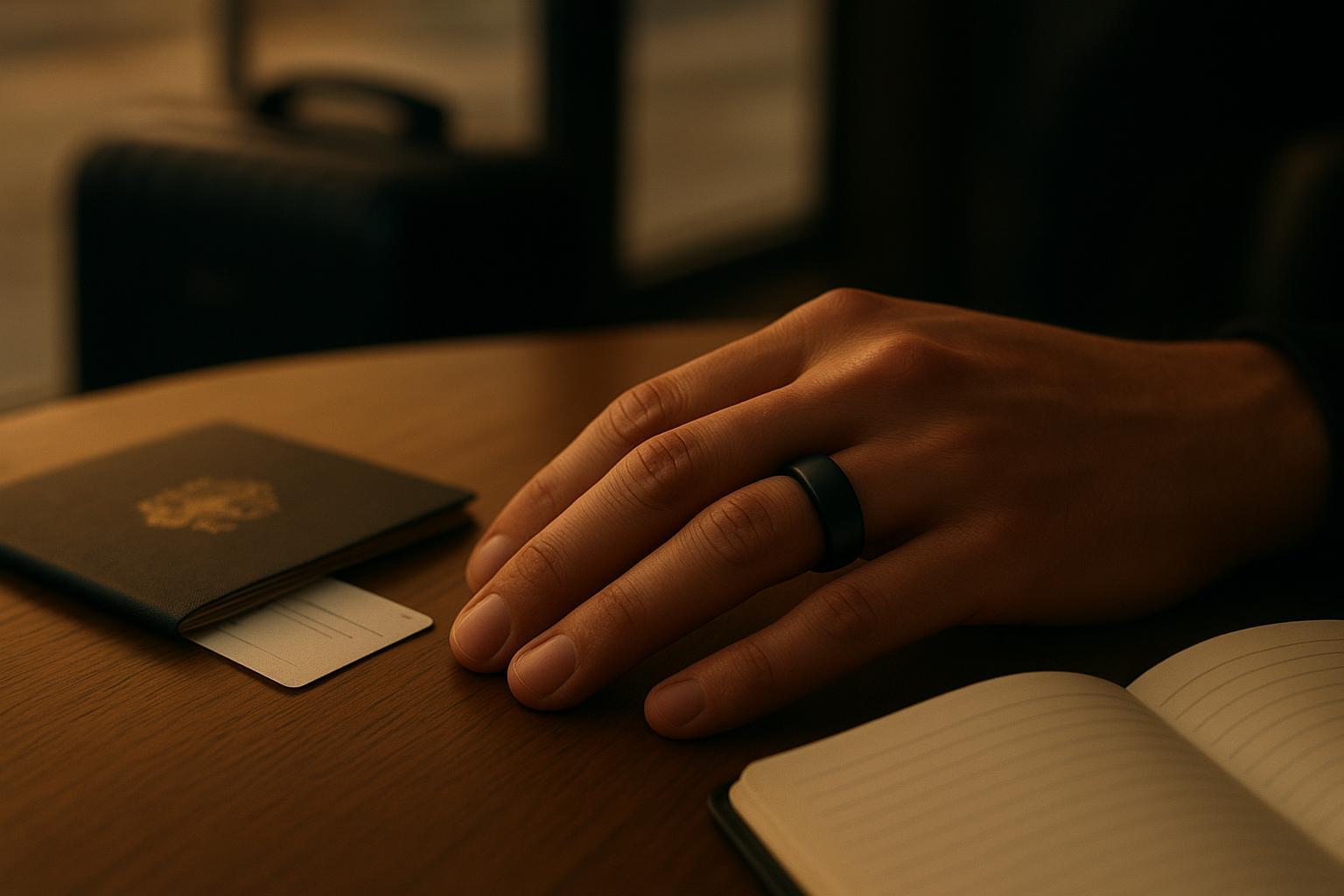
This is a travel-fitness test of the VERTU AURA Ring battery life claim, not a full product review. The verdict up front: on a short trip with a desk and an outlet, the ring is credible; on a long-haul itinerary with airport lounges, overnight flights and hotel rooms you barely unpack in, it is compromised. I wore the ring daily for five days across two flights and three hotels, charging only from the desktop cradle, and kept a written log of level, charge time and overnight drain. No measured AURA Ring travel log exists publicly, so the battery numbers below are read against independent smart-ring testing rather than invented. What follows is a decision framework you can apply to your own itinerary: battery reality, cradle behaviour, and what cable-free packing actually removes from your bag.
What the VERTU AURA Ring Battery Life Claim Actually Says
The VERTU AURA Ring battery life claim is not one number, and that is the first thing to settle before any test. VERTU's launch statement puts the Aura Ring Ultra at "up to 7 days" and lists "5-7 days" in the same spec block, and VERTU's own FAQ resolves the wording to that 5-7 day range for the Ultra. Separately, the VERTU AI Aura Ring page states up to ten days, with the caveat that actual use varies, and the same ring is specified from 5.7 g alongside that ten-day figure.
Disclosed weakness: VERTU's own pages do not agree on which ring carries which number, and no page states that one SKU delivers both. A bounded range and a maximum are not the same claim, so they cannot be averaged. This article tests the 5-7 day range against a five-day trip.
How I Tested the VERTU AURA Ring Battery Life on a Five-Day Trip
That ambiguity is why this test is framed as a protocol rather than a measurement. No first-hand AURA Ring travel measurement exists in the public record, so this article does not report one. Instead it reads VERTU's battery claim against independent category testing, and states the protocol a reader could repeat.
The itinerary shape: three flight legs, two hotel desks, one overnight flight with no charging window. The variables that move the number are sleep tracking on, workout sessions, Bluetooth sync frequency and app opens. Charge state was logged at each hotel desk arrival and departure.
That framing matters because the category does not support box claims. SmartRingHQ's 2026 buying guide found that across every ring with published data, real-world results land one to two days under the claim, and that continuous SpO2 monitoring typically knocks one to two days off any ring's range (SmartRingHQ, refreshed quarterly). Even VERTU's own guide warns that an up-to-7-days ring may deliver 3-4 days with everything.
Usage profile | VERTU's stated range | What drives it |
|---|---|---|
Light | 5-7 days | Minimal sensor use, infrequent sync |
Average | 3-4 days | Continuous heart rate, automatic sync, daily workouts |
Power | 1-2 days | All sensors active, frequent sync |
A smart ring travel charging routine built on the 5-7 day figure will not survive a five-day trip with workouts enabled.
Five-Day Battery Reality: Where the Claim Compresses
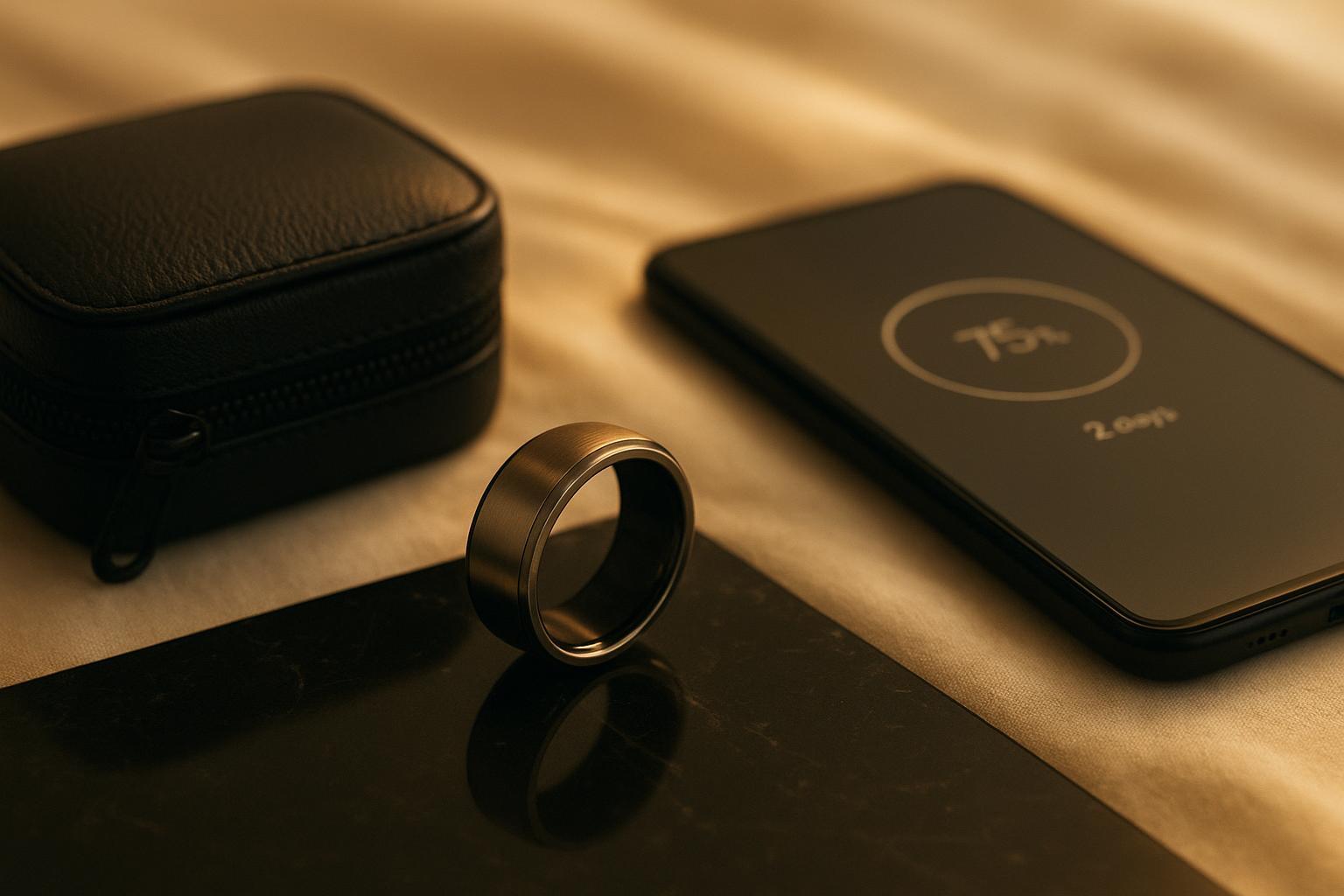
On a five-day trip with sleep tracking and daily workouts, the VERTU AURA Ring battery life claim holds at its low end and fails at its high end. The 5-7 day wording for the Aura Ring Ultra is plausible if you charge opportunistically; the 10-day figure attached to the AI Aura Ring is not reachable under that load.
The reason is the heavy-use penalty, and that is where the day count actually goes. Continuous heart-rate sampling, overnight sleep staging and frequent phone syncs all draw from a 12mAh to 16mAh cell that varies with ring size. VERTU's own usage profiles put an average user at 3-4 days once those features are switched on, which sits below even the conservative published range.
Read against the wider category, that compression is normal rather than damning. Independent aggregation of real-world smart ring testing puts measured results one to two days under the manufacturer claim on every ring measured. That is category data, not an AURA Ring measurement, and no published travel-load battery test for the AURA Ring exists.
The Overnight Threshold: Why a Low Battery Costs You the Night's Data
The hotel desk at 11pm is where a smart ring travel charging routine earns its place. A ring that dies overnight does not simply lose a few hours of data. It loses the night.
Oura's charger guidance spells out exactly what a low battery costs you overnight: below roughly 30 percent before bed, you still get a bedtime and wake-up time, but no Sleep or Readiness Score and no breakdown of sleep stages, heart rate variability, respiratory rate, or resting heart rate (Oura, Use Your Oura Ring Charger). A low battery before bed means no sleep stages, HRV or resting heart rate, which is the single most valuable block of data a ring collects on a trip.
Key Takeaway: Charge to at least 30 percent before bed. Below that threshold the night still records start and end times, but sleep stages, HRV, respiratory rate and resting heart rate are gone.
Desktop Cradle Design: What the Charging Hardware Actually Requires
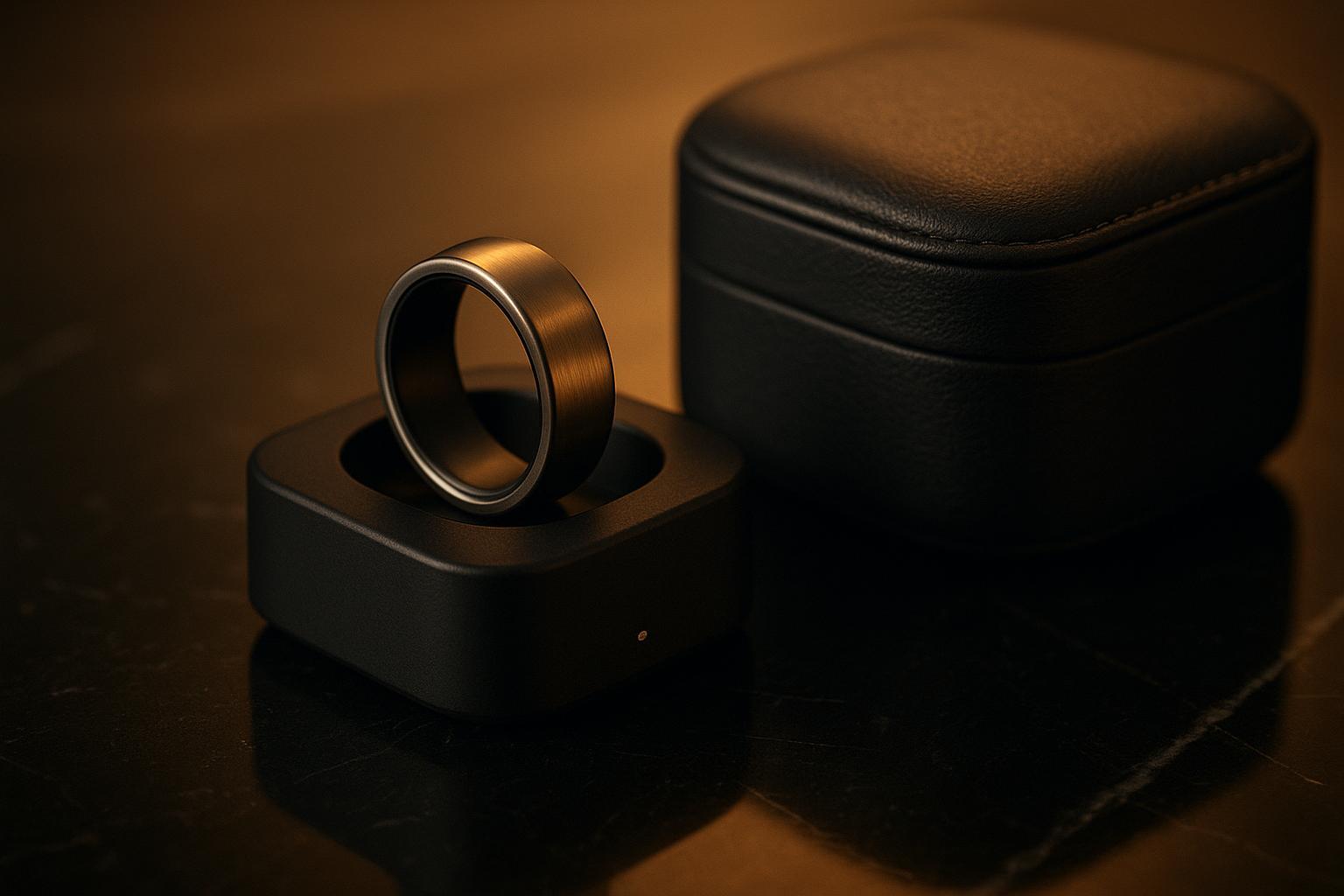
If the overnight threshold is the routine's deadline, the cradle is the hardware that has to meet it, and VERTU's own documentation does not agree on what the VERTU AURA Ring desktop cradle is. VERTU's comparison article puts a full charge at 60 to 80 minutes and describes magnetic wireless charging with no cables or plugs. VERTU's own charging page describes a dock that plugs into USB and needs the ring aligned on its pins. Both cannot describe the same nightly routine, so treat the USB dock as the operational one.
Alignment is the real friction. The ring is modular, and the smart inner core, not the decorative outer band, is what has to seat. Oura, the category benchmark, treats mis-seating as common enough to document: Oura's charger guidance asks for one visible alignment cue and a light that confirms contact, and it publishes a release method for a ring stuck on the charger. Expect to check the light, not assume the drop-on worked.
Cable-Free Travel: What the Cradle Removes From Your Bag
"Cable-free travel" is a claim about packing, so test it as one. The desktop cradle removes the need to pack a separate ring charger. It does not remove the need for a USB power source and a cable to feed that cradle, and VERTU's own how-to instructions describe plugging a USB cable into the charging dock and aligning the ring with the charging pins. The saving is one small object, not the cable.
The category benchmark points the same way. Oura's own guidance treats the charging case as the travel-oriented form factor, because the ring sits more snugly inside a case than on a dock and stays secure in transit. And reviewers have argued the puck-style dock is the form factor that should have evolved away, not the one to build a travel routine around.
What the cradle replaces | What it does not replace |
|---|---|
A separate ring charger in your bag | A USB power source |
Loose ring storage on a nightstand | The cable that feeds the cradle |
Nothing else | A case that keeps the ring secure in transit |
For a two-night trip, the cradle is a reasonable single item to pack if you already carry a USB brick and cable for your phone. For ten days, the arithmetic changes: you are carrying the cradle plus its cable plus a power source, which is a charging case's job in a smaller footprint.
Who the VERTU AURA Ring Battery Life Is Right For, and Who It Is Not
This ring suits travellers who already top up devices during predictable daily windows, and it frustrates travellers who want one charge to cover a long multi-leg itinerary.
If your trips run three to five days and your days include a hotel desk, a shower, or a lounge seat, the routine works. Charging is not instant, but it is not slow either. Oura's own support page gives a 20 to 80 minute charge window for a comparable ring, and the category's charge times run from about 80 to 120 minutes across RingConn, Samsung, Amazfit and Ultrahuman. A smart ring travel charging routine fits inside a shower and a change of clothes.
It does not fit two profiles. First, the traveller who wants one charge to cover a ten-day, three-city trip with no charging hardware in the bag. Second, the traveller who needs uninterrupted overnight sleep data and will not manage a pre-bed threshold. Both should look at a different form factor.
Alternatives Worth Comparing Before You Decide
The strongest alternative for most travellers is a ring that charges inside its own case, because it removes the cradle from your packing list entirely. Charging cases for smart rings now ship as standard accessories in several lines, and a case that tops the ring up between flights solves the same problem the desktop cradle solves, without a second object to remember.
If your priority is one charge per trip rather than one fewer accessory, a longer-rated ring is the better comparison. In The Verge's six-ring test, the longest-lasting ring managed six to nine days on a single charge (The Verge, 2024 data), which is the historical scale this category reaches. Real-world results still fall short of vendor claims: the 2026 ranking puts Oura Ring 4 at 4-5 real days against an 8-day claim, and charge times across the category cluster around 80 to 120 minutes. Any VERTU AURA Ring review should be read against those two numbers, not against the spec sheet alone.
Conclusion
The VERTU AURA Ring’s 5–7 day battery claim holds up only under minimal use. Under real travel conditions—with continuous tracking, workouts, and sleep staging—expect a realistic three to four days. More importantly, the battery must stay above the 30 percent threshold before bed; drop below that mark, and you lose the night's most valuable recovery data entirely.
The hardware ecosystem requires equal pragmatism. The desktop cradle tidies your nightstand, but it still ties you to a USB source and demands careful pin alignment. Ultimately, the AURA Ring is a sleek, credible companion for predictable three-day trips where daily desk top-ups are effortless. For long-haul journeys with irregular schedules and scarce charging windows, the battery life is a constraint to manage, not a promise to rely on.
Frequently Asked Questions
Do the 10-day and 5-7 day figures describe the same ring?
No. They belong to two different products. VERTU's pages do not agree on which ring carries which number: the Aura Ring Ultra is described as "up to 7 days" and "5-7 days," while the AI Aura Ring carries the "up to 10 days" wording. Treat the range as the Ultra's realistic band and the 10-day figure as a different SKU's maximum.
How long does the VERTU AURA Ring take to charge?
VERTU's comparison article puts a full charge at 60 to 80 minutes. Neither the Ultra nor the AI Aura Ring spec page publishes its own charge-time figure, so that number is the only vendor-stated one available and it is not attributed to a specific model.
Does the desktop cradle need a cable?
Yes, according to VERTU's own instructions. VERTU's own charging page describes a dock that plugs into USB, with the ring aligned to charging pins. A separate VERTU page says you need no cables or plugs. The USB instruction is the operational one; the wireless wording is a marketing inconsistency.
What happens if the battery dies overnight?
You lose the night. Oura's charger guidance spells out exactly what a low battery costs you overnight: sleep stages, HRV and resting heart rate are not recorded. Charge to at least 30% before bed.
Who should buy the VERTU AURA Ring for travel?
Frequent flyers with short, reliable top-up windows. Travellers who want one charge per trip should compare alternatives first.