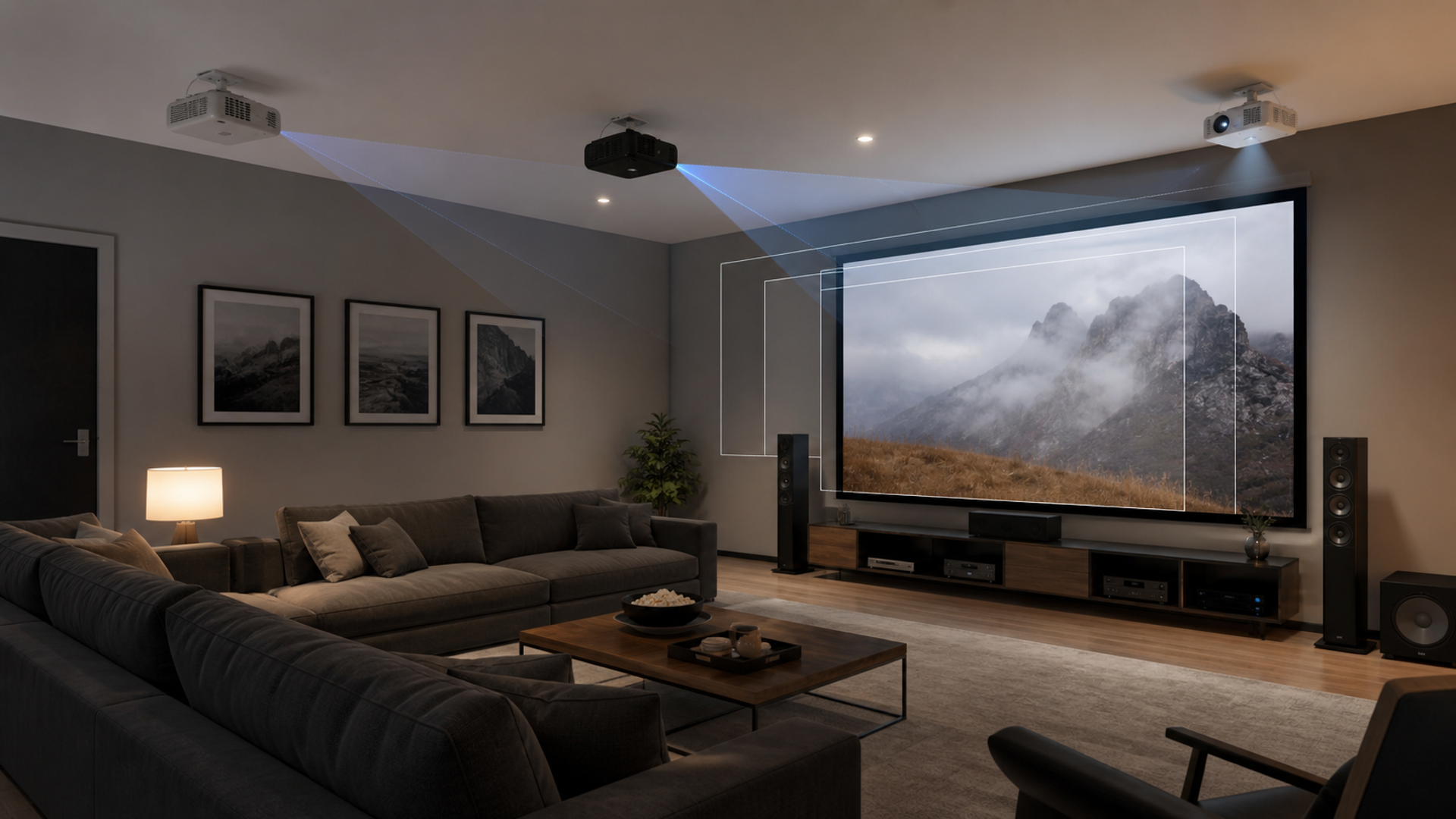
The best projector is determined before a model name enters the shortlist. Throw distance fixes which lenses can fill the screen; ambient light determines how much contrast survives; seating distance shapes useful resolution; and installation decides whether a theoretically superior machine can be aligned without digital correction. Search interest is rising, but a universal top-ten list cannot see the reader's room. This guide turns the room into a specification.
Searches for best home cinema projector are rising because large-format viewing now spans dedicated theatres and multipurpose living rooms. The room's light control, throw geometry and screen size define the shortlist before resolution or smart-platform features do.
The short answer on best home cinema projector
For a controlled dark room, prioritise native contrast, black-level performance, lens flexibility and accurate HDR handling. For a mixed-use room, prioritise measured brightness, screen choice and reflection control. Measure throw distance and desired image width before shopping. Shortlist only projectors whose lens range, vertical position, inputs, noise and service path fit the installation.
Separate dedicated-theatre priorities from living-room priorities. Deep blacks and quiet operation matter more in a dark cinema, while brightness, reflections and easy placement often dominate a shared space.
best home cinema projector decision matrix
| Decision factor | Dedicated dark room | Mixed-use living room | Ultra-short-throw setup |
|---|---|---|---|
| Light control | Blackout or very low ambient light | Windows and practical daytime use | Controlled wall zone but room light still matters |
| Primary metric | Contrast and dark-scene detail | Usable colour brightness | Screen compatibility and geometry |
| Placement | Ceiling or rear shelf with lens shift | Flexible shelf or ceiling position | Exact cabinet depth and screen relationship |
| Screen | Neutral fixed frame often suits | Ambient-light strategy may be required | UST-specific screen may be decisive |
| Noise | Audible in quiet scenes if too close | Competes with normal room sound | Near viewers and furniture ventilation |
| HDR | Tone mapping and contrast are critical | Brightness helps but cannot remove ambient washout | Model processing and screen determine result |
| Installation risk | Long cable and alignment work | Compromised placement for furniture | Surface flatness and cabinet movement |
| Best proof | Calibrated review in dark material | Measured bright-scene performance | In-room demonstration at the target size |
The room-first matrix stops two common mistakes: buying too little light for a multipurpose room and buying excess brightness that compromises black level in a controlled theatre. Each recommendation remains tied to an installation condition.
Evidence checked for best home cinema projector
Verified point 1. ProjectorCentral's current home-theatre guide compares models using room and performance context rather than relying on resolution labels alone.
Verified point 2. Epson's home-cinema catalogue shows that lens, light source, placement and brightness vary widely even within one manufacturer's premium range.
Verified point 3. A projector's image size depends on its lens and throw ratio, so room measurements can exclude an otherwise attractive model before picture quality is considered.
Reader-visible sources:
projectorcentral.com current source —
https://www.projectorcentral.com/best-home-theater-projectors.htmepson.com current source —
https://epson.com/For-Home/Projectors/Home-Cinema/c/h310
The linked projection references explain brightness, throw and screen relationships. Buyers still need model-level measurements because claimed light output, contrast behaviour and lens capability vary substantially.
How to read the E06 matrix
best home cinema projector: light control test 1
The Dedicated dark room route is supported only when blackout or very low ambient light. The alternative Mixed-use living room route means windows and practical daytime use. For Ultra-short-throw setup, the relevant control is that controlled wall zone but room light still matters. Resolve this light control row with the exact product, account, room, service or schedule in front of the reader. If a decisive fact remains unavailable, preserve the least irreversible option and set a dated recheck; the E06-1 comparison is not permission to convert an unknown into a favourable assumption.
best home cinema projector: primary metric test 2
The Dedicated dark room route is supported only when contrast and dark-scene detail. The alternative Mixed-use living room route means usable colour brightness. For Ultra-short-throw setup, the relevant control is that screen compatibility and geometry. Resolve this primary metric row with the exact product, account, room, service or schedule in front of the reader. If a decisive fact remains unavailable, preserve the least irreversible option and set a dated recheck; the E06-2 comparison is not permission to convert an unknown into a favourable assumption.
best home cinema projector: placement test 3
The Dedicated dark room route is supported only when ceiling or rear shelf with lens shift. The alternative Mixed-use living room route means flexible shelf or ceiling position. For Ultra-short-throw setup, the relevant control is that exact cabinet depth and screen relationship. Resolve this placement row with the exact product, account, room, service or schedule in front of the reader. If a decisive fact remains unavailable, preserve the least irreversible option and set a dated recheck; the E06-3 comparison is not permission to convert an unknown into a favourable assumption.
best home cinema projector: screen test 4
The Dedicated dark room route is supported only when neutral fixed frame often suits. The alternative Mixed-use living room route means ambient-light strategy may be required. For Ultra-short-throw setup, the relevant control is that uST-specific screen may be decisive. For the screen row, calculate image width, gain and seating distance with the chosen projector's real throw range before fixing any mounts. If a decisive fact remains unavailable, preserve the least irreversible option and set a dated recheck; the E06-4 comparison is not permission to convert an unknown into a favourable assumption.
best home cinema projector: noise test 5
The Dedicated dark room route is supported only when audible in quiet scenes if too close. The alternative Mixed-use living room route means competes with normal room sound. For Ultra-short-throw setup, the relevant control is that near viewers and furniture ventilation. Resolve this noise row with the exact product, account, room, service or schedule in front of the reader. If a decisive fact remains unavailable, preserve the least irreversible option and set a dated recheck; the E06-5 comparison is not permission to convert an unknown into a favourable assumption.
best home cinema projector: hdr test 6
The Dedicated dark room route is supported only when tone mapping and contrast are critical. The alternative Mixed-use living room route means brightness helps but cannot remove ambient washout. For Ultra-short-throw setup, the relevant control is that model processing and screen determine result. Resolve this hdr row with the exact product, account, room, service or schedule in front of the reader. If a decisive fact remains unavailable, preserve the least irreversible option and set a dated recheck; the E06-6 comparison is not permission to convert an unknown into a favourable assumption.
best home cinema projector: installation risk test 7
The Dedicated dark room route is supported only when long cable and alignment work. The alternative Mixed-use living room route means compromised placement for furniture. For Ultra-short-throw setup, the relevant control is that surface flatness and cabinet movement. Resolve this installation risk row with the exact product, account, room, service or schedule in front of the reader. If a decisive fact remains unavailable, preserve the least irreversible option and set a dated recheck; the E06-7 comparison is not permission to convert an unknown into a favourable assumption.
best home cinema projector: best proof test 8
The Dedicated dark room route is supported only when calibrated review in dark material. The alternative Mixed-use living room route means measured bright-scene performance. For Ultra-short-throw setup, the relevant control is that in-room demonstration at the target size. Resolve this best proof row with the exact product, account, room, service or schedule in front of the reader. If a decisive fact remains unavailable, preserve the least irreversible option and set a dated recheck; the E06-8 comparison is not permission to convert an unknown into a favourable assumption.
Measure a geometry envelope
Record lens-to-screen distance, allowable projector height, screen width, seating distance and every obstruction. Use the manufacturer's throw calculator for the exact model and preserve margin at both ends of the lens range. Avoid planning around maximum digital keystone because it discards pixels and can complicate focus. The installation should work optically before software correction is asked to rescue it.
Brightness is not one universal number
Published lumens may use different modes and measurement conditions. Look for measured colour and white output in a calibrated mode, then account for screen size and ambient light. A larger image spreads the same light over more area. High-output modes may increase fan noise or shift colour. Compare the mode you would actually watch, not the brightest setting available in a specification table.
Screen choice belongs in the same budget
A smooth, correctly tensioned surface can improve consistency, while ambient-light-rejecting screens have viewing-angle and placement constraints. Ultra-short-throw projectors are especially sensitive to wall flatness and screen structure. Decide screen gain, size and material with the projector. Spending the entire budget on the light engine and projecting onto an unsuitable surface can erase the upgrade.
Plan the signal path and service path
Long HDMI runs, receivers, control systems and hidden power points are common failure sources. Verify bandwidth for the intended frame rate and HDR format. Leave ventilation and physical access for filters, firmware recovery and replacement. A premium room should be repairable without opening finished walls. Document cable routes and settings after commissioning so future changes do not begin from zero.
Three practical best home cinema projector scenarios
Film-first dedicated room
Prioritise contrast, lens control and quiet operation, then calibrate the projector and screen as one system. Record the fact that would reverse this choice and the date on which it must be checked.
Family living room
Choose realistic brightness and an appropriate screen, preserve simple television-like operation and accept that darkness still improves the image. Record the fact that would reverse this choice and the date on which it must be checked.
Design-led UST room
Template the cabinet and image geometry on site, confirm wall flatness and use a compatible screen before furniture is ordered. Record the fact that would reverse this choice and the date on which it must be checked.
Verification checklist for best home cinema projector
Measure lens-to-screen distance.
Choose image width.
Record ambient light.
Check lens shift.
Compare calibrated brightness.
Budget for the screen.
Verify HDMI bandwidth.
Listen for fan noise.
Plan ventilation and access.
Confirm local service and warranty.
Measure the lens position, throw distance, image width and ambient light before choosing a chassis. Confirm that the selected model can fill the screen without extreme digital correction and that ventilation noise is acceptable at the seating position.
Related VERTU context for best home cinema projector
VERTU's home and entertainment guides provide design context only. Projector specifications, calibration data and the actual room determine whether a model belongs on the final list.
Verdict on best home cinema projector
For a controlled dark room, prioritise native contrast, black-level performance, lens flexibility and accurate HDR handling. For a mixed-use room, prioritise measured brightness, screen choice and reflection control. Measure throw distance and desired image width before shopping. Shortlist only projectors whose lens range, vertical position, inputs, noise and service path fit the installation.
A strong home-cinema projector is one the room can support. Match lens and brightness to the installation first, then compare contrast, colour, motion, gaming latency and convenience within that viable set.