

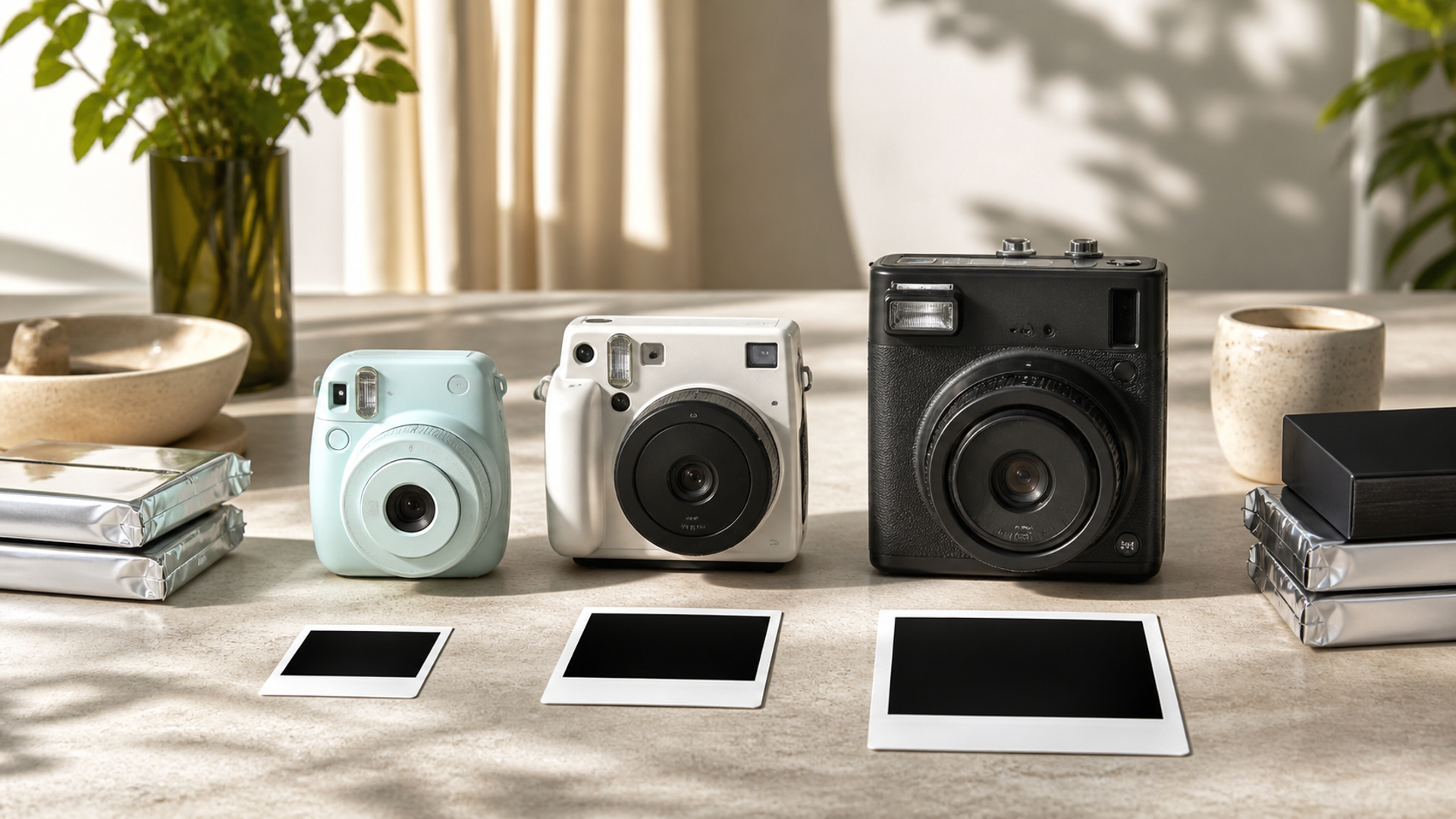
A Polaroid camera is a system, not a one-off device purchase. The body determines focus and exposure control, but the film determines image size, colour, development behaviour and the cost of every experiment. The best choice therefore starts with the photographs you want to make and the friction you are willing to accept after the first week.
Begin with the photograph you want
Choose a compact Go-format camera when physical size matters most, an i-Type autofocus camera when simple full-size pictures are the priority, or a control-led model when exposure decisions and a more deliberate workflow justify the higher body and film spend. Confirm film compatibility and current consumable pricing before committing.
| Decision factor | Compact Go system | Full-size autofocus system | Manual-control system |
|---|---|---|---|
| Picture format | Small prints and pocketable equipment are acceptable | Classic full-size instant prints are the objective | Full-size film is paired with creative exposure control |
| Focusing | Close framing is learned within a simpler system | Autofocus should remove most setup decisions | Focus method and distance are intentionally managed |
| Exposure | Automatic exposure is enough for casual daylight use | Reliable automatic exposure matters more than intervention | Manual or priority control is central to the work |
| Recurring cost | A lower-volume travel habit keeps film spend bounded | Regular full-size film purchases fit the budget | Testing and failed frames are accepted as part of the craft |
| Portability | The camera must fit a small bag | A normal instant-camera body is manageable | A larger body and protected carrying plan are acceptable |
| Workflow | Scan-and-share convenience is secondary | A straightforward social and family workflow is preferred | App or manual functions are worth learning and maintaining |
This best Polaroid camera matrix is the article's working value object. Read the best Polaroid camera rows together: the decisive failure mode depends on this topic's evidence, operating context and reader objective.
What the current camera evidence establishes
Evidence 1. Polaroid's current range uses more than one film format, so body-to-film compatibility must be confirmed rather than inferred from the brand name.
Evidence 2. The official support guidance distinguishes modern i-Type use from vintage 600 and SX-70 systems; a used-camera bargain can create a different film and battery decision.
Evidence 3. Current comparison guides separate small Go-format cameras from full-size autofocus and control-oriented bodies because size, handling and cost per image differ materially.
Evidence 4. Instant film is sensitive to storage and development conditions, making transport and use practice part of image quality rather than an accessory detail.
Reader-visible sources checked for this article:
support.polaroid.com — reader-visible current or official evidence
polaroid.com — reader-visible current or official evidence
tomsguide.com — reader-visible current or official evidence
digitalcameraworld.com — reader-visible current or official evidence
For best Polaroid camera, these sources establish only the claims inside their documented scope. Recheck every changeable specification, availability condition, price, policy or service term in the relevant market before acting.
Treat film as the recurring purchase
Read picture format as a stop/go test: small prints and pocketable equipment are acceptable supports the first option; classic full-size instant prints are the objective supports the second; and full-size film is paired with creative exposure control supports the third. Record which source proves the condition and when it was checked.
A buyer can resolve focusing without starting from a brand preference. Ask whether close framing is learned within a simpler system; compare that with whether autofocus should remove most setup decisions; then use focus method and distance are intentionally managed as the third route's safeguard. An unknown condition stays unknown.
On exposure, popularity is not enough. The evidence for option one is that automatic exposure is enough for casual daylight use. Option two means reliable automatic exposure matters more than intervention. Option three is rational where manual or priority control is central to the work. Recheck any changeable term immediately before commitment.
The decision changes at recurring cost. Choose the first path only if a lower-volume travel habit keeps film spend bounded; move to the second when regular full-size film purchases fit the budget; use the third when testing and failed frames are accepted as part of the craft. Save the downside that would make this row fail.
For portability, the first route works when the camera must fit a small bag; the second requires a normal instant-camera body is manageable. The control for the third is a larger body and protected carrying plan are acceptable. Verify this row against the exact product, property, account or environment before it can reverse the decision.
The workflow row exposes a practical boundary. Route one assumes scan-and-share convenience is secondary, while route two is defensible only when a straightforward social and family workflow is preferred. Route three depends on app or manual functions are worth learning and maintaining. If that evidence is absent, keep the more reversible option.
Facts that would reverse the current choice
Reversal control 1 — Picture format. Before choosing Compact Go system, write down how the decision changes if “Small prints and pocketable equipment are acceptable” proves false. Do the same for Full-size autofocus system and “Classic full-size instant prints are the objective”. Keep the Manual-control system route available until “Full-size film is paired with creative exposure control” is verified. This control belongs to best Polaroid camera; update it from the cited source or exact supplier rather than copying a generic checklist.
Reversal control 2 — Focusing. Before choosing Compact Go system, write down how the decision changes if “Close framing is learned within a simpler system” proves false. Do the same for Full-size autofocus system and “Autofocus should remove most setup decisions”. Keep the Manual-control system route available until “Focus method and distance are intentionally managed” is verified. This control belongs to best Polaroid camera; update it from the cited source or exact supplier rather than copying a generic checklist.
Reversal control 3 — Exposure. Before choosing Compact Go system, write down how the decision changes if “Automatic exposure is enough for casual daylight use” proves false. Do the same for Full-size autofocus system and “Reliable automatic exposure matters more than intervention”. Keep the Manual-control system route available until “Manual or priority control is central to the work” is verified. This control belongs to best Polaroid camera; update it from the cited source or exact supplier rather than copying a generic checklist.
Reversal control 4 — Recurring cost. Before choosing Compact Go system, write down how the decision changes if “A lower-volume travel habit keeps film spend bounded” proves false. Do the same for Full-size autofocus system and “Regular full-size film purchases fit the budget”. Keep the Manual-control system route available until “Testing and failed frames are accepted as part of the craft” is verified. This control belongs to best Polaroid camera; update it from the cited source or exact supplier rather than copying a generic checklist.
Reversal control 5 — Portability. Before choosing Compact Go system, write down how the decision changes if “The camera must fit a small bag” proves false. Do the same for Full-size autofocus system and “A normal instant-camera body is manageable”. Keep the Manual-control system route available until “A larger body and protected carrying plan are acceptable” is verified. This control belongs to best Polaroid camera; update it from the cited source or exact supplier rather than copying a generic checklist.
Reversal control 6 — Workflow. Before choosing Compact Go system, write down how the decision changes if “Scan-and-share convenience is secondary” proves false. Do the same for Full-size autofocus system and “A straightforward social and family workflow is preferred”. Keep the Manual-control system route available until “App or manual functions are worth learning and maintaining” is verified. This control belongs to best Polaroid camera; update it from the cited source or exact supplier rather than copying a generic checklist.
Price the next fifty photographs
Record the current local price and frame count for the exact film pack. Add a realistic failure allowance for learning, low light and group shots, then price fifty usable photographs rather than one camera. This calculation often changes the ranking more than a modest difference in body price. It also reveals whether a smaller format genuinely saves money or merely changes the look.
Separate autofocus from creative control
Autofocus reduces one class of missed picture, but it does not choose a flattering distance, control mixed light or manage motion for you. Decide whether the camera should behave like a social appliance or a photographic instrument. A control-led body is only better when the owner will use those controls and can tolerate slower setup.
Plan for film temperature and travel
Keep unopened film within the maker's storage guidance, allow it to reach operating temperature and protect developing pictures from inappropriate light and pressure. Travellers should count packs, check carry-on rules and avoid leaving film in hot cars. A small camera with poorly handled film is not a portable advantage.
Evaluate the used-camera route separately
Vintage bodies can be rewarding, but they introduce condition, rollers, seals, flash behaviour and film-compatibility checks. Test with a known pack, inspect ejection and look for uneven development before treating a used body as dependable. The used route belongs in its own budget with a repair or replacement allowance.
Three Polaroid buyer profiles
Travel journal
The Go system fits when the smallest credible kit and a high-carry rate matter more than classic print size. Define the fact that would reverse this recommendation before committing.
Family and event table
A full-size autofocus model works when several people will use it and the picture should feel immediately familiar. Define the fact that would reverse this recommendation before committing.
Deliberate portrait project
A control-led camera is justified when the photographer will meter, compose and repeat rather than expect every first frame to succeed. Define the fact that would reverse this recommendation before committing.
Action checklist
Choose the required print size.
Verify exact film compatibility.
Calculate cost for fifty frames.
Check minimum focus distance.
Compare flash and exposure controls.
Inspect app dependence.
Plan film storage.
Test the carrying case.
Confirm warranty or used-camera return rights.
Buy one film pack before bulk stock.
Continue the decision
The linked VERTU articles expand adjacent parts of the best Polaroid camera decision. They do not substitute for the external evidence above.
The practical Polaroid verdict
Choose a compact Go-format camera when physical size matters most, an i-Type autofocus camera when simple full-size pictures are the priority, or a control-led model when exposure decisions and a more deliberate workflow justify the higher body and film spend. Confirm film compatibility and current consumable pricing before committing.
Keep the best Polaroid camera decision reversible until its material cost, safety, access, privacy and compatibility facts are verified. Unknown evidence stays unknown; it is never silently scored as favourable.
![How to Scan Receipts and Documents with Your Phone [Full Guide]](https://cdn.sanity.io/images/e0gp1l2g/production/0db13feec1d5e72b8a8a5f976d1f3e86619c9228-3840x1860.webp?w=180&h=180&q=78&auto=format&fit=crop)
![How to Scan Receipts and Documents with Your Phone [Full Guide]](https://cdn.sanity.io/images/e0gp1l2g/production/0db13feec1d5e72b8a8a5f976d1f3e86619c9228-3840x1860.webp?w=800&h=450&q=82&auto=format&fit=crop)
![Top 10 Two-Tone Carbon-Fibre Watches for Men [2026 List]](https://cdn.sanity.io/images/e0gp1l2g/production/18870799ba33fab0e038968359cd5772d7d7db30-1024x576.webp?w=800&h=450&q=82&auto=format&fit=crop)
![Top 10 Luxury Watches with Digital Complication Displays for Men [Latest]](https://cdn.sanity.io/images/e0gp1l2g/production/c4f6bf8c080f291c39f7cc85c7344ecff2fd3799-1024x553.webp?w=800&h=450&q=82&auto=format&fit=crop)