

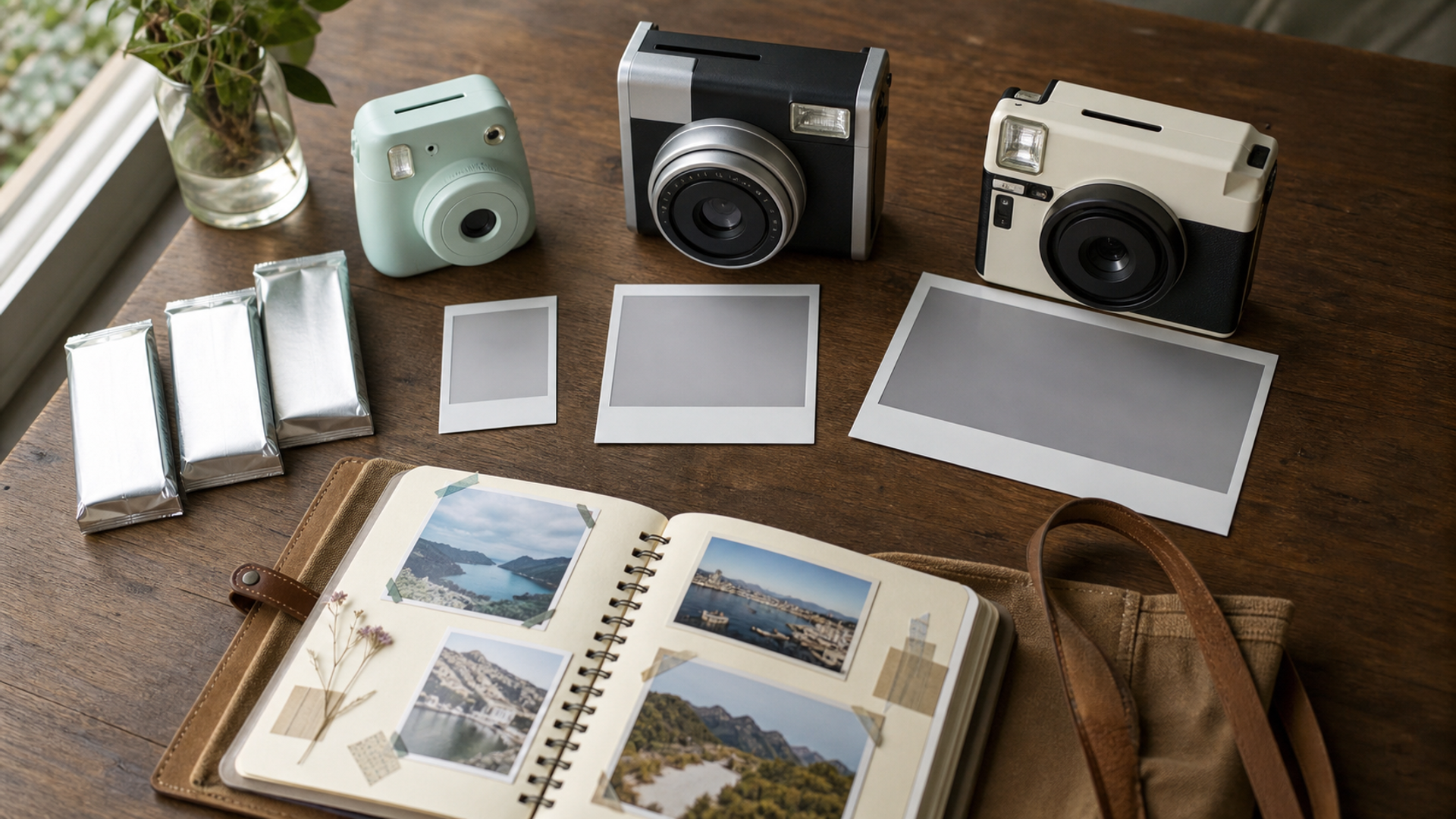
Instant cameras make a physical photograph at the moment of the event, but every shutter press consumes a fixed sheet of film. The best camera is therefore defined by print size, focus reliability, exposure control, flash behaviour and the cost of mistakes—not by the longest feature list.
Choose the print before the camera
Choose a simple mini-format camera for social events, a wider format when the physical print and group composition matter, or a hybrid digital-instant model when preview and selective printing justify more complexity. Price a year of film and test the minimum focus distance before choosing.
| Decision factor | Simple mini-format camera | Wide-format instant camera | Hybrid digital-instant camera |
|---|---|---|---|
| Small shareable prints are the goal | Larger groups and scenes need more area | Selected digital frames become prints | |
| Exposure | Automation keeps the event moving | The photographer accepts slower framing | Preview reduces costly exposure mistakes |
| Focus | Portrait and table distances dominate | Groups require deliberate subject distance | Digital review catches focus errors |
| Flash | Automatic flash is acceptable indoors | Fill behaviour is tested for the wider frame | Flash can be chosen after preview |
| Cost | Low camera cost and frequent film purchases fit | Higher film cost is reserved for key moments | Selective printing lowers waste but raises camera cost |
| Archive | The physical print is primary | Large prints are labelled and stored | Digital files create a second archive |
This best instant camera matrix is the article's working value object. Read the best instant camera rows together: the decisive failure mode depends on this topic's evidence, operating context and reader objective.
What current film and camera specifications prove
Evidence 1. Fujifilm's current instax mini 13 specifications define the lens, focusing range, exposure system, flash and film format for that exact model; the family name alone is not sufficient.
Evidence 2. The current instax mini 12 page describes automatic exposure and close-up operation, illustrating how simple instant cameras optimise speed rather than full manual control.
Evidence 3. Fujifilm's instax mini film data sheet gives the physical film and image dimensions, which should be compared with the desired way of sharing and archiving prints.
Evidence 4. Instant film develops chemically after ejection, so temperature, handling and the manufacturer's storage guidance can affect results; shaking or opening a film pack is not a recovery method.
Reader-visible sources checked for this article:
fujifilm.com — reader-visible current or official evidence
fujifilm.com — reader-visible current or official evidence
asset.fujifilm.com — reader-visible current or official evidence
fujifilm.com — reader-visible current or official evidence
For best instant camera, these sources establish only the claims inside their documented scope. Recheck every changeable specification, availability condition, price, policy or service term in the relevant market before acting.
Build a deliberate shooting workflow
The print row exposes a practical boundary. Route one assumes small shareable prints are the goal, while route two is defensible only when larger groups and scenes need more area. Route three depends on selected digital frames become prints. If that evidence is absent, keep the more reversible option.
Read exposure as a stop/go test: automation keeps the event moving supports the first option; the photographer accepts slower framing supports the second; and preview reduces costly exposure mistakes supports the third. Record which source proves the condition and when it was checked.
A buyer can resolve focus without starting from a brand preference. Ask whether portrait and table distances dominate; compare that with whether groups require deliberate subject distance; then use digital review catches focus errors as the third route's safeguard. An unknown condition stays unknown.
On flash, popularity is not enough. The evidence for option one is that automatic flash is acceptable indoors. Option two means fill behaviour is tested for the wider frame. Option three is rational where flash can be chosen after preview. Recheck any changeable term immediately before commitment.
The decision changes at cost. Choose the first path only if low camera cost and frequent film purchases fit; move to the second when higher film cost is reserved for key moments; use the third when selective printing lowers waste but raises camera cost. Save the downside that would make this row fail.
For archive, the first route works when the physical print is primary; the second requires large prints are labelled and stored. The control for the third is digital files create a second archive. Verify this row against the exact product, property, account or environment before it can reverse the decision.
Facts that would reverse the current choice
Reversal control 1 — Print. Before choosing Simple mini-format camera, write down how the decision changes if “Small shareable prints are the goal” proves false. Do the same for Wide-format instant camera and “Larger groups and scenes need more area”. Keep the Hybrid digital-instant camera route available until “Selected digital frames become prints” is verified. This control belongs to best instant camera; update it from the cited source or exact supplier rather than copying a generic checklist.
Reversal control 2 — Exposure. Before choosing Simple mini-format camera, write down how the decision changes if “Automation keeps the event moving” proves false. Do the same for Wide-format instant camera and “The photographer accepts slower framing”. Keep the Hybrid digital-instant camera route available until “Preview reduces costly exposure mistakes” is verified. This control belongs to best instant camera; update it from the cited source or exact supplier rather than copying a generic checklist.
Reversal control 3 — Focus. Before choosing Simple mini-format camera, write down how the decision changes if “Portrait and table distances dominate” proves false. Do the same for Wide-format instant camera and “Groups require deliberate subject distance”. Keep the Hybrid digital-instant camera route available until “Digital review catches focus errors” is verified. This control belongs to best instant camera; update it from the cited source or exact supplier rather than copying a generic checklist.
Reversal control 4 — Flash. Before choosing Simple mini-format camera, write down how the decision changes if “Automatic flash is acceptable indoors” proves false. Do the same for Wide-format instant camera and “Fill behaviour is tested for the wider frame”. Keep the Hybrid digital-instant camera route available until “Flash can be chosen after preview” is verified. This control belongs to best instant camera; update it from the cited source or exact supplier rather than copying a generic checklist.
Reversal control 5 — Cost. Before choosing Simple mini-format camera, write down how the decision changes if “Low camera cost and frequent film purchases fit” proves false. Do the same for Wide-format instant camera and “Higher film cost is reserved for key moments”. Keep the Hybrid digital-instant camera route available until “Selective printing lowers waste but raises camera cost” is verified. This control belongs to best instant camera; update it from the cited source or exact supplier rather than copying a generic checklist.
Reversal control 6 — Archive. Before choosing Simple mini-format camera, write down how the decision changes if “The physical print is primary” proves false. Do the same for Wide-format instant camera and “Large prints are labelled and stored”. Keep the Hybrid digital-instant camera route available until “Digital files create a second archive” is verified. This control belongs to best instant camera; update it from the cited source or exact supplier rather than copying a generic checklist.
Mock up the physical print
Cut paper to the exact outer and image dimensions of the candidate formats. Put it in a wallet, album and place setting. A larger frame can show groups and environments more clearly but takes more storage and costs more per press. A small print is easier to exchange and annotate. Choose the object before the electronics.
Measure focus distance and framing
Mark the minimum focus distance on the floor and practise portraits, pairs and groups. Close-up modes may correct framing differently from ordinary use, and viewfinders can show parallax at short distance. Leave space around important faces because the final frame may not match a phone screen's preview.
Test flash and ambient light
Instant cameras often use flash to keep indoor subjects visible. Photograph the same scene with a bright window, dim restaurant light and a reflective background. Watch for dark distant backgrounds, over-bright close faces and mirrors. A hybrid camera offers selection, but it cannot create detail the sensor never captured.
Calculate the cost of a year
Multiply film price by realistic packs per month and add batteries, case and album storage. Reserve a test sheet when lighting changes, then commit only after subjects are positioned. Buy film from reliable channels, observe expiry and temperature guidance, and keep unopened packs protected during travel.
Three instant-camera decisions
Wedding table and party
A simple mini camera keeps the interaction fast and produces easy-to-share prints. Define the fact that would reverse this recommendation before committing.
Travel groups and landscapes
Wide format earns its size when context and multiple faces matter. Define the fact that would reverse this recommendation before committing.
Selective creative archive
A hybrid camera fits when the owner values preview, effects and digital backup more than analogue simplicity. Define the fact that would reverse this recommendation before committing.
Action checklist
Mock up each print size.
Price twelve months of film.
Check minimum focus distance.
Test viewfinder parallax.
Test automatic flash indoors.
Compare group framing.
Confirm battery and charging route.
Plan film temperature during travel.
Choose album and labelling method.
Keep a test-shot rule for changing light.
Continue the decision
The linked VERTU articles expand adjacent parts of the best instant camera decision. They do not substitute for the external evidence above.
The instant-camera verdict
Choose a simple mini-format camera for social events, a wider format when the physical print and group composition matter, or a hybrid digital-instant model when preview and selective printing justify more complexity. Price a year of film and test the minimum focus distance before choosing.
Keep the best instant camera decision reversible until its material cost, safety, access, privacy and compatibility facts are verified. Unknown evidence stays unknown; it is never silently scored as favourable.
![How to Scan Receipts and Documents with Your Phone [Full Guide]](https://cdn.sanity.io/images/e0gp1l2g/production/0db13feec1d5e72b8a8a5f976d1f3e86619c9228-3840x1860.webp?w=180&h=180&q=78&auto=format&fit=crop)
![How to Scan Receipts and Documents with Your Phone [Full Guide]](https://cdn.sanity.io/images/e0gp1l2g/production/0db13feec1d5e72b8a8a5f976d1f3e86619c9228-3840x1860.webp?w=800&h=450&q=82&auto=format&fit=crop)
![Top 10 Two-Tone Carbon-Fibre Watches for Men [2026 List]](https://cdn.sanity.io/images/e0gp1l2g/production/18870799ba33fab0e038968359cd5772d7d7db30-1024x576.webp?w=800&h=450&q=82&auto=format&fit=crop)
![Top 10 Luxury Watches with Digital Complication Displays for Men [Latest]](https://cdn.sanity.io/images/e0gp1l2g/production/c4f6bf8c080f291c39f7cc85c7344ecff2fd3799-1024x553.webp?w=800&h=450&q=82&auto=format&fit=crop)