A home safe is a risk-management decision before it is a piece of furniture. The buyer must decide what needs protecting, how long it should remain accessible during a fire or break-in, who may open it, how it will be anchored and what happens if the primary code or key is lost. A beautiful safe that cannot fit the documents, cannot be fixed to the building or cannot be recovered without damaging access is a poor luxury purchase.
The short answer by protection objective
Choose a fire-focused document safe when papers and media are the main risk; choose a burglary-resistant anchored safe when valuables and attack time matter more; or choose a controlled-access safe with a clear recovery route when more than one trusted person needs entry. Verify the actual test claim, dimensions, anchoring method, battery and recovery process before buying.
| Decision factor | Document fire safe | Anchored burglary safe | Controlled-access safe |
|---|---|---|---|
| Main risk | Paper, passports or media need time | Valuables need delay against attack | Several trusted users need accountable access |
| Protection claim | The tested fire duration matches the contents | The tested resistance class is understood | The lock and audit behaviour are documented |
| Installation | Weight and location reduce movement | Anchoring is designed into floor or wall | Access works without exposing the room |
| Recovery | A key or code backup is protected | A manufacturer route is available | A named administrator can recover access |
| Capacity | Documents fit flat and dry | Valuables do not force the door | Separate users and items remain organised |
| Household use | Few openings are required | The safe stays discreet | Every user has a bounded role |
This best home safe 2026 matrix is the article's working value object. Read the best home safe 2026 rows together: the decisive failure mode depends on this topic's evidence, operating context and reader objective.
What the label and installation must prove
Evidence 1. UL describes safe and strongroom testing as an evaluation of security performance; buyers should read the actual standard, test scope and rating instead of treating a marketing phrase such as 'fireproof' as a universal result.
Evidence 2. NFPA's home-fire guidance reinforces the need for prevention and preparedness; a safe is one layer of protection and does not replace alarms, evacuation planning or a sensible location.
Evidence 3. A fire rating applies to a defined test condition and time, and the protection of paper, digital media, jewellery or photographs may differ; match the claim to the material being stored.
Evidence 4. Electronic locks introduce batteries, codes and recovery procedures, while mechanical locks introduce keys and service needs; either can be appropriate when the failure path is known and controlled.
Reader-visible sources checked for this article:
ready.gov — reader-visible current or official evidence
nfpa.org — reader-visible current or official evidence
For best home safe 2026, these sources establish only the claims inside their documented scope. Recheck every changeable specification, availability condition, price, policy or service term in the relevant market before acting.
Plan access, recovery and the room
For main risk, the first route works when paper, passports or media need time; the second requires valuables need delay against attack. The control for the third is several trusted users need accountable access. Verify this row against the exact product, property, account or environment before it can reverse the decision.
The protection claim row exposes a practical boundary. Route one assumes the tested fire duration matches the contents, while route two is defensible only when the tested resistance class is understood. Route three depends on the lock and audit behaviour are documented. If that evidence is absent, keep the more reversible option.
Read installation as a stop/go test: weight and location reduce movement supports the first option; anchoring is designed into floor or wall supports the second; and access works without exposing the room supports the third. Record which source proves the condition and when it was checked.
A buyer can resolve recovery without starting from a brand preference. Ask whether a key or code backup is protected; compare that with whether a manufacturer route is available; then use a named administrator can recover access as the third route's safeguard. An unknown condition stays unknown.
On capacity, popularity is not enough. The evidence for option one is that documents fit flat and dry. Option two means valuables do not force the door. Option three is rational where separate users and items remain organised. Recheck any changeable term immediately before commitment.
The decision changes at household use. Choose the first path only if few openings are required; move to the second when the safe stays discreet; use the third when every user has a bounded role. Save the downside that would make this row fail.
Facts that would reverse the current choice
Reversal control 1 — Main risk. Before choosing Document fire safe, write down how the decision changes if “Paper, passports or media need time” proves false. Do the same for Anchored burglary safe and “Valuables need delay against attack”. Keep the Controlled-access safe route available until “Several trusted users need accountable access” is verified. This control belongs to best home safe 2026; update it from the cited source or exact supplier rather than copying a generic checklist.
Reversal control 2 — Protection claim. Before choosing Document fire safe, write down how the decision changes if “The tested fire duration matches the contents” proves false. Do the same for Anchored burglary safe and “The tested resistance class is understood”. Keep the Controlled-access safe route available until “The lock and audit behaviour are documented” is verified. This control belongs to best home safe 2026; update it from the cited source or exact supplier rather than copying a generic checklist.
Reversal control 3 — Installation. Before choosing Document fire safe, write down how the decision changes if “Weight and location reduce movement” proves false. Do the same for Anchored burglary safe and “Anchoring is designed into floor or wall”. Keep the Controlled-access safe route available until “Access works without exposing the room” is verified. This control belongs to best home safe 2026; update it from the cited source or exact supplier rather than copying a generic checklist.
Reversal control 4 — Recovery. Before choosing Document fire safe, write down how the decision changes if “A key or code backup is protected” proves false. Do the same for Anchored burglary safe and “A manufacturer route is available”. Keep the Controlled-access safe route available until “A named administrator can recover access” is verified. This control belongs to best home safe 2026; update it from the cited source or exact supplier rather than copying a generic checklist.
Reversal control 5 — Capacity. Before choosing Document fire safe, write down how the decision changes if “Documents fit flat and dry” proves false. Do the same for Anchored burglary safe and “Valuables do not force the door”. Keep the Controlled-access safe route available until “Separate users and items remain organised” is verified. This control belongs to best home safe 2026; update it from the cited source or exact supplier rather than copying a generic checklist.
Reversal control 6 — Household use. Before choosing Document fire safe, write down how the decision changes if “Few openings are required” proves false. Do the same for Anchored burglary safe and “The safe stays discreet”. Keep the Controlled-access safe route available until “Every user has a bounded role” is verified. This control belongs to best home safe 2026; update it from the cited source or exact supplier rather than copying a generic checklist.
Buy the protection claim, not the adjective
Start with the contents and the failure event. Paper needs a different internal environment from jewellery, a drive or a watch. Ask what the rating was tested to protect, for how long and under what conditions. If the seller cannot show the test scope or the rating applies only to a marketing category, treat the claim as incomplete. Do not store the only copy of a recovery key inside the safe, and do not assume a heavier body automatically provides a relevant fire or attack rating.
Installation is part of the lock
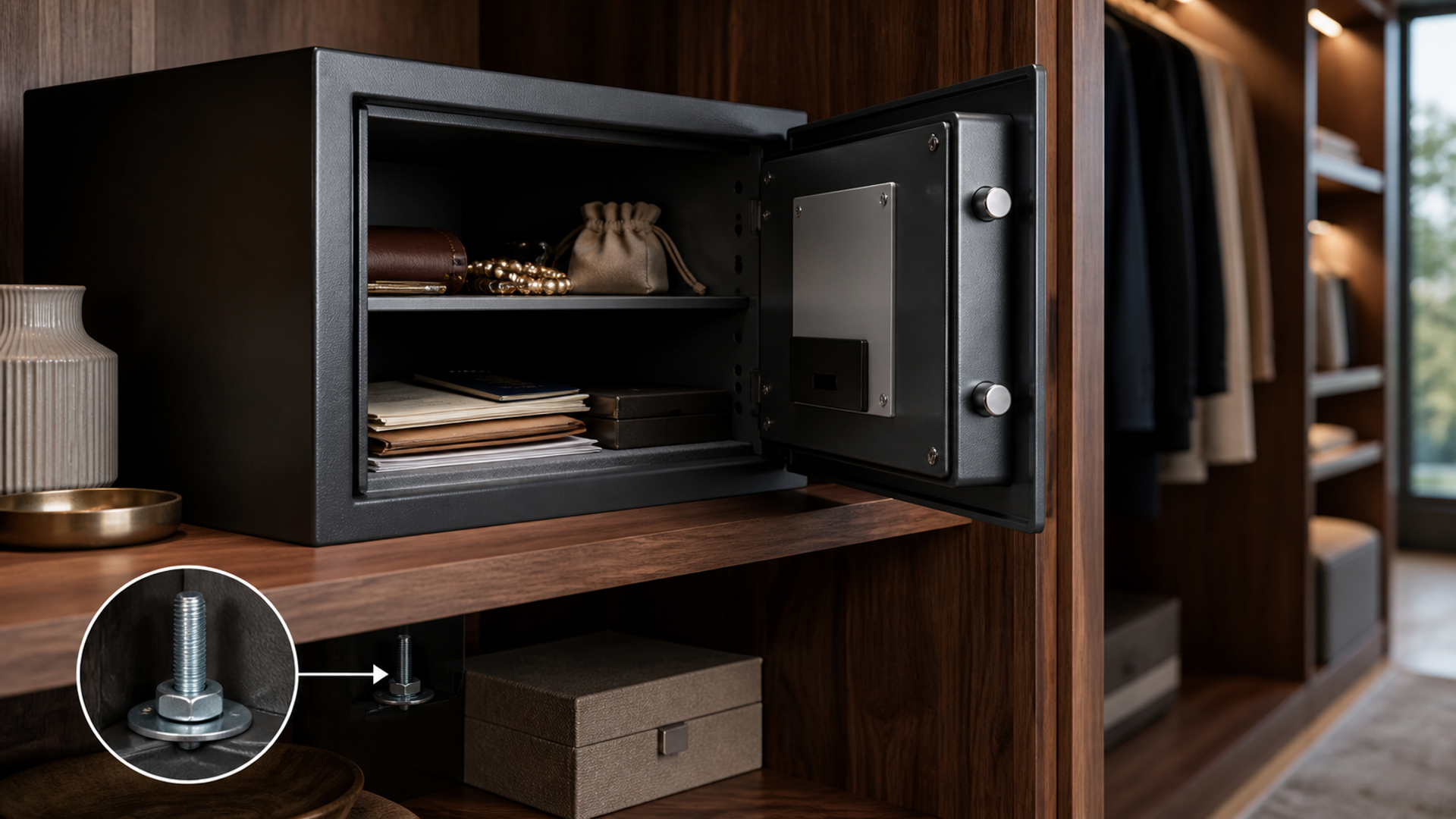
A safe that can be carried away changes the problem. Check the floor, wall, joists, door swing and building rules before ordering. Anchoring should follow the manufacturer's instructions and a qualified installer where the structure or utilities make DIY risky. The location should stay discreet while remaining reachable in an emergency. Photograph the installation, retain the documentation and ensure the anchor does not create a new trip, moisture or access hazard. A concealed safe is not useful if the people who need it cannot open the room or reach it safely.
Write the recovery rule before setting the code
Every safe needs a path for a forgotten code, a flat battery, a damaged keypad and a change in household responsibility. Decide who may recover access and where the backup key, battery or administrator record lives. Do not leave an override key taped to the cabinet or write the primary code in an obvious drawer. For a shared household, use separate roles where supported, review access after staff or tenants change and remove a temporary user immediately rather than trusting memory.
Keep a small inventory outside the safe
The safe protects objects, but the owner still needs a record of what is stored, why it matters and what evidence is needed for insurance or replacement. Keep an encrypted inventory or a secure paper record in a separate location, without publishing serial numbers or full personal details in an open cloud folder. Review humidity, batteries and contents on a calendar. A safe is a long-term system: the wrong size, an untested lock or an undocumented key becomes harder to correct after the purchase has disappeared into a wall or cabinet.
Three household situations that change the choice
The document-heavy home
A tested fire-focused safe is more relevant when passports, deeds and paper records are the primary concern. Define the fact that would reverse this recommendation before committing.
The jewellery and watch collector
An anchored burglary-focused safe is defensible when delay, discretion and controlled installation matter more than flat document storage. Define the fact that would reverse this recommendation before committing.
The staffed residence
A controlled-access safe can be useful when roles, recovery, access logs and removal are clearly managed. Define the fact that would reverse this recommendation before committing.
Action checklist
List the contents and the failure event that matters.
Read the exact fire or security test claim.
Confirm interior dimensions and shelf fit.
Plan anchoring with the building structure.
Choose a discreet but reachable location.
Document code, key and battery recovery.
Assign household or staff roles.
Keep an inventory and insurance record separately.
Inspect batteries, humidity and contents on a schedule.
Retain installation and service documentation.
Continue the decision
The linked VERTU articles expand adjacent parts of the best home safe 2026 decision. They do not substitute for the external evidence above.
The home-safe verdict
Choose a fire-focused document safe when papers and media are the main risk; choose a burglary-resistant anchored safe when valuables and attack time matter more; or choose a controlled-access safe with a clear recovery route when more than one trusted person needs entry. Verify the actual test claim, dimensions, anchoring method, battery and recovery process before buying.
Keep the best home safe 2026 decision reversible until its material cost, safety, access, privacy and compatibility facts are verified. Unknown evidence stays unknown; it is never silently scored as favourable.