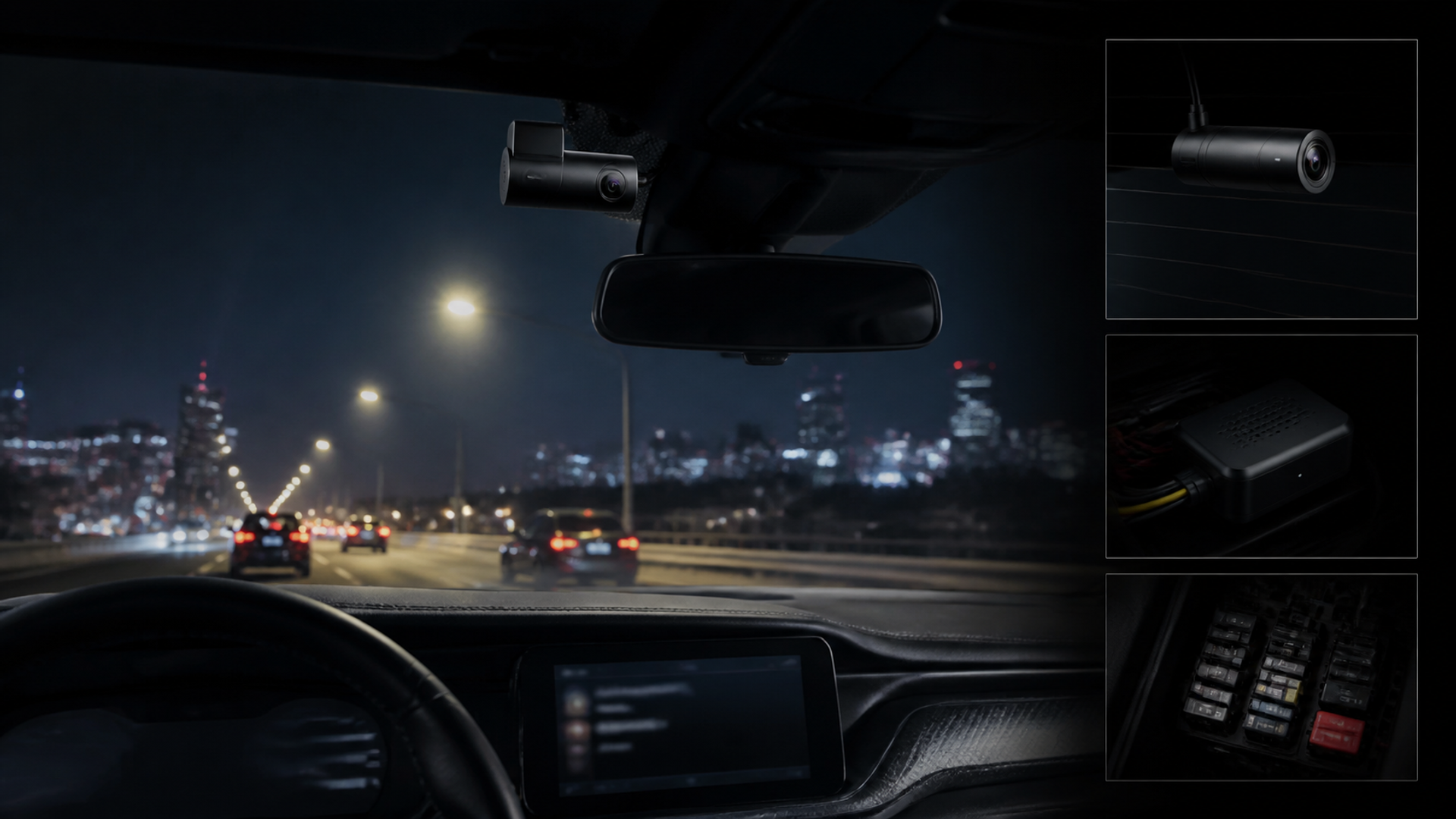
A dash cam earns its place only when it preserves useful evidence without obstructing the driver, draining the battery or creating an avoidable privacy problem. Resolution matters, but plate capture depends just as much on exposure, shutter behaviour, lens position, compression and the distance to the vehicle ahead. The best 2026 choice is therefore an installation decision before it is a camera decision.
The short answer by driving pattern
Choose a compact single-channel camera when discretion and simple incident evidence matter most; a front-and-rear system when rear impacts and road context justify more wiring; or a connected parking system only when remote access, subscription terms and a professionally designed power strategy are acceptable. Test footage in your own car by day and night before trusting any headline specification.
| Decision factor | Compact front camera | Front-and-rear system | Connected parking system |
|---|---|---|---|
| Primary evidence need | Forward incidents dominate | Rear context materially changes claims | Remote parking alerts justify complexity |
| Power strategy | Ignition power is sufficient | Hardwire kit supports both channels | Dedicated battery or controlled hardwire is specified |
| Privacy exposure | Local removable storage is preferred | Two viewpoints remain proportionate | Cloud access and account security are accepted |
| Heat and cabin fit | Small body clears sensors and mirror | Cable route and rear glass suit installation | Modem and parking hardware tolerate the environment |
| Storage workflow | Important clips are exported manually | Larger card and overwrite plan are maintained | Subscription retention is understood |
| Legal and visual field | Local recording rules are checked | Passenger and rear-window issues are checked | Remote viewing and audio rules are checked |
This best dash cams 2026 matrix is the article's working value object. Read the best dash cams 2026 rows together: the decisive failure mode depends on this topic's evidence, operating context and reader objective.
What makes footage useful rather than merely sharp
Evidence 1. Garmin's current Dash Cam X310 page describes 4K capture, a 140-degree field of view and a polarising element, while warning that drivers remain responsible for compliance with local privacy and use rules.
Evidence 2. Garmin's manual states that cloud Vault and remote network functions require compatible connectivity and, for some functions, a paid subscription; this makes recurring cost part of the ownership calculation.
Evidence 3. BlackVue's DR970X manual documents separate front-only and two-channel configurations, installation positioning and recording-time differences by card capacity and image-quality setting.
Evidence 4. The UK Information Commissioner's Office explains that domestic camera users should consider whether recording is necessary and proportionate, particularly when images extend beyond private property; road-camera rules vary by jurisdiction.
Reader-visible sources checked for this article:
garmin.com — reader-visible current or official evidence
www8.garmin.com — reader-visible current or official evidence
manual.blackvue.com — reader-visible current or official evidence
ico.org.uk — reader-visible current or official evidence
For best dash cams 2026, these sources establish only the claims inside their documented scope. Recheck every changeable specification, availability condition, price, policy or service term in the relevant market before acting.
Design the installation before choosing the camera
The primary evidence need row exposes a practical boundary. Route one assumes forward incidents dominate, while route two is defensible only when rear context materially changes claims. Route three depends on remote parking alerts justify complexity. If that evidence is absent, keep the more reversible option.
Read power strategy as a stop/go test: ignition power is sufficient supports the first option; hardwire kit supports both channels supports the second; and dedicated battery or controlled hardwire is specified supports the third. Record which source proves the condition and when it was checked.
A buyer can resolve privacy exposure without starting from a brand preference. Ask whether local removable storage is preferred; compare that with whether two viewpoints remain proportionate; then use cloud access and account security are accepted as the third route's safeguard. An unknown condition stays unknown.
On heat and cabin fit, popularity is not enough. The evidence for option one is that small body clears sensors and mirror. Option two means cable route and rear glass suit installation. Option three is rational where modem and parking hardware tolerate the environment. Recheck any changeable term immediately before commitment.
The decision changes at storage workflow. Choose the first path only if important clips are exported manually; move to the second when larger card and overwrite plan are maintained; use the third when subscription retention is understood. Save the downside that would make this row fail.
For legal and visual field, the first route works when local recording rules are checked; the second requires passenger and rear-window issues are checked. The control for the third is remote viewing and audio rules are checked. Verify this row against the exact product, property, account or environment before it can reverse the decision.
Facts that would reverse the current choice
Reversal control 1 — Primary evidence need. Before choosing Compact front camera, write down how the decision changes if “Forward incidents dominate” proves false. Do the same for Front-and-rear system and “Rear context materially changes claims”. Keep the Connected parking system route available until “Remote parking alerts justify complexity” is verified. This control belongs to best dash cams 2026; update it from the cited source or exact supplier rather than copying a generic checklist.
Reversal control 2 — Power strategy. Before choosing Compact front camera, write down how the decision changes if “Ignition power is sufficient” proves false. Do the same for Front-and-rear system and “Hardwire kit supports both channels”. Keep the Connected parking system route available until “Dedicated battery or controlled hardwire is specified” is verified. This control belongs to best dash cams 2026; update it from the cited source or exact supplier rather than copying a generic checklist.
Reversal control 3 — Privacy exposure. Before choosing Compact front camera, write down how the decision changes if “Local removable storage is preferred” proves false. Do the same for Front-and-rear system and “Two viewpoints remain proportionate”. Keep the Connected parking system route available until “Cloud access and account security are accepted” is verified. This control belongs to best dash cams 2026; update it from the cited source or exact supplier rather than copying a generic checklist.
Reversal control 4 — Heat and cabin fit. Before choosing Compact front camera, write down how the decision changes if “Small body clears sensors and mirror” proves false. Do the same for Front-and-rear system and “Cable route and rear glass suit installation”. Keep the Connected parking system route available until “Modem and parking hardware tolerate the environment” is verified. This control belongs to best dash cams 2026; update it from the cited source or exact supplier rather than copying a generic checklist.
Reversal control 5 — Storage workflow. Before choosing Compact front camera, write down how the decision changes if “Important clips are exported manually” proves false. Do the same for Front-and-rear system and “Larger card and overwrite plan are maintained”. Keep the Connected parking system route available until “Subscription retention is understood” is verified. This control belongs to best dash cams 2026; update it from the cited source or exact supplier rather than copying a generic checklist.
Reversal control 6 — Legal and visual field. Before choosing Compact front camera, write down how the decision changes if “Local recording rules are checked” proves false. Do the same for Front-and-rear system and “Passenger and rear-window issues are checked”. Keep the Connected parking system route available until “Remote viewing and audio rules are checked” is verified. This control belongs to best dash cams 2026; update it from the cited source or exact supplier rather than copying a generic checklist.
Test the evidence chain, not the showroom clip
Record the same plate while stationary, approaching, passing and driving at night. Export the original file rather than judging a compressed phone preview. Check whether date, time and location metadata are correct, how incident locking works and whether an overwritten card can erase an event before export. A higher pixel count cannot compensate for glare, motion blur or a lens hidden behind a tinted band. Keep one known-good card, replace worn media on a schedule and practise retrieving a clip before an incident creates pressure.
Engineer parking mode around the battery
Parking surveillance can be useful, but it changes the electrical design. Confirm the camera's cut-off controls, vehicle battery type, expected parked duration and whether an auxiliary battery is appropriate. A low-voltage cut-off is not a promise that every vehicle will start after a long stay. Professional installation matters on complex electrical systems, and any cable or module must remain clear of airbags, sensors and service access. If the car spends days at an airport, a simpler motion strategy may be safer than continuous recording.
Treat connected features as an account-security surface
Remote view, location alerts and automatic uploads can help when a vehicle is parked away from home. They also create credentials, subscriptions, retention settings and another copy of location history. Use a unique account password, strong multifactor authentication where offered, and the narrowest sharing setting. Decide who may view the feed, how access is revoked after a sale and whether audio is disabled. A local-only camera is often the more private answer when live access has no defined use case.
Make installation reversible and serviceable
Place the lens within the lawful swept area without reducing the driver's view. Confirm the adhesive surface, camera removal method, cable slack and rear-hatch movement. Photograph the route before trim is closed and retain the installer invoice. Check the footage after windscreen replacement, software updates and seasonal temperature changes. A neat, documented installation protects evidence quality and makes it easier to diagnose rattles, battery drain or a camera that has shifted by a few degrees.
Three driving situations that change the recommendation
The city executive car
A compact front camera can be sufficient where short urban trips, frequent valet use and privacy favour local storage and minimal cabin hardware. Define the fact that would reverse this recommendation before committing.
The motorway family SUV
A front-and-rear system is more defensible when rear impacts, towing or long motorway mileage make a second viewpoint materially useful. Define the fact that would reverse this recommendation before committing.
The airport-parked vehicle
A connected parking system makes sense only after power duration, mobile coverage, subscription and account access have been tested for the actual car park. Define the fact that would reverse this recommendation before committing.
Action checklist
Check local windscreen, audio and privacy rules.
Record sample day and night footage in the actual vehicle.
Confirm front and rear field of view.
Specify ignition, hardwire or auxiliary-battery power.
Check low-voltage cut-off behaviour.
Choose endurance-rated storage and replacement interval.
Test export of an original incident file.
Secure cloud accounts and review retention.
Document cable routing around airbags and sensors.
Recheck alignment after service or windscreen work.
Continue the decision
The linked VERTU articles expand adjacent parts of the best dash cams 2026 decision. They do not substitute for the external evidence above.
The dash-cam verdict
Choose a compact single-channel camera when discretion and simple incident evidence matter most; a front-and-rear system when rear impacts and road context justify more wiring; or a connected parking system only when remote access, subscription terms and a professionally designed power strategy are acceptable. Test footage in your own car by day and night before trusting any headline specification.
Keep the best dash cams 2026 decision reversible until its material cost, safety, access, privacy and compatibility facts are verified. Unknown evidence stays unknown; it is never silently scored as favourable.