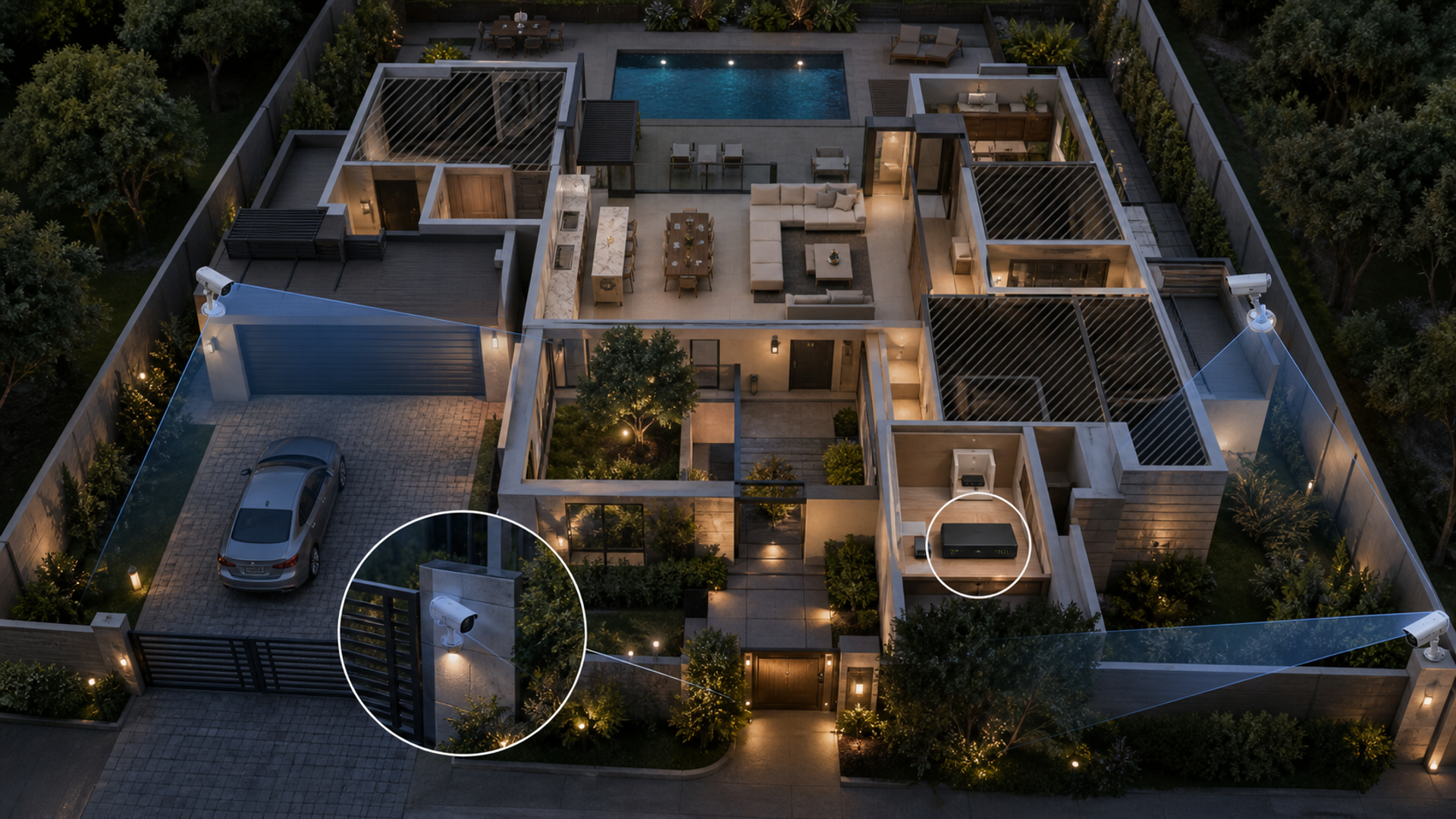
A security camera is useful only when it covers a defined risk and produces evidence the household can retrieve under pressure. Adding cameras without a property plan often creates blind spots, excessive alerts and unnecessary recordings of family, staff or neighbours. The best 2026 system starts with zones, retention and access rules before choosing resolution or an app ecosystem.
The short answer by property risk
Use local-recording cameras for predictable retention and tighter control, cloud-connected cameras when remote resilience and managed access justify subscription and data exposure, or a hybrid design when critical zones need local evidence plus selected remote alerts. Cover entrances and approach paths first; avoid using interior cameras where less intrusive sensors solve the same problem.
| Decision factor | Local recording | Cloud recording | Hybrid architecture |
|---|---|---|---|
| Primary objective | Private on-site evidence dominates | Remote access and managed retention dominate | Critical zones need both paths |
| Connectivity failure | Recording continues locally | Camera fallback is verified | Local path survives while alerts may degrade |
| Account exposure | Few external accounts are preferred | Strong account controls are maintained | Access is separated by zone and role |
| Retention | Storage capacity is sized and monitored | Subscription window meets evidence need | Important clips can move between tiers |
| Maintenance | Recorder, drives and updates are owned | Provider lifecycle is accepted | Both local and cloud components are tested |
| Privacy | Interior recording is minimised | Sharing and cloud regions are reviewed | Private zones remain local where possible |
This best home security cameras 2026 matrix is the article's working value object. Read the best home security cameras 2026 rows together: the decisive failure mode depends on this topic's evidence, operating context and reader objective.
Define evidence, retention and access
Evidence 1. NIST's Privacy Framework provides a way to identify, govern, control, communicate and protect privacy risk rather than treating camera privacy as one product switch.
Evidence 2. CISA's consumer guidance emphasises strong credentials, multifactor authentication and software updates for connected devices; camera accounts are part of the security perimeter.
Evidence 3. Storage duration depends on bitrate, number of cameras, recording schedule and capacity, so a nominal drive size or cloud plan must be converted into the property's actual retention window.
Evidence 4. Camera placement can record beyond the property boundary or capture workers and visitors; applicable privacy, labour and surveillance rules vary by jurisdiction and use.
Reader-visible sources checked for this article:
nist.gov — reader-visible current or official evidence
cisa.gov — reader-visible current or official evidence
ico.org.uk — reader-visible current or official evidence
ftc.gov — reader-visible current or official evidence
For best home security cameras 2026, these sources establish only the claims inside their documented scope. Recheck every changeable specification, availability condition, price, policy or service term in the relevant market before acting.
Draw every field of view before installation
The primary objective row exposes a practical boundary. Route one assumes private on-site evidence dominates, while route two is defensible only when remote access and managed retention dominate. Route three depends on critical zones need both paths. If that evidence is absent, keep the more reversible option.
Read connectivity failure as a stop/go test: recording continues locally supports the first option; camera fallback is verified supports the second; and local path survives while alerts may degrade supports the third. Record which source proves the condition and when it was checked.
A buyer can resolve account exposure without starting from a brand preference. Ask whether few external accounts are preferred; compare that with whether strong account controls are maintained; then use access is separated by zone and role as the third route's safeguard. An unknown condition stays unknown.
On retention, popularity is not enough. The evidence for option one is that storage capacity is sized and monitored. Option two means subscription window meets evidence need. Option three is rational where important clips can move between tiers. Recheck any changeable term immediately before commitment.
The decision changes at maintenance. Choose the first path only if recorder, drives and updates are owned; move to the second when provider lifecycle is accepted; use the third when both local and cloud components are tested. Save the downside that would make this row fail.
For privacy, the first route works when interior recording is minimised; the second requires sharing and cloud regions are reviewed. The control for the third is private zones remain local where possible. Verify this row against the exact product, property, account or environment before it can reverse the decision.
Facts that would reverse the current choice
Reversal control 1 — Primary objective. Before choosing Local recording, write down how the decision changes if “Private on-site evidence dominates” proves false. Do the same for Cloud recording and “Remote access and managed retention dominate”. Keep the Hybrid architecture route available until “Critical zones need both paths” is verified. This control belongs to best home security cameras 2026; update it from the cited source or exact supplier rather than copying a generic checklist.
Reversal control 2 — Connectivity failure. Before choosing Local recording, write down how the decision changes if “Recording continues locally” proves false. Do the same for Cloud recording and “Camera fallback is verified”. Keep the Hybrid architecture route available until “Local path survives while alerts may degrade” is verified. This control belongs to best home security cameras 2026; update it from the cited source or exact supplier rather than copying a generic checklist.
Reversal control 3 — Account exposure. Before choosing Local recording, write down how the decision changes if “Few external accounts are preferred” proves false. Do the same for Cloud recording and “Strong account controls are maintained”. Keep the Hybrid architecture route available until “Access is separated by zone and role” is verified. This control belongs to best home security cameras 2026; update it from the cited source or exact supplier rather than copying a generic checklist.
Reversal control 4 — Retention. Before choosing Local recording, write down how the decision changes if “Storage capacity is sized and monitored” proves false. Do the same for Cloud recording and “Subscription window meets evidence need”. Keep the Hybrid architecture route available until “Important clips can move between tiers” is verified. This control belongs to best home security cameras 2026; update it from the cited source or exact supplier rather than copying a generic checklist.
Reversal control 5 — Maintenance. Before choosing Local recording, write down how the decision changes if “Recorder, drives and updates are owned” proves false. Do the same for Cloud recording and “Provider lifecycle is accepted”. Keep the Hybrid architecture route available until “Both local and cloud components are tested” is verified. This control belongs to best home security cameras 2026; update it from the cited source or exact supplier rather than copying a generic checklist.
Reversal control 6 — Privacy. Before choosing Local recording, write down how the decision changes if “Interior recording is minimised” proves false. Do the same for Cloud recording and “Sharing and cloud regions are reviewed”. Keep the Hybrid architecture route available until “Private zones remain local where possible” is verified. This control belongs to best home security cameras 2026; update it from the cited source or exact supplier rather than copying a generic checklist.
Write an evidence requirement for each zone
For every gate, door, driveway, corridor or valuables room, state the event to detect and the detail required afterwards. A wide overview may prove movement but not identity; a tight face view may miss the route. Combine lighting, angle and height with the camera rather than expecting digital zoom to recover absent detail. Test with real people at day and night and remove any camera that cannot answer a defined question.
Calculate retention from real recording conditions
Record bitrate for each chosen mode, expected motion frequency and continuous-recording zones. Convert those values into daily storage and leave safety margin for firmware changes. Decide who may export footage and how an incident is preserved before overwrite. If cloud retention is contractual, confirm what happens after cancellation or service outage. Keep the system clock and time zone correct so clips can be reconciled with alarms, access logs and police reports.
Design least-privilege access
Create named accounts instead of shared passwords, enable multifactor authentication where supported and separate installer access from household viewing. Review mobile-device permissions and remove former staff or contractors promptly. Remote sharing links should expire. For high-sensitivity interior zones, ask whether door, glass or presence sensors provide the required alert without continuous video. Privacy minimisation can improve security by reducing the amount of valuable household data available to steal.
Test failure states every quarter
Disconnect internet while confirming local recording, remove power if backup is expected, trigger a night event and export a clip. Check camera obstruction, spider webs, glare, plant growth and clock accuracy. Verify that notifications reach the correct people without exposing sensitive preview images on lock screens. Document serials, firmware, network segment and replacement procedure. A system is not operational merely because every camera appears online in one app view.
Three properties that need different systems
The city apartment
A small local or hybrid system covering the entrance can provide useful evidence without placing cameras throughout private living areas. Define the fact that would reverse this recommendation before committing.
The detached family home
A hybrid design can keep continuous perimeter evidence locally while sending selected intrusion alerts to authorised phones. Define the fact that would reverse this recommendation before committing.
The multi-residence household
Cloud management may simplify remote health checks, but named roles, regional data handling, installer separation and local outage recording become essential. Define the fact that would reverse this recommendation before committing.
Action checklist
Map risks and required evidence by zone.
Test fields of view with real people.
Check local surveillance and worker rules.
Calculate retention from bitrate and schedule.
Choose local, cloud or hybrid failure behaviour.
Use named accounts and multifactor authentication.
Segment cameras from sensitive devices.
Test night lighting and backlight.
Export a clip before an incident.
Run quarterly power, internet and obstruction tests.
Continue the decision
The linked VERTU articles expand adjacent parts of the best home security cameras 2026 decision. They do not substitute for the external evidence above.
The camera-system verdict
Use local-recording cameras for predictable retention and tighter control, cloud-connected cameras when remote resilience and managed access justify subscription and data exposure, or a hybrid design when critical zones need local evidence plus selected remote alerts. Cover entrances and approach paths first; avoid using interior cameras where less intrusive sensors solve the same problem.
Keep the best home security cameras 2026 decision reversible until its material cost, safety, access, privacy and compatibility facts are verified. Unknown evidence stays unknown; it is never silently scored as favourable.