

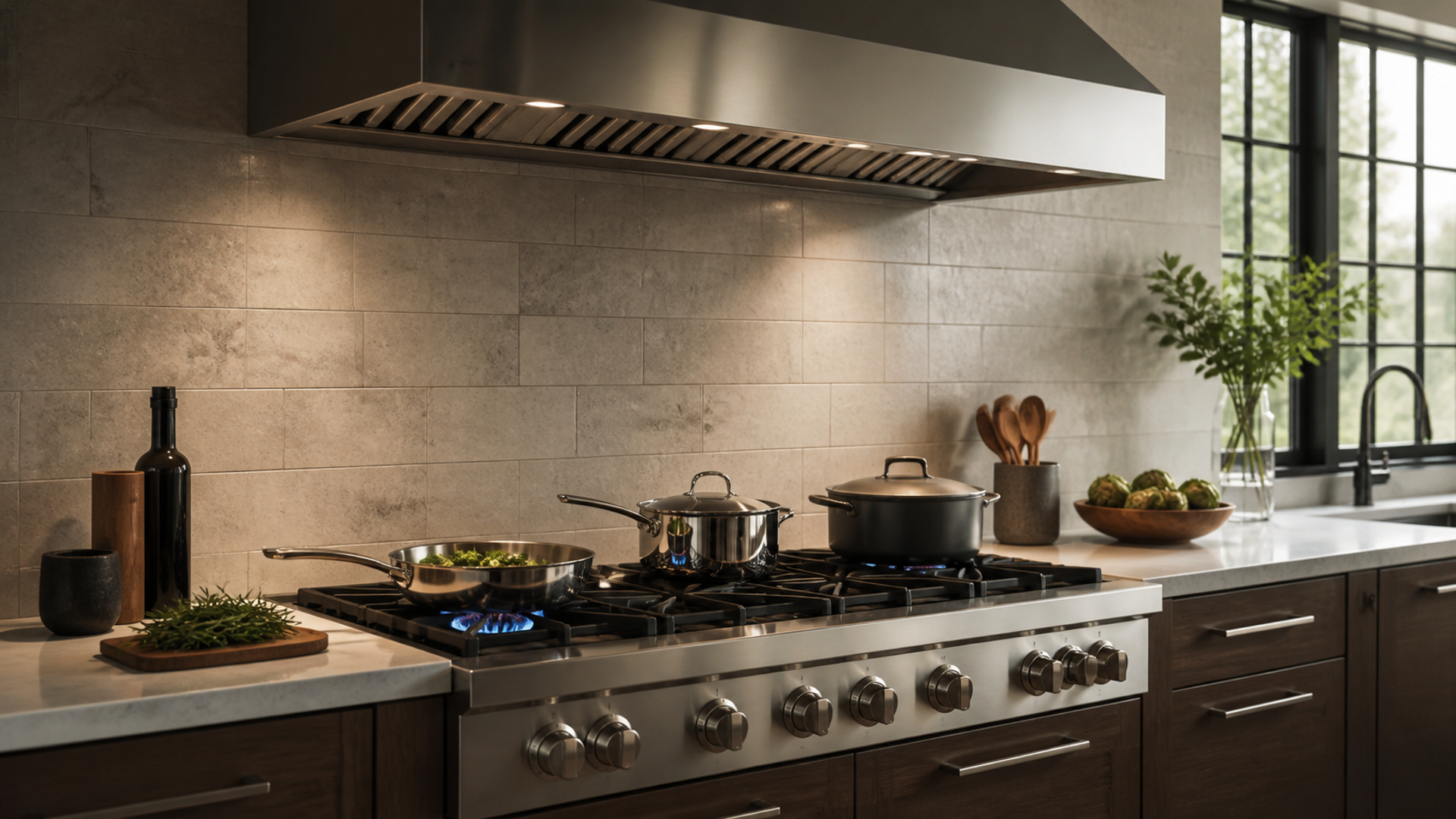
A gas range is not just a row of burner power figures. It is a combustion appliance, an oven, a control interface and an installation that depends on fuel supply and ventilation. The useful evaluation is how precisely the burners handle real cookware, how evenly the oven performs, whether the hood captures cooking emissions and whether qualified local service exists. A statement-style chassis cannot compensate for poor control or an unsuitable room.
Start with installation and ventilation
Choose a gas range only after confirming a compliant installation, effective venting and the household's actual cooking pattern. Test low simmer, pan spacing, ignition and control feel; verify oven temperature behaviour and cleaning access; then confirm clearances, fuel type, conversion rules and local service. If ventilation or installation cannot be solved well, compare induction rather than forcing a gas appliance into the space.
| Decision factor | Control-led everyday range | High-output cooking system | Oven-led or alternative-fuel route |
|---|---|---|---|
| Fuel and installation | Existing compliant supply and clearances are verified | Supply and exhaust support sustained high heat | Induction or dual fuel remains open if constraints fail |
| Low simmer | Small burner holds gentle heat reliably | High-output burners still offer control range | Oven priority can outweigh gas-burner preference |
| Pan spacing | Daily pans fit without handle conflict | Large cookware has stable dedicated positions | Alternative layout solves crowding better |
| Oven | Routine roasting and baking are consistent | Large meals fit usable rack positions | Separate or electric oven performance leads |
| Ventilation | Capture hood matches normal cooking | Duct and make-up air support heavier plume | Unsuitable venting vetoes gas |
| Cleaning | Caps, grates and spill paths are accessible | Heavy grates remain manageable | Smooth alternative surface may fit routine better |
| Service | Ignition and parts support are local | Professional-style complexity has qualified labour | Simpler alternative wins if service is weak |
This best gas range matrix is the article's working value object. Read the best gas range rows together: the decisive failure mode depends on this topic's evidence, operating context and reader objective.
What official sources establish
Evidence 1. The US Department of Energy publishes technical and rulemaking materials for consumer cooking products, including test and energy-conservation-standard context; exact model performance still comes from current certified data and direct testing.
Evidence 2. The Consumer Product Safety Commission carbon-monoxide safety guide explains that fuel-burning appliances can produce carbon monoxide and that appliances should be installed, maintained and used correctly with suitable alarms and ventilation precautions.
Evidence 3. Nominal burner output does not establish low-simmer stability, flame coverage, pan spacing or control resolution, all of which depend on burner geometry and the full cooktop layout.
Evidence 4. A hood works as an installed capture system involving width, depth, mounting height, airflow, duct path and make-up air—not as a decorative accessory selected after the range.
Reader-visible sources checked for this article:
energy.gov — reader-visible current or official evidence
cpsc.gov — reader-visible current or official evidence
For best gas range, these sources establish only the claims inside their documented scope. Recheck every changeable specification, availability condition, price, policy or service term in the relevant market before acting.
Test burner and oven behaviour together
The decision changes at fuel and installation. Choose the first path only if existing compliant supply and clearances are verified; move to the second when supply and exhaust support sustained high heat; use the third when induction or dual fuel remains open if constraints fail. Save the downside that would make this row fail.
For low simmer, the first route works when small burner holds gentle heat reliably; the second requires high-output burners still offer control range. The control for the third is oven priority can outweigh gas-burner preference. Verify this row against the exact product, property, account or environment before it can reverse the decision.
The pan spacing row exposes a practical boundary. Route one assumes daily pans fit without handle conflict, while route two is defensible only when large cookware has stable dedicated positions. Route three depends on alternative layout solves crowding better. If that evidence is absent, keep the more reversible option.
Read oven as a stop/go test: routine roasting and baking are consistent supports the first option; large meals fit usable rack positions supports the second; and separate or electric oven performance leads supports the third. Record which source proves the condition and when it was checked.
A buyer can resolve ventilation without starting from a brand preference. Ask whether capture hood matches normal cooking; compare that with whether duct and make-up air support heavier plume; then use unsuitable venting vetoes gas as the third route's safeguard. An unknown condition stays unknown.
On cleaning, popularity is not enough. The evidence for option one is that caps, grates and spill paths are accessible. Option two means heavy grates remain manageable. Option three is rational where smooth alternative surface may fit routine better. Recheck any changeable term immediately before commitment.
The decision changes at service. Choose the first path only if ignition and parts support are local; move to the second when professional-style complexity has qualified labour; use the third when simpler alternative wins if service is weak. Save the downside that would make this row fail.
Facts that would reverse the current choice
Reversal control 1 — Fuel and installation. Before choosing Control-led everyday range, write down how the decision changes if “Existing compliant supply and clearances are verified” proves false. Do the same for High-output cooking system and “Supply and exhaust support sustained high heat”. Keep the Oven-led or alternative-fuel route route available until “Induction or dual fuel remains open if constraints fail” is verified. This control belongs to best gas range; update it from the cited source or exact supplier rather than copying a generic checklist.
Reversal control 2 — Low simmer. Before choosing Control-led everyday range, write down how the decision changes if “Small burner holds gentle heat reliably” proves false. Do the same for High-output cooking system and “High-output burners still offer control range”. Keep the Oven-led or alternative-fuel route route available until “Oven priority can outweigh gas-burner preference” is verified. This control belongs to best gas range; update it from the cited source or exact supplier rather than copying a generic checklist.
Reversal control 3 — Pan spacing. Before choosing Control-led everyday range, write down how the decision changes if “Daily pans fit without handle conflict” proves false. Do the same for High-output cooking system and “Large cookware has stable dedicated positions”. Keep the Oven-led or alternative-fuel route route available until “Alternative layout solves crowding better” is verified. This control belongs to best gas range; update it from the cited source or exact supplier rather than copying a generic checklist.
Reversal control 4 — Oven. Before choosing Control-led everyday range, write down how the decision changes if “Routine roasting and baking are consistent” proves false. Do the same for High-output cooking system and “Large meals fit usable rack positions”. Keep the Oven-led or alternative-fuel route route available until “Separate or electric oven performance leads” is verified. This control belongs to best gas range; update it from the cited source or exact supplier rather than copying a generic checklist.
Reversal control 5 — Ventilation. Before choosing Control-led everyday range, write down how the decision changes if “Capture hood matches normal cooking” proves false. Do the same for High-output cooking system and “Duct and make-up air support heavier plume”. Keep the Oven-led or alternative-fuel route route available until “Unsuitable venting vetoes gas” is verified. This control belongs to best gas range; update it from the cited source or exact supplier rather than copying a generic checklist.
Reversal control 6 — Cleaning. Before choosing Control-led everyday range, write down how the decision changes if “Caps, grates and spill paths are accessible” proves false. Do the same for High-output cooking system and “Heavy grates remain manageable”. Keep the Oven-led or alternative-fuel route route available until “Smooth alternative surface may fit routine better” is verified. This control belongs to best gas range; update it from the cited source or exact supplier rather than copying a generic checklist.
Reversal control 7 — Service. Before choosing Control-led everyday range, write down how the decision changes if “Ignition and parts support are local” proves false. Do the same for High-output cooking system and “Professional-style complexity has qualified labour”. Keep the Oven-led or alternative-fuel route route available until “Simpler alternative wins if service is weak” is verified. This control belongs to best gas range; update it from the cited source or exact supplier rather than copying a generic checklist.
Resolve the fuel and room first
Confirm gas type, connection, shut-off access, electrical supply, combustible clearances and whether local rules require a qualified installer. Do not assume a conversion kit makes every model appropriate for every fuel. Measure doorway and counter openings, but also inspect the wall, floor and anti-tip provision. A freestanding, slide-in and professional-style range can have different installation assumptions despite similar nominal width.
Evaluate low heat before maximum heat
High output can shorten boiling time, but many daily tasks depend on holding a small saucepan below a hard simmer. Test the smallest useful flame, how evenly it reaches the pan and whether controls allow fine adjustment without extinguishing. Look at burner spacing with the household's widest pans in place. An impressive centre burner has limited value if neighbouring cookware cannot sit flat or handles collide.
Interrogate the oven
Ask for temperature recovery, usable rack positions, convection behaviour and broiler coverage rather than relying on cavity volume. Check whether controls show actual preheat status and remain readable from a normal standing angle. A large oven can still heat unevenly. If baking matters, use a controlled multi-tray test or independent measurement. If roasting dominates, rack strength, probe support and cleaning access may matter more than a small temperature difference.
Design capture and air replacement
A hood should overlap the cooking plume and discharge as intended by the installation design. Long, narrow or heavily bent ducting can reduce performance. Powerful exhaust may require planned make-up air depending on the building and local requirements. Recirculation is a different strategy and should not be described as equivalent to outside venting without evidence. Keep smoke and carbon-monoxide alarms installed and maintained according to applicable guidance.
Price serviceability, not just finish
Igniters, valves, fans, electronics, door seals and control boards can fail. Check who services the exact brand locally, parts availability and whether warranty labour includes access to the installed range. Enamel, stainless surfaces and cast-iron grates have different cleaning burdens. A finish that looks pristine in photographs may be frustrating around burner caps and seams. Inspect removable parts and the path spills take before committing.
Three gas-range kitchen profiles
Frequent wok and high-heat cooking
Prioritise suitable burner geometry, stable grates, pan spacing and a capture hood designed for the real plume. Maximum output is useful only when control and ventilation keep pace. Define the fact that would reverse this recommendation before committing.
Baking-led household
Oven consistency, rack layout, convection performance and service access may outweigh an extra high-power burner. Compare induction or dual-fuel routes if they better fit the work. Define the fact that would reverse this recommendation before committing.
Renovation with uncertain venting
Pause the appliance decision until duct route, make-up air, fuel and clearances are resolved. A gas range should not be used to conceal an unresolved building-services problem. Define the fact that would reverse this recommendation before committing.
Action checklist
Confirm fuel type and qualified installation path.
Measure opening, clearances and anti-tip provision.
Test minimum stable simmer.
Place the household's widest pans together.
Check ignition and controls with wet hands avoided.
Evaluate oven across real rack positions.
Design hood capture and duct path.
Confirm carbon-monoxide and smoke alarms.
Inspect spill and cleaning access.
Verify local parts, labour and warranty service.
Continue the decision
The linked VERTU articles expand adjacent parts of the best gas range decision. They do not substitute for the external evidence above.
The gas-range verdict
Choose a gas range only after confirming a compliant installation, effective venting and the household's actual cooking pattern. Test low simmer, pan spacing, ignition and control feel; verify oven temperature behaviour and cleaning access; then confirm clearances, fuel type, conversion rules and local service. If ventilation or installation cannot be solved well, compare induction rather than forcing a gas appliance into the space.
Keep the best gas range decision reversible until its material cost, safety, access, privacy and compatibility facts are verified. Unknown evidence stays unknown; it is never silently scored as favourable.
![How to Scan Receipts and Documents with Your Phone [Full Guide]](https://cdn.sanity.io/images/e0gp1l2g/production/0db13feec1d5e72b8a8a5f976d1f3e86619c9228-3840x1860.webp?w=180&h=180&q=78&auto=format&fit=crop)
![How to Scan Receipts and Documents with Your Phone [Full Guide]](https://cdn.sanity.io/images/e0gp1l2g/production/0db13feec1d5e72b8a8a5f976d1f3e86619c9228-3840x1860.webp?w=800&h=450&q=82&auto=format&fit=crop)
![Top 10 Two-Tone Carbon-Fibre Watches for Men [2026 List]](https://cdn.sanity.io/images/e0gp1l2g/production/18870799ba33fab0e038968359cd5772d7d7db30-1024x576.webp?w=800&h=450&q=82&auto=format&fit=crop)
![Top 10 Luxury Watches with Digital Complication Displays for Men [Latest]](https://cdn.sanity.io/images/e0gp1l2g/production/c4f6bf8c080f291c39f7cc85c7344ecff2fd3799-1024x553.webp?w=800&h=450&q=82&auto=format&fit=crop)